
AnimaliaNot EvaluatedacceptedspeciesAccepted

Eumida longicornuta
(Moore, 1906) Moore, 1906
GBIF:119528277
0year
0
Synonyms
ABOUT
Descriptions(1)
Type material: Holotype (USNM 5515) and 1 paratype (ANSP 1983). Material examined: Oregon. Holotype (USNM 5515), Quarantine Station dock, Port Townsend, among serpulid tubes, 27 Jun 1903. California. 1 spm preserved in formaldehyde (SIO-BIC A 2607), La Jolla, off La Jolla Cove, 32 ° 51.211 ’ N, 117 ° 16.273 ’ W, 19 m depth, Macrocystis pyrifera holdfasts, SCUBA, colls FP and GWR 23 Aug 2007; 1 spm, preserved in ethanol (SIO-BIC A 2608), same collection data; 2 spms preserved in formaldehyde (SIO-BIC A 2609), La Jolla, off La Jolla Cove, 32 ° 50.713 ’ N, 117 ° 17.058 ’ W, 12 m depth, Macrocystis pyrifera holdfasts, colls FP and GWR 29 Aug 2007; 1 spm, anterior end preserved in formaldehyde (SIO-BIC A 2610), posterior end in ethanol (SIO-BIC A 2611), La Jolla, Bird’s Rock, 32 ° 48.323 ’ N, 117 ° 17.107 ’ W, 18 m depth, Macrocystis pyrifera holdfasts, SCUBA, coll. Eddie Kisfaludy 2 Feb 2010; 1 spm, preserved in ethanol (SIO-BIC A 2612), La Jolla, off Casa Cove, 32 ° 51.058 ’ N, 117 ° 16.802 ’ W, 17 m, Macrocystis pyrifera holdfasts, SCUBA, coll. Eddie Kisfaludy 11 Feb 2010; 1 spm, preserved in ethanol (SIO-BIC A 2613), same collection data; 1 spm preserved in ethanol (SIO-BIC A 2614), La Jolla, off La Jolla Beach, 32 ° 50.26 ’ N, 32 ° 50.26 ’ N, 15 m depth, Macrocystis pyrifera holdfasts, SCUBA, colls GWR & Phil Zerofski 15 Oct 2010; 3 spms (in poor condition) preserved in ethanol (SIO-BIC A 2615), same collection data; 6 spms preserved in ethanol (in FP collection), same collection data; 1 spm preserved in ethanol, same collection data, destroyed for DNA sequencing. Description: Entire specimens 32 mm long for 106 segments, 14 mm long for 63 segments, and 50 mm long for 121 segments. Live specimens semi-transparent with dark transverse green-brown band across each segment dorsally and centrally on dorsal cirri (Fig. 7). White pigmentation covering segment 2 dorsally, including dorsal cirrophores (Fig. 7). Eyes dark red. Preserved specimens yellowish brown, eyes dark brown, white pigmentation disappears. Body elongated cylindrical with truncate anterior and tapering posterior end (Fig. 7), venter flattened. Prostomium rounded triangular, about as wide as long. Palps and paired antennae tapering to fine tips, inserted on distinct prostomial protuberance. Median antenna similar to paired antennae and palps, inserted medially on dorsal side of prostomium, just anterior to eyes. Eyes rounded, large. Nuchal organs not observed. Everted proboscis with scattered micropapillae, terminal ring with about 20 smooth papillae. Segment 1 dorsally reduced. Cirri segment of 1 and ventral cirri of segment 2 reaching segment 7, dorsal cirri of segments 2 and 3 reaching segment 10 – 12. Ventral cirri of segment 2 cylindrical in cross section. Chaetae from segment 2. Dorsal cirri cordate with pointed tips, longer than wide or as long as wide, on anterior segments strongly asymmetrical along longitudinal axis, on median segments more but not fully asymmetrical (Fig. 8 A – D). Prechaetal parapodial lobes rounded (Fig. 8 E), supraacicular lobes slightly larger than subacicular lobes. Chaetae 15 – 20. Rostrum of chaetal shafts with teeth evenly increasing in size towards apex. Blades rather short, pointed, with serrated dorsal side. Ventral cirri oval, longer than wide, reaching as far as supraacicular lobes or slightly further. Pygidial cirri cylindrical with slightly inflated bases and long fine tips (Fig. 7). Median pygidial papilla absent. Habitat: Moore collected his specimens among serpulid tubes at a dock, Hartman (1968) reported it from intertidal rocky habitats, and we collected our specimens from Macrocystis pyrifera holdfasts from 12 – 19 m depth. Distribution: Recorded from La Jolla in south California (this study), Lopez Point in central California (Hartman 1968), and Port Townsend in north Oregon (Moore 1906). Remarks: Unlike other phyllodocids, the animals do not react well to relaxation with magnesium chloride and fragment. Eibye-Jacobsen (1996) identified two colour morphs of E. longicornuta (based on preserved specimens), one uniformly brown with dark red eyes, without a median dark spot on the dorsal cirri, and another with greenbrown transverse bands across each segment, with dark brown eyes and with a median dark spot on the dorsal cirri. The first form approached E. tubiformis; however, he also noted the presence of many intermediate specimens. Our specimens, as well as Hartman’s holotype, belong to the second form. Preserved specimens of this form have dark brown eyes, whereas in live ones they are dark red (Fig. 7). Morphologically, E. longicornuta is closest to a group of Eumida with wide dorsal cirri, i. e. E. bahusiensis Bergström, 1914 from Sweden, E. minuta (Grube, 1880) from Brazil, and E. tubiformis Moore, 1909 from deeper water (359 m for holotype) in California. The white dorsal pigmentation is shared by several other species, including E. bahusiensis, but unknown in E. minuta and E. tubiformis. Eumida longicornuta differs from E. bahusiensis in having less wide and more asymmetrical dorsal cirri, especially on anterior segments, and in the green-brown colour of the transverse bands (clear green in E. bahusiensis), and from E. minuta in that this species has more symmetrical dorsal cirri and pointed ventral cirri (Eibye-Jacobsen 1991 a). It differs from E. tubiformis in that the latter also has less asymmetrical dorsal cirri, and also diverging and pointed supra- and subacicular lobes (Eibye-Jacobsen 1991 a, 1996). The sequence of COI (GenBank accession number JQ 623499) shows a closest BLAST match to two sequences listed as Eumida tubiformis (HM 473378, HM 473378) from British Columbia (Carr et al. 2010) with an identity of 98 %. Unfortunately there were no vouchers deposited and we suggest that the identities of the COI sequences at GenBank for Eumida tubiformis requires confirmation and should be used with caution. Eumida has recently been shown to include a number of cryptic species in European waters (Nygren & Pleijel 2010), and similar complexity may be present along the US west coast.
Pleijel, Fredrik, Aguado, Maria Teresa, Rouse, Greg W. (2012): New and lesser known species of Chrysopetalidae, Phyllodocidae and Syllidae from south California (Phyllodocida, Aciculata, Annelida). Zootaxa 3506: 1-25, DOI: 10.5281/zenodo.211061
Export occurrence data
Darwin Core Archive (ZIP)
CLASSIFICATION
Taxonomic Classification Tree

NOMENCLATURE
Synonyms(1)
MULTIMEDIA
Media Files(2)
FIGURE 7. Micrograph of live, relaxed specimen of Eumida longicornuta (in FP collection). The red pigmentation is unusual and was observed only on this specimen. Scale bar 1 mm.
Imageimage/png© Pleijel, Fredrik;Aguado, Maria Teresa;Rouse, Greg W.Pleijel, Fredrik;Aguado, Maria Teresa;Rouse, Greg W.
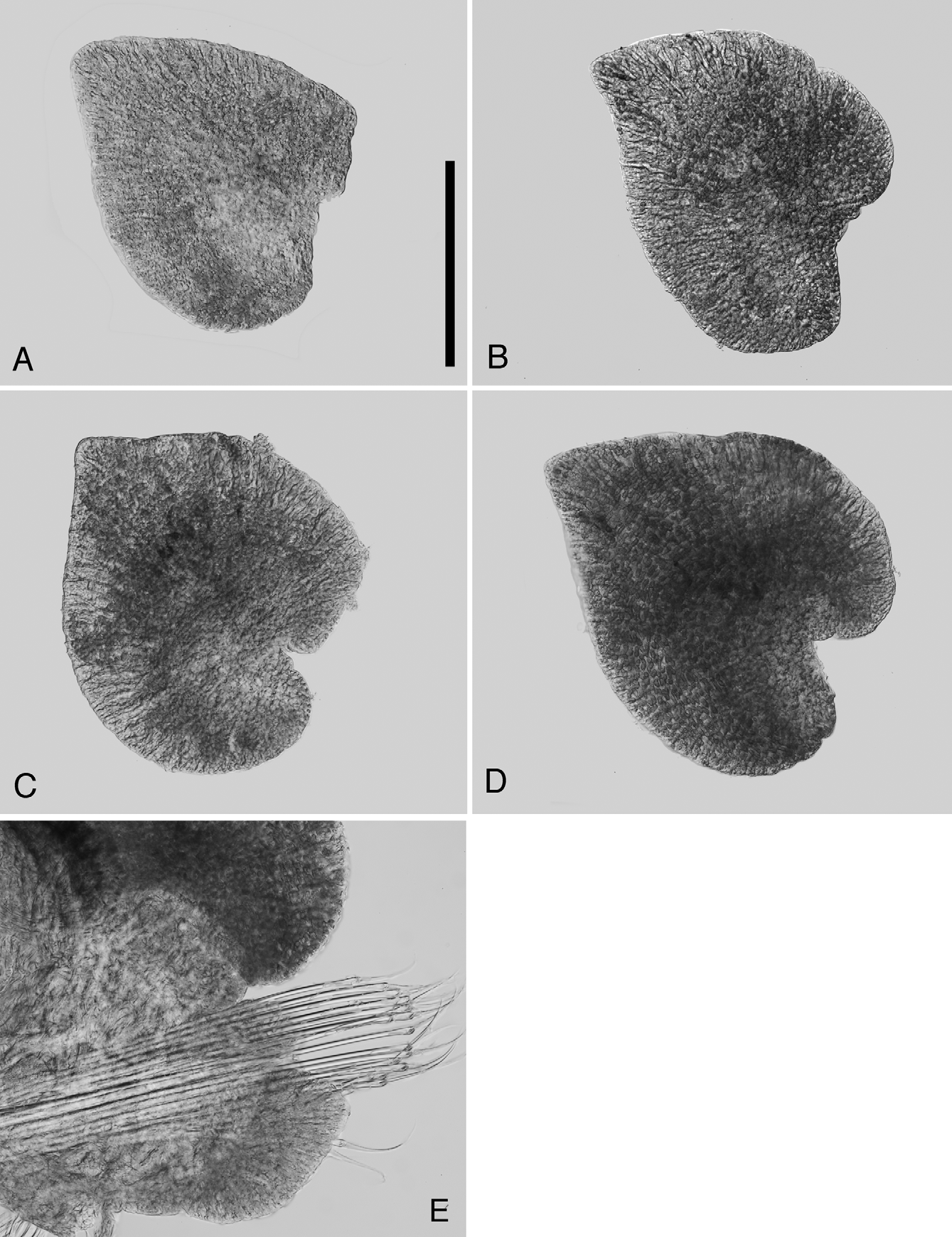
FIGURE 8. LM micrographs of dorsal cirri of Eumida longicornuta (SIO-BIC A 2607). A, dorsal cirrus segment 10. Scale bar 100 µm. B, dorsal cirrus segment 20. Same scale. C, dorsal cirrus segment 30. Same scale. D, dorsal cirrus segment 40. Same scale. E, parapodium segment 30. Same scale.
Imageimage/png© Pleijel, Fredrik;Aguado, Maria Teresa;Rouse, Greg W.Pleijel, Fredrik;Aguado, Maria Teresa;Rouse, Greg W.
IMAGES