
AnimaliaNot EvaluatedacceptedspeciesAccepted

Pterocirrus montereyensis
(Hartman, 1936) Hartman, 1936
GBIF:119528280
0year
0
Synonyms
ABOUT
Descriptions(1)
Type material: Holotype (USNM 20340). Material examined: California. Holotype (USNM 20340), Monterey Bay, 6 – 8 fathoms, coll. E. F. Ricketts Jun 1934; 1 spm, preserved in ethanol (SIO-BIC A 2631), La Jolla, off La Jolla Beach, 32 ° 50.26 ’ N, 32 ° 50.26 ’ N, 15 m depth, Macrocystis pyrifera holdfasts, SCUBA, colls GWR & Phil Zerofski 15 Oct 2010; 1 spm, preserved in ethanol (SIO-BIC A 2632), same collection data; 1 spm, preserved in ethanol (SIO-BIC A 2633), same collection data; 1 spm, preserved in ethanol, same collection data, destroyed for DNA sequencing. Description: Entire specimen 35 mm long for 115 segments (specimen used for sequencing). Live specimens yellowish transparent with dorsum covered with dense, fine brown-grey spots, also on dorsal cirri but less dense (Fig. 11 A, B). Eyes dark red. Preserved specimens yellowish with brown to violet dorsum. Body elongated cylindrical with truncate anterior and tapering posterior end (Fig. 11 A), venter flattened. Prostomium rounded, about as wide as long (Fig. 11 B). Palps and paired antennae long, tapering to fine tips, insert point without prostomial protuberance. Median antenna similar to paired antennae and palps, inserted on antero-dorsal side of prostomium, well anterior to eyes. Eyes very large, rounded. Nuchal organs not observed. Everted proboscis densely covered with diffusely distributed filiform papillae, terminal ring not observed. Segment 1 dorsally partly reduced, visible as triangular section forming a posterior incision in posterior side of prostomium. Dorsal cirri of segment 1 and ventral cirri of segment 2 reaching segment 7 – 8, dorsal cirri of segments 2 and 3 reaching segment 14 – 16. Ventral cirri of segment 2 with large foliaceous ventral extension (Fig. 12 A). Segment 3 without neuropodial lobes and chaetae, segment 4 with neuropodial lobes and chaetae. Dorsal cirri almost twice as long as wide, asymmetrical at bases around longitudinal axis, with pointed tips (Fig. 12 B). Supraacicular parapodial lobes distinctly larger and more elongated than subacicular lobes. Chaetae ca. 20. Rostrum of chaetal shaft with small teeth, similar to other Pterocirrus (Eibye-Jacobsen 1991 b, fig. 3 H) and many other phyllodocids. Ventral cirri oval, near twice as long as wide, with poorly defined tips. Pygidial cirri cylindrical, inflated, with pointed ends (Fig. 11 A). Pygidial papilla absent. Distribution: Only known from Monterey and La Jolla in California. Habitat: In her original description, Hartman did not specify habitat, but later (1961) stated that it occurs in intertidal rocky areas; otherwise only known from holdfasts of Macrocystis pyrifera. Remarks: This species is referred to Pterocirrus based on the presence of very large and elliptical eyes, enlarged ventral cirri on segment 2 with prolonged ventral wings, and densely and diffusely distributed long, filform proboscideal papillae. Pterocirrus montereyensis is very similar to P. macroceros (Grube, 1860), and belongs to what may be referred to as a P. macroceros species complex with a world-wide distribution in temperate and warm water regions (Pleijel pers. obs.). The group is characterized by having a triangular portion of segment 1 visible as a posterior incision in the prostomium, dorsal cirri near twice as long as wide and with asymmetrical basis, ventral cirri without distinct tips, and dorsum with a uniform brownish pigmentation. A distance analysis in PAUP * of the COI sequence of P. montereyensis (GenBank Accession number JQ 623498) showed a 17 % uncorrected distance from the sequence of P. macroceros from Banyuls in southern France (GenBank AY 996111; Eklöf et al. 2007). A BLAST search for our COI sequence of P. montereyensis showed 99 % identity to two sequences already on GenBank; one is listed as Anaitides sp. THS- 2005 (GenBank AY 894308) from Point Sur, CA deposited by Struck et al (2005) and the other is listed as Bergstroemia nigrimaculata (GenBank HM 473327) from British Columbia from Carr et al (2011). We suggest that the identities of the COI sequences at GenBank for both Anaitides sp. and Bergstroemia nigrimaculata require confirmation and should be used with caution.
Pleijel, Fredrik, Aguado, Maria Teresa, Rouse, Greg W. (2012): New and lesser known species of Chrysopetalidae, Phyllodocidae and Syllidae from south California (Phyllodocida, Aciculata, Annelida). Zootaxa 3506: 1-25, DOI: 10.5281/zenodo.211061
Export occurrence data
Darwin Core Archive (ZIP)
CLASSIFICATION
Taxonomic Classification Tree

NOMENCLATURE
Synonyms(1)
MULTIMEDIA
Media Files(2)
FIGURE 11. Micrographs of live, relaxed specimen of Pterocirrus montereyensis (specimen used for sequencing). A, entire specimen, dorsal view. B, anterior end, dorsal view. Scale bars A 2 mm, B 1 mm.
Imageimage/png© Pleijel, Fredrik;Aguado, Maria Teresa;Rouse, Greg W.Pleijel, Fredrik;Aguado, Maria Teresa;Rouse, Greg W.
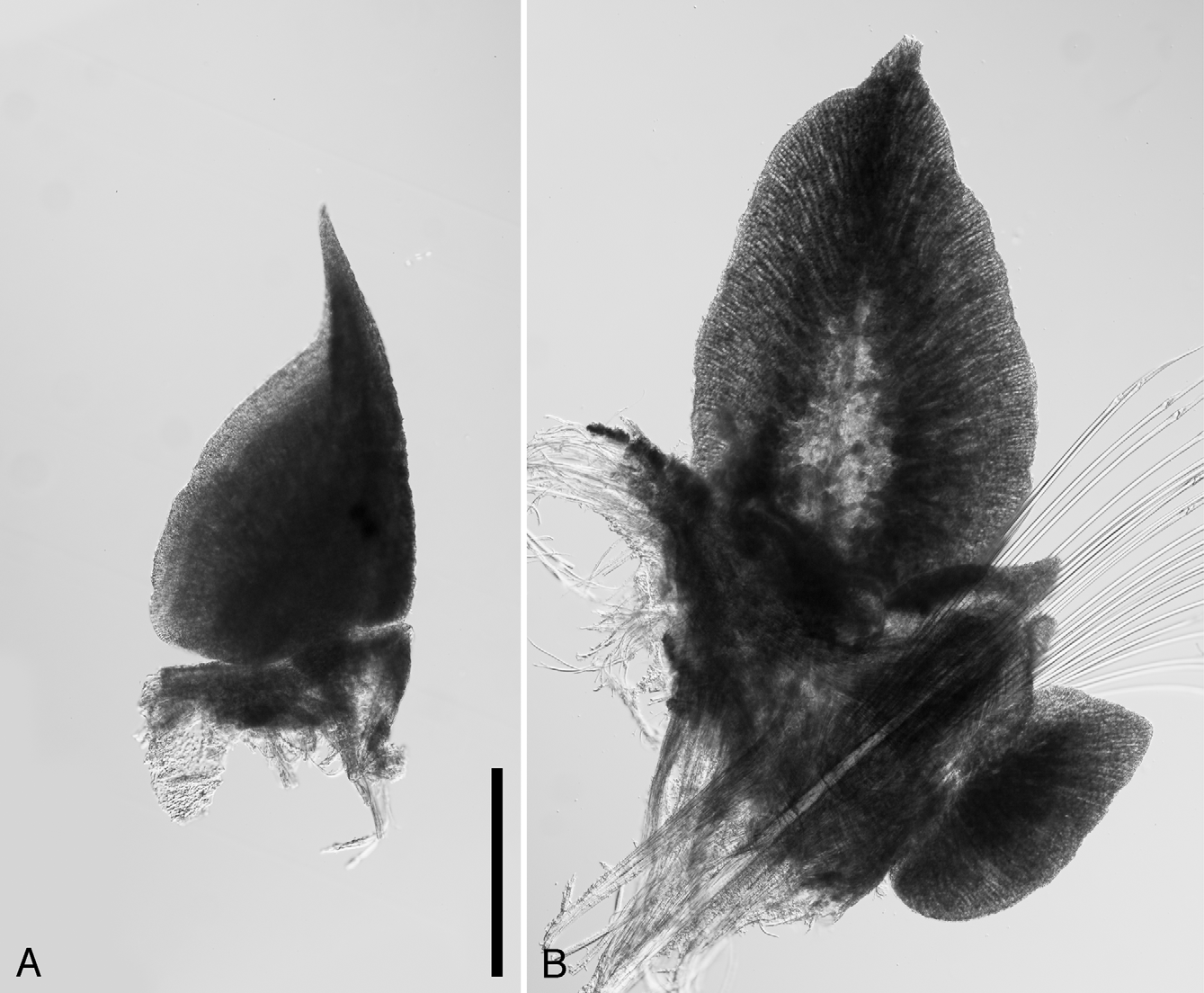
FIGURE 12. LM micrographs of Pterocirrus montereyensis (SIO-BIC A 2631). A, ventral cirrus segment 2, right side. Scale bar A 200 µm. B, dorsal cirrus from median segment. Same scale.
Imageimage/png© Pleijel, Fredrik;Aguado, Maria Teresa;Rouse, Greg W.Pleijel, Fredrik;Aguado, Maria Teresa;Rouse, Greg W.
IMAGES