
AnimaliaNot EvaluatedacceptedspeciesAccepted
Cryptonura persica
GBIF:119530053
ABOUT
Descriptions(5)
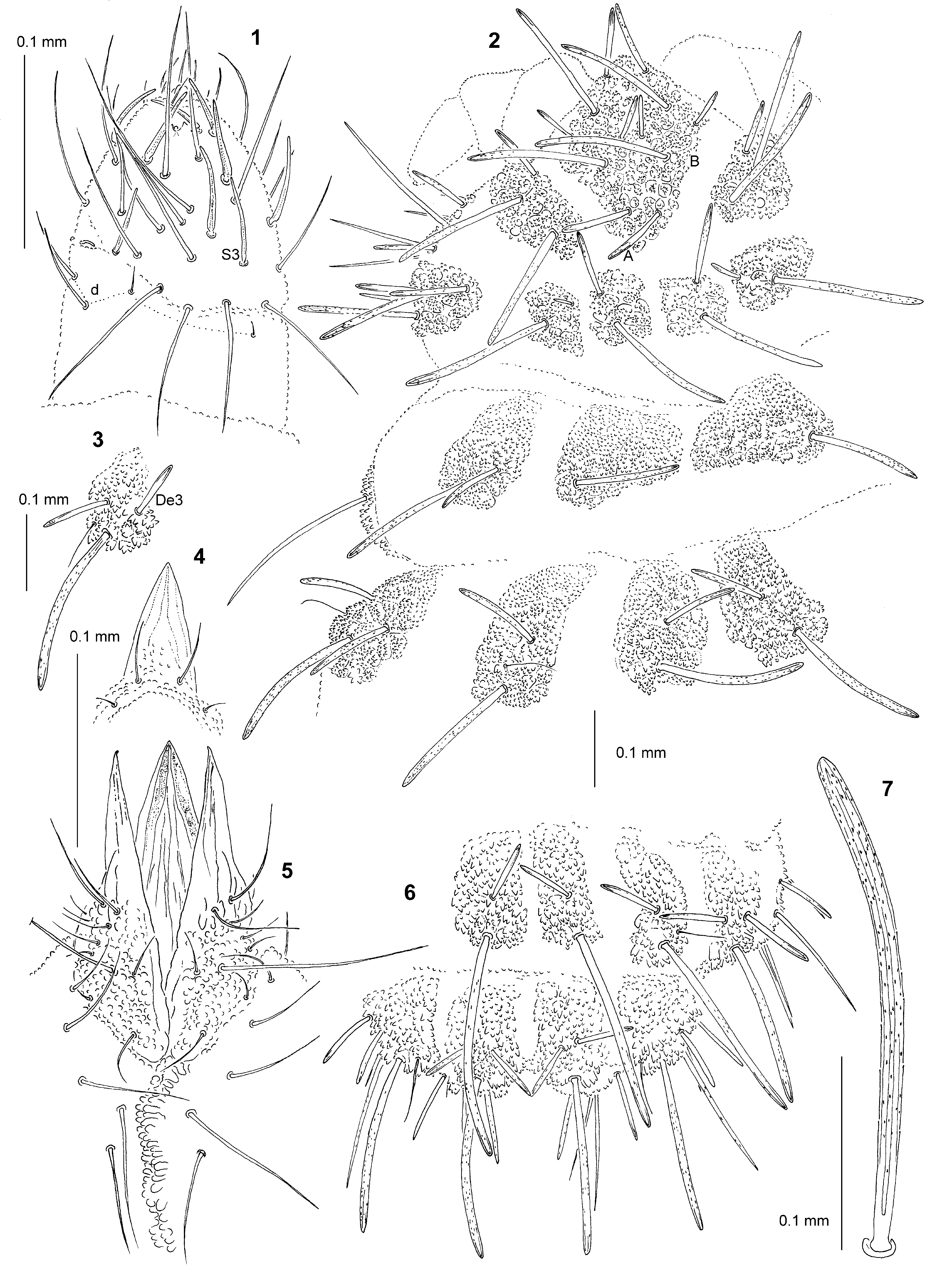
Description. Habitus typical of the genus. Body length (without antennae): 1.5 – 3.3 mm (holotype: 1.5 mm). Colour of the body bluish-gray. 2 + 2 eyes relatively small (diameter of ocellus equal to diameter of alveolus Ocp), darkly pigmented (Fig. 2). Types of dorsal ordinary chaetae. Macrochaetae Ml relatively long, strongly thickened, almost cylindrical, arclike or straight, narrowly sheathed, apically rounded (Figs 2, 6 – 7); macrochaetae Mc and Mcc thickened, straight and blunt; mesochaetae and microchaetae short, thin, feebly serrated and pointed. Macrochaetae densely covered by minute denticles. Head. Buccal cone elongated. Labrum pointed, with ventral sclerifications ogival as in Figs 4, 5. Labrum chaetotaxy 0 / 2, 2, prelabral chaetae absent. Labium with 11 chaetae: A, C, D, E, F, G, b, c, d, e and f. Labial papillae x not detected (Fig. 5). Maxilla styliform, mandible thin tridentate. Chaetotaxy of antennae as in Tab. 1 b and in Fig. 1. Apical vesicle poorly developed, trilobed. S – chaetae of ant. IV long and thin, S 3 thinner than others (Fig. 1). Group d on ant. III with 4 chaetae. Chaetotaxy of head as in Tab. 1 a and Fig. 2, 5. Tubercles Cl and Af fused (Fig. 2). Chaeta O absent. Tubercle Dl with 5 chaetae, chaeta Dl 6 absent (Fig. 2). Tubercle (L + So) with 8 chaetae, chaetae L 2 and L 3 absent. Chaeta A distinctly shorter than B. a) Cephalic chaetotaxy – dorsal side. Tubercle Number of chaetae Types of chaetae Names of chaetae (Af + Cl) 12 Ml B, F Mc A, G Mcc C, E Oc 3 Ml Ocm, Ocp Mc Oca Di 2 Ml Di 1 Mc Di 2 De 2 Ml De 1 Mcc De 2 Dl 5 Ml Dl 1, Dl 5 Mc Dl 2, Dl 3, Dl 4 (L + So) 8 Ml L 1, L 4, So 1 Mcc So 2, So 3 me So 4 – 6 b) Chaetotaxy of antennae. vi 4 cm 3 bs, 1 miA d 4 cp 8 miA, 1 brs c) Postcephalic chaetotaxy. abd. VI 7 + mi Ve: 12 – 14 An: 2 mi Thorax, abdomen, legs. Body s – chaeta thin and smooth, distinctly shorter than nearby macrochaetae (Figs 2, 6). Chaetotaxy of th. and abd. as in Tab. 1 c and in Figs 2 – 3, 6 – 7. Tubercles Di on th I with 1 chaeta. Tubercles Di on th. II – III with 2 chaetae. Chaetae De 2 on th. II – III and De 3 on th. III connected with tubercle De. Chaetae De 3 on abd. I – III connected with tubercle De (Fig. 3). Tubercle L on abd. III and IV with 4 and 6 chaetae respectively. Furcal vestige without microchaetae. Tubercles Di on abd. V with chaetae Di 2 and Di 3 as Mc (Fig. 6). Chaetae L' and Vl on abd. V present. Cryptopygy present, relatively well developed, Abd. VI hardly visible from dorsal side (Fig. 6). Chaetotaxy of legs as in Tab. 1 c. Tibiotarsi with chaetae B 4 and B 5 short. Claw without inner tooth.
Smolis, Adrian, Falahati, Asghar, Skarżyński, Dariusz (2012): The genus Cryptonura Cassagnau, 1979 (Collembola: Neanuridae: Neanurinae) in Iran. Zootaxa 3530: 51-58, DOI: 10.5281/zenodo.214290
Diagnosis. Habitus typical of the genus Cryptonura. Colour of the body bluish-gray, 2 + 2 eyes darkly pigmented. Dorsal tubercles present and well developed, triangular in shape. Buccal cone rather long, labrum ogival. Head with chaetae A, B, C and E. Chaeta O absent. Tubercles Af and Cl fused. Tubercles Dl and (L + So) on head with 5 and 8 chaetae respectively. Tubercle Di on th. I with 1 chaeta. Tubercles De on th. II and III with 3 and 4 chaetae respectively. Tubercles L on abd. III and IV with 4 and 6 chaetae respectively. Macrochaetae Ml relatively long, Ml Di 1 of abd. IV longer than axial diameter of the abdomen. Cryptopygy present, relatively well developed. Claw without inner tooth.
Smolis, Adrian, Falahati, Asghar, Skarżyński, Dariusz (2012): The genus Cryptonura Cassagnau, 1979 (Collembola: Neanuridae: Neanurinae) in Iran. Zootaxa 3530: 51-58, DOI: 10.5281/zenodo.214290
Remarks. See remarks of Cryptonura maxima sp. nov.
Smolis, Adrian, Falahati, Asghar, Skarżyński, Dariusz (2012): The genus Cryptonura Cassagnau, 1979 (Collembola: Neanuridae: Neanurinae) in Iran. Zootaxa 3530: 51-58, DOI: 10.5281/zenodo.214290
Etymology. The species name refers to the historic name of Iran.
Smolis, Adrian, Falahati, Asghar, Skarżyński, Dariusz (2012): The genus Cryptonura Cassagnau, 1979 (Collembola: Neanuridae: Neanurinae) in Iran. Zootaxa 3530: 51-58, DOI: 10.5281/zenodo.214290
Type material. Holotype: adult male on slide: Iran: Elburz Mts., Golestan province, near Gorgan town, Barankoh Forest [36 ° 47 ’ N 56 ° 23 ’ E], Carpinus betulus forest, soil, N slope, 4.09.2011, leg. A. Falahati. Paratypes: adult male, two adult females and two juveniles on slides, same data as holotype. Holotype and 2 paratypes are housed in the Department of Evolutionary Biology and Ecology, Wrocław University, Poland, 3 paratypes in the collection of the second author.
Smolis, Adrian, Falahati, Asghar, Skarżyński, Dariusz (2012): The genus Cryptonura Cassagnau, 1979 (Collembola: Neanuridae: Neanurinae) in Iran. Zootaxa 3530: 51-58, DOI: 10.5281/zenodo.214290
Export occurrence data
Darwin Core Archive (ZIP)
CLASSIFICATION
Taxonomic Classification Tree

MULTIMEDIA
Media Files(1)
FIGURES 1 – 7. Cryptonura persica sp. nov.: 1, dorsal chaetotaxy of ant. III – IV; 2, dorsal chaetotaxy of head and th. I – II; 3, tubercle De of abd. III; 4, labrum; 5, labium; 6, dorsal chaetotaxy of abd. IV – VI; 7, chaeta Di 1 of abd. V.
Imageimage/png© Smolis, Adrian;Falahati, Asghar;Skarżyński, DariuszSmolis, Adrian;Falahati, Asghar;Skarżyński, Dariusz
IMAGES