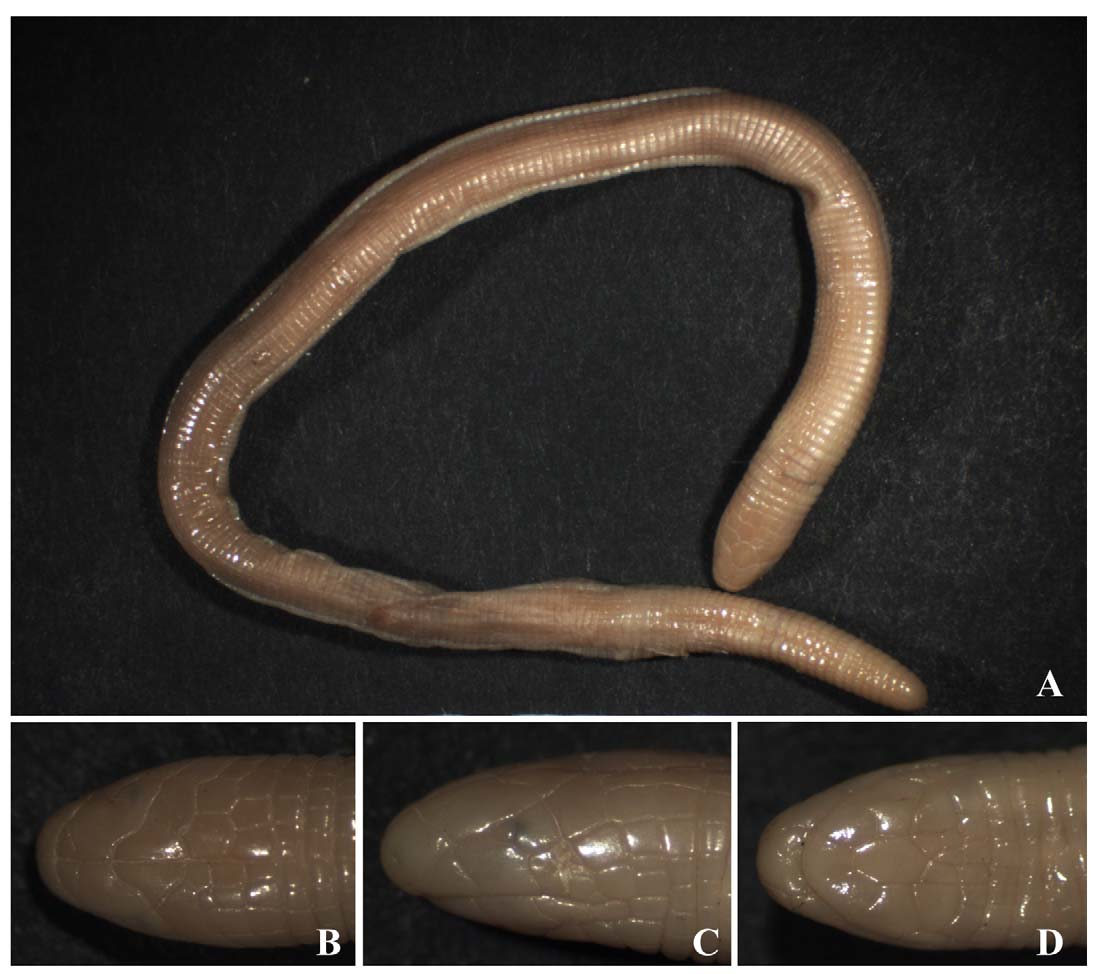
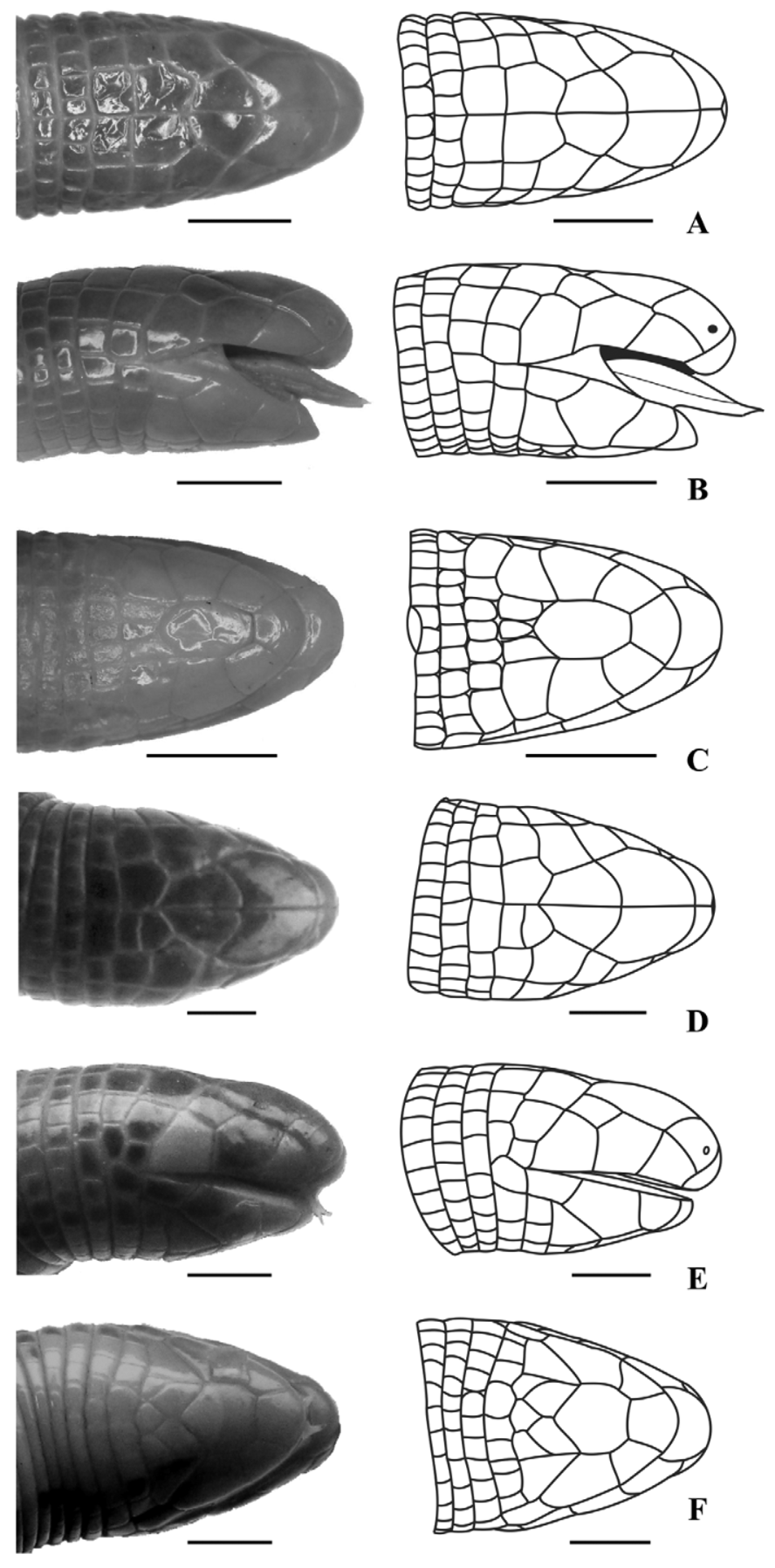
Description. (Figure 11 A – C) Slim, small-sized species. Snout-vent length 121.0 – 138.0 mm (mean = 130.2 mm; SD = 8.5; n = 4), caudal length 15.9 – 19.6 mm (mean = 18.0 mm; SD = 1.8; n = 3). Total length 140.9 – 156.6 mm (mean = 151.3 mm; SD = 8.9; n = 3). Head elongated, representing 3.3 – 3.6 % of snout-vent length (mean = 3.4; SD = 0.1; n = 4). Rostral shield triangular, barely visible in dorsal view, contacting first supralabial latero-posteriorly and nasals posteriorly. One pair of quadrangular nasal shields, together with rostral, constituting anterior face of snout. Suture between nasal shields representing 15.0 – 19.8 % of head length (mean = 17.4; SD = 2.0; n = 4). Nasal shields contact the first supralabials laterally and prefrontals posteriorly. Nostrils placed in the antero-lateral portion of shields. One pair of prefrontal shields enlarged, representing 32.9 – 34.6 % of head length (mean = 33.7; SD = 0.7; n = 4) and 35.4 – 38.6 % of head width (mean = 36.8; SD = 1.6; n = 4); prefrontal contacting second supralabial and ocular shield laterally and frontals posteriorly. One pair of frontal shields small, representing 27.6 – 32.1 % of head length (mean = 30.2; SD = 2.0; n = 4) and 26.4 – 30.3 % of head width (mean = 27.5; SD = 1.9; n = 4); frontal contacting postocular shields and dorsal angle of ocular shields laterally and parietals posteriorly. Eight parietal shields, centrals being pentagonal, with length equivalent to frontal shields (frontal length: mean = 0.9 mm; SD = 0.05; parietal length: mean = 1.1 mm; SD = 0.03). Other parietal shields quadrangular, contacting postocular and postlabial shields anteriorly, and occipital row posteriorly. Widened and quadrangular occipital shields, having different shape compared to body shields. Ocular shield rhomboid, contacting postocular posteriorly, and second and third supralabials ventrally. Postocular with similar size of ocular shields (postocular length: mean = 1.1 mm; SD = 0.04; postocular width: mean = 0.9 mm; SD = 0.09; ocular legth: mean = 1.2 mm; SD = 0.09; ocular width: mean = 0.9 mm; SD = 0.08). Temporal quadrangular, small, contacting postlabials shield in latero-ventral portion and third supralabial anteriorly. Ventral line sequence of shields comprise postocular, temporal and postlabial, forming first body annulus. Three supralabial shields. First triangular and smaller than others. Second and third higher than first, second having width similar to the first. Third shield pentagonal, wider than others, contacting postlabial posteriorly. Three infralabial shields. First quadrangular, contacting mental and postmental laterally, and second infralabial posteriorly. Second infralabial being wider and higher than others, contacting postmental and malar laterally, and third infralabial posteriorly. Third infralabial elongated and rectangular, as long as wide, contacting malar laterally and first body annulus posteriorly. Mental shield trapezoidal, small, representing 24.2 – 27.9 % of ventral head length (mean = 26.7; SD = 2.1; n = 3), contacting postmental shield posteriorly. Postmental shield elongated and heptagonal, representing 41.4 – 45.1 % of ventral head length (mean = 43.4; SD = 1.9; n = 3), contacting postgenial shields posteriorly. Presence of one or two rows of postgenial shields. The first postgenial row composed by two to three diamond-shaped shields. Second row of postgenial shields composed by three or four small, rounded shields, contacting laterally malar shields. One pair of malar shields trapezoidal, with internal line 39.8 – 54.6 % longer than external line (mean = 46.1; SD = 7.7; n = 3), contacting first body annulus posteriorly. Postmalars row absent, replaced by the first body annuli. Body annuli 190 – 204 (mean = 197.8; SD = 5.5; n = 5). Lateral sulcus visible from 20 th body annulus to cloacal shields. Dorsal segments of midbody annulus 12 – 14 (mean = 12.5; SD = 1.0; n = 4). Ventral segments of midbody annulus 16 – 18 (mean = 17.7; SD = 1.3; n = 4), centrals being wider than others. Caudal annuli 24 – 27 (mean = 25.5; SD = 1.3; n = 4), caudal autotomy plan evident on the eighth or ninth annulus. Segments from tip of the tail plain. Segments of fourth caudal annulus 22 – 25 (mean = 23.8; SD = 1.5; n = 3). Four precloacal pores, sequentially arranged in posterior portion of the last ventral annulus. Cloacal shield with 6 – 7 precloacal scales and 9 – 10 postcloacal scales. Colouration. Preserved specimens have nearly uniform pale brown colouration. Dorsally, brown colour increases slightly in intensity from head to tail. Ventrally, brown colouration more intense laterally, becoming faint on the mid-ventral line and head. On the tail, the colouration becomes darker. The cloacal shield may or may not be brown pigmented. Pigmentation uniform on each shields.
Perez, Renata, Ribeiro, Síria, Borges-Martins, Márcio (2012): Reappraisal of the taxonomic status of Amphisbaena prunicolor (Cope 1885) and Amphisbaena albocingulata Boettger 1885 (Amphisbaenia: Amphisbaenidae). Zootaxa 3550: 1-25, DOI: 10.5281/zenodo.211171