
AnimaliaNot EvaluatedacceptedspeciesAccepted
Amphisbaena prunicolor

Amphisbaena prunicolor

(Cope, 1885) Cope, 1885

GBIF:119555184

0year

0

Synonyms

ABOUT

Descriptions(5)

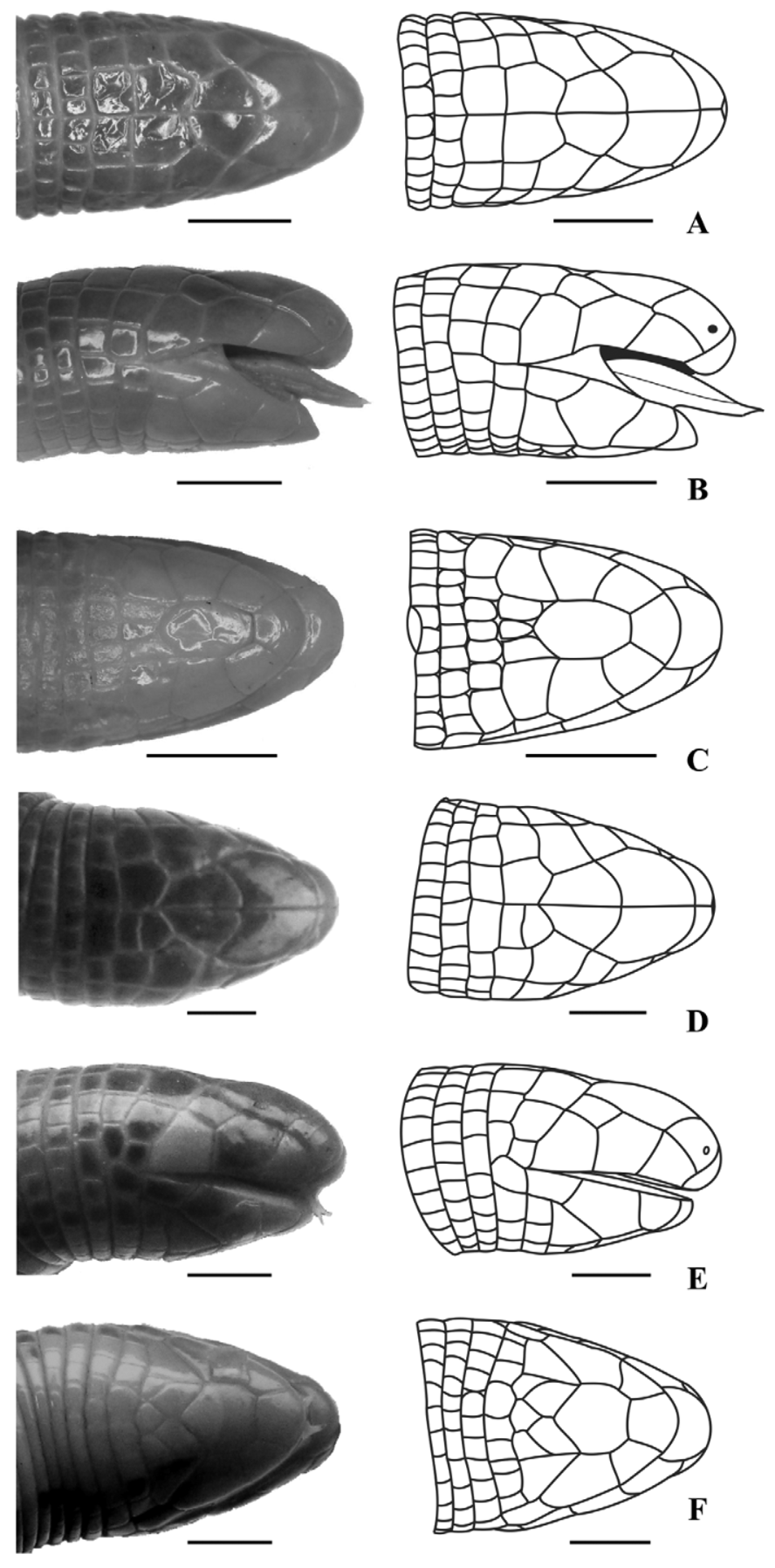
Description. (Figure 11 D – F) Slim, medium-sized species. Snout-vent length 141.0 – 238.0 mm (mean = 178.3 mm; SD = 23.0; n = 110 adults), caudal length 15.8 – 34.8 mm (mean = 23.4 mm; SD = 3.9; n = 98 adults). Adults total length 157.6 – 272.8 mm (mean = 201.1 mm; SD = 25.9; n = 98), juveniles total length 87.7 – 157.9 mm (mean = 127.2 mm; SD = 22.6; n = 25). Head elongated, representing 2.8 – 4.1 % of snout-vent length in adults (mean = 3.4; SD = 0.3; n = 110) and 3.6 – 6.0 % of snout-vent length in juveniles (mean = 4.3; SD = 0.5; n = 26). Rostral shield triangular, barely visible in dorsal view, contacting first supralabial shields latero-posteriorly and nasal shields laterally. One pair of quadrangular nasal shields contacting to each other, constituting together with the rostral the anterior face of the snout. Nostrils placed in the antero-lateral portion of shields. One pair of prefrontal shields enlarged, representing 32.8 – 45.4 % of adults head length (mean = 37.4; SD = 2.8; n = 110) and 29.3 – 47.8 % of adults head width (mean = 37.9; SD = 2.8; n = 110); contacting second supralabial shields and ocular shields laterally and frontal shields posteriorly. One pair of frontal shields with similar length to prefrontal shields (prefrontal length: mean = 2.2 mm; SD = 0.3; n = 110; frontal length: mean = 2.2; SD = 0.3; n = 110); prefrontal shields representing 22.4 – 47.5 % of adults head length (mean = 36.9; SD = 3.7; n = 110) and 22.1 – 34.7 % of adults head width (mean = 28.1; SD = 2.7; n = 110); contacting postocular shields laterally and central parietal shields posteriorly. Row with 6 – 12 parietal shields, centrals being pentagonal or rectangular, representing 4.9 – 22.4 % of adults head length (mean = 14.3; SD = 2.8; n = 110); other parietal shields quadrangular, contacting temporal and postlabial shields anteriorly and row of occipital shields, when present, posteriorly. Row of rectangular occipital shields. Parietal and occipital region shows variation in number and / or shape of shields. Rhomboid ocular shields contacting postocular posteriorly and second and third supralabial shields ventrally. Enlarged postocular shield with similar size as ocular shields (postocular length: mean = 1.4 mm; SD = 0.2; postocular width: mean = 1.1 mm; SD = 0.2; ocular length: mean = 1.4 mm; SD = 0.2; ocular width: mean = 1.2 mm; SD = 0.2). Rectangular temporal shields, contacting postlabial shields latero-inferiorly and third supralabial shields anteriorly. Small postlabial shields, quadrangular, contacting third supralabial shields anteriorly; together with the last parietal shields, forming the first body annulus. Three supralabial shields. First being triangular and smaller than the others. Second and third higher and wider than the first, second being quadrangular. Third pentagonal. Three infralabial shields. First quadrangular, contacting mental anteriorly, second infralabial posteriorly and postmental ventrally. Second infralabial largest, being wider and higher than others, contacting mental posterior-ventrally, malar latero-ventrally and third infralabial posteriorly. Third infralabial shields elongated and rectangular, longer than wider, contacting malar and postmalar row laterally and the first body annulus posteriorly. Mental shield quadrangular, representing 20.3 – 32.3 % of adults head length on venter (mean = 27.4; SD = 2.4; n = 109) and 27.1 – 42.6 % of adults head width (mean = 34.3; SD = 3.0; n = 109); contacting postmental posteriorly. Postmental shield quadrangular and heptagonal, representing 27.6 – 50.0 % of adults head length on venter (mean = 39.9; SD = 3.5; n = 109) and 25.5 – 39.0 % of adults head width (mean = 32.3; SD = 27.7; n = 109); contacting postgenial shields posteriorly. Presence of one or two rows of postgenial shields; first having 2 – 3 diamond-shaped shields and second having 1 – 5 small and rounded shields, contacting malar shields laterally. One pair of trapezoidshaped malar shields, internal line 36.7 – 96.8 % longer than the external line (mean = 62.8; SD = 8.4; n = 107), contacting first body annulus posteriorly. Postmalars row present with 6 – 12 shields. Body annuli 181 – 215 (mean = 195.6; SD = 5.6; n = 136). Lateral sulcus present and visible from the 10 th body annulus to cloacal shields. Dorsal segments of midbody annulus 10 – 17 (mean = 13.0; SD = 1.2; n = 135), all quadrangular. Ventral segments of midbody annulus 14 – 20 (mean = 16.6; SD = 1.4; n = 135), the central being wider than the others. Caudal annuli 18 – 27 (mean = 21.8; SD = 1.7; n = 120), caudal autotomy plan evident on the seventh to the 10 th caudal annulus. Segments from tip of the tail plain. Segments of fourth caudal annulus 18 – 29 (mean = 23.8; SD = 2.2; n = 135). Four precloacal pores, sequentially arranged in posterior portion of the last ventral annulus, usually rounded in males and scars in females. Cloacal shield with 6 – 8 precloacal scales and 7 – 14 postcloacals scales. Colouration. Specimens have a uniform dorsal dark brown-purplish colouration (Figure 14). Discolouration is observed on preserved specimens, which are pale brown. Pigmentation uniform in every segment, but still could be seen in discolourated specimens, forming a checkerboard pattern, with contrasting white and brown scales in the venter. White region may vary along the belly, concentrating only in the head and gular region (Figure 14 A – B) or extending to the end of the body, forming a central line with a few pigmented shields (Figure 14 C – D). The tail is darker than the rest of the body.
Perez, Renata, Ribeiro, Síria, Borges-Martins, Márcio (2012): Reappraisal of the taxonomic status of Amphisbaena prunicolor (Cope 1885) and Amphisbaena albocingulata Boettger 1885 (Amphisbaenia: Amphisbaenidae). Zootaxa 3550: 1-25, DOI: 10.5281/zenodo.211171
Diagnosis. Amphisbaena prunicolor is distinguished from other Amphisbaena species by the following combination of characters: (1) rounded snout; (2) nasal shields in contact on the dorsal portion of head; (3) caudal autotomy externally visible; (4) plain segments in the tip of the tail; (5) four precloacal pores; (6) 3 / 3 supralabial and 3 / 3 infralabial shields; (7) 181 – 215 body annuli; (8) 18 – 24 caudal annuli; (9) 10 – 17 dorsal and 14 – 20 ventral segments in the midbody annulus; (10) presence of the postmalar row; (11) brown-purplish colouration, checkerboard pale ventral pattern. Comparison. Amphisbaena prunicolor can be distinguished from the species in the A. darwini complex, mainly by having a dorsal brown-purplish colouration and a ventral pale checkerboard pattern (vs. ventral uniformly coloured). Differs from the species formerly considered belonging to the genus Anops by having a rounded-head (vs. keeled-head). Differs from A. angustifrons by having caudal autotomy (vs. lacking caudal autotomy). Differs from A. leeseri by having four precloacal pores (vs. two precloacal pores). Differs from A. trachura by having plain segments in the tip of the tail (vs. tuberculated segments). Differs from A. nigricauda by having 181 – 215 body annuli (vs. 222 – 226 body annuli). Differs from A. munoai by having the anterior portion of the head smooth (vs. concavity in the anterior portion of the head) and quadrangular-shaped frontal shields when considered together (vs. diamond-shaped). Differs from A. hogei and A. heterozonata by having a higher number of caudal annuli [18 – 27] (vs. smaller number of caudal annuli [15 – 19 in A. hogei and 15 – 18 in A. heterozonata]). Differs from A. darwini by having segments uniformly pigmented (vs. segments more pigmented in the anterior portion). It also differs from A. albocingulata by having the posmalar row (vs. lacking posmalar row).
Perez, Renata, Ribeiro, Síria, Borges-Martins, Márcio (2012): Reappraisal of the taxonomic status of Amphisbaena prunicolor (Cope 1885) and Amphisbaena albocingulata Boettger 1885 (Amphisbaenia: Amphisbaenidae). Zootaxa 3550: 1-25, DOI: 10.5281/zenodo.211171
Comments. The genus Aporarchus was described in a dichotomous key (Cope 1885), and diagnosed by presenting a distinct nasal shields, in contact medially, and absence of precloacal pores. This genus distinguished from Amphisbaena only by the lacking of pores. In the photographies of the holotype it was not possible to observe the condition of the pores, because the cloacal shield is folded over the last body annulus. In the other specimens analysed the pores were observed; on males the pores are circular and well defined, and on females only scares of the pores can be seen. There was no literature data about the age and sex of the holotype.
Perez, Renata, Ribeiro, Síria, Borges-Martins, Márcio (2012): Reappraisal of the taxonomic status of Amphisbaena prunicolor (Cope 1885) and Amphisbaena albocingulata Boettger 1885 (Amphisbaenia: Amphisbaenidae). Zootaxa 3550: 1-25, DOI: 10.5281/zenodo.211171
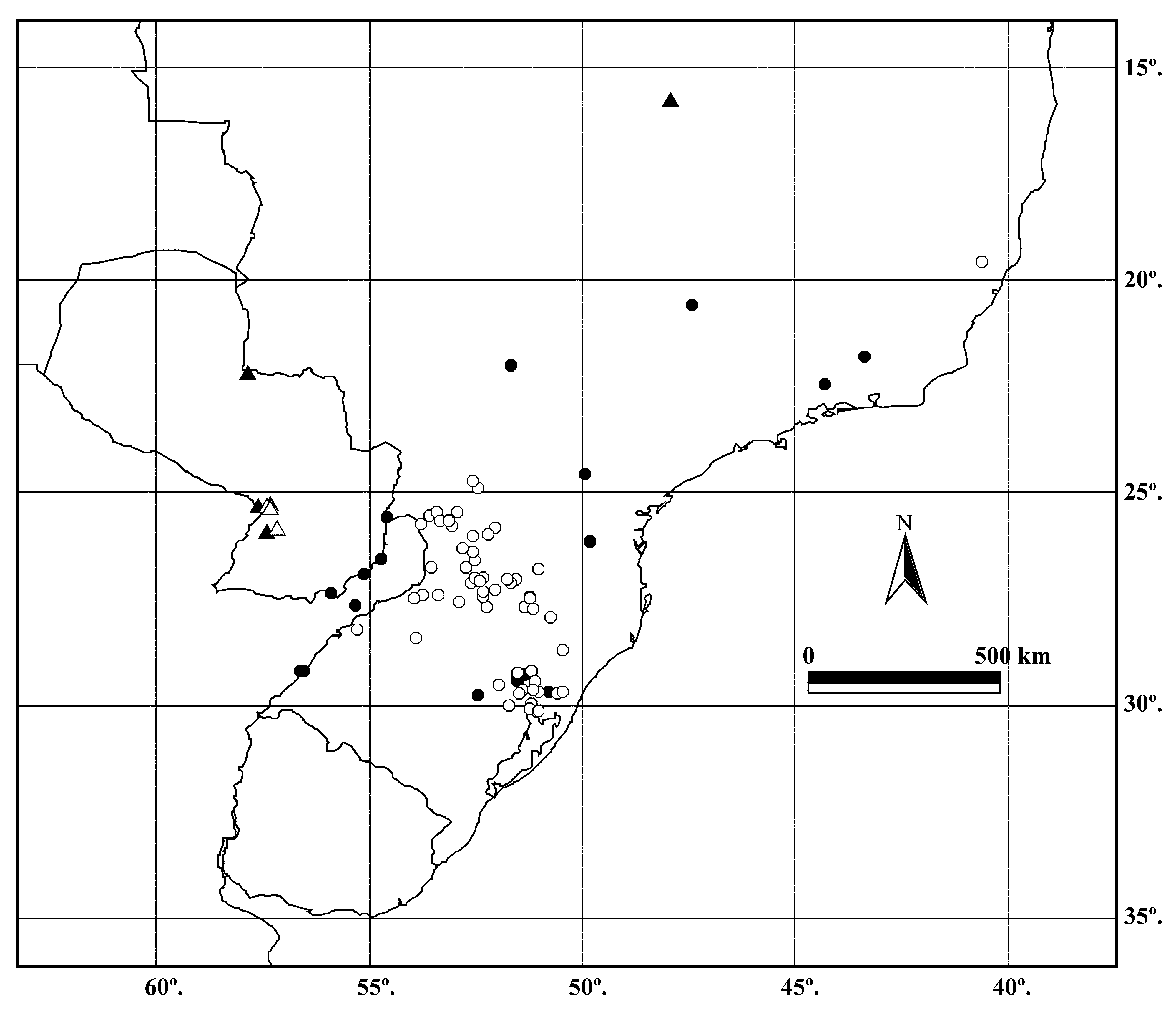
Distribution. Distributed in Argentina, in Corrientes and Misiones provinces, in Paraguay, Itapuá department, and in Brazil, in the states of Rio Grande do Sul to Espírito Santo (Figure 12). Records made by Gans (1966) for the states of São Paulo, Rio de Janeiro and Minas Gerais, Brazil, were not confirmed on the present study because we cannot examine the specimens. The voucher-specimen of São Paulo record (MZUSP 6632) presents desiccation, and therefore it wasn’t possible to identify it. Records for Rio de Janeiro didn’t have voucher-number, only an indicative of the collection where they were housed. Voucher-specimens of Minas Gerais records were not found. The record for Colatina (MZUSP 3507), Espírito Santo corresponds to a typical Amphisbaena prunicolor and this record distant approximately 507 km from the last record confirmed in the present study.
Perez, Renata, Ribeiro, Síria, Borges-Martins, Márcio (2012): Reappraisal of the taxonomic status of Amphisbaena prunicolor (Cope 1885) and Amphisbaena albocingulata Boettger 1885 (Amphisbaenia: Amphisbaenidae). Zootaxa 3550: 1-25, DOI: 10.5281/zenodo.211171
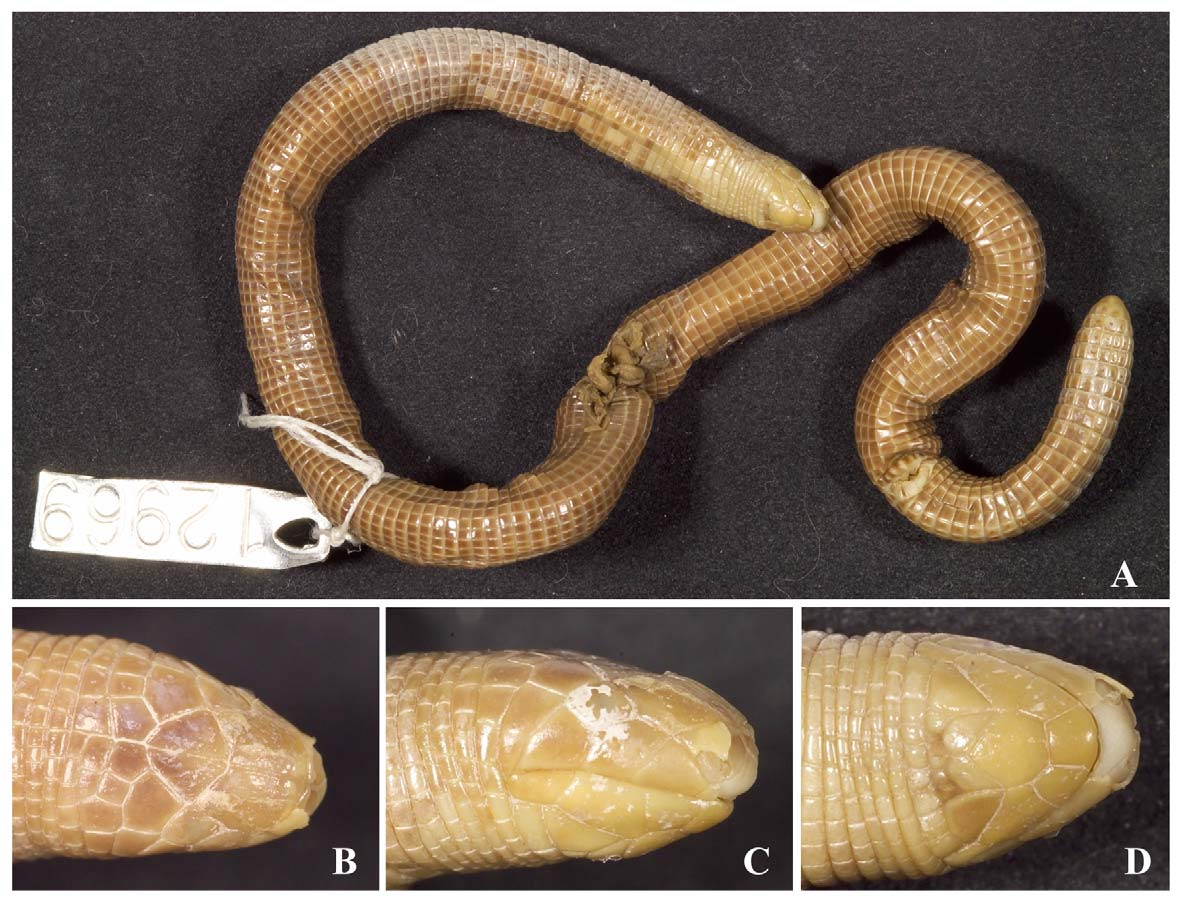
Holotype. ANSP 12969 (Figure 13), from São João do Monte Negro, currently Montenegro municipality, state of Rio Grande do Sul, Brazil, collected by Herbert H. Smith, no date of collection (specimen examined by photographies). Specimen in good condition, presenting a small cut on the venter, showing part of viscera. According to Cope (1885): total length 214 mm; tail length 29 mm; head to canthus oris length (= mouth corner) 6 mm; body annuli 186; caudal annuli 23. Uniform dark brown colour turning purple on the dorsum and venter, except for the inferior jaw and gular region, part of the pectoral and postcloacal shield that are white.
Perez, Renata, Ribeiro, Síria, Borges-Martins, Márcio (2012): Reappraisal of the taxonomic status of Amphisbaena prunicolor (Cope 1885) and Amphisbaena albocingulata Boettger 1885 (Amphisbaenia: Amphisbaenidae). Zootaxa 3550: 1-25, DOI: 10.5281/zenodo.211171

Export occurrence data

Darwin Core Archive (ZIP)

CLASSIFICATION

Taxonomic Classification Tree

MULTIMEDIA

Media Files(4)

FIGURE 11. Dorsal, lateral and ventral views of the Amphisbaena albocingulata (A – C) and A. prunicolor (D – F), respectively. A, C: MHNP 6094; B: MHNP 4316; D – F: CHUFSC 943. Scale 2 mm.
Imageimage/png© Perez, Renata;Ribeiro, Síria;Borges-Martins, MárcioPerez, Renata;Ribeiro, Síria;Borges-Martins, Márcio

FIGURE 12. Geographic distribution of Amphisbaena albocingulata (triangles) and A. prunicolor (circles). White symbols correspond to the specimens examined in the present study, and black symbols to unverified literature records (Gans 1966; Montero 1996; Montero & Terol 1999).
Imageimage/png© Perez, Renata;Ribeiro, Síria;Borges-Martins, MárcioPerez, Renata;Ribeiro, Síria;Borges-Martins, Márcio

FIGURE 13. Ventral view of body (A) and dorsal (B), lateral (C) and ventral (D) views of head of the holotype of Amphisbaena prunicolor (ANSP 12969). Photos by N. Gilmore (ANSP).

Imageimage/png© Perez, Renata;Ribeiro, Síria;Borges-Martins, MárcioPerez, Renata;Ribeiro, Síria;Borges-Martins, Márcio

FIGURE 14. General view in life of Amphisbaena prunicolor. Dorsal (A) and ventral (B) views of the MCN 15284 and dorsal (C) an ventral (D) views of the MCN 15285. Specimens from Triunfo, Rio Grande do Sul, Brazil. Photos by M. Borges-Martins.

Imageimage/png© Perez, Renata;Ribeiro, Síria;Borges-Martins, MárcioPerez, Renata;Ribeiro, Síria;Borges-Martins, Márcio

IMAGES

Gallery(4)

See Gallery

Occurrences with images

Source Information

Reappraisal of the taxonomic status of Amphisbaena prunicolor (Cope 1885) and Amphisbaena albocingulata Boettger 1885 (Amphisbaenia: Amphisbaenidae)

checklist

This dataset contains the digitized treatments in Plazi based on the original journal article Perez, Renata, Ribeiro, Síria, Borges-Martins, Márcio (2012): Reappraisal of the taxonomic status of Amphisbaena prunicolor (Cope 1885) and Amphisbaena albocingulata Boettger 1885 (Amphisbaenia: Amphisbaenidae). Zootaxa 3550: 1-25, DOI: 10.5281/zenodo.211171

Abstract

We revised the taxonomic status of Amphisbaena prunicolor and A. albocingulata, two taxa traditionally recognized as subspecies of A. prunicolor in the A. darwini complex. Despite some authors elevated both taxa to the specific rank, its taxonomic decisions were made without specific commentaries and/or proper diagnostic characters. The comparison of morphological characters between the two taxa with other similar species, associated with A. darwini (A. darwini, A. heterozonata, A. munoai and A. trachura), revealed a unique combination of diagnostic characters. Amphisbaena prunicolor and A. albocingulata were considered distinct species, diagnosable by the presence of the postmalar row in A. prunicolor, absent in A. albocingulata and by the ventral colour pattern uniform (pale brown) in A. albocingulata and checkerboard (brown-purplish and white) in A. prunicolor. We also provided a redescription of the two species, information on intraspecific variation in A. munoai and suggested the extension of the distribution of A. darwini to southern Brazil.

Key words: Morphology, Squamata, subspecies, species complex, Amphisbaena darwini

Perez R, Ribeiro S, Borges-Martins M, plazi (2012). Reappraisal of the taxonomic status of Amphisbaena prunicolor (Cope 1885) and Amphisbaena albocingulata Boettger 1885 (Amphisbaenia: Amphisbaenidae). Plazi.org taxonomic treatments database. Checklist dataset https://doi.org/10.5281/zenodo.211171 accessed via GBIF.org on 2026-06-14.

CC0Published 12/31/2012View dataset
GBIF Usage Key
119555184
Dataset Key
8f4be858-858c-46dd-8215-c9b87944290b
Origin
source
Backbone Key
2472912
Taxon ID
7D454B0BFFCDA81D7ED14BEEFB902EAE.taxon
Last Crawled
6/11/2026
Last Interpreted
6/11/2026