
AnimaliaNot EvaluatedacceptedspeciesAccepted
Lebrunia danae

Lebrunia danae

(Duchassaing & Michelotti, 1860) Duchassaing & Michelotti, 1860

GBIF:119555649

0year

0

Synonyms

ABOUT

Descriptions(6)

Natural history. — Lebrunia danae lives in shallow waters inside holes or crevices of calcareous skeletons among corals and rocks, often between 2 – 12 m depth, in the fore and back-reef zones, although it has been reported down to 60 m (Ocaña et al. 2007). Lebrunia danae is associated with the caridean shrimps Thor amboinensis, Periclimenes yucatanicus, and Ancylomenes pedersoni (Manjarrés 1978; Cairns et al. 1986; Ritson-Williams & Paul 2007). During the day pseudotentacles (incapable of feeding) remain fully expanded, allowing zooxanthellae to capture sunlight. During night, pseudotentacles are contracted and the true feeding tentacles are expanded (Sebens & DeRiemer 1977). The nematocysts batteries in the vesicles of the pseudotentacles are hypothesized to have a defensive function (Sebens & DeRiemer 1977). The sting of this anemone can be highly irritating to humans (McMurrich 1889 a; Verrill 1905; Cairns et al. 1986; Ocaña et al. 2007).
Gonzalez-Muñoz, Ricardo, Simões, Nuno, Sanchez-Rodriguez, Judith, Rodriguez, Estefania, Segura-Puertas, Lourdes (2012): First Inventory of Sea Anemones (Cnidaria: Actiniaria) of the Mexican Caribbean. Zootaxa 3556: 1-38, DOI: 10.5281/zenodo.203987
(Figure 6, Table 2)
Gonzalez-Muñoz, Ricardo, Simões, Nuno, Sanchez-Rodriguez, Judith, Rodriguez, Estefania, Segura-Puertas, Lourdes (2012): First Inventory of Sea Anemones (Cnidaria: Actiniaria) of the Mexican Caribbean. Zootaxa 3556: 1-38, DOI: 10.5281/zenodo.203987
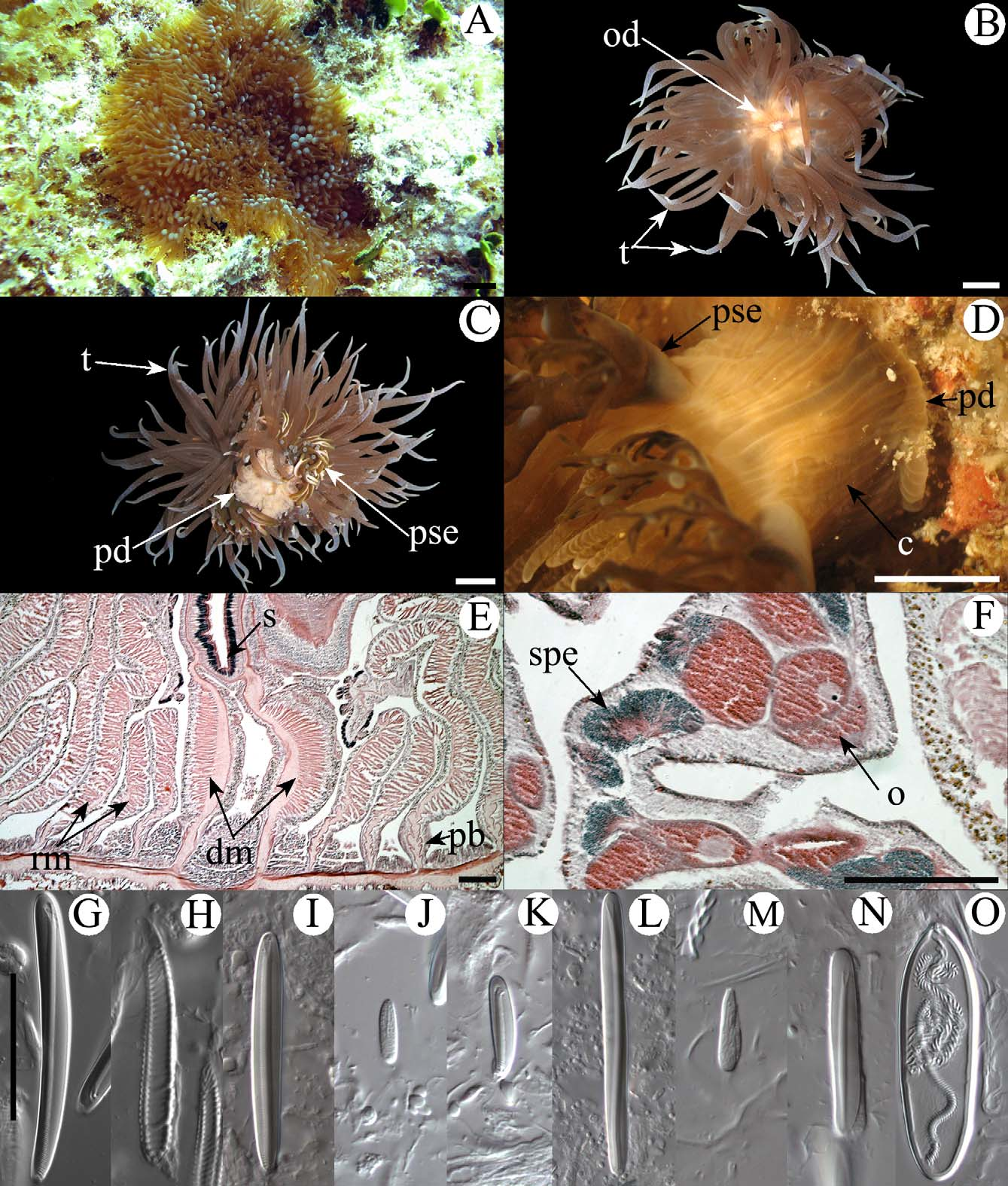
Diagnosis. — Fully expanded tentacles and oral disc 45 – 95 mm in diameter. Oral disc 10 – 25 mm in diameter, smooth, flat, wider than column, light brown, semi-transparent (Figure 6 B). Tentacles about 48, hexamerously arranged in four cycles, smooth but striated in appearance, tapering distally, inner ones longer than outer ones, contractile, light brown but whitish towards tips, with small white dots (Figure 6 B – C). Column cylindrical, smooth, 8 – 40 mm in diameter and 10 – 35 mm in height. Column distally with 4 – 6 branched outgrowths (pseudotentacles) with tips forked, and small round vesicles among ramifications (Figure 6 D); vesicles with batteries of macrobasic p - amastigophores. Pseudotentacles light to dark brown, vesicles white or bluish (Figure 6 A). Pedal disc well developed, 12 – 50 mm in diameter, wider than column. Pedal disc and column light brown or beige, semi-transparent (Figure 6 D). Mesenteries hexamerously arranged in four cycles (48 pairs in specimens examined): first and second cycles perfect and fertile, others imperfect and sterile. Same number of mesenteries distally and proximally. Hermaphroditic (Figure 6 F). Two pairs of directives each attached to a well developed siphonoglyph (Figure 6 E). Retractor muscles strong, diffuse to restricted; parietobasilar muscles poorly developed (Figure 6 E). Basilar muscles developed. Marginal sphincter muscle absent. Longitudinal muscles of tentacles ectodermal. Zooxanthellae present, mainly in pseudotentacles. Cnidom: basitrichs, macrobasic p - amastigophores, microbasic p - amastigophores, and spirocysts (Figure 6 G – O; see Table 2).
Gonzalez-Muñoz, Ricardo, Simões, Nuno, Sanchez-Rodriguez, Judith, Rodriguez, Estefania, Segura-Puertas, Lourdes (2012): First Inventory of Sea Anemones (Cnidaria: Actiniaria) of the Mexican Caribbean. Zootaxa 3556: 1-38, DOI: 10.5281/zenodo.203987
Remarks. — Currently Lebrunia contains two valid species, both reported in the Caribbean Sea (Fautin 2011). The species differ in the branched pseudotentacles: those of L. danae are longer, dark brown, and have forked ends, whereas those of L. coralligens are shorter, bright bluish-gray, and have rounded ends (Varela 2002). We did not observe the weak longitudinal muscles in the distal column cited in the generic diagnosis (Carlgren 1949).
Gonzalez-Muñoz, Ricardo, Simões, Nuno, Sanchez-Rodriguez, Judith, Rodriguez, Estefania, Segura-Puertas, Lourdes (2012): First Inventory of Sea Anemones (Cnidaria: Actiniaria) of the Mexican Caribbean. Zootaxa 3556: 1-38, DOI: 10.5281/zenodo.203987
Distribution. — Lebrunia danae occurs from Bermuda to Brazil, along the entire Caribbean Sea (see Table 1). In the Mexican Caribbean, Lebrunia danae is reported in Puerto Morelos and Cozumel reefs (INE 2000; Jordán- Dahlgren 2008), but these represent the first records in Punta Cancún, Punta Nizuc, Akumal, Xcalak, and Isla Contoy reefs.
Gonzalez-Muñoz, Ricardo, Simões, Nuno, Sanchez-Rodriguez, Judith, Rodriguez, Estefania, Segura-Puertas, Lourdes (2012): First Inventory of Sea Anemones (Cnidaria: Actiniaria) of the Mexican Caribbean. Zootaxa 3556: 1-38, DOI: 10.5281/zenodo.203987
Material examined. — Puerto Morelos (20 ° 49 ’ 53.2 ” N, 86 ° 52 ’ 28.02 ” W; 4 specimens); Punta Cancún (21 ° 9 ’ 10.5 ” N, 86 ° 44 ’ 41.20 ” W; 2 specimens); Punta Nizuc (21 ° 8 ’ 15.65 ” N, 86 ° 44 ’ 20.57 ” W; 1 specimen); Akumal (20 ° 23 ’ 37.03 ” N, 87 ° 18 ’ 44.51 ” W; 1 specimen), Xcalak (18 ° 13 ’ 4.7 ” N, 87 ° 49 ’ 48.8 ” W; 2 specimens); Isla Contoy (21 ° 28 ’ 16.98 ” N, 86 ° 47 ’ 27.87 ” W; 1 specimen).
Gonzalez-Muñoz, Ricardo, Simões, Nuno, Sanchez-Rodriguez, Judith, Rodriguez, Estefania, Segura-Puertas, Lourdes (2012): First Inventory of Sea Anemones (Cnidaria: Actiniaria) of the Mexican Caribbean. Zootaxa 3556: 1-38, DOI: 10.5281/zenodo.203987

Export occurrence data

Darwin Core Archive (ZIP)

CLASSIFICATION

Taxonomic Classification Tree

MULTIMEDIA

Media Files(1)

FIGURE 6. — Lebrunia danae. (A) Live specimen in natural habitat. (B) Oral view. (C) Pedal disc view. (D) Lateral view. (E) Cross section through distal column. (F) Cross section through proximal column. (G – O) Cnidae. — tentacle: (G) microbasic p - amastigophore, (H) spirocyst; actinopharynx: (I) microbasic p - amastigophore; column: (J) basitrich, (K) microbasic p - amastigophore; filament: (L) microbasic p - amastigophore; pseudotentacle: (M) basitrich, (N) microbasic p - amastigophore, (O) macrobasic p - amastigophore. Abbreviations. — c: column, dm; directive mesenteries, od: oral disc, pb: parietobasilar muscle, pd: pedal disc, pse: pseudotentacle, rm: retractor muscle, s: siphonoglyph, spe: spermatic cyst, o: oocyte, t: tentacle. Scale bars. — A – D: 10 mm; E – F: 200 µm; H – K, M – N: 25 µm; G, O: 17.5 µm; L: 15 µm.

Imageimage/png© Gonzalez-Muñoz, Ricardo;Simões, Nuno;Sanchez-Rodriguez, Judith;Rodriguez, Estefania;Segura-Puertas, LourdesGonzalez-Muñoz, Ricardo;Simões, Nuno;Sanchez-Rodriguez, Judith;Rodriguez, Estefania;Segura-Puertas, Lourdes

IMAGES

Gallery(1)

See Gallery

Occurrences with images

Source Information

First Inventory of Sea Anemones (Cnidaria: Actiniaria) of the Mexican Caribbean

checklist

This dataset contains the digitized treatments in Plazi based on the original journal article Gonzalez-Muñoz, Ricardo, Simões, Nuno, Sanchez-Rodriguez, Judith, Rodriguez, Estefania, Segura-Puertas, Lourdes (2012): First Inventory of Sea Anemones (Cnidaria: Actiniaria) of the Mexican Caribbean. Zootaxa 3556: 1-38, DOI: 10.5281/zenodo.203987

Abstract

Ten species of sea anemones (Anthozoa: Actiniaria) are documented in the Mexican Caribbean based on observations and collections in 11 coral reef localities during 2006–2011; three of them are new records for Mexico. These species belong to families Actiniidae, Aiptasiidae, Aliciidae, Boloceroididae, Phymanthidae, and Stichodactylidae. Although these do not represent all species reported in the Mexican Caribbean, these are the most abundant and conspicuous. This work represents the first inventory of sea anemones of the Mexican Caribbean.

Key words: Anthozoa, Zoantharia, Taxonomy, Coelenterates, Coral reefs

Gonzalez-Muñoz R, Simões N, Sanchez-Rodriguez J, Rodriguez E, Segura-Puertas L, plazi (2012). First Inventory of Sea Anemones (Cnidaria: Actiniaria) of the Mexican Caribbean. Plazi.org taxonomic treatments database. Checklist dataset https://doi.org/10.5281/zenodo.203987 accessed via GBIF.org on 2026-06-18.

CC0Published 12/31/2012View dataset
GBIF Usage Key
119555649
Dataset Key
16b1faac-a76c-4b8c-8a10-1942a32bb460
Origin
source
Backbone Key
5184206
Taxon ID
35648787DB18FFB188E5FBEAFAB8FAAC.taxon
Last Crawled
6/11/2026
Last Interpreted
6/11/2026