
AnimaliaNot EvaluatedacceptedspeciesAccepted
Condylactis gigantea

Condylactis gigantea

(Weinland, 1860) Weinland, 1860

GBIF:119555667

0year

0

Synonyms

ABOUT

Descriptions(6)

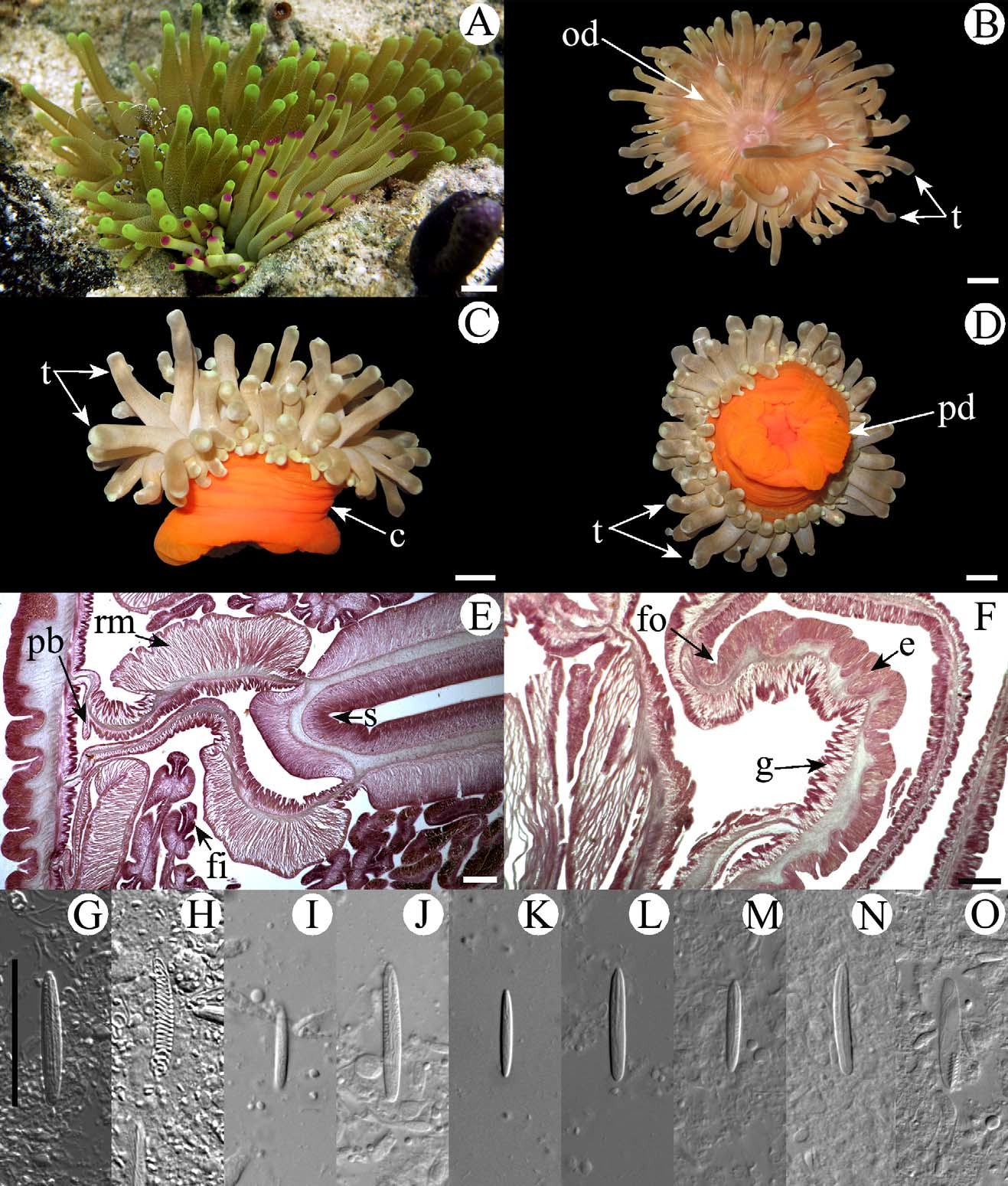
Natural history. — Condylactis gigantea lives in shallow waters inside crevices and holes of coral rocks, in rubble flats, seagrass fields, and rocky patches, often between 2 – 12 m depth, but can be found down to 30 m in the lagoon, fore and back-reef zones. It is often associated with the crustaceans Thor amboinensis, Ancylomenes pedersoni (Chace, 1958), Periclimenes yucatanicus (Ives, 1891) (Figure 5 A), and Mithrax cinctimanus Stimpson, 1860 (Manjarrés 1977; Cairns et al. 1986; Ritson-Williams & Paul 2007), as well as with some reef fishes (Hanlon & Hixon 1986).
Gonzalez-Muñoz, Ricardo, Simões, Nuno, Sanchez-Rodriguez, Judith, Rodriguez, Estefania, Segura-Puertas, Lourdes (2012): First Inventory of Sea Anemones (Cnidaria: Actiniaria) of the Mexican Caribbean. Zootaxa 3556: 1-38, DOI: 10.5281/zenodo.203987
(Figure 5, Table 2)
Gonzalez-Muñoz, Ricardo, Simões, Nuno, Sanchez-Rodriguez, Judith, Rodriguez, Estefania, Segura-Puertas, Lourdes (2012): First Inventory of Sea Anemones (Cnidaria: Actiniaria) of the Mexican Caribbean. Zootaxa 3556: 1-38, DOI: 10.5281/zenodo.203987
Diagnosis. — Fully expanded tentacles and oral disc often more than 200 mm in diameter. Oral disc 25 – 80 mm in diameter, wider than column, smooth, concave, pale brown to pale orange, or bright green to pale green (Figure 5 B). Tentacles 48 – 96, hexamerously arranged in four or five cycles, simple, cylindrical, long (to 120 mm), inner ones longer than outer ones, not completely contractile, smooth but striated in appearance, white, greenish or pale brown (Figure 5 A – D). Tentacle tips slightly swollen, blunt, with a terminal pore, mainly bright green or pink, sometimes bluish or purple (Figure 5 A). Juveniles usually with knobby tentacles. Deep fossa (Figure 5 F). Column cylindrical, smooth, 16 – 65 mm in diameter and 23 – 55 mm in height. Pedal disc well developed, 18 – 75 mm in diameter, slightly wider than column (Figure 5 C, D). Pedal disc and column bright scarlet to pale orange, or brownish to pale yellow (Figure 5 C, D). Mesenteries hexamerously arranged in four cycles (48 pairs in specimens examined): first, second and most of third cycle perfect, others imperfect. No gametogenic tissue observed. Two pairs of directives each attached to a well developed siphonoglyph (Figure 5 E). Retractor muscles restricted and strong; parietobasilar muscles well developed with free mesogleal pennon (Figure 5 E). Basilar muscles well developed. Marginal sphincter muscle absent (Figure 5 F). Longitudinal muscles of tentacles ectodermal. Zooxanthellae present. Cnidom: basitrichs, microbasic p- mastigophores and spirocysts (Figure 5 G – O; see Table 2).
Gonzalez-Muñoz, Ricardo, Simões, Nuno, Sanchez-Rodriguez, Judith, Rodriguez, Estefania, Segura-Puertas, Lourdes (2012): First Inventory of Sea Anemones (Cnidaria: Actiniaria) of the Mexican Caribbean. Zootaxa 3556: 1-38, DOI: 10.5281/zenodo.203987
Remarks. — The genus Condylactis includes four valid species of which only C. gigantea is distributed in the Caribbean Sea (Fautin 2011). Condylactis gigantea is mainly distinguished from the other species in lacking verrucae in the distal column (Studer 1879; Kwietniewski 1896, 1898; McMurrich 1889 a, Corrêa 1964). However, juvenile individuals may present verrucae that dissapear in the adult form (McMurrich 1889 a, Duerden 1898). Furthermore, several authors have mentioned the presence of more or less inconspicuously colored longitudinal rows of dots in the column of C. gigantea (Duchassaing & Michelotti 1864; Verrill 1905; Carlgren 1952). Although in some specimens we also observed the coloration pattern with minute dots (and some juveniles with knobby tentacles and small white dots scattered in the distal column), we did not find verrucae in our histological examinations. Although the marginal sphincter muscle of C. gigantea has been described as diffuse (McMurrich 1889 a; Verrill 1905), we did not observe a developed marginal sphincter muscle (as indicated in Carlgren’s (1949) diagnosis for the genus). We also found the retractor muscles restricted rather than diffuse (Carlgren 1949). Voss (1980) considered that the coloration of C. gigantea is variable according to habitat; however, whether this variation is due to the direct influence of the habitat, accidental settling of a particular morph in one area, or genetics is unknown (Wicksten 1989). The genetic studies of Stoletzki & Schierwater (2005) of C. gigantea from Jamaica suggest that green-tip color morphs are more frequent in shallow waters and pink-tip color morphs dominate deeper areas due to adaptation to different levels of radiation. In the Mexican Caribbean, both green- and pink-tip color morphs could be often found at the same depth and frequently sharing the same niche (Figure 5 A).
Gonzalez-Muñoz, Ricardo, Simões, Nuno, Sanchez-Rodriguez, Judith, Rodriguez, Estefania, Segura-Puertas, Lourdes (2012): First Inventory of Sea Anemones (Cnidaria: Actiniaria) of the Mexican Caribbean. Zootaxa 3556: 1-38, DOI: 10.5281/zenodo.203987
Distribution. — Condylactis gigantea is found along the entire Caribbean Sea, from Bermuda to Colombia (see Table 1); it is also reported in southern Brazil (Abrolhos Islands and Rio de Janeiro) (Corrêa 1973; Zamponi et al. 1998). Although C. gigantea is reported for the Mexican Caribbean in Punta Cancún, Punta Nizuc, Isla Mujeres, Puerto Morelos, and Cozumel reefs (INE 1998 a, 1998 b, 2000), this is the first time recorded for Akumal, Majahual, Xcalak, and Isla Contoy reefs.
Gonzalez-Muñoz, Ricardo, Simões, Nuno, Sanchez-Rodriguez, Judith, Rodriguez, Estefania, Segura-Puertas, Lourdes (2012): First Inventory of Sea Anemones (Cnidaria: Actiniaria) of the Mexican Caribbean. Zootaxa 3556: 1-38, DOI: 10.5281/zenodo.203987
Material examined. — Puerto Morelos (20 ° 52 ’ 5.10 ” N, 86 ° 51 ’ 42.66 ” W; 13 specimens); Majahual (18 ° 42 ’ 28.18 ” N, 87 ° 42 ’ 36.92 ” W; 1 specimen); Punta Cancún (21 ° 9 ’ 10.5 ” N, 86 ° 44 ’ 41.2 ” W; 1 specimen); Isla Mujeres (21 ° 11 ’ 55.06 ” N, 86 ° 43 ’ 35.88 ” W; 3 specimens), Punta Nizuc (21 ° 8 ’ 15.65 ” N, 86 ° 44 ’ 20.57 ” W; 1 specimen); Akumal (20 ° 23 ’ 39.68 ” N, 87 ° 18 ’ 47.39 ” W; 1 specimen); Xcalak (18 ° 15 ’ 53.55 ” N, 87 ° 49 ’ 43.2 ” W; 2 specimens); Isla Contoy (21 ° 29 ’ 0.1 ” N, 86 ° 47 ’ 39.1 ” W; 4 specimens).
Gonzalez-Muñoz, Ricardo, Simões, Nuno, Sanchez-Rodriguez, Judith, Rodriguez, Estefania, Segura-Puertas, Lourdes (2012): First Inventory of Sea Anemones (Cnidaria: Actiniaria) of the Mexican Caribbean. Zootaxa 3556: 1-38, DOI: 10.5281/zenodo.203987

Export occurrence data

Darwin Core Archive (ZIP)

CLASSIFICATION

Taxonomic Classification Tree

MULTIMEDIA

Media Files(1)

FIGURE 5. — Condylactis gigantea. (A) Live specimen in natural habitat. (B) Oral view. (C) Lateral view. (D) Pedal disc view. (E) Cross section through distal column. (F) Detail of longitudinal section through column margin. (G – O) Cnidae. — tentacles: (G) basitrich, (H) spirocyst; actinopharynx: (I) basitrich, (J) basitrich; column: (K) basitrich, (L) basitrich; filament: (M) basitrich, (N) basitrich, (O) microbasic p - mastigophore. Abbreviations. — c: column, e: epidermis, fi: filament, fo: fossa, g: gastrodermis, od: oral disc, pb: parietobasilar muscles, pd: pedal disc, rm: retractor muscle, s: siphonoglyph, t: tentacle. Scale bars. — A – D: 10 mm; E – F: 200 µm; G – O: 25 µm.

Imageimage/png© Gonzalez-Muñoz, Ricardo;Simões, Nuno;Sanchez-Rodriguez, Judith;Rodriguez, Estefania;Segura-Puertas, LourdesGonzalez-Muñoz, Ricardo;Simões, Nuno;Sanchez-Rodriguez, Judith;Rodriguez, Estefania;Segura-Puertas, Lourdes

IMAGES

Gallery(1)

See Gallery

Occurrences with images

Source Information

First Inventory of Sea Anemones (Cnidaria: Actiniaria) of the Mexican Caribbean

checklist

This dataset contains the digitized treatments in Plazi based on the original journal article Gonzalez-Muñoz, Ricardo, Simões, Nuno, Sanchez-Rodriguez, Judith, Rodriguez, Estefania, Segura-Puertas, Lourdes (2012): First Inventory of Sea Anemones (Cnidaria: Actiniaria) of the Mexican Caribbean. Zootaxa 3556: 1-38, DOI: 10.5281/zenodo.203987

Abstract

Ten species of sea anemones (Anthozoa: Actiniaria) are documented in the Mexican Caribbean based on observations and collections in 11 coral reef localities during 2006–2011; three of them are new records for Mexico. These species belong to families Actiniidae, Aiptasiidae, Aliciidae, Boloceroididae, Phymanthidae, and Stichodactylidae. Although these do not represent all species reported in the Mexican Caribbean, these are the most abundant and conspicuous. This work represents the first inventory of sea anemones of the Mexican Caribbean.

Key words: Anthozoa, Zoantharia, Taxonomy, Coelenterates, Coral reefs

Gonzalez-Muñoz R, Simões N, Sanchez-Rodriguez J, Rodriguez E, Segura-Puertas L, plazi (2012). First Inventory of Sea Anemones (Cnidaria: Actiniaria) of the Mexican Caribbean. Plazi.org taxonomic treatments database. Checklist dataset https://doi.org/10.5281/zenodo.203987 accessed via GBIF.org on 2026-06-22.

CC0Published 12/31/2012View dataset
GBIF Usage Key
119555667
Dataset Key
16b1faac-a76c-4b8c-8a10-1942a32bb460
Origin
source
Backbone Key
2256741
Taxon ID
35648787DB1AFFB788E5FC5CFA0CFC04.taxon
Last Crawled
6/20/2026
Last Interpreted
6/20/2026