
AnimaliaNot EvaluatedacceptedspeciesAccepted
Bunodosoma granuliferum

Bunodosoma granuliferum

(Le Sueur, 1817) Le Sueur, 1817

GBIF:119555669

0year

0

Synonyms

ABOUT

Descriptions(6)

Natural history. — Bunodosoma granuliferum lives in shallow waters on sandy and rocky areas, and seagrass fields, often between 0.5 – 2 m depth, but can be found down to 6 m in the lagoon and back-reef zones. One specimen was collected adhered to a leaf of Thalassia testudinum, as epiphytic species do. It is reported to be associated with the crustaceans Periclimenes rathbunae Schmitt, 1924, Thor amboinensis (De Man, 1888), and some reef fishes (Manjarrés 1977). Toxicological studies considered this species as a potential source of biological active compounds (Garateix et al. 2003; Nuñez et al. 2006).
Gonzalez-Muñoz, Ricardo, Simões, Nuno, Sanchez-Rodriguez, Judith, Rodriguez, Estefania, Segura-Puertas, Lourdes (2012): First Inventory of Sea Anemones (Cnidaria: Actiniaria) of the Mexican Caribbean. Zootaxa 3556: 1-38, DOI: 10.5281/zenodo.203987
(Figure 4, Table 2)
Gonzalez-Muñoz, Ricardo, Simões, Nuno, Sanchez-Rodriguez, Judith, Rodriguez, Estefania, Segura-Puertas, Lourdes (2012): First Inventory of Sea Anemones (Cnidaria: Actiniaria) of the Mexican Caribbean. Zootaxa 3556: 1-38, DOI: 10.5281/zenodo.203987
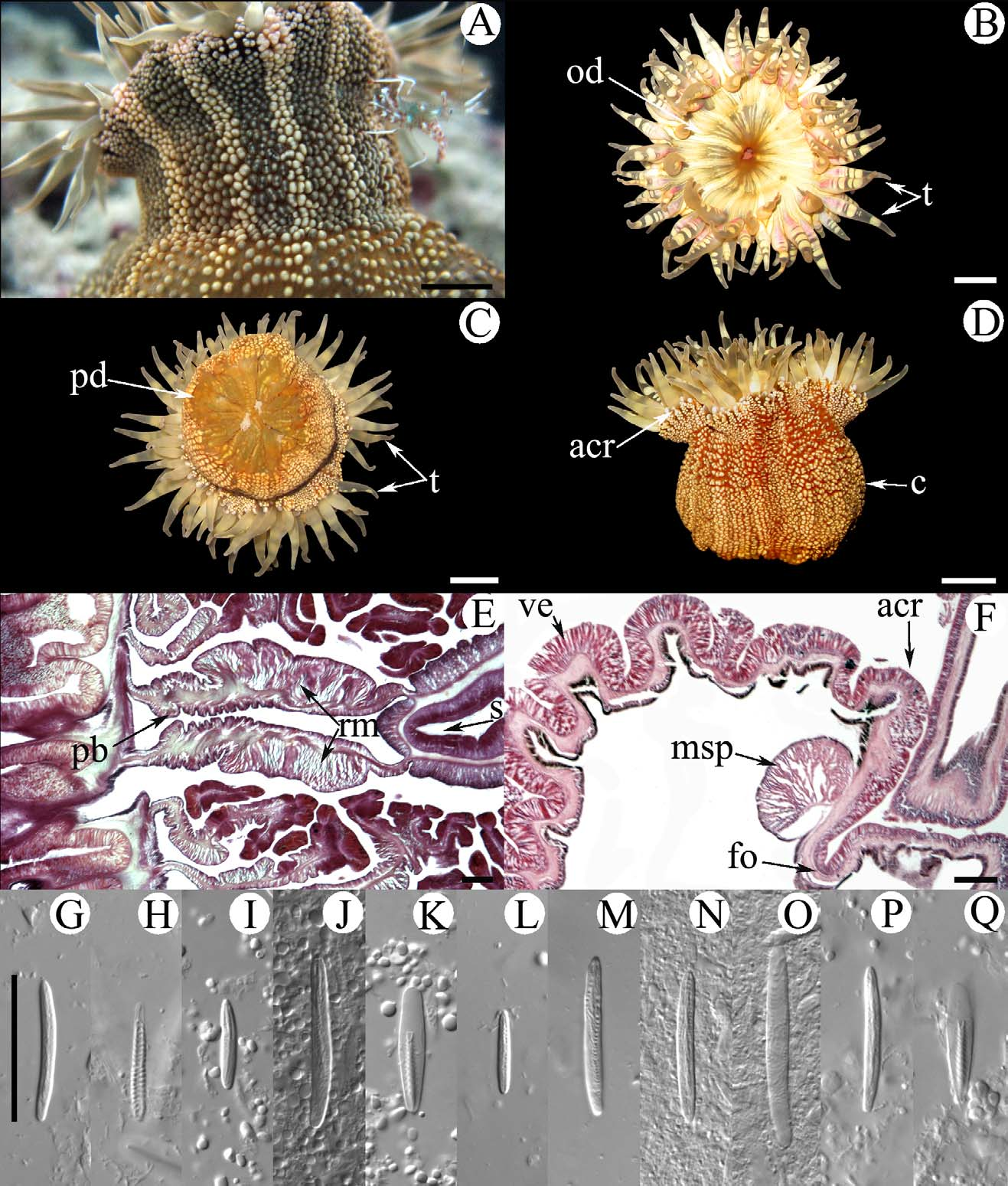
Diagnosis. — Fully expanded tentacles and oral disc to 100 mm in diameter. Oral disc 10 – 70 mm in diameter, smooth, flat, olive-green or reddish-brown (Figure 4 B). Tentacles 48 – 96, hexamerously arranged in four or five cycles, simple, conical, moderately long, 10 – 30 mm in length, smooth, tapering distally, inner ones longer than outer ones, contractile, olive-green to green-greyish, often with white spots and flashes of pink or purple (Figure 4 B – D). Deep fossa (Figure 4 F). Margin with acrorhagi (Figure 4 D). Column cylindrical, 6 – 55 mm in height and 6 – 38 mm in diameter, densely covered with rounded non-adhesive vesicles arranged in 24 alternating dark and light bands (Figure 4 A, D); dark bands with about five rows of vesicles, light ones with about three. Pedal disc well developed, 8 – 42 mm in diameter, olive-green to orange (Figure 4 C). Mesenteries hexamerously arranged in four cycles (48 pairs in specimens examined): first, second and some mesenteries of third cycle perfect, others imperfect. No gametogenic tissue observed in specimens examined. Two pairs of directives each attached to a well developed siphonoglyph (Figure 4 E). Retractor muscles more or less restricted and strong; parietobasilar muscles well developed with free mesogleal pennon (Figure 4 E). Basilar muscles well developed. Marginal sphincter muscle endodermal, circumscribed and strong (Figure 4 F). Zooxanthellae present. Cnidom: basitrichs, microbasic p- mastigophores, holotrichs and spirocysts (Figure 4 G – Q; see Table 2).
Gonzalez-Muñoz, Ricardo, Simões, Nuno, Sanchez-Rodriguez, Judith, Rodriguez, Estefania, Segura-Puertas, Lourdes (2012): First Inventory of Sea Anemones (Cnidaria: Actiniaria) of the Mexican Caribbean. Zootaxa 3556: 1-38, DOI: 10.5281/zenodo.203987
Remarks. — Four valid species of Bunodosoma are reported in the Caribbean Sea: B. granuliferum, B. cavernatum (Bosc, 1802), B. kuekenthali Pax, 1910, and B. sphaerulatum Duerden, 1902 b; one, B. cangicum Belém & Preslercravo, 1973 in the northern coast of Brazil (Fautin 2011, Table 1). Bunodosoma granuliferum is distinguished mainly by the chromatic pattern of alternating pale and dark longitudinal bands in the column (Duerden 1902 b; Pax 1910; Corrêa 1964; Cairns et al. 1986). The distinction between B. granuliferum and B. cavernatum has been widely discussed (see Carlgren 1952; Carlgren & Hedgpeth 1952; Corrêa 1964). Using allozymes, McCommas & Lester (1980) found that the species are genetically different and considered them as separate valid species. Bunodosoma biscayensis (Fischer, 1874) also has a chromatic pattern of alternating dark and light longitudinal bands in the column; however, it differs from B. granuliferum in the cnidae and geographic distribution (found in the northeast Atlantic Ocean) (den Hartog 1987). Although we did not observe fertile specimens of B. granuliferum, it has been described to have all mesenteries (except the directives) fertile (McMurrich 1889 a, Duerden 1902 b).
Gonzalez-Muñoz, Ricardo, Simões, Nuno, Sanchez-Rodriguez, Judith, Rodriguez, Estefania, Segura-Puertas, Lourdes (2012): First Inventory of Sea Anemones (Cnidaria: Actiniaria) of the Mexican Caribbean. Zootaxa 3556: 1-38, DOI: 10.5281/zenodo.203987
Distribution. — Although this is the first record of Bunodosoma granuliferum for the Mexican Caribbean (Puerto Morelos and Isla Contoy reefs), it is found along the entire Caribbean Sea, from Bermuda to Barbados (see Table 1).
Gonzalez-Muñoz, Ricardo, Simões, Nuno, Sanchez-Rodriguez, Judith, Rodriguez, Estefania, Segura-Puertas, Lourdes (2012): First Inventory of Sea Anemones (Cnidaria: Actiniaria) of the Mexican Caribbean. Zootaxa 3556: 1-38, DOI: 10.5281/zenodo.203987
Material examined. — Puerto Morelos (20 ° 55 ’ 39.13 ” N, 86 ° 49 ’ 58.93 ” W; 7 specimens); Isla Contoy (21 ° 28 ’ 16.98 ” N, 86 ° 47 ’ 27.87 ” W; 2 specimens).
Gonzalez-Muñoz, Ricardo, Simões, Nuno, Sanchez-Rodriguez, Judith, Rodriguez, Estefania, Segura-Puertas, Lourdes (2012): First Inventory of Sea Anemones (Cnidaria: Actiniaria) of the Mexican Caribbean. Zootaxa 3556: 1-38, DOI: 10.5281/zenodo.203987

Export occurrence data

Darwin Core Archive (ZIP)

CLASSIFICATION

Taxonomic Classification Tree

MULTIMEDIA

Media Files(1)

FIGURE 4. — Bunodosoma granuliferum. (A) Live specimen, lateral view. (B) Oral view. (C) Pedal disc view. (D) Lateral view. (E) Cross section through distal column. (F) Longitudinal section through column margin. (G – Q) Cnidae. — tentacles: (G) basitrich, (H) spirocyst; actinopharynx: (I) basitrich, (J) basitrich, (K) microbasic p - mastigophore; column: (L) basitrich, (M) basitrich; acrorhagi: (N) basitrich, (O) holotrich; filament: (P) basitrich, (Q) microbasic p - mastigophore. Abbreviations. — acr: acrorhagi, c: column, fo: fossa, msp: marginal sphincter, od: oral disc, pb: parietobasilar muscles, pd: pedal disc, rm: retractor muscles, s: siphonoglyph, t: tentacle, ve: vesicle. Scale bars. — A – D: 10 mm; E – F: 200 µm; G – Q: 25 µm.

Imageimage/png© Gonzalez-Muñoz, Ricardo;Simões, Nuno;Sanchez-Rodriguez, Judith;Rodriguez, Estefania;Segura-Puertas, LourdesGonzalez-Muñoz, Ricardo;Simões, Nuno;Sanchez-Rodriguez, Judith;Rodriguez, Estefania;Segura-Puertas, Lourdes

IMAGES

Gallery(1)

See Gallery

Occurrences with images

Source Information

First Inventory of Sea Anemones (Cnidaria: Actiniaria) of the Mexican Caribbean

checklist

This dataset contains the digitized treatments in Plazi based on the original journal article Gonzalez-Muñoz, Ricardo, Simões, Nuno, Sanchez-Rodriguez, Judith, Rodriguez, Estefania, Segura-Puertas, Lourdes (2012): First Inventory of Sea Anemones (Cnidaria: Actiniaria) of the Mexican Caribbean. Zootaxa 3556: 1-38, DOI: 10.5281/zenodo.203987

Abstract

Ten species of sea anemones (Anthozoa: Actiniaria) are documented in the Mexican Caribbean based on observations and collections in 11 coral reef localities during 2006–2011; three of them are new records for Mexico. These species belong to families Actiniidae, Aiptasiidae, Aliciidae, Boloceroididae, Phymanthidae, and Stichodactylidae. Although these do not represent all species reported in the Mexican Caribbean, these are the most abundant and conspicuous. This work represents the first inventory of sea anemones of the Mexican Caribbean.

Key words: Anthozoa, Zoantharia, Taxonomy, Coelenterates, Coral reefs

Gonzalez-Muñoz R, Simões N, Sanchez-Rodriguez J, Rodriguez E, Segura-Puertas L, plazi (2012). First Inventory of Sea Anemones (Cnidaria: Actiniaria) of the Mexican Caribbean. Plazi.org taxonomic treatments database. Checklist dataset https://doi.org/10.5281/zenodo.203987 accessed via GBIF.org on 2026-06-22.

CC0Published 12/31/2012View dataset
GBIF Usage Key
119555669
Dataset Key
16b1faac-a76c-4b8c-8a10-1942a32bb460
Origin
source
Backbone Key
2256512
Taxon ID
35648787DB04FFB588E5FB88FDBCFCF1.taxon
Last Crawled
6/20/2026
Last Interpreted
6/20/2026