
AnimaliaNot EvaluatedacceptedspeciesAccepted
Actinostella flosculifera

Actinostella flosculifera

(Le Sueur, 1817) Le Sueur, 1817

GBIF:119555671

0year

ABOUT

Descriptions(5)

(Figure 3, Table 2)
Gonzalez-Muñoz, Ricardo, Simões, Nuno, Sanchez-Rodriguez, Judith, Rodriguez, Estefania, Segura-Puertas, Lourdes (2012): First Inventory of Sea Anemones (Cnidaria: Actiniaria) of the Mexican Caribbean. Zootaxa 3556: 1-38, DOI: 10.5281/zenodo.203987
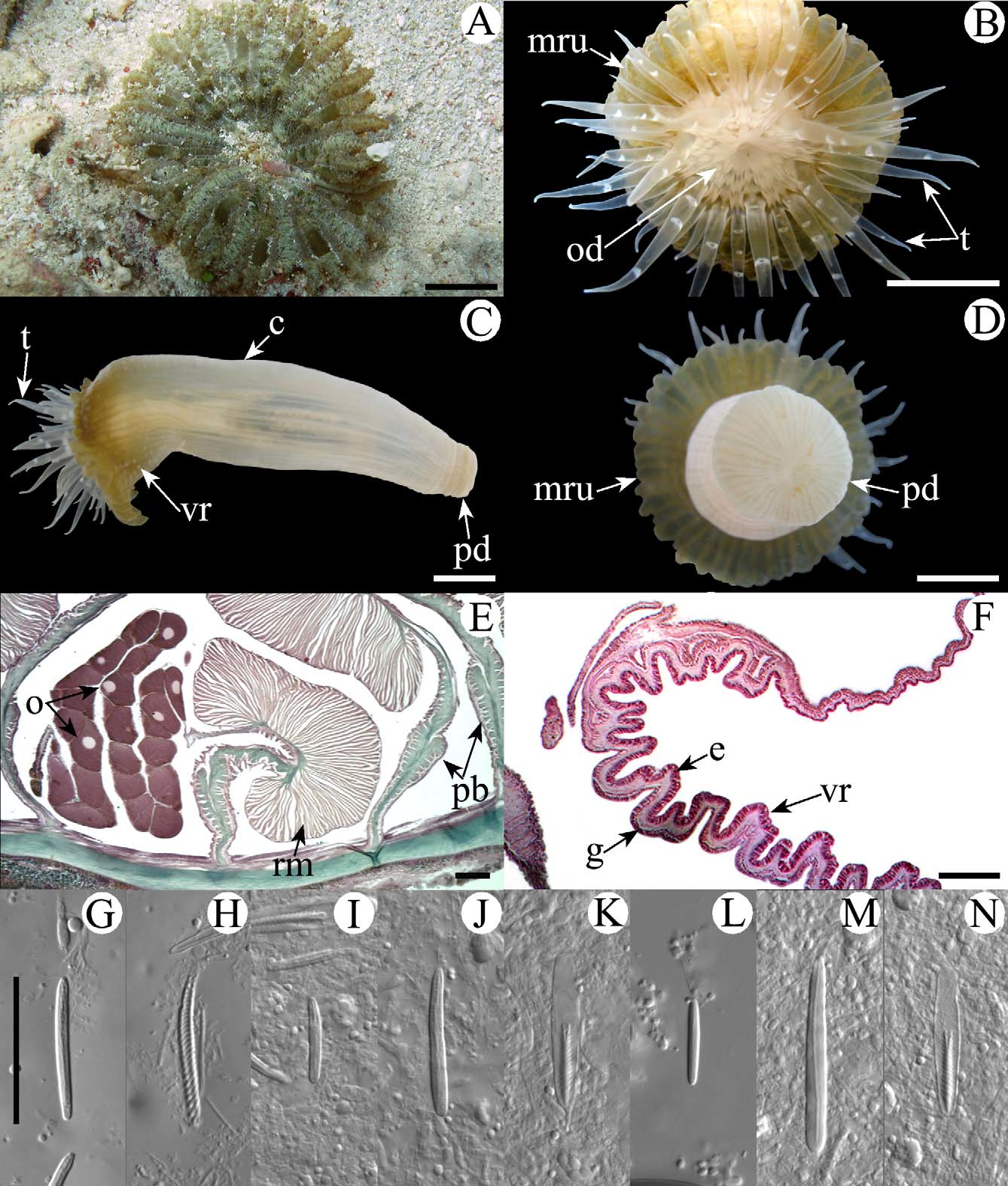
Diagnosis. — Fully expanded tentacles and marginal ruff to 120 mm in diameter. Oral disc 15 – 45 mm in diameter, with white spots (Figure 3 B). Tentacles about 48, hexamerously arranged in four cycles, smooth, conical, tapering distally, moderately long, inner ones longer than outer ones, contractile, white, semi-transparent with scattered small circular white spots (Figure 3 B). Column more or less elongated, 20 – 65 mm in height and 15 – 30 mm in diameter, smooth but with small rows of verrucae distally (Figure 3 C, F). Above verrucae lies a marginal ruff (or collar) formed by 48 rows of small frond-like fused papillae, light brown or olive-green (Figure 3 A, B). Pedal disc well developed, 11 – 29 mm in diameter (Figure 3 D). Pedal disc and column beige, semi-transparent. Mesenteries hexamerously arranged in three cycles (24 pairs in specimens examined): first cycle (including directives) and some pairs of second cycle perfect and fertile, others imperfect and sterile; gonochoric (?), only oocytes in examined specimens (Figure 3 E); same number of mesenteries distally and proximally. Two pairs of directives each attached to a well developed siphonoglyph. Retractor muscles strong and restricted; parietobasilar muscles well developed with a free mesogleal pennon (Figure 3 E). Basilar muscles well developed. Marginal sphincter muscle not developed (Figure 3 F). Zooxanthellae present. Cnidom: basitrichs, microbasic pmastigophores and spirocysts (Figure 3 G – N; see Table 2). Natural history. — Actinostella flosculifera inhabits fields of the seagrasses Thalassia testudinum and Syringodium filiforme, often between 0.5 – 5 m depth, in areas of the lagoon-reef zone with low wave energy. It is usually found with the column burrowed, but the pedal disc is actually adhered to buried rocks, shells or rhizomes of seagrasses. During the day, the tentacles remain contracted and the marginal ruff fully expanded, allowing zooxanthellae (particularly abundant in this area) to capture sunlight; during night the situation is the opposite, allowing tentacles to capture food (Häussermann 2003). The marginal ruff is similar in color to dead leaves of seagrass, probably camouflaging this species.
Gonzalez-Muñoz, Ricardo, Simões, Nuno, Sanchez-Rodriguez, Judith, Rodriguez, Estefania, Segura-Puertas, Lourdes (2012): First Inventory of Sea Anemones (Cnidaria: Actiniaria) of the Mexican Caribbean. Zootaxa 3556: 1-38, DOI: 10.5281/zenodo.203987
Remarks. — Three of the 10 valid species of Actinostella have been recorded in the Caribbean Sea: A. flosculifera, A. radiata (Duchassaing & Michelotti, 1860), and A. variabilis (Hargitt, 1911) (Fautin 2011). According to McMurrich (1905), A. radiata resembles A. conchilega (= A. flosculifera) in its general appearance but differs perhaps in the number of tubercles on the fronds and the verrucae in each longitudinal row, and in the circumscribed endodermal sphincter; however, the distinction between A. radiata and A. flosculifera remains unclear and needs further revision. The specimens of A. variabilis (= Cradactis variabilis) showen in Hargitt’s (1911) description are actually specimens of Lebrunia coralligens (Wilson, 1890) and perhaps some young individuals of L. danae. The diagnosis of Actinostella mentions a strong to very weak circumscribed marginal sphincter muscle (Carlgren 1949; Häussermann 2003); however, like McMurrich (1905), we did not observe a distinct marginal sphincter muscle in the specimens examined. Further revision is needed to clarify the presence or absence of marginal sphincter in A. flosculifera.
Gonzalez-Muñoz, Ricardo, Simões, Nuno, Sanchez-Rodriguez, Judith, Rodriguez, Estefania, Segura-Puertas, Lourdes (2012): First Inventory of Sea Anemones (Cnidaria: Actiniaria) of the Mexican Caribbean. Zootaxa 3556: 1-38, DOI: 10.5281/zenodo.203987
Distribution. — From Bermuda to Brazil, along the entire Caribbean Sea (see Table 1). Also reported in Canary Islands (Ocaña & den Hartog 2002) and the Gulf of Guinea (Wirtz 2003). This species is reported for the Mexican Caribbean in Punta Cancún, Punta Nizuc, and Isla Mujeres reefs (INE 1998 a), but this is the first time recorded for Puerto Morelos, Akumal, and Isla Contoy reefs.
Gonzalez-Muñoz, Ricardo, Simões, Nuno, Sanchez-Rodriguez, Judith, Rodriguez, Estefania, Segura-Puertas, Lourdes (2012): First Inventory of Sea Anemones (Cnidaria: Actiniaria) of the Mexican Caribbean. Zootaxa 3556: 1-38, DOI: 10.5281/zenodo.203987
Material examined. — Puerto Morelos (20 ° 54 ’ 26.38 ” N, 86 ° 50 ’ 43.14 ” W; 5 specimens); Isla Contoy (21 ° 29 ’ 0.10 ” N, 86 ° 47 ’ 39.10 ” W; 5 specimens); Akumal (20 ° 23 ’ 37.03 ” N, 87 ° 18 ’ 44.51 ” W; 1 specimen).
Gonzalez-Muñoz, Ricardo, Simões, Nuno, Sanchez-Rodriguez, Judith, Rodriguez, Estefania, Segura-Puertas, Lourdes (2012): First Inventory of Sea Anemones (Cnidaria: Actiniaria) of the Mexican Caribbean. Zootaxa 3556: 1-38, DOI: 10.5281/zenodo.203987

Export occurrence data

Darwin Core Archive (ZIP)

CLASSIFICATION

Taxonomic Classification Tree

MULTIMEDIA

Media Files(1)

FIGURE 3. — Actinostella flosculifera. (A) Live specimen in natural habitat. (B) Oral view. (C) Lateral view. (D) Pedal disc view. (E) Cross section through distal column. (F) Detail of longitudinal section of column margin. (G – N) Cnidae. — tentacles: (G) basitrich, (H) spirocyst; actinopharynx: (I) basitrich, (J) basitrich, (K) microbasic p - mastigophore; column: (L) basitrich; filament: (M) basitrich, (N) microbasic p - mastigophore. Abbreviations. — c: column, e: epidermis, g: gastrodermis, mru: marginal ruff, od: oral disc, o: oocyte, pb: parietobasilar muscle, pd: pedal disc, rm: retractor muscle, t: tentacles, vr: verrucae. Scale bars. — A – D: 10 mm; E – F: 200 µm; G – N: 25 µm.

Imageimage/png© Gonzalez-Muñoz, Ricardo;Simões, Nuno;Sanchez-Rodriguez, Judith;Rodriguez, Estefania;Segura-Puertas, LourdesGonzalez-Muñoz, Ricardo;Simões, Nuno;Sanchez-Rodriguez, Judith;Rodriguez, Estefania;Segura-Puertas, Lourdes

IMAGES

Gallery(1)

See Gallery

Occurrences with images

Source Information

First Inventory of Sea Anemones (Cnidaria: Actiniaria) of the Mexican Caribbean

checklist

This dataset contains the digitized treatments in Plazi based on the original journal article Gonzalez-Muñoz, Ricardo, Simões, Nuno, Sanchez-Rodriguez, Judith, Rodriguez, Estefania, Segura-Puertas, Lourdes (2012): First Inventory of Sea Anemones (Cnidaria: Actiniaria) of the Mexican Caribbean. Zootaxa 3556: 1-38, DOI: 10.5281/zenodo.203987

Abstract

Ten species of sea anemones (Anthozoa: Actiniaria) are documented in the Mexican Caribbean based on observations and collections in 11 coral reef localities during 2006–2011; three of them are new records for Mexico. These species belong to families Actiniidae, Aiptasiidae, Aliciidae, Boloceroididae, Phymanthidae, and Stichodactylidae. Although these do not represent all species reported in the Mexican Caribbean, these are the most abundant and conspicuous. This work represents the first inventory of sea anemones of the Mexican Caribbean.

Key words: Anthozoa, Zoantharia, Taxonomy, Coelenterates, Coral reefs

Gonzalez-Muñoz R, Simões N, Sanchez-Rodriguez J, Rodriguez E, Segura-Puertas L, plazi (2012). First Inventory of Sea Anemones (Cnidaria: Actiniaria) of the Mexican Caribbean. Plazi.org taxonomic treatments database. Checklist dataset https://doi.org/10.5281/zenodo.203987 accessed via GBIF.org on 2026-06-16.

CC0Published 12/31/2012View dataset
GBIF Usage Key
119555671
Dataset Key
16b1faac-a76c-4b8c-8a10-1942a32bb460
Origin
source
Backbone Key
2256709
Taxon ID
35648787DB01FFAB88E5FCD4FD2AFC04.taxon
Last Crawled
6/11/2026
Last Interpreted
6/11/2026