AnimaliaNot EvaluatedacceptedspeciesAccepted
Digitipes jangii

Digitipes jangii

GBIF:119563406

ABOUT

Descriptions(5)

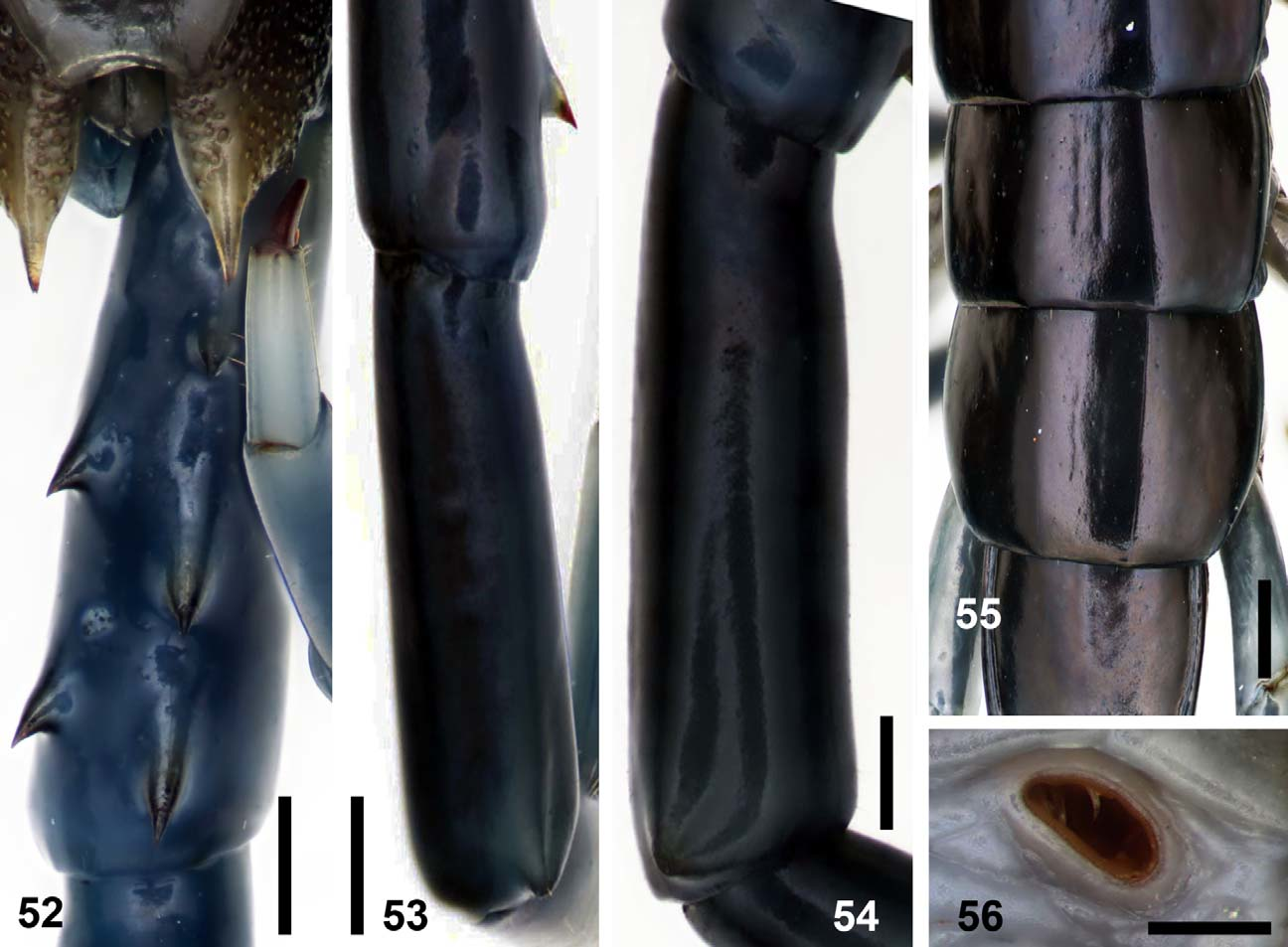
Description. Length to 47 mm. 17 antennal articles; basal three (five individuals) or four (six individuals) articles glabrous both dorsally and ventrally. Longitudinal median furrow on anterior 20 % of cephalic plate. Short paired longitudinal furrows on posterior part of cephalic plate (Fig. 46). Anterior part of cephalic plate and basal (glabrous) part of antenna blue, remainder of cephalic plate usually brown; T 1 variably light brown or mostly blue; tergites often mostly blue from T 2 to middle of body and increasingly brown in posterior segments but may be dark brown from T 2; legs usually light blue, in some specimens dark blue. Forcipular coxosternal tooth plates wider than long (Figs 47, 48), with four main teeth, inner two grouped together, the outer tooth smaller than the inner three; base of tooth plates defined by relatively obtuse oblique sutures diverging at 140 – 145 °. Trochanteroprefemoral process with two distinctly defined teeth along inner margin. Second maxillary claw with slender accessory spurs. Tergites with paramedian sutures complete from TT 4 or (usually) 5. Tergites marginate starting from 7 to 13, most commonly from 8 or 9. Tergites smooth (Fig. 55), lacking median ridge or keels. Paramedian sutures 20 – 35 % length of sternites in mid body region. First three or four pairs of legs (two pairs in a single specimen) with two tarsal spurs, the subsequent up to 19 with one, 20 without tarsal spur (except one individual). Tibial spur on leg 1 only. Femoral spur usually lacking on leg 1, present in one individual. Tergite of ultimate leg-bearing segment with gently convex lateral margins that converge posteriorly; posterolateral margins straight, variably pointed posteromedially (Fig. 50). Sternite of ultimate leg-bearing segment with sides converging posteriorly, weakly convex outwards, posterior margin moderately concave (Fig. 51). Coxopleural process long, slender, with two apical spines, mostly with a lateral spine on each side (Figs 49, 51), a few individuals with lateral spine on one side only, one lacking spines on both sides. Pores relatively dense, approximately bimodal mix of large and small pores; pore field extending close to but not reaching dorsal margin of coxopleuron (Fig. 49); non-porose area on process narrow, at least half length to posterior margin of sternite of ultimate leg-bearing segment, sometimes extending to that margin. Ultimate leg prefemur with width at distal end about one-third its length; prefemoral spines usually large, distally curved (Fig. 52): VL 3, VM 2, DM 1 or 2, apart from one individual with VL 1 / 2, VM 1, DM 0. Distomedial process in males blunt, not extending to distal end of femur on its dorsal side (Fig. 53); groove on medial surface of femur confined to distal end of femur or as much as half length of femur (Fig. 54); slightly flattened and variably depigmented area on medial surface of femur bearing dense field of fine pores. Distomedial end of ultimate leg tibia in male either bears (CES 08912) or lacks (CES 08915, CES 091020) a weak rounded process similar to that on femur. Ultimate leg tarsus 1 1.6 – 1.8 times length of tarsus 2; tarsus 1 2.4 – 6 times longer than pretarsus; pretarsus with pair of short accessory claws.
Joshi, Jahnavi, Edgecombe, Gregory D. (2013): Revision of the scolopendrid centipede Digitipes Attems, 1930, from India (Chilopoda: Scolopendromorpha): reconciling molecular and morphological estimates of species diversity. Zootaxa 3626 (1): 99-145, DOI: 10.11646/zootaxa.3626.1.5
Diagnosis. Digitipes with basal three or four antennal articles glabrous both dorsally and ventrally. Forcipular tooth plates wider than long. Tergite paramedian sutures complete from TT 4 or 5; tergites smooth, lacking longitudinal median ridge or keels. Coxopleural process long, slender, lateral spine usually present. Leg 20 without tarsal spur. Spines on ultimate leg prefemur moderate to strong. Distomedial process on ultimate leg femur of male short, blunt.
Joshi, Jahnavi, Edgecombe, Gregory D. (2013): Revision of the scolopendrid centipede Digitipes Attems, 1930, from India (Chilopoda: Scolopendromorpha): reconciling molecular and morphological estimates of species diversity. Zootaxa 3626 (1): 99-145, DOI: 10.11646/zootaxa.3626.1.5
Discussion. Putative species 5 and 6 had previously been observed not to be differentiated on the environmental and morphological axis (Joshi and Karanth 2012). In the current revision we treat them as one species but recognise it as distinct from all previously named congeners. Its distinctive features include the presence of four glabrous antennal articles in some specimens, relatively short forcipular tooth plates, a slender coxopleural process, robust prefemoral spines, and a short femoral process on the male ultimate leg. It is also the only species in our sample apart from D. periyarensis with individuals (4 of 11 specimens, all from the same population) having two DM spines on the ultimate leg prefemur; other Indian Digitipes have at most one DM spine. A character of potential taxonomic importance is a small distomedial process on the ultimate leg tibia in the sole mature male of PS 5 (the holotype of D. jangii) versus its absence in two mature males of PS 6. We are reluctant to attribute diagnostic value to this difference without additional samples.
Joshi, Jahnavi, Edgecombe, Gregory D. (2013): Revision of the scolopendrid centipede Digitipes Attems, 1930, from India (Chilopoda: Scolopendromorpha): reconciling molecular and morphological estimates of species diversity. Zootaxa 3626 (1): 99-145, DOI: 10.11646/zootaxa.3626.1.5
Etymology. For B. S. Jangi, in recognition of his work on the Scolopendridae of India, including the identification of Digitipes.
Joshi, Jahnavi, Edgecombe, Gregory D. (2013): Revision of the scolopendrid centipede Digitipes Attems, 1930, from India (Chilopoda: Scolopendromorpha): reconciling molecular and morphological estimates of species diversity. Zootaxa 3626 (1): 99-145, DOI: 10.11646/zootaxa.3626.1.5
Type specimens. Holotype CES 08912, male, from Kudremukh National Park, Karnataka, India, 13 ° 20052 N 75 ° 19289 E, leg. J. Joshi, vii. 2008. Paratypes: CES 08915, male, CES 08907, CES 08922, females, from type locality, same collection; CES 07219, CES 07223, CES 07226, CES 07230, from Anshi-Dandeli Tiger Reserve, Karnataka; CES 07230, from Dodamanne Ghat, Karnataka; CES 08288, from Talacauvery Reserve Forest, Karnataka; CES 08930, from Bombay point, Mahabaleshwar Reserve Forest, Maharashtra; CES 091020, from Bisale Ghat Reserve Forest, Karanataka. All leg. J. Joshi, 2007 – 2010.
Joshi, Jahnavi, Edgecombe, Gregory D. (2013): Revision of the scolopendrid centipede Digitipes Attems, 1930, from India (Chilopoda: Scolopendromorpha): reconciling molecular and morphological estimates of species diversity. Zootaxa 3626 (1): 99-145, DOI: 10.11646/zootaxa.3626.1.5

Export occurrence data

Darwin Core Archive (ZIP)

CLASSIFICATION

Taxonomic Classification Tree

MULTIMEDIA

Media Files(2)

FIGURES 46 – 51. Digitipes jangii n. sp. 46, 50, 51, CES 08912 (holotype male); 47 – 49, CES 08915 (paratype male). 46. Cephalic plate and T 1, dorsal view, scale = 2 mm. 47. Forcipular segment, ventral view, scale = 1 mm. 48. Tooth plates, ventral view, scale = 0.5 mm. 49. Coxopleuron, lateral view, scale = 1 mm. 50. Tergite of ultimate leg-bearing segment, dorsal view, scale = 1 mm. 51. Coxopleuron and sternite of ultimate leg-bearing segment, ventral view, scale = 0.5 mm.

Imageimage/png© Joshi, Jahnavi;Edgecombe, Gregory D.Joshi, Jahnavi;Edgecombe, Gregory D.

FIGURES 52 – 56. Digitipes jangii n. sp. CES 08912 (holotype male) except Fig. 56, CES 08915 (paratype male). 52. Ultimate leg prefemur, ventral view, scale = 0.5 mm. 53. Ultimate leg femur, dorsal view, scale = 0.5 mm. 54. Ultimate leg femur, medial view, scale = 0.5 mm. 55. TT 18 – 20, dorsal view, scale = 0.5 mm. 56. Spiracle on segment 3, scale = 0.25 mm.

Imageimage/png© Joshi, Jahnavi;Edgecombe, Gregory D.Joshi, Jahnavi;Edgecombe, Gregory D.

IMAGES

Gallery(2)

See Gallery

Occurrences with images

Source Information

Revision of the scolopendrid centipede Digitipes Attems, 1930, from India (Chilopoda: Scolopendromorpha): reconciling molecular and morphological estimates of species diversity

checklist

This dataset contains the digitized treatments in Plazi based on the original journal article Joshi, Jahnavi, Edgecombe, Gregory D. (2013): Revision of the scolopendrid centipede Digitipes Attems, 1930, from India (Chilopoda: Scolopendromorpha): reconciling molecular and morphological estimates of species diversity. Zootaxa 3626 (1): 99-145, DOI: 10.11646/zootaxa.3626.1.5

Abstract

Recent work on molecular phylogenetics of Scolopendridae from the Western Ghats, Peninsular India, has suggested the presence of six cryptic species of the otostigmine Digitipes Attems, 1930, together with three species described in previous taxonomic work by Jangi and Dass (1984). Digitipes is the correct generic attribution for a monophyletic group of Indian species, these being united with three species from tropical Africa (including the type) that share a distomedial process on the ultimate leg femur of males that is otherwise unknown in Otostigminae. Second maxillary characters previously used in the diagnosis of Digitipes are dismissed because Indian species do not possess the putatively diagnostic character states. Two new species from the Western Ghats that correspond to groupings identified based on monophyly, sequence divergence and coalescent analysis using molecular data are diagnosed based on distinct morphological characters. They are D. jangii and D. periyarensis n. spp. Three species named by Jangi and Dass (Digitipes barnabasi, D. coonoorensis and D. indicus) are revised based on new collections; D. indicus is a junior subjective synonym of Arthrorhabdus jonesii Verhoeff, 1938, the combination becoming Digitipes jonesii (Verhoeff, 1938) n. comb. The presence of Arthrorhabdus in India is accordingly refuted. Three putative species delimited by molecular and ecological data remain cryptic from the perspective of diagnostic morphological characters and are presently retained in D. barnabasi, D. jangii and D. jonesii. A molecularly-delimited species that resolved as sister group to a well-supported clade of Indian Digitipes is identified as Otostigmus ruficeps Pocock, 1890, originally described from a single specimen and revised herein. One Indian species originally assigned to Digitipes, D. gravelyi, deviates from confidently-assigned Digitipes with respect to several characters and is reassigned to Otostigmus, as O. gravelyi (Jangi and Dass, 1984) n. comb.

Key words: Scolopendridae, Otostigmini, Otostigmus, Western Ghats, cryptic species

Joshi J, Edgecombe G D, plazi (2013). Revision of the scolopendrid centipede Digitipes Attems, 1930, from India (Chilopoda: Scolopendromorpha): reconciling molecular and morphological estimates of species diversity. Plazi.org taxonomic treatments database. Checklist dataset https://doi.org/10.11646/zootaxa.3626.1.5 accessed via GBIF.org on 2026-06-14.

CC0Published 12/31/2013View dataset
GBIF Usage Key
119563406
Dataset Key
135b7553-b75c-4020-b1a6-c689a05b7e66
Origin
source
Backbone Key
9146453
Taxon ID
4F7A87F2FFDFFFA8FF0BFD68FC2CF815.taxon
Last Crawled
6/11/2026
Last Interpreted
6/11/2026