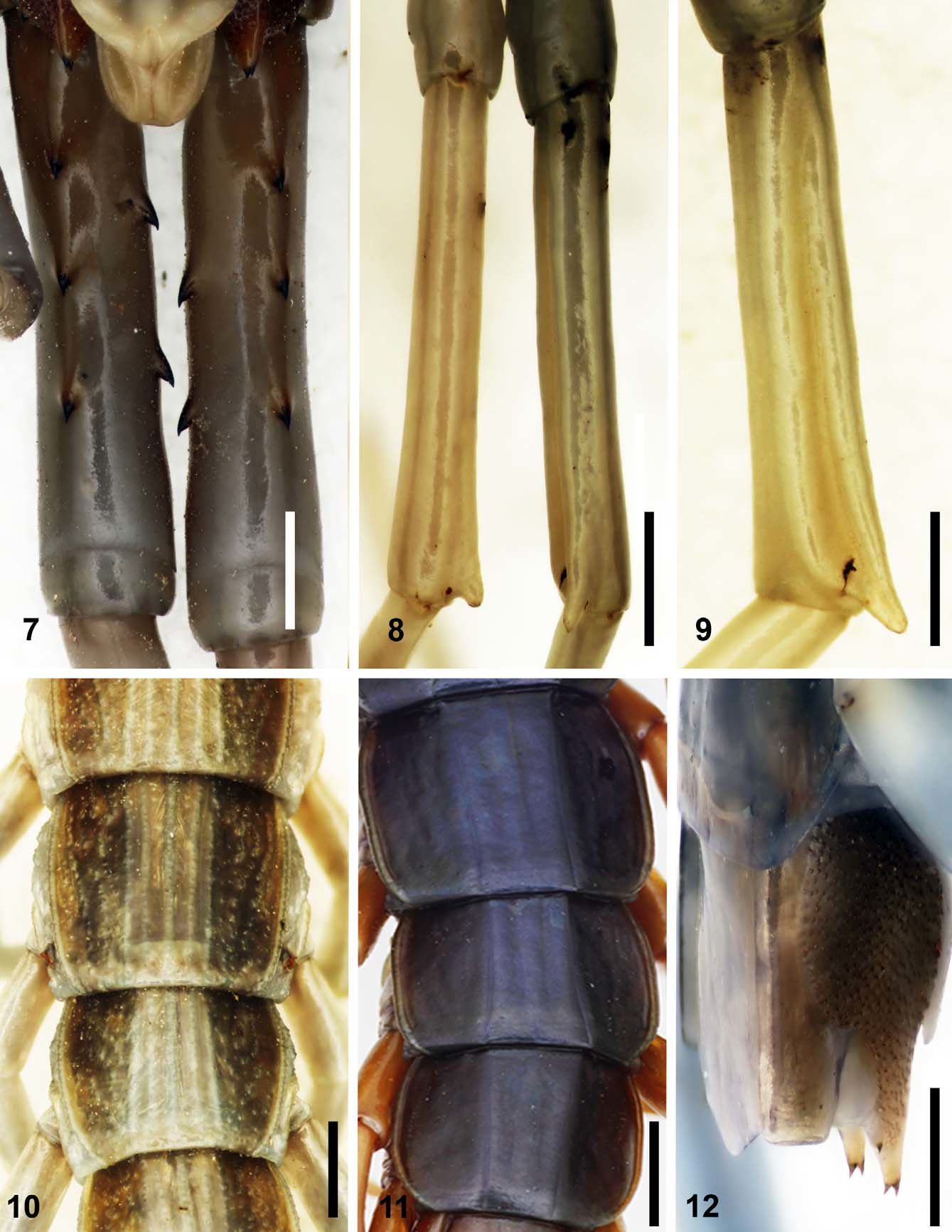
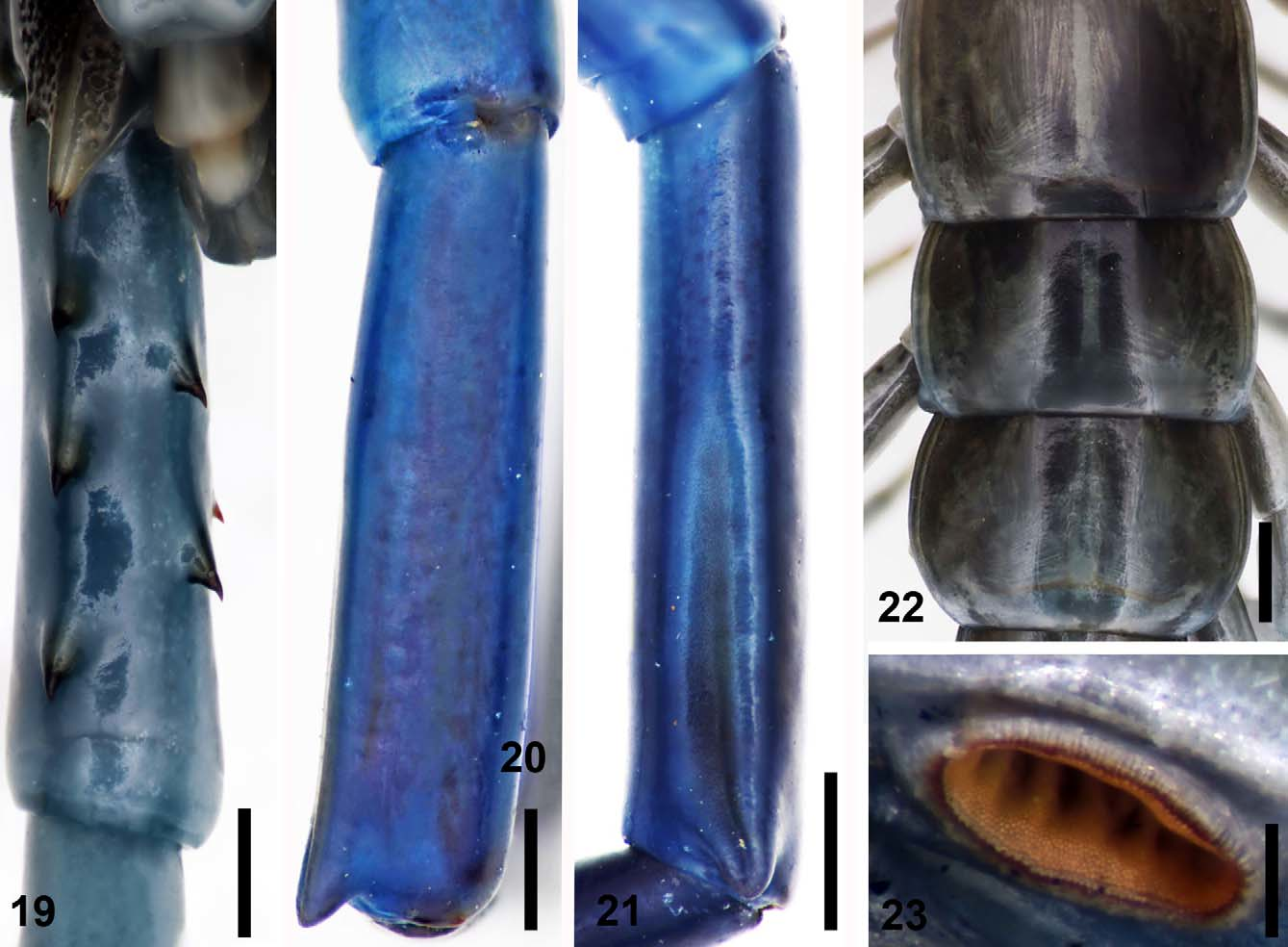
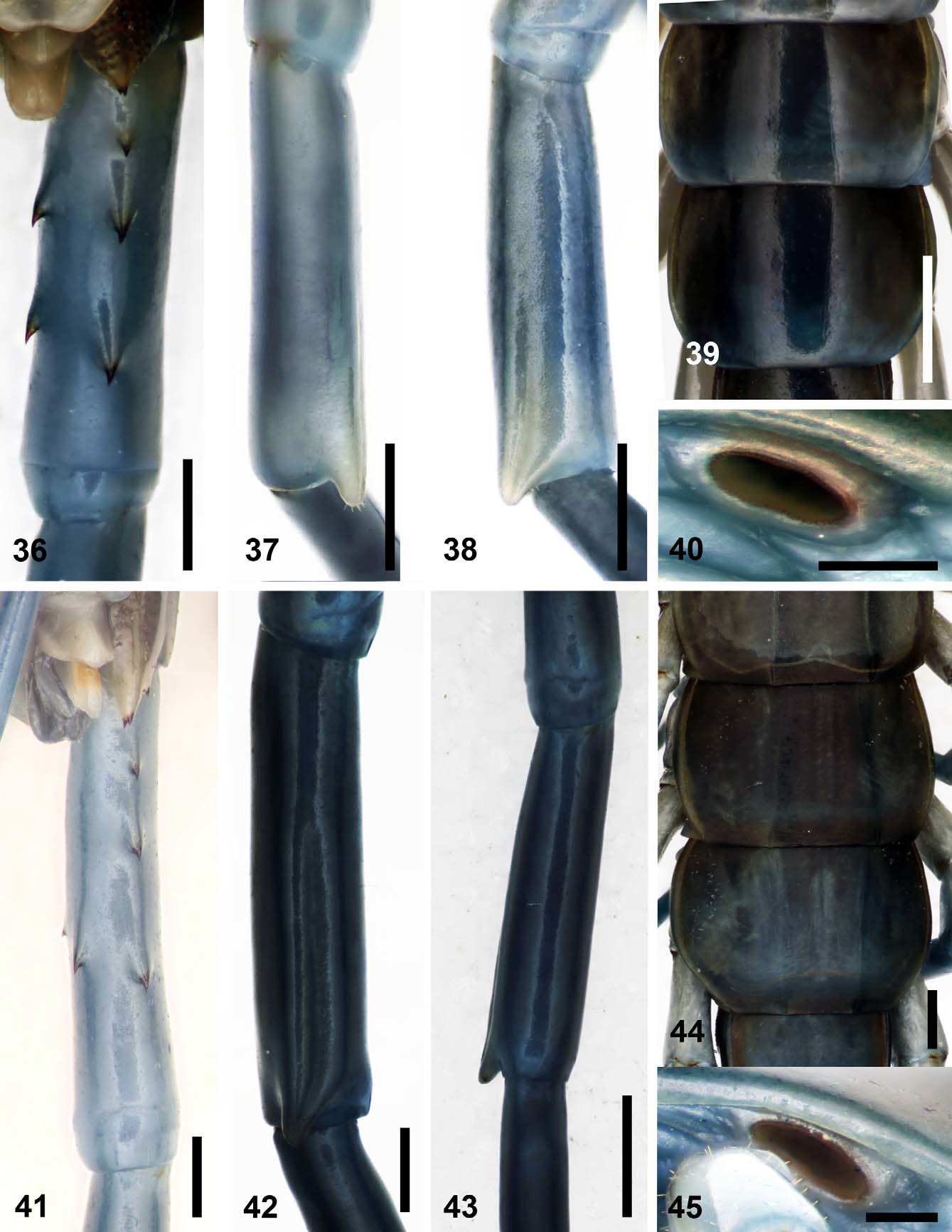
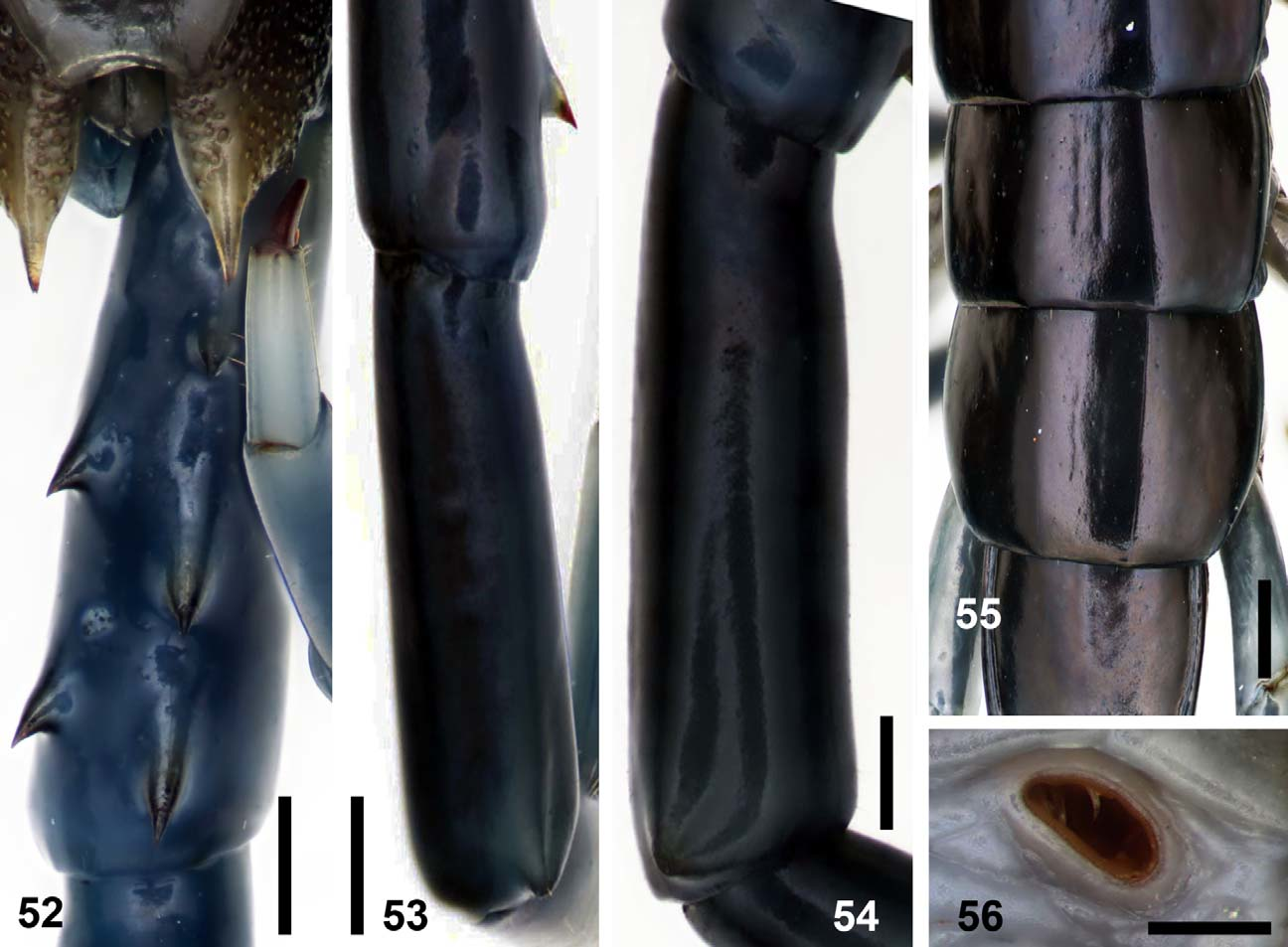
Discussion. Digitipes was erected as a monotypic genus to accommodate D. verdascens from the then Belgian Congo (Democratic Republic of Congo). Attems (1930 a) noted that it was easily distinguished from other genera of Otostigmini by the process on the femur of the ultimate legs of the male. Two additional species with types from the Democratic Republic of Congo were subsequently attributed to the genus: D. katangensis Kraus, 1957, and D. krausi Dobroruka, 1968. The former at least demonstrably has the distomedial process on the ultimate leg femur in the male (Kraus, 1957: figs. 8 – 10), whereas the latter is known only from the female. Digitipes katangensis was placed in synonymy with Otostigmus reichardti Kraepelin, 1903, by Lewis (2004), extending its geographic range to Tanzania and Angola. The current combination for this species is Digitipes reichardti (Kraepelin, 1903). The first attribution of non-African species to Digitipes was made by Jangi and Dass (1984), who assigned six new species from peninsular India to the genus. Their justification for this assignment was the shared presence of two characters in these species that separated Digitipes from Otostigmus in their key: the femur of the ultimate leg in the male bears a distomedial process and “ claw of 2 nd maxilla without spur ”. The latter refers to a lack of accessory spurs on the pretarsus, and was also listed by Attems (1930 a, b) as diagnostic of Digitipes. Another second maxillary character was also regarded as diagnostic of the genus by Attems (1930 a, b), the lack of a spine on article 2 of the telopodite (presence of a spine in this position being widespread throughout Scolopendridae). Lewis (2004) cautioned that Digitipes could prove to be a junior synonym of Otostigmus Porat, 1876, because its only reliable diagnostic character (the process on the ultimate leg femur) is confined to males. Lewis (2004) pointed out instances within Otostigmus in which an absence of a spine on article 2 of the telopodite had been recorded, e. g., in O. reservatus Schileyko, 1995, such that this character would not consistently separate Digitipes from Otostigmus. The absence of this spine has also been recorded in various South American species of O. (Parotostigmus) by Chagas-Jr. et al. (2007), who likewise questioned the separation of Digitipes from Otostigmus. An even more serious defect of this character as regards the assignment of Indian species to Digitipes, however, is that all of them in fact have a slender, pigmented spine on segment 2, such that its absence may be restricted to African species alone. Lewis (2004) was likewise critical of the utility of the pretarsal accessory spurs on the second maxilla as a diagnostic character of Digitipes because the size of these spurs is so variable between species of Otostigmus, ranging to rudimentary expression in some species. Within Digitipes an absence of accessory spurs also appears to be confined to African species (D. verdascens and D. reichardti) because we observe their presence in the three Indian species assigned to Digitipes by Jangi and Dass (1984) that we have examined as well as in the two new species described herein. Thus we agree with Lewis (2004) and Chagas et al. (2007) that the two peculiarities of the second maxilla cited by Attems (1930 a, b) as diagnostic for Digitipes are of no value for the generic concept if it is meant to encompass Indian species. However, we maintain that the shared presence of a distomedial process on the femur of the ultimate leg in males is a strong argument that most of the Indian species of Digitipes named by Jangi and Dass (1984) together with new species erected here are most closely related to tropical African Digitipes. Though a similar process is present on the tibia of males in the Brazilian Otostigmus (Parotostigmus) tibialis Brölemann, 1902, a potentially homologous process on the femur is not known in any other member of Otostigmini. This peculiarity is, in the absence of any other competing hypothesis of relationship (i. e., better support for separate sister groups of African and Indian Digitipes within Otostigmus), indicative of affinity. In Indian species, a longitudinal furrow on the distal half of the medial surface of the femur terminates on the process (Figs 9, 21, 38, 42, 54), and a corresponding furrow was depicted in the African D. reichardti (“ D. katangensis ”) by Kraus (1957: figs 8, 9). The association of the furrow and process strengthens the basis for homology. In Indian species, the flattened medial surface of the femur bears a dense field of fine pores that we infer to be the openings of epidermal glands. The alternative to recognising the Indian species as Digitipes would be to relegate them to Otostigmus, a genus that already includes some 120 species. We consider that this would create more rather than less taxonomic confusion because Otostigmus is demonstrably non-monophyletic (Vahtera et al. 2012): molecular data resolve it as polyphyletic, and none of its putatively diagnostic morphological characters is apomorphic. We are left with a situation in which Digitipes is morphologically diagnosed by a character that is confined to one sex, an uncommon practice in centipede taxonomy but of course one that is commonplace in spiders and millipedes, where the male palps and gonopods, respectively, are often necessary for taxonomic diagnoses. Specimens that possess the femoral process make up a small percentage of our total sample of Digitipes, they are consistently large, and we have not detected incipient stages of its development in small specimens. Accordingly we consider it likely that it is a structure that emerges with sexual maturity. Despite these limitations in applying this character to the diagnosis of the genus, access to molecular tools makes it possible to associate females to males from the same collection, and the monophyly of the Indian radiation of Digitipes is robustly supported by the sequence data (Joshi and Karanth 2011, 2012). As noted under discussion of Otostigmus gravelyi below, Indian Digitipes to the exclusion of that species (originally assigned to Digitipes but transferred herein to Otostigmus) share a suite of characters that is highly conserved and is shared by African congeners. Forcipular tooth plates with 4 + 4 teeth are shared by all specimens of Indian and African species apart from one specimen of D. coonoorensis with five teeth on one tooth plate. The arrangement of the teeth shows a consistent pattern of the inner pair being grouped, the second tooth being the largest and having an asymmetrical outline, its outer margin less steeply sloping than its inner margin, a seta being situated behind the outer edge of the second tooth, and the outer tooth being the smallest and distinctly posterior to the other three. Indian Digitipes have a highly conserved number of 17 antennal articles, fixed in all species apart from a single specimen of D. coonoorensis with 18 articles on one antenna and two specimens of D. jonesii that have 18 or 18 / 19 articles. African Digitipes have 16 – 17 antennal articles. Unlike most Otostigmus, the transition from glabrous to densely setose antennal articles in Digitipes apart from D. chhotanii corresponds precisely to the boundaries of articles (i. e., two or three glabrous articles rather than 2.25, 2.33, 2.5, etc.). All Indian Digitipes have two apical spines on the coxopleural process and lack dorsal spines. These character states are shared by all African Digitipes as well. The transfer of Otostigmus graveleyi allows these stable characters to be added to the diagnosis of Digitipes, though it is recognised that all of them are observed in various species of Otostigmus as well.
Joshi, Jahnavi, Edgecombe, Gregory D. (2013): Revision of the scolopendrid centipede Digitipes Attems, 1930, from India (Chilopoda: Scolopendromorpha): reconciling molecular and morphological estimates of species diversity. Zootaxa 3626 (1): 99-145, DOI: 10.11646/zootaxa.3626.1.5