AnimaliaNot EvaluatedacceptedspeciesAccepted
Missulena faulderi

Missulena faulderi

GBIF:119566001

ABOUT

Descriptions(5)

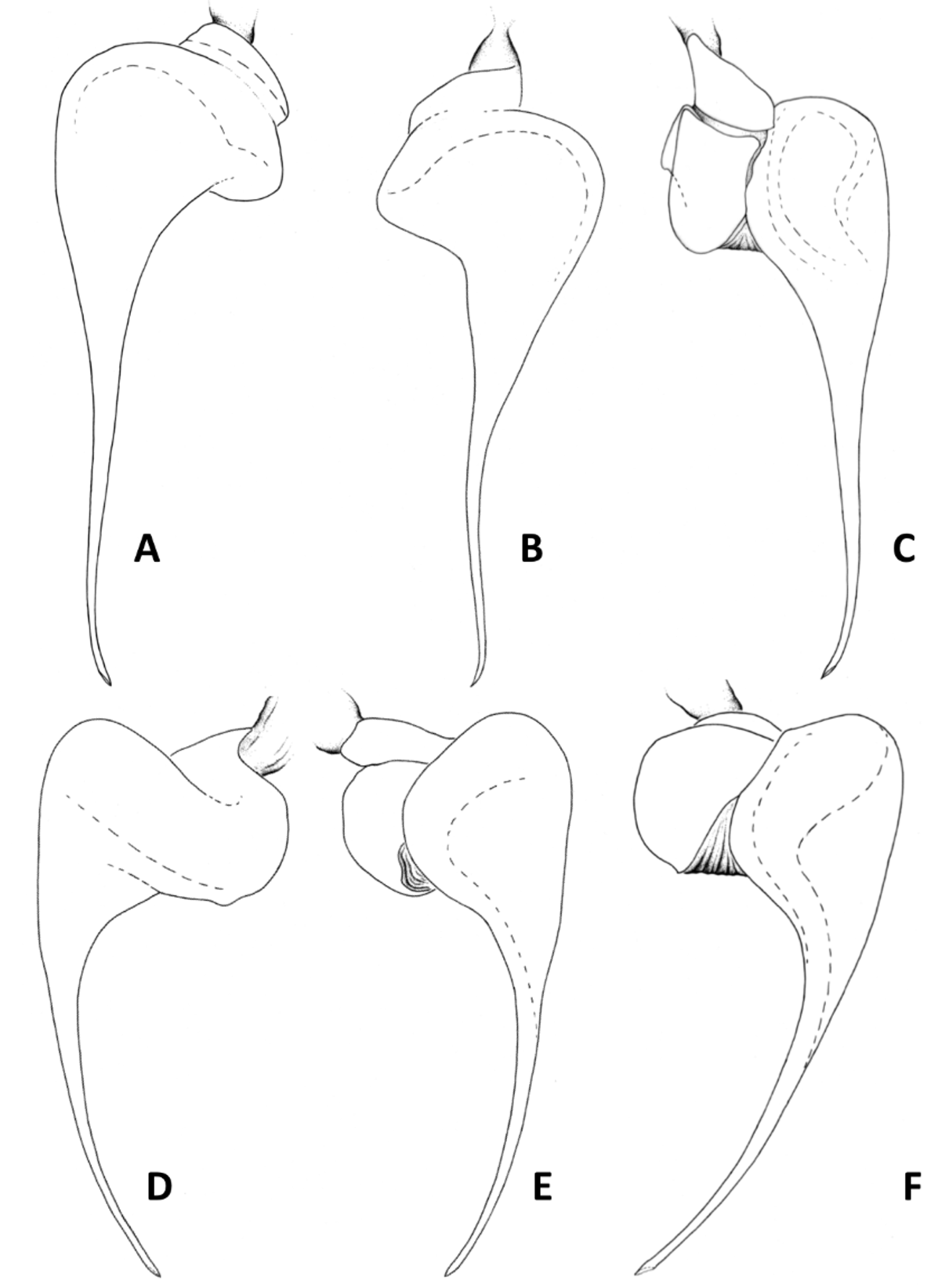
Description. Adult male, based on holotype WAM T 97017. Medium-sized spider (total length 7.5). Colour: carapace (Figs 4 A – C) dark reddish-brown but distally lighter, margins dark brown; eye region (Fig. 5 D) dark brown, anterior median eyes on black tubercle; chelicerae (Figs 4 B, 5 B, E) proximally dark brown but distally lighter, fangs (Figs 5 A, C) dark brown; abdomen (Figs 4 A, D) dark grey with yellow longitudinal streaks and two proximomedial pale patches of two to three individual spots each, mottled with some more spots posteriorly which form oblique lines; sternum (Fig. 6 A) yellowish-brown, margins contoured greyish-brown, sigilla orange-brown; labium (Figs 6 B, D) and maxillae dark reddish-brown; legs (Figs 4 A, E, F) yellowish greybrown, tarsi and metatarsi ventrally yellow; spinnerets (Fig. 6 C) pale yellow, spigots white. Carapace: 3.5 long, 3.9 wide; caput and eye region (Fig. 4 C) elevated in lateral view, strongly arched and differentiated from lower carapace; fovea (Fig. 4 G) very deep, strongly procurved (Fig. 4 B); lower carapace rugose with bands of fine, random fissures centered around fovea (Fig. 4 B). Eyes: OQ 3.4 times wider than long, occupies 0.76 of cephalic width; MOQ 1.42 long; width of anterior eye group 2.3, width of posterior group 1.8, OQ length 0.6; AME on tubercle, 0.6 wide, 0.4 long; AME inter-distance 0.1; AME to ALE 0.35; PLE to ALE 0.4; PME to ALE 0.25; PLE to PME 0.35; eye region (Fig. 5 D) with reduced setation but some setae anterior to AME. Chelicerae: 2.1 long, 1.3 wide; distally broad, diagonal, slightly conical; edges smoothly rounded; with very strong transverse ridges distally over entire length (Figs 5 B, E), without setae in area of transverse ridges but with 10 setae along inner margin of chelicera; rastellum (Figs 5 A, C) strongly developed, very pronounced, consisting of sclerotised process with four strong conical spines and 20 − 22 disordered setae (Figs 5 A, E), 10 long setae extend forward from anterior margin of each chelicera and cover base of fang, setae largest on latero-ventral side; inner margin of cheliceral furrow with three rows of teeth (Figs 5 F, G); prolateral (inner) row with 13 teeth, distal teeth entirely fused and forming blade, all teeth fused at base; intermediate row with four proximal, spaced teeth; retrolateral (outer) row with two proximal, spaced teeth; without basomedial teeth. Maxillae: 1.6 long; 1.1 wide, almost square (Fig. 6 E), 50 pointed cuspules along entire anterior margin, distally pointed and extended onto prominent heel. Labium: 0.7 long, 0.65 wide; conical, 18 pointed cuspules anteriorly (Fig. 6 D); labiosternal suture developed as shallow groove; pair of sigilla near labiosternal suture (Fig. 6 A), developed as irregular, poorly-defined patches. Sternum: 2.2 long, 1.8 wide; oval, rebordered (Fig. 6 A); with prominent setae, arranged irregular but denser lateral to labium; three pairs of sigilla, anterior pair smallest but well defined, posterior pair roughly oval but not well defined, all sigilla slightly depressed. Abdomen: 3.7 long, 3.0 wide; roughly oval, without bumps or processes (Fig. 4 D); four spinnerets (Fig. 6 C), PLS 0.9 long, 0.4 wide; PMS 0.42 long, 0.2 wide. Pedipalp: length of trochanter 0.7, femur 2.3, patella 1.2, tibia 1.8, tarsus 0.5; entire palp aspinose, tarsus terminally blunt (Figs 7 B, C); bulb pyriform and more stout than globular (Figs 7 A, B, F, H), two strongly sclerotised sections connected by median haematodocha (Fig. 12 C); bulb strongly twisted proventrally (Figs 7 A, G); embolus very long, tapering and slightly twisted medially (Figs 12 A, B, C); embolus tip simple, triangular, without processes (Figs 7 D, 12 A, B, C). Legs: with less than 150 brown setae over all segments, ventral setae of tibiae and metatarsi generally much longer and thicker than dorsal setae and bent towards exterior, dorsal and lateral setae of tibiae and metatarsi shorter than diameter of respective segment, ventral setae as long or longer than respective leg segment; preening comb absent (Figs 4 A, E, F); metatarsi I and II ascopulate, tarsi I ascopulate but with 80 fine ventral setae distally, apical sections with tiny ventral scopula; tarsi II slightly scopulate ventrally across entire length but fine setae of scopula not very dense; tarsi and metatarsi III and IV scopulate ventrally across entire length. Leg spination: pedipalp aspinose; leg I: tibia rv 0, v 12, pv 0, d 0; metatarsus rv 3, v 17, pv 0, d 0; tarsus rv 3, v 4, pv 2, d 0; leg II: tibia rv 0, v 12, pv 0, d 0; metatarsus rv 4, v 8, pv 0, d 0; tarsus rv 4, v 4, pv 3, d 0; leg III: tibia rv 0, v 16, pv 8, d 0; metasarsus rv 12, v 0, pv 7, d 11; tarsus rv 3, v 3 (apical), pv 3, d 3 (apical); leg IV: tibia rv 13, v 0, pv 0, d 0; metatarus rv 10, v 0, pv 2, d 0; tarsus rv 12, v 7 (apical), pv 5, d 2 (apical); patellae I, II without rasps and spines, patellae III with 31 rasps in eight oblique rows dorsally, median rows shorter than lateral rows and with less spines (Fig. 4 E); patella four with three to four thick, short spines (Fig. 4 F) retrolaterally. Leg measurements: leg formula IV> I> II> III. Leg I: coxa 1.4, trochanter 0.8, femur 2.8, patella 1.4, tibia 2.0, metatarsus 1.8, tarsus 1.1, total = 11.3; tibia width 0.7, leg I index = 3.2. Leg II: coxa 1.3, trochanter 0.9, femur 2.6, patella 1.4, tibia 2.1, metatarsus 1.6, tarsus 1.0, total = 10.9; tibia width 0.8, leg II index = 3.1. Leg III: coxa 1.4, trochanter 0.7, femur 2.3, patella 1.3, tibia 1.4, metatarsus 2.1, tarsus 1.3, total = 10.5; tibia width 0.7, leg III index = 3.0. Leg IV: coxa 1.4, trochanter 0.8, femur 3.4, patella 1.3, tibia 2.2, metatarsus 2.3, tarsus 1.3, total = 12.7; tibia width 0.7, leg IV index = 3.6. Trichobothria: arranged in discontinuous rows; tibiae I – IV with two rows of 3 − 4 in dorsolateral position, first row prodorsal and second row retrodorsal, metatarsi with 4 mediodorsal, tarsi I + II with 3, III + IV with 4 mediodorsal. Tarsal claws: leg I: 5 − 6 / 2; leg II: 3 − 4 / 1; leg III: 1 − 2 / 1; leg IV: 1 − 2 / 0 − 1, teeth on claws III − IV very small and broad; claws slightly shorter than spines of tarsi. Variation in paratypes (N = 2): total length 6.3 – 7.8; carapace 3.4 – 3.7 long, 3.9 – 4.0 wide; number of labial cuspules 9 – 13, maxillary cuspules 28 – 38; labial groove may be inconspicuous; rastellum with 3 – 5 thick, conical spines.
Harms, Danilo, Framenau, Volker W. (2013): New species of Mouse Spiders (Araneae: Mygalomorphae: Actinopodidae: Missulena) from the Pilbara region, Western Australia. Zootaxa 3637 (5): 521-540, DOI: 10.11646/zootaxa.3637.5.2

Diagnosis. Males of M. faulderi sp. nov. differ from all other Missulena from Australia by the very long and slightly curved embolus of the male bulb. They differ from other Missulena, except the most similar species M. rutraspina, by the presence of a pronounced rastellum, which is developed as a distinct process with three to five large conical spines rather than a series of narrow spines on a process or low mound. Missulena faulderi sp. nov. males (carapace length <3.5) differ from the males of M. rutraspina (carapace length> 3.8) by the smaller size, the presence of an interior row of seven to eight fused teeth in the cheliceral furrow (teeth divided in M. rutraspina), the shape of the male bulb which has no depressions, and a medially curved embolus (bulb with spiral depression and embolus almost straight in M. rutraspina, see Faulder 1995). Missulena faulderi sp. nov. males do not have any red markings on the carapace and chelicerae (as do males of M. occatoria and M. langlandsi sp. nov.), do not have rasps on patellae I, II (similar to M. dipsaca, M. rutraspina & M. tussulina) and IV, and have lateral ridges on the chelicerae. Females of M. faulderi sp. nov. are unknown.
Harms, Danilo, Framenau, Volker W. (2013): New species of Mouse Spiders (Araneae: Mygalomorphae: Actinopodidae: Missulena) from the Pilbara region, Western Australia. Zootaxa 3637 (5): 521-540, DOI: 10.11646/zootaxa.3637.5.2
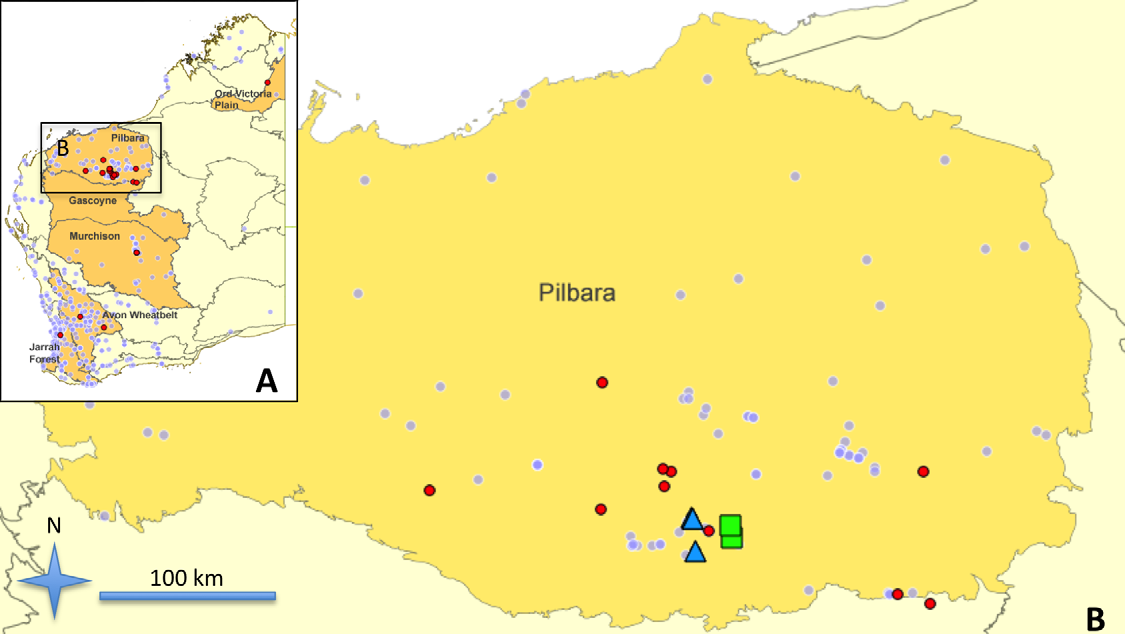
Distribution. Currently known only from the Jinayri exploration lease (BHP Billiton Iron Ore) in the Pilbara region northeast of Newman (Fig. 2 B). Phenology and habitat preferences. All males were collected in pitfall traps in February, the month of highest annual rainfall in the Pilbara region. The holotype was collected adjacent to a then dry creek bed near Weeli Wolli Creek.
Harms, Danilo, Framenau, Volker W. (2013): New species of Mouse Spiders (Araneae: Mygalomorphae: Actinopodidae: Missulena) from the Pilbara region, Western Australia. Zootaxa 3637 (5): 521-540, DOI: 10.11646/zootaxa.3637.5.2
Etymology. The specific epithet is a patronym in honour of Richard Faulder for his work on Missulena (Faulder 1995).
Harms, Danilo, Framenau, Volker W. (2013): New species of Mouse Spiders (Araneae: Mygalomorphae: Actinopodidae: Missulena) from the Pilbara region, Western Australia. Zootaxa 3637 (5): 521-540, DOI: 10.11646/zootaxa.3637.5.2
Type material. AUSTRALIA: Western Australia: holotype male, Jinayri, ca. 60 km NW of Newman, 22 ° 58 ’ 04 ” S, 119 ° 16 ’ 02 ” E, 1 February 2009, pitfall trap, J. Gollan, N. Sullivan, M. Semeniuk & M. Beatson (WAM T 97017 DNA). Paratypes: 1 male, same data as holotype, except 23 ° 02 ’ 27 ” S, 119 ° 16 ’ 47 ” E, 2 February 2009 (WAM T 96133); 1 male, as for holotype, except 23 ° 02 ’ 30 ” S, 119 º 16 ’ 40 ” E, 5 February 2009 (WAM T 96132).
Harms, Danilo, Framenau, Volker W. (2013): New species of Mouse Spiders (Araneae: Mygalomorphae: Actinopodidae: Missulena) from the Pilbara region, Western Australia. Zootaxa 3637 (5): 521-540, DOI: 10.11646/zootaxa.3637.5.2

Export occurrence data

Darwin Core Archive (ZIP)

CLASSIFICATION

Taxonomic Classification Tree

MULTIMEDIA

Media Files(6)

FIGURES 2 A – B. Distribution records of Missulena spp. in Western Australia: A, records of Missulena compiled from the WA Museum database (grey circles) and locality data for specimens included in molecular analyses (red circles). The biogeographic (IBRA) regions (Thackway & Cresswell 1995) are displayed in yellow. Bioregions from which specimens were sequenced are shaded darker. B, close-up of the Pilbara bioregion in Western Australia, highlighting the distribution of Missulena faulderi sp. nov. (green squares) and M. langlandsi sp. nov. (blue triangles).

Imageimage/png© Harms, Danilo;Framenau, Volker W.Harms, Danilo;Framenau, Volker W.

FIGURES 4 A − G. Missulena faulderi sp. nov., holotype male (WAM T 97017): A, habitus, dorsal view; B, carapace, dorsal view; C, same, lateral view; D, abdomen, dorsal view; E, patella III, dorsal view; F, patella II, dorsal view; G, fovea, dorsal view.

Imageimage/png© Harms, Danilo;Framenau, Volker W.Harms, Danilo;Framenau, Volker W.

FIGURES 5 A − G. Missulena faulderi sp. nov., holotype male (WAM T 97017): A, tip of chelicerae, white rectangle indicates rastellum; B, chelicerae and eye group, frontodorsal view; C, rastellum, ventral view; D, eye group, dorsal view; E chelicerae, frontal view; F, detail of right cheliceral groove, inner row of teeth; G, same, depicting inner, medial and outer row of teeth.

Imageimage/png© Harms, Danilo;Framenau, Volker W.Harms, Danilo;Framenau, Volker W.

FIGURES 6 A − E. Missulena faulderi sp. nov., holotype male (WAM T 97017): A, sternum, ventral view; B, labium and chelicerae, ventral view; C, spinnerets, ventral view (paratype WAM T 91911); D, labium, ventral view; E, right maxilla, ventral view.

Imageimage/png© Harms, Danilo;Framenau, Volker W.Harms, Danilo;Framenau, Volker W.

FIGURES 7 A − H. Missulena faulderi sp. nov., holotype male (WAM T 97017): A, bulb and tarsus, dorsal view; B, left pedipalp, retroventral view; C, left pedipalp, proventral view; D, tip of embolus, dorsal view; E, bulb and embolus, dorsolateral view; F, same, dorsal view; G, tibia and bulb, retroventral view; H, same, proventral view.

Imageimage/png© Harms, Danilo;Framenau, Volker W.Harms, Danilo;Framenau, Volker W.

FIGURES 12 A − F. Male bulb and embolus of Missulena faulderi sp. nov., holotype male (WAM T 97017) and Missulena langlandsi sp. nov., holotype male (WAM T 115948). Missulena faulderi sp. nov.: A, prolateral view; B, same, ventral view (slightly twisted retrolaterally); C, same, dorsal view. Missulena langlandsi sp. nov.: D, ventral view; E, same, dorsal view (slightly twisted retrolaterally); F, same, prolateral view.

Imageimage/png© Harms, Danilo;Framenau, Volker W.Harms, Danilo;Framenau, Volker W.

IMAGES

Gallery(6)

See Gallery

Occurrences with images

Source Information

New species of Mouse Spiders (Araneae: Mygalomorphae: Actinopodidae: Missulena) from the Pilbara region, Western Australia

checklist

This dataset contains the digitized treatments in Plazi based on the original journal article Harms, Danilo, Framenau, Volker W. (2013): New species of Mouse Spiders (Araneae: Mygalomorphae: Actinopodidae: Missulena) from the Pilbara region, Western Australia. Zootaxa 3637 (5): 521-540, DOI: 10.11646/zootaxa.3637.5.2

Abstract

Two new species of Mouse Spiders, genus Missulena, from the Pilbara region in Western Australia are described based on morphological features of males. Missulena faulderi sp. nov. and Missulena langlandsi sp. nov. are currently known from a small area in the southern Pilbara only. Mitochondrial cytochrome c oxidase subunit I (COI) sequence divergence failed in clearly delimiting species in Missulena, but provided a useful, independent line of evidence for taxonomic work in addition to morphology.

Key words: taxonomy, systematics, barcoding, mitochondrial DNA, short-range endemism, Actinopus, Plesiolena

Harms D, Framenau V W, plazi (2013). New species of Mouse Spiders (Araneae: Mygalomorphae: Actinopodidae: Missulena) from the Pilbara region, Western Australia. Plazi.org taxonomic treatments database. Checklist dataset https://doi.org/10.11646/zootaxa.3637.5.2 accessed via GBIF.org on 2026-06-14.

CC0Published 12/31/2013View dataset
GBIF Usage Key
119566001
Dataset Key
c26cead5-4d20-4621-a952-b5bb8306d88a
Origin
source
Backbone Key
8315270
Taxon ID
D70A3C3CFFBA5A62FF6DFD88DC4644A4.taxon
Last Crawled
6/11/2026
Last Interpreted
6/11/2026