AnimaliaNot EvaluatedacceptedspeciesAccepted
Heterophrynus boterorum

Heterophrynus boterorum

GBIF:119567691

ABOUT

Descriptions(4)

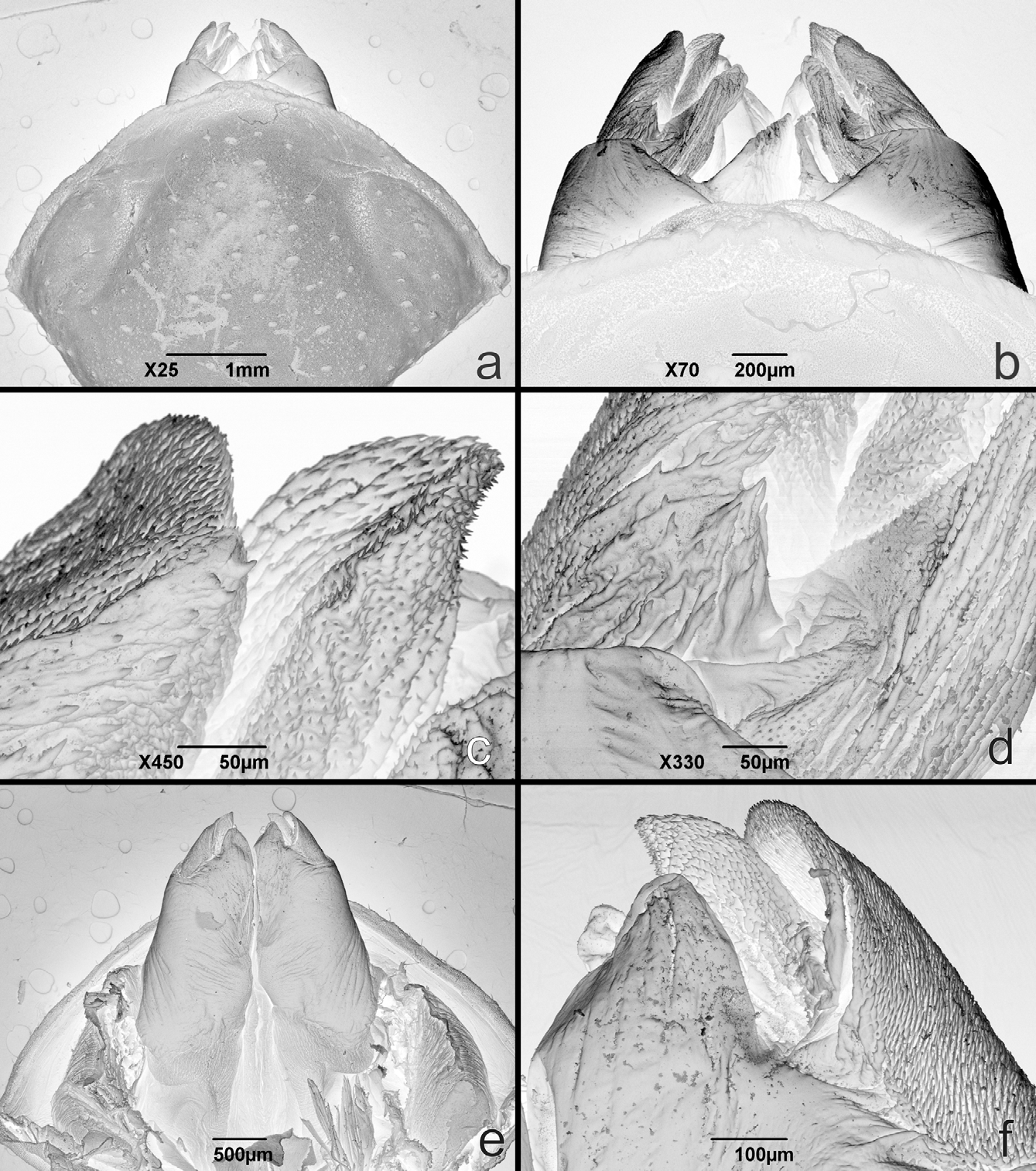
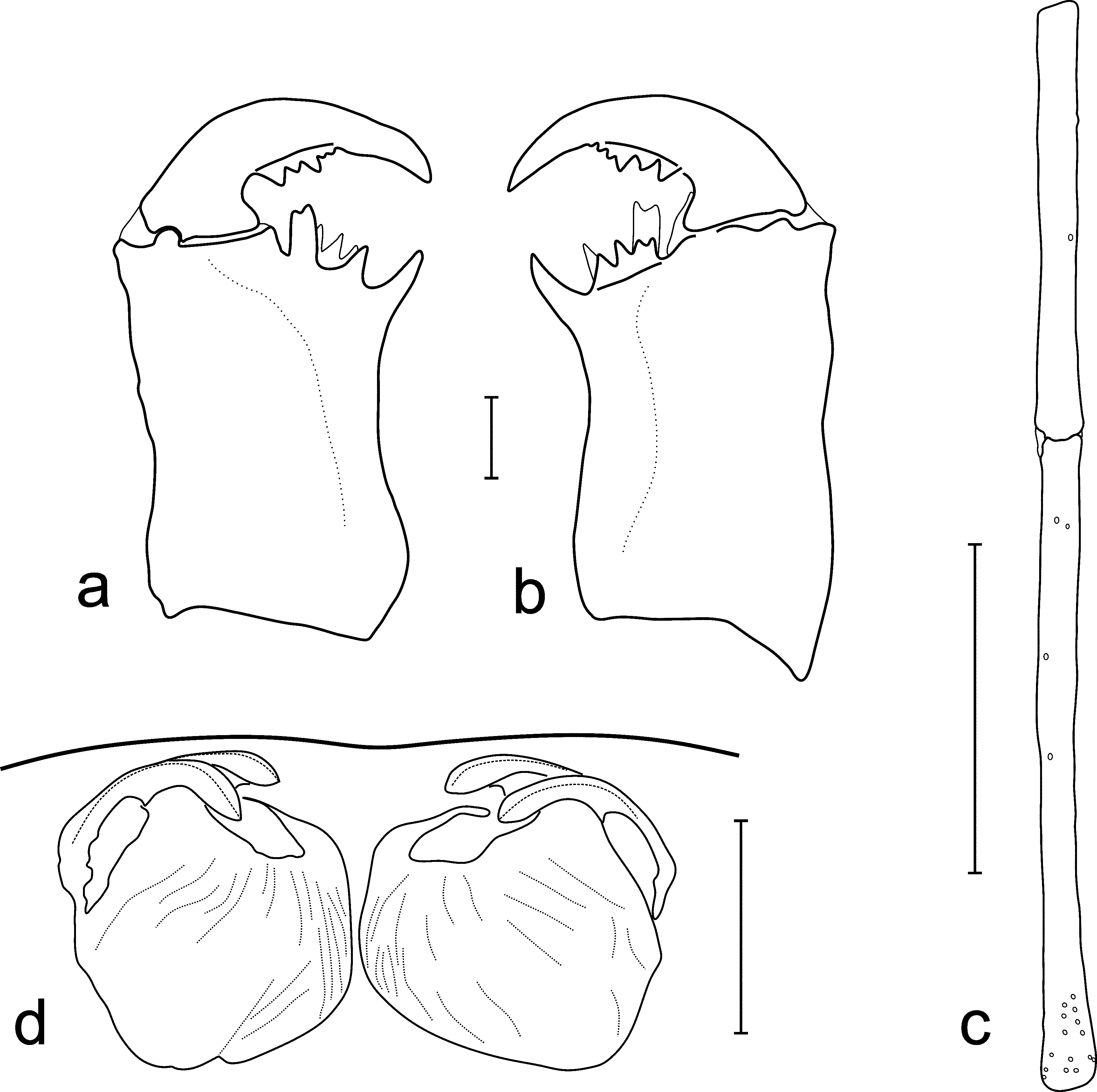
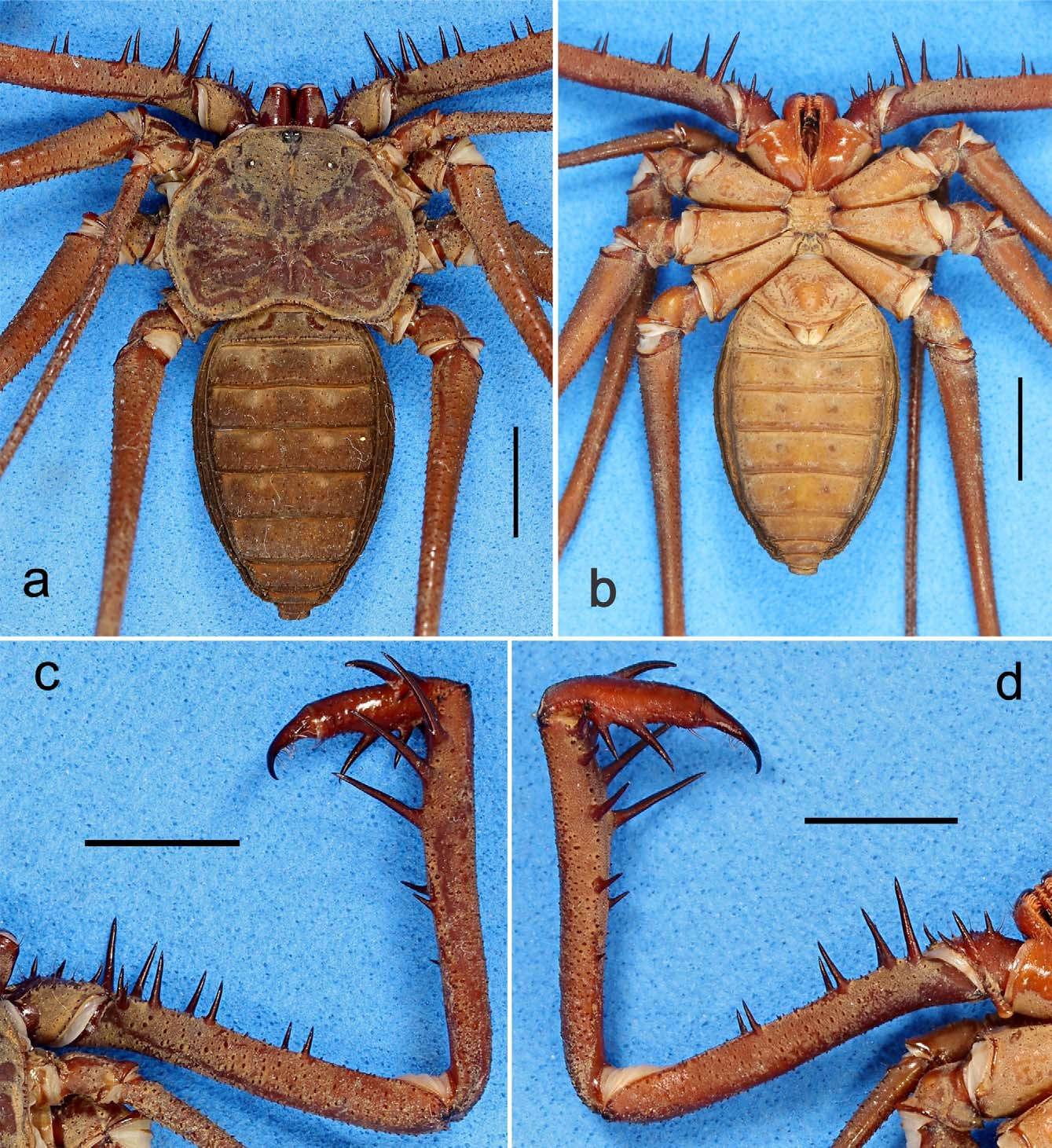
Description of female (holotype): Carapace (Fig. 4 a): flattened, wider than long; prominent eyes, median eye tubercle dark-brown, without apical setae, lateral eye tubercle smaller, with around half its size. Margin of carapace entirely with sinuous lines and coarse granules, anterior margin in a very smooth, practically straight curve. Overall densely covered by small granules mostly anteriorly, bundles of bigger and more sparse granules departing from the fovea towards the border. Frontal process well-developed, with greatly widened base and abruptly getting thin in distal half, ending in a very acute hook, not exceeding front line of carapace, this way not visible in dorsal view. Sternum (Fig. 4 b): Tri-segmented, typical of Phrynidae. Tritosternum extremely long projecting between pedipalp coxae, reaching almost half of their length. Covered with bristles on its entire length, from apex to base, with an increase in the density at base. Mesosternum convex, reduced to a small tubercle, ranging from slightly oblong to sharply oblong, with six to eight bristles. Metasternum is a small convex mound with two bristles Abdomen (Figs. 4 a – b): oblong, with almost indistinguishable punctuations, thinner than in the carapace. Chelicera: Cheliceral furrow (Figs. 6 a – b) with 3 internal teeth, the distal one bifid, the first cusp bigger than the second one II IIIb. The third tooth (middle) much smaller than the others. With 3 external teeth, the distal one bifid, the first cusp bigger than the second one II> I = IIIa> IIIb. Claw with five denticles, with the two distalmost much reduced, the second smaller than first and third. Pedipalp: Trochanter (Figs. 4 c – d): with well-developed retro-ventral apophysis, armed with four spines, the one adjoining the retro-ventral apophysis is the largest, but not more than twice the size of others, which are subequal. The biggest spine is of comparable size to the fourth ventral spine of pedipalpal femur. Femur (Figs. 4 c – d): three dorsal spines in the main series (1> 2> 3), the first one three times bigger than the last one; prominent geminate spines before the first spine, the dorsalmost subequal to spine 2 and the other subequal to spine 3; four ventral spines (1> 2> 3> 4) of approximately the same length of the dorsal ones; one spine placed proximally to the first one, which is located more interiorly than the main series of spines, with a similar length of the third one, but less robust; last spine ½ the length of the first one. Tibia (Figs. 4 c – d): six spines, main series with four spines (I = II = III> IV); two accessory spine anterior to spine I, with its length similar to spine IV; five ventral spines (III> IV> II> I> V), Basitarsus (Figs. 4 c – d): two dorsal spines and two ventral spines dorsal distal> dorsal basal = ventral distal> ventral basal. The distal dorsal spine subequal to the claw. Claw (Figs. 4 c – d): long, with an acute, curved tip. The males do not exhibit considerable secondary sexual dimorphic features, and the pedipalps of males and females are of comparable size. Legs: All densely setose. Ventral corner of the prolateral face of femora II – IV projecting in a distinct spiniform process. Femur length I> III> IV> II. Tibia I with 35 pseudoarticles and tarsus (basitarsus + distitarsus) I with 79 - 80 pseudoarticles in both legs. Leg IV: (Fig. 6 c): Basitibia: 4 pseudoarticles, one trichobothrium at the first and one at the last pseudoarticle. Distitibia: 16 trichobothria. Basitibia-distitibia length BT 1> DT> BT 3 = BT 4> BT 2. Distitarsus: with 3 pseudoarticles. Measurements. Females (n = 1): Total body length: 23.0, Cephalothorax: Length: 8.0 mm, Width: 10,5 mm. Abdomen: 13.0 mm. Pedipalp: Femur 9.0 mm, Tibia 10.0 mm, Tarsus 5.0 mm, Tarsal claw 3.5 mm. Males (n = 1): Total body length: 24.2, Cephalothorax: Length: 10.0 mm, Width: 11,0 mm. Abdomen: 17.0 mm. Pedipalp: Femur 11.0 mm, Tibia 14.5 mm, Tarsus 5.1 mm, Tarsal claw 4.0 mm. Color pattern (in alcohol): Chelicerae, pedipalps, legs and carapace reddish-brown. Coxae and ventral surface of abdomen lighter colored. Genitalia: Male (Figs. 5 a – f). PI longer than LaM. LoL 1 and LoL 2 subequal in length, both densely covered with minute denticles (but larger than in H. silviae). In dorsal view the LoD is subequal in size to LoL 1. Female. (Fig. 6 d) Gonopod claws bifid. Inner branch probably arising from basal third of claw complex. Natural history. The specimens described were collected on rocks and ravines in a fragment of Andean montane secondary forest in a very disturbed area surrounded by coffee plantations and rural residential areas.
Giupponi, Alessandro P. L., Kury, Adriano B. (2013): Two new species of Heterophrynus Pocock, 1894 from Colombia with distribution notes and a new synonymy (Arachnida: Amblypygi: Phrynidae). Zootaxa 3647 (2): 329-342, DOI: 10.11646/zootaxa.3647.2.5

Diagnosis. Tibia I with 35 pseudoarticles and tarsus I with 79 - 80 pseudoarticles. Male gonopod: tegument of lobus lateralis secundus with densely clustered small acuminate denticles and length almost equal to lobus lateralis primus (Figs. 5 b – c). Female gonopod: sclerotized claw bifid. Distalmost (third) inner tooth of basal article of chelicera bifid. Small body size for the genus (Total body length: 23.0 mm).
Giupponi, Alessandro P. L., Kury, Adriano B. (2013): Two new species of Heterophrynus Pocock, 1894 from Colombia with distribution notes and a new synonymy (Arachnida: Amblypygi: Phrynidae). Zootaxa 3647 (2): 329-342, DOI: 10.11646/zootaxa.3647.2.5
Etymology. Species name is a tribute to our Colombian friends and colleagues Ricardo Botero Trujillo and Juan Pablo Botero, who aided in many ways in the discovery of this species.
Giupponi, Alessandro P. L., Kury, Adriano B. (2013): Two new species of Heterophrynus Pocock, 1894 from Colombia with distribution notes and a new synonymy (Arachnida: Amblypygi: Phrynidae). Zootaxa 3647 (2): 329-342, DOI: 10.11646/zootaxa.3647.2.5
Type material. 1 3 holotype and 1 3 paratype: COLOMBIA: Tolima, Ibague, viii- 2006, Col., A. Giupponi, R. Botero e J. P. Botero (ICN). Other paratypes same data 1 3 and 1 Ƥ MNRJ 0 9124.
Giupponi, Alessandro P. L., Kury, Adriano B. (2013): Two new species of Heterophrynus Pocock, 1894 from Colombia with distribution notes and a new synonymy (Arachnida: Amblypygi: Phrynidae). Zootaxa 3647 (2): 329-342, DOI: 10.11646/zootaxa.3647.2.5

Export occurrence data

Darwin Core Archive (ZIP)

CLASSIFICATION

Taxonomic Classification Tree

MULTIMEDIA

Media Files(3)

FIGURE 4. Heterophrynus boterorum sp. nov., male (MNRJ 09124) paratype: a. Habitus, dorsal view; b. Same, ventral view; c. Right pedipalp, dorsal view; d. Right pedipalp, ventral view. Scale bars = 5 mm.

Imageimage/png© Giupponi, Alessandro P. L.;Kury, Adriano B.Giupponi, Alessandro P. L.;Kury, Adriano B.

FIGURE 5. Heterophrynus boterorum sp. nov., male (MNRJ 09124) paratype, genitalia and surroundings: a. Male gonopod, general ventral view; b. Same, detail of left and right lobes; c. Same, detail of left distal part of lateral lobe (LoL 2), spinytongue-like with only one layer covered with denticles; d. Same, detail of basal part of Lol 2; e. Male gonopod, general dorsal view; f. Same, detail of right dorsal and lateral lobes.

Imageimage/png© Giupponi, Alessandro P. L.;Kury, Adriano B.Giupponi, Alessandro P. L.;Kury, Adriano B.

FIGURE 6. Heterophrynus boterorum sp. nov., male (MNRJ 09124) paratype: a. Right chelicera, inner lateral view; b. Same, outer lateral view; c. Leg IV, basitibia and distitibia showing trichobothria, dorsal view; d. Female gonopod, general dorsal view. Scale bars = 1 mm (Figs. a – b); 5 mm (Fig. c); 0.5 mm (Fig. d).

Imageimage/png© Giupponi, Alessandro P. L.;Kury, Adriano B.Giupponi, Alessandro P. L.;Kury, Adriano B.

IMAGES

Gallery(3)

See Gallery

Occurrences with images

Source Information

Two new species of Heterophrynus Pocock, 1894 from Colombia with distribution notes and a new synonymy (Arachnida: Amblypygi: Phrynidae)

checklist

This dataset contains the digitized treatments in Plazi based on the original journal article Giupponi, Alessandro P. L., Kury, Adriano B. (2013): Two new species of Heterophrynus Pocock, 1894 from Colombia with distribution notes and a new synonymy (Arachnida: Amblypygi: Phrynidae). Zootaxa 3647 (2): 329-342, DOI: 10.11646/zootaxa.3647.2.5

Abstract

The genus Heterophrynus is for the first time recorded from Transandean areas. Heterophrynus boterorum sp. nov. and Heterophrynus silviae sp. nov. are described respectively from Tolima and Valle del Cauca departments, Colombia, based on material from the 2006 Arachnological Expedition of Museu Nacional to Colombia. Heterophrynus nicefori Amado & Morales, 1986, from Meta department is newly considered a junior subjective synonym of Phrynus batesii Butler, 1873 (currently in Heterophrynus). Heterophrynus is currently known from Amazon forest, Brazilian Cerrado, Littoral Ridge of Venezuela and Andean forests. A revised terminology is proposed for the constituent parts of male and female gonopods of Heterophrynus.

Resumo

Este é o primeiro registro transandino do gênero Heterophrynus. Heterophrynus boterorum sp. nov. e Heterophrynus silviae sp. nov. são descritos respectivamente dos departamentos de Tolima e Valle del Cauca, baseado em material da Expedição Aracnológica do Museu Nacional à Colômbia. Heterophrynus nicefori, do departamento de Meta é considerado sinônimo júnior subjetivo de Phrynus batesii Butler, 1873 (atualmente em Heterophrynus). Heterophrynus é conhecido atualmente de floresta amazônica, cerrado brasileiro, Cordilheira Costeira da Venezuela e florestas andinas. Uma nova terminologia é proposta para as partes constituintes dos gonópodos masculino e feminino de Heterophrynus.

Giupponi A P L, Kury A B, plazi (2013). Two new species of Heterophrynus Pocock, 1894 from Colombia with distribution notes and a new synonymy (Arachnida: Amblypygi: Phrynidae). Plazi.org taxonomic treatments database. Checklist dataset https://doi.org/10.11646/zootaxa.3647.2.5 accessed via GBIF.org on 2026-06-14.

CC0Published 12/31/2013View dataset
GBIF Usage Key
119567691
Dataset Key
04304da3-4175-4127-a605-ec7e6637c927
Origin
source
Backbone Key
8585509
Taxon ID
D84C307CFFE9FF86FF2516B9F6237271.taxon
Last Crawled
6/11/2026
Last Interpreted
6/11/2026