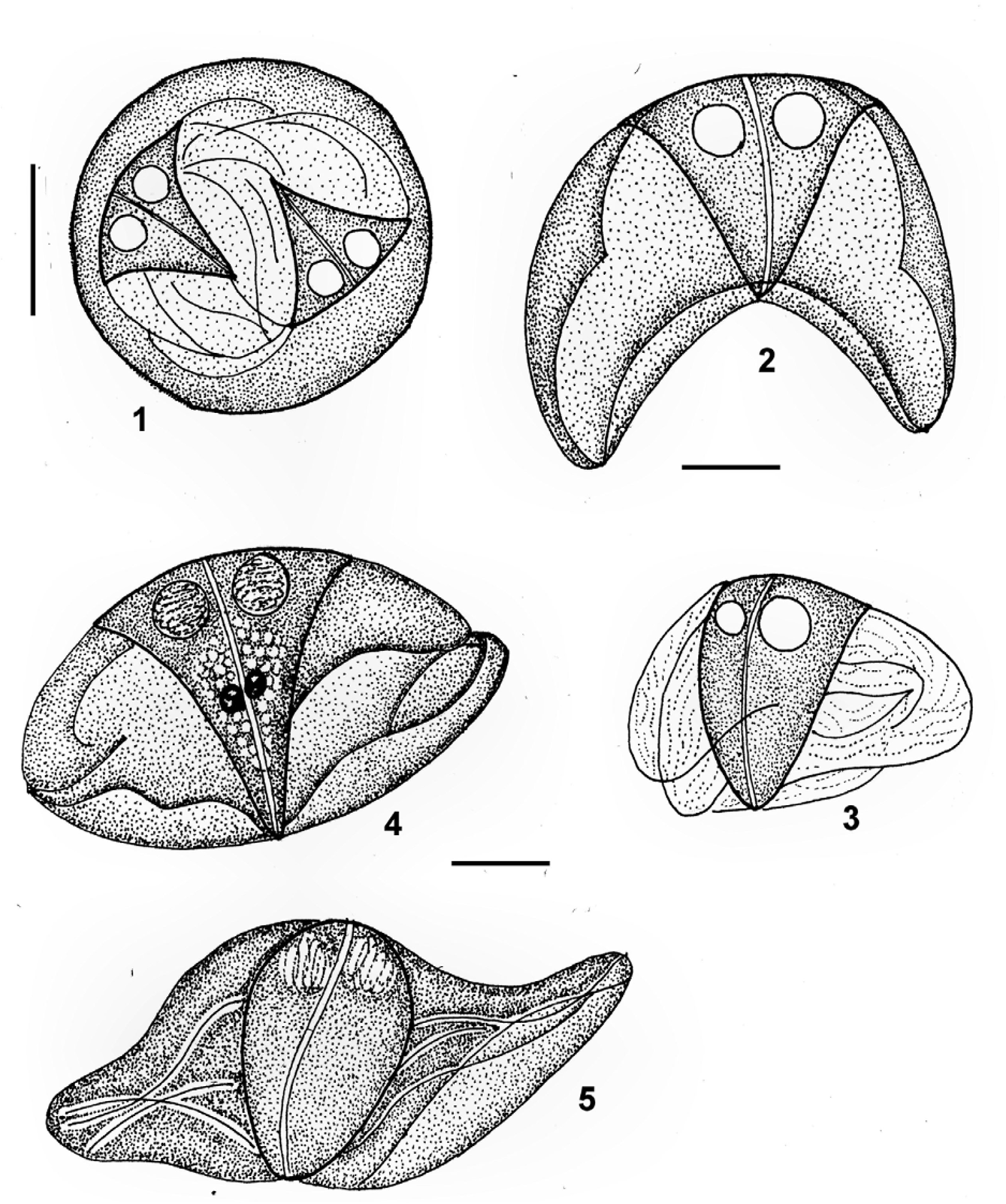
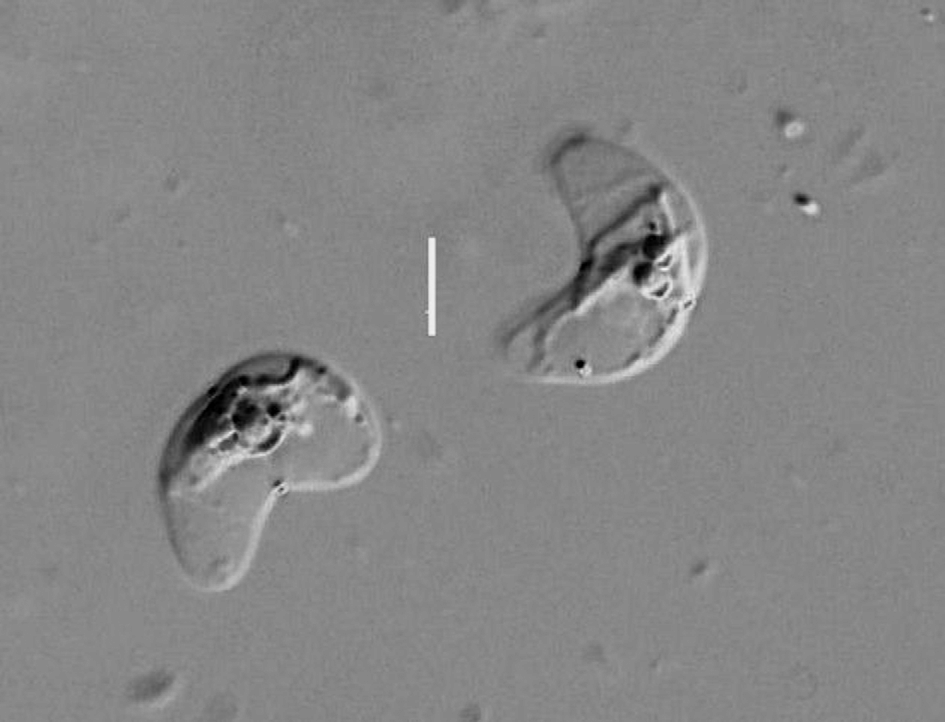
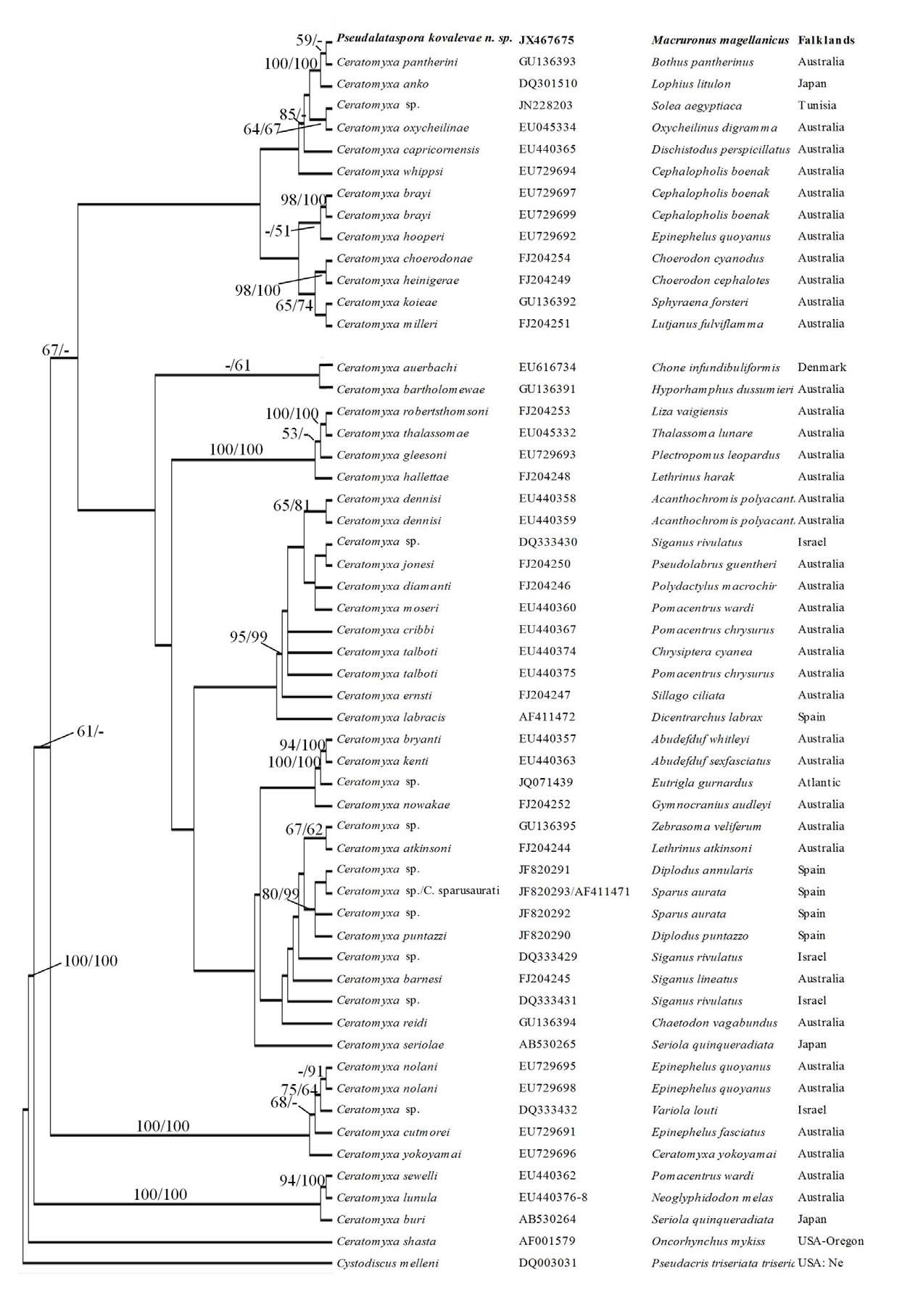
Discussion. Twelve species of the genus Pseudalataspora have been described from the gall bladders of marine fishes but none has been sequenced to date. In addition, we were made aware of an unpublished manuscript discovered in the late Professor Kovaleva’s laboratory in Kaliningrad, which includes the morphological description of Pseudalataspora pacifica Kovaleva and Grudnev, a new species found in the gall bladder of M. magellanicus caught off the coast of Chile in 1983. The authors described the new species as being similar to P. umbraculiformis, originally described by Gaevskaya and Kovaleva (1984) from the gadid fish Gaidropsarus mediterraneus (L., 1758) in the Northeast Atlantic. However, they considered the two species to differ sufficiently in certain features to be considered different species. The main differences they identified were in the shape and size of the spores, the diameter of the polar capsules, and the number of coils in the polar filament. Because the description of P. pacifica remains unpublished, it cannot be considered to be a valid species, but in recognition of Professor Kovaleva’s discovery we decided to name our new species after her. Table 1 compares P. kovalevae with both P. umbraculiformis and P. pacifica. Pseudalataspora kovalevae is from the same host and locality as P. pacifica and these two species are clearly more similar in morphology than either is to P. umbraculiformis. Gunter et al. (2009) suggested that the Ceratomyxa clade currently contains a number of as yet undifferentiated genera and that additional sampling and further morphological and genetic data are needed to resolve the divisions within the group. As previously mentioned, there are currently no sequence data deposited in GenBank for any species of Pseudalataspora, and the new P. kovalevae 18 S rRNA gene sequence grouped most closely with some Ceratomyxa species. Morphologically the spores of these two genera are very similar, with the presence or absence of delicate alate processes being the main distinguishing feature between them. The morphological and molecular similarities between these genera therefore suggest that they are closely related, but they are currently classified in different families. The alate processes are fragile and not always easily observed, which raises the possibility that some species currently assigned to the genus Ceratomyxa may turn out on closer inspection to belong in Pseudalataspora. Feature P. umbraculiformis P. “ pacifica ” (*) P. kovalevae Plasmodium shape Club-shaped or spherical, Spherical, disporous Spherical, disporous disporous Plasmodium dimensions 18.0 – 21.0 29.28 – 32.28 28.4 – 38.4 x 28.0 – 36.0 Spore shape Wedge-shaped, expanded Rounded tops, sharply Triangular with pointed anteriorly, narrowed curved anteriorly extremities in side view; curved posteriorly and flat anteriorly in apical view Spore length 8.0 – 9.3 7.98 – 12.63 8.0 – 10.5 Spore thickness with alate 14.6 – 17.3 27.93 – 35.91 30.0 – 35.5 processes Spore thickness without alate 6.7 – 8.0 Not given 8.8 – 11.6 processes Spore width 14.6 – 17.3 Not given 14.0 – 20.0 Sutural line Clear and straight Clear and straight Prominent, raised Polar capsule diameter 2.7 3.0 - 3.32 2.5 – 3.0 No. of polar filament coils 5 6 Number not observed
Kalavati, Chaganti, Mackenzie, Ken, Collins, Catherine, Hemmingsen, Willy, Brickle, Paul (2013): Two new species of myxosporean parasites (Myxosporea: Bivalvulida) from gall bladders of Macruronus magellanicus Lönnberg, 1907 (Teleostei: Merlucciidae). Zootaxa 3647 (4): 541-554, DOI: 10.11646/zootaxa.3647.4.4