
AnimaliaNot EvaluatedacceptedspeciesAccepted
Neonaphorura alicatai
GBIF:119568680
ABOUT
Descriptions(5)
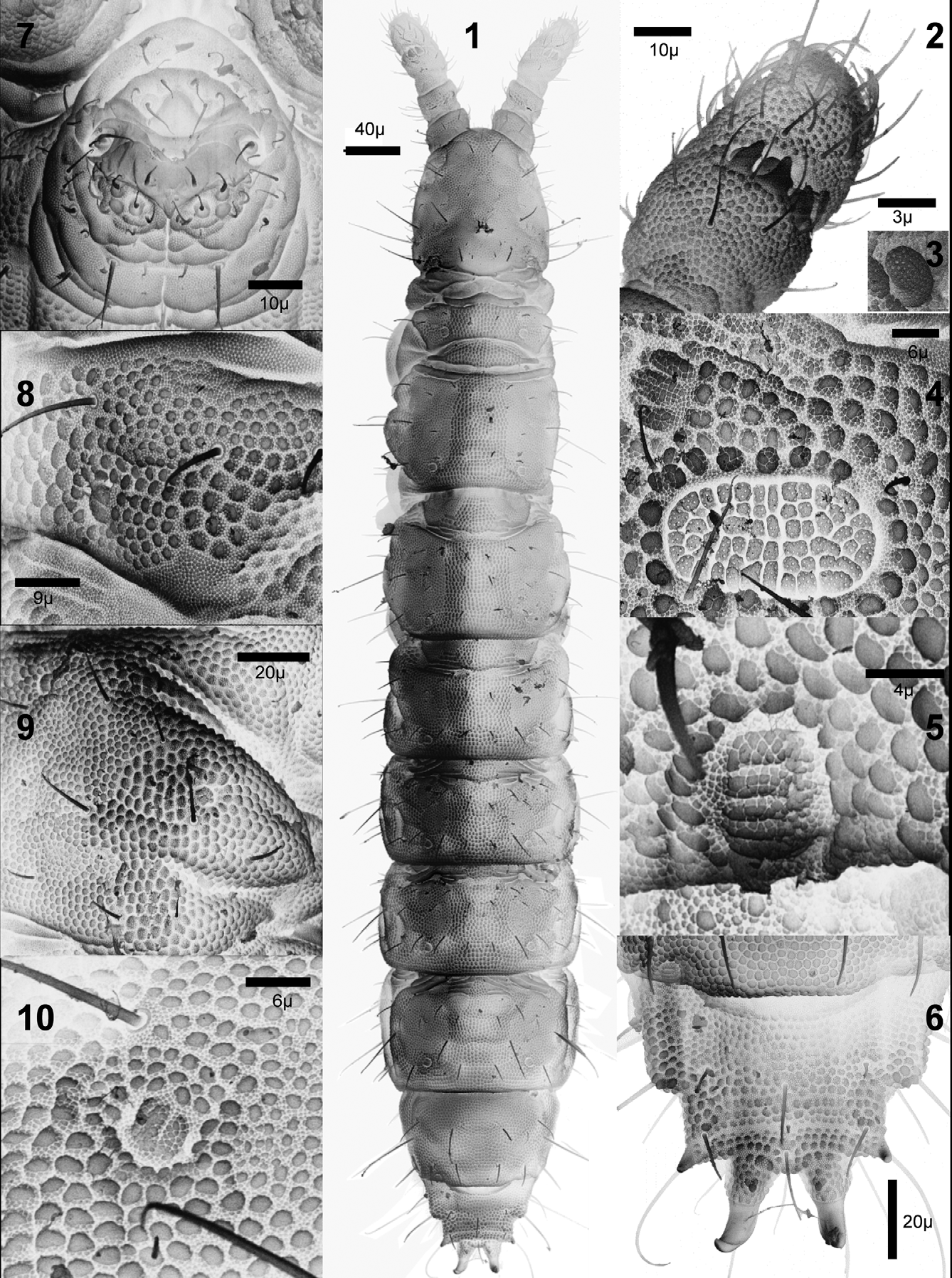
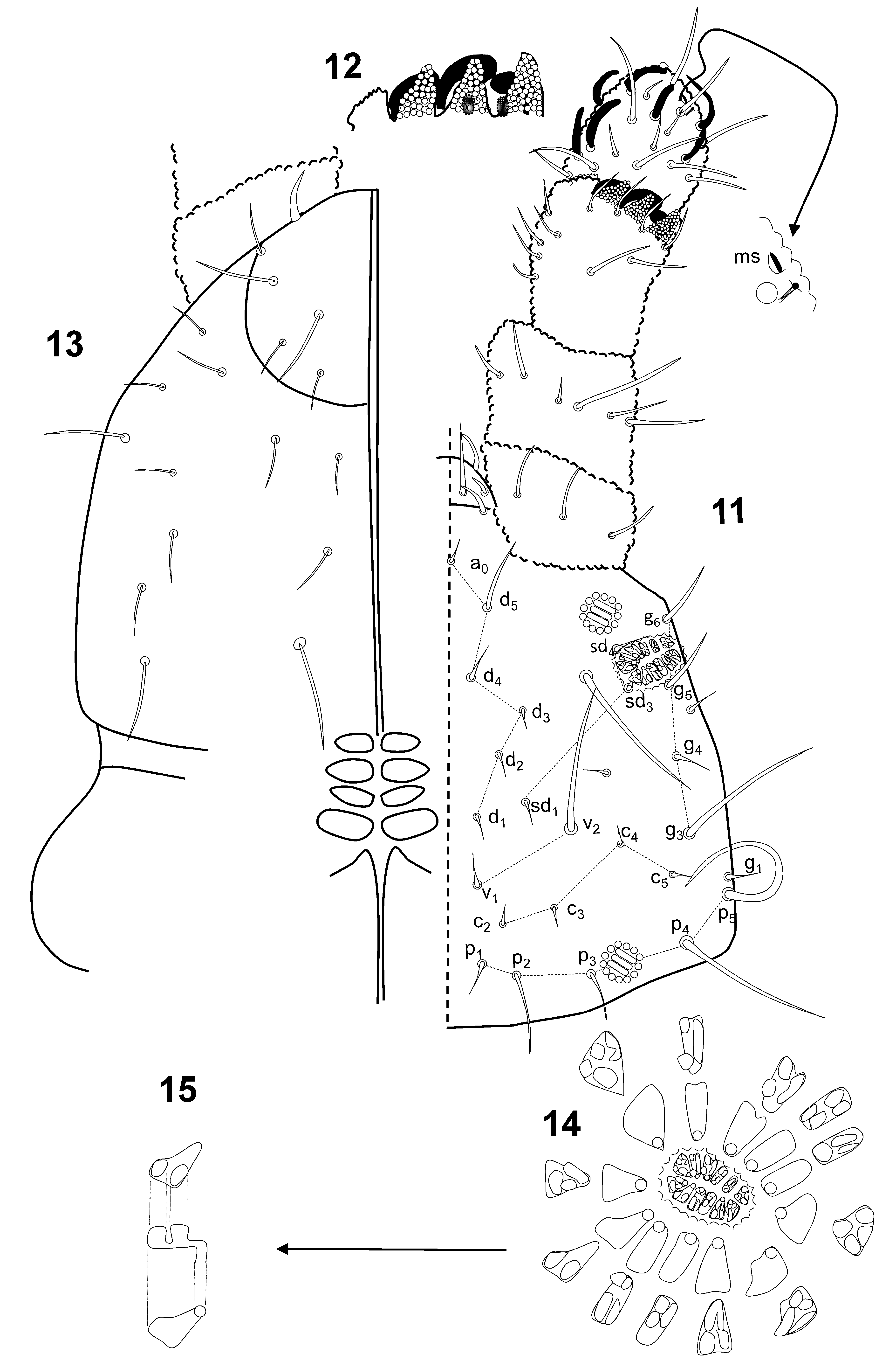
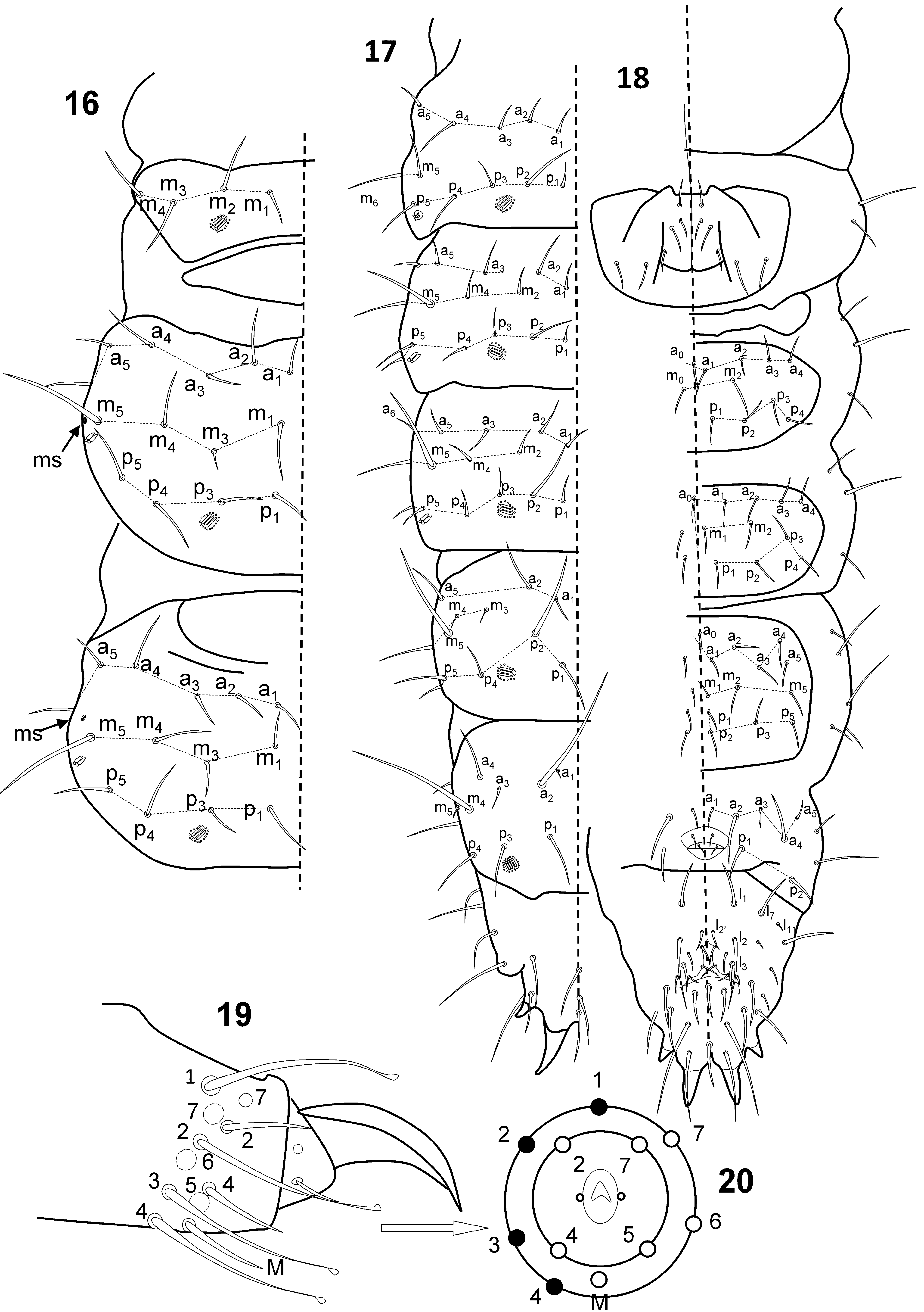
Description. Female: length 0.93 mm (holotype). White. Dorsal setae well differentiated in microsetae, mesosetae and macrosetae (Figs 1, 16 – 17). Head. Antennae slightly shorter than head (Ant / head ratio 0.8 – 0.9). Ant IV (Figs 2, 11) with 7 thickened sensilla, 1 subapical organite, 1 small sensillum (ms) (Fig. 11, enlarged detail) and an apical small entire vesicle. Ant III sense organ (Figs 11 – 12) with two sense rods between the two broad sensilla, internally there is another broad sensillum, three cuticular papillae and four guard setae; a sensillum is present on the ventral side of Ant III (Fig. 3). Ant I and II with 7 (6) and 11 setae respectively (Fig. 11). Labium with a distal spine-like seta, 2 papillate setae and 11 normal setae. Chaetotaxy of labial region and ventral side of head are showed in Fig. 7. Labrum with 2, 4, 2 setae. PAO with 12 compound vesicles in two rows (Figs 4, 14 – 15). Pseudocelli on head with 3 - 4 (fore pseudocelli) and 3 ridges (hind pseudocelli) (Figs 4, 11). Dorsal chaetotaxy (Fig. 11) after Najt and Rubio (1978) with a 0, d 1 - 5, sd 3 ’, sd 1, sd 3 - 4, v 1 - 2, oc 3, c 2 - 5, p 1 - 5, g 1, g 3 - g 6. Sd 3 ’, v 2, p 4, p 5 and g 3 are macrosetae; d 5, p 2, p 3, g 5 and g 6 are mesosetae; rest of setae are microsetae. Ventral chaetotaxy as in Fig. 13. Body dorsal chaetotaxy is given in Table 1 and Figs 16 – 17. Th I with 4 + 4 mesosetae. On Th II and III m 5 is macroseta. On Abd I m 5 and m 6 are macrosetae. On Abd II and III m 5 and m 6 are macrosetae. On Abd IV m 5, m 6 and p 2 are macrosetae. On Abd V a 2, m 4 and m 6 are macrosetae. Small microsetae are present on Abd IV (m 3 and m 4) and Abd V (a 1 and m 5). Pseudocelli distributed as it follows: 122 / 22211 (Figs 1, 16 – 17). Dorsal pseudocelli with 2 – 5 ridges within a shallow pit. Lateral pseudocelli without ridges but with some granules within a pit (Figs 5, 8 – 10). Abd IV and V without lateral pseudocelli. Abd VI with four anal spines inserted on cuticular papillae and two tubercles as shown in Figs 6, 17. Body ventral chaetotaxy is given in Table 1 and Fig. 18. Th I without setae. Th II – III with 1 + 1 setae. Abd I with 4 + 4 setae on distal part of VT and 2 + 2 on its base. Abd VI with four anal spines inserted on cuticular papillae and two tubercles as shown in Figs 6, 17. Female genital plate with two microsetae on the anterior half of the plate and three circumgenital setae (Fig. 18). Legs (Figs 19 – 20). Tita with four long, knobbed hairs. Claw without inner tooth. Unguiculus absent. The chaetotaxy of the legs is given in Table 2. Bionomy and distribution. All specimens were collected from litter of cork-oak (Quercus suber) forests located on the northern slope of Nebrodi Mountains.
Giuga, Luca, Jordana, Rafael (2013): Three new species of Collembola from soils of Mediterranean cork-oak forests of Sicily (Italy). Zootaxa 3664 (2): 283-300, DOI: 10.11646/zootaxa.3664.2.9
Diagnosis. PAO with 12 compound vesicles. Abd VI with 4 anal spines and 2 lateral tubercles, without unpair spiniform process. Pseudocellar formula 11 / 122 / 22211.
Giuga, Luca, Jordana, Rafael (2013): Three new species of Collembola from soils of Mediterranean cork-oak forests of Sicily (Italy). Zootaxa 3664 (2): 283-300, DOI: 10.11646/zootaxa.3664.2.9
Remarks. As Neonaphorura alicatai sp. nov. has 3 + 1 clavate seate on Tita, the key of Tullbergiidae of Dunger (2011) brings to genus Clavaphorura Salmon, 1943; but by having Ant III organ with 5 sensory elements Neonaphorura alicatai sp. nov. does not belong to that genus. The alternative step in the key is with weakly developed setae on Tita, but not having Neonaphorura alicatai sp. nov., as other species of Neonaphorura, ventromedial protuberance, the key does not bring to any genus. The description of the genus Neonaphorura from Dunger (2011) agrees almost entirely with this species except in relation to the number of anal spines additional to the 1 + 1 distal ones; the range of variation is 2 – 8 instead of 4 – 8. For this reason since it is no possible to include Neonaphorura alicatai sp. nov. in the key of genus Neonaphorura given by Dunger (2011), a new key, that considers the expanded range of variation, is given. The presence of four anal spines on Abd VI situates N. alicatai sp. nov. close to N. ortali Palissa, 2006. N. alicatai sp. nov. differs from N. ortali by having two dorsolateral tubercles on Abd VI and by the pseudocellar formula (11 / 122 / 22211), see the key. Also N. hexaspina Arbea & Mateos, 1991 has two dorsolateral tubercles on Abd VI, but it has six spines.
Giuga, Luca, Jordana, Rafael (2013): Three new species of Collembola from soils of Mediterranean cork-oak forests of Sicily (Italy). Zootaxa 3664 (2): 283-300, DOI: 10.11646/zootaxa.3664.2.9
Etymology. The species is dedicated to the zoologist Pietro Alicata who helped us in collecting the material.
Giuga, Luca, Jordana, Rafael (2013): Three new species of Collembola from soils of Mediterranean cork-oak forests of Sicily (Italy). Zootaxa 3664 (2): 283-300, DOI: 10.11646/zootaxa.3664.2.9
Type locality. Caronia (Messina), Sicily, Italy. Coordinates: 38 ° 00 ' 36.82 " N, 14 ° 32 ' 27.99 " E; 460 m asl. Type material. Holotype (female) on slide MZNASI 20100305 - 1 - 1, date: 05. iii. 2010. Paratypes of same date and locality as holotype: 1 juvenile on slide MZNASI 20100305 - 3 - 2. Paratypes collected at same locality as holotype with date 07. ii. 2011: 1 female on slide MZNASI 20110207 - 01; 6 specimens in ethyl alcohol 70 %; 3 specimens on stub for SEM. Holotype and 11 paratypes deposited in MZNA.
Giuga, Luca, Jordana, Rafael (2013): Three new species of Collembola from soils of Mediterranean cork-oak forests of Sicily (Italy). Zootaxa 3664 (2): 283-300, DOI: 10.11646/zootaxa.3664.2.9
Export occurrence data
Darwin Core Archive (ZIP)
CLASSIFICATION
Taxonomic Classification Tree

MULTIMEDIA
Media Files(3)
FIGURES 1 – 10. Neonaphorura alicatai sp. nov. SEM microphotographs: 1, habitus dorsal view; 2, Ant. III – IV; 3, Ant. III ventral sensillum; 4, head pseudocellus and PAO; 5, dorsal pseudocellus of Abd V; 6, Abd VI dorsal view; 7, mouth cone; 8, dorsal pseudocellus of Th I; 9, Dorsal and lateral pseudocelli of Th III; 10, dorsal pseudocellus of Abd IV.
Imageimage/png© Giuga, Luca;Jordana, RafaelGiuga, Luca;Jordana, Rafael
IMAGES