
AnimaliaNot EvaluatedacceptedspeciesAccepted
Friesea guarinoi
GBIF:119568687
ABOUT
Descriptions(5)
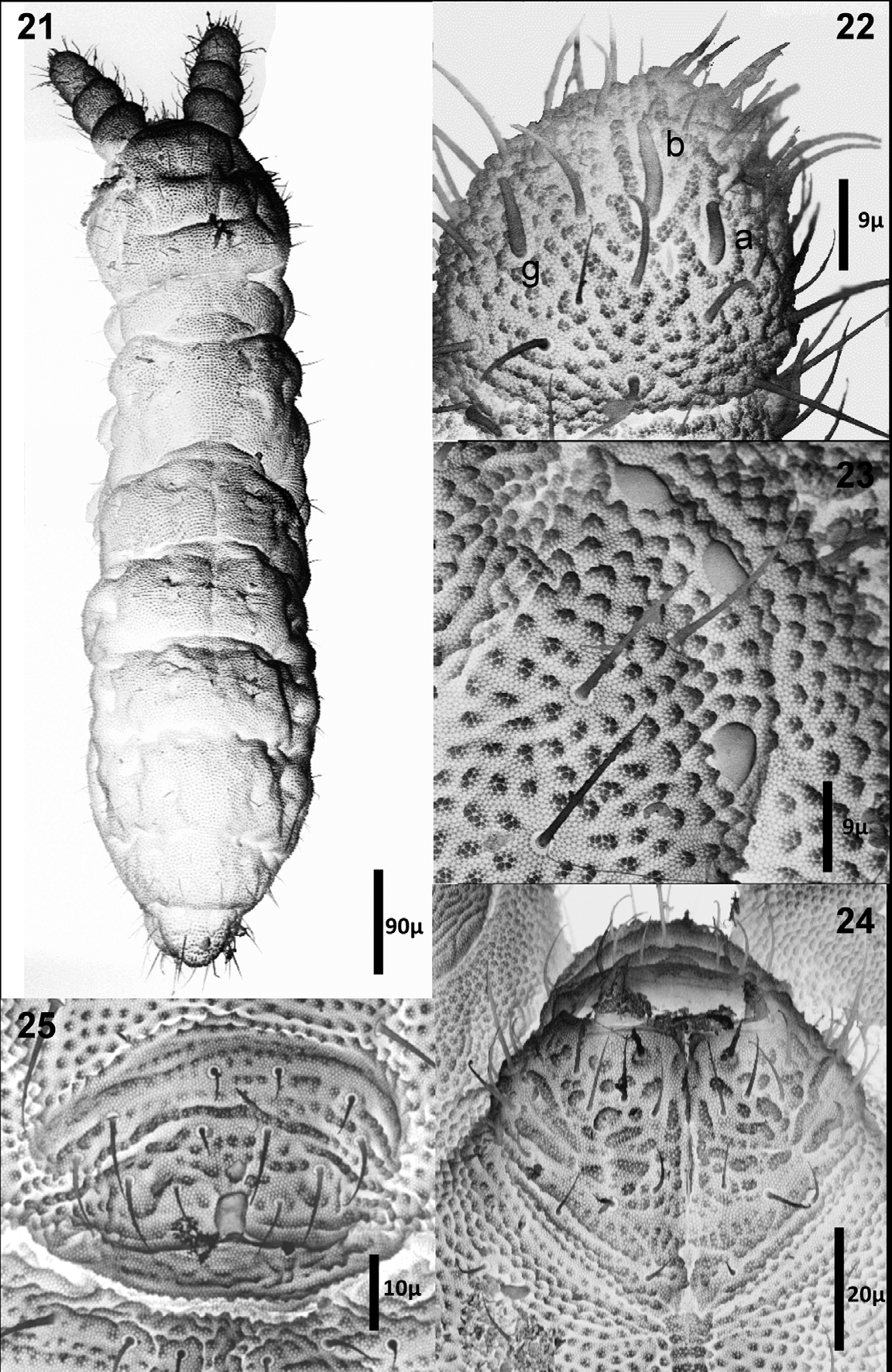
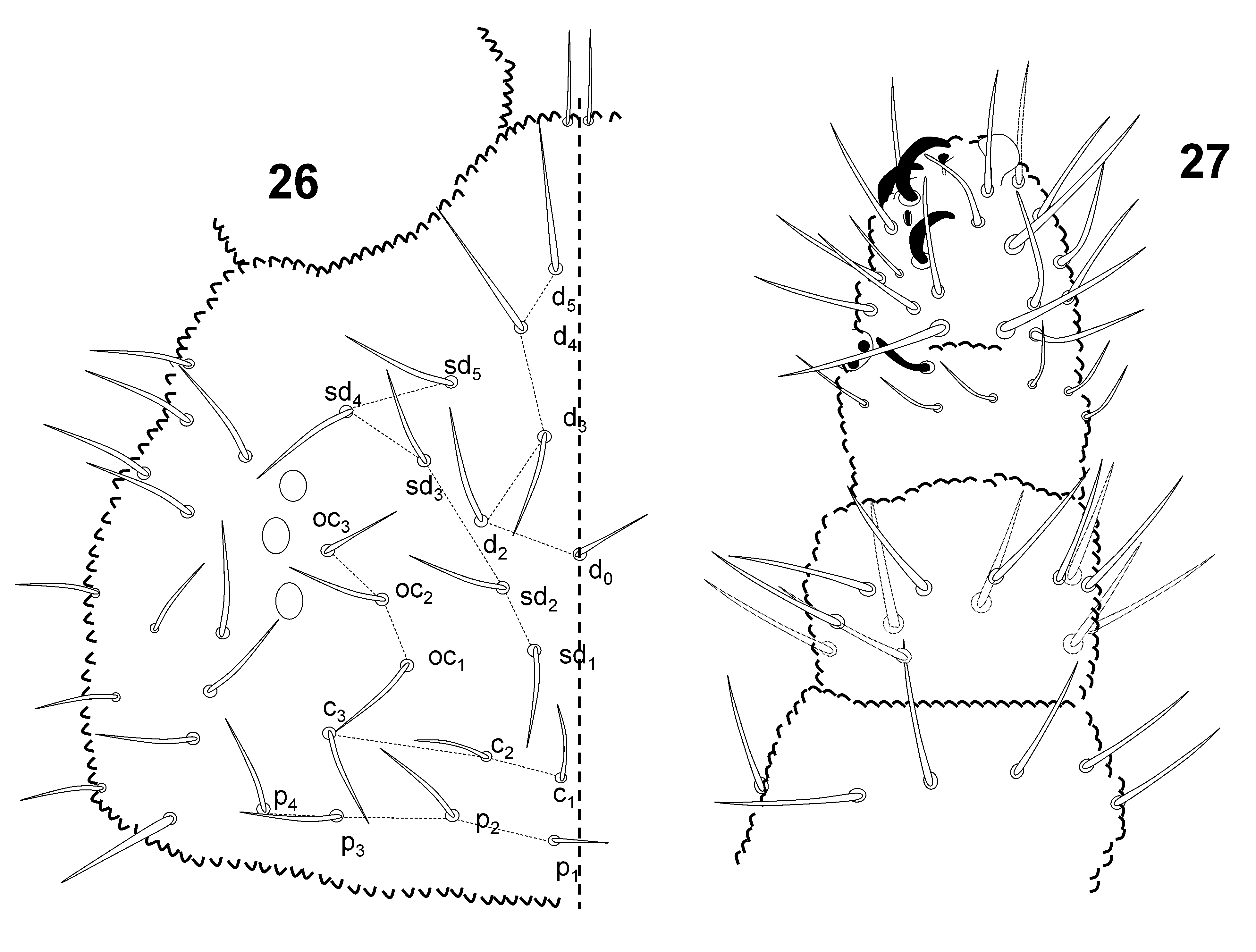
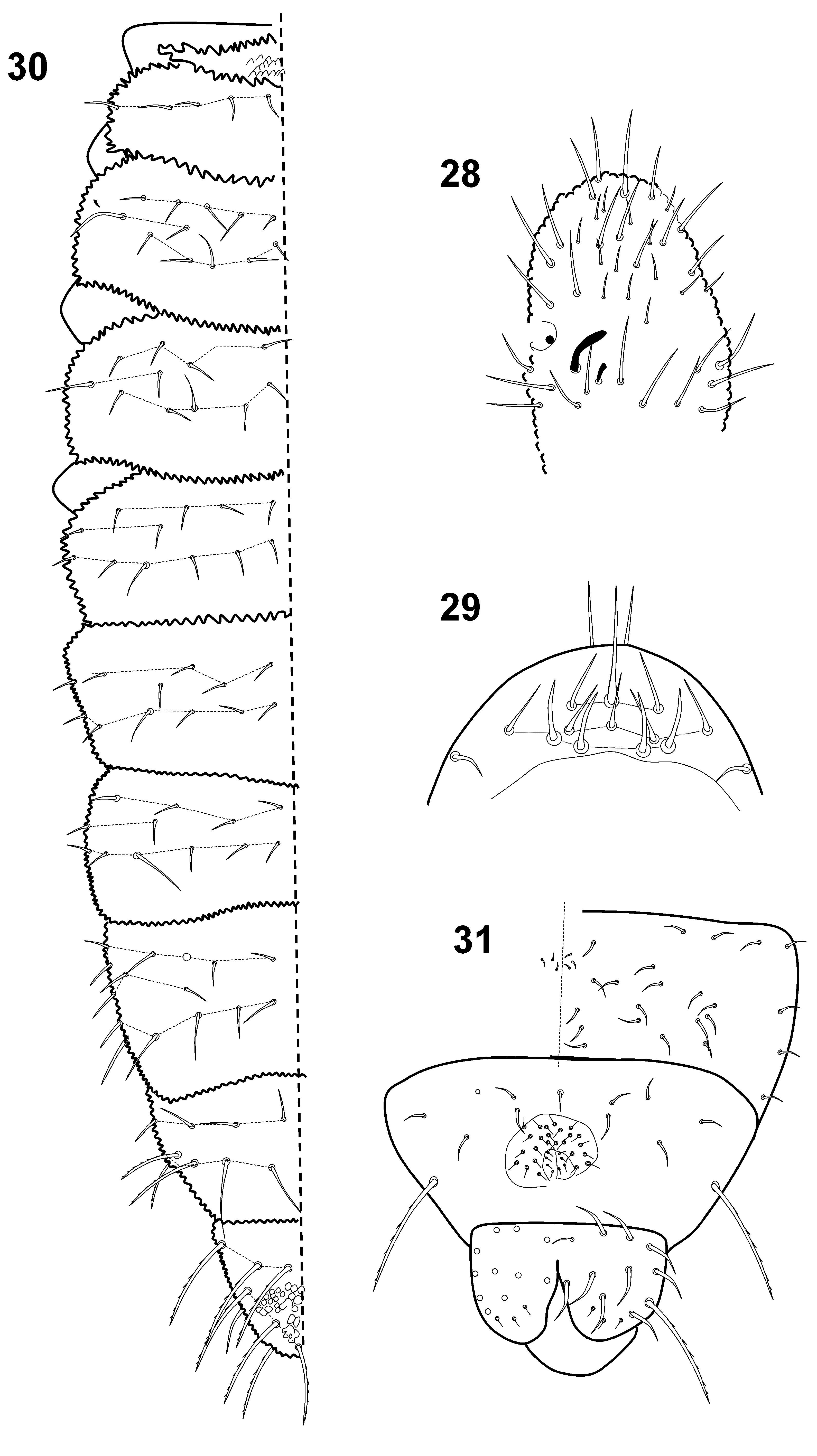
Description. Habitus classical of the genus (Fig. 21). Body length: 0.8 – 1 mm. Body color: greyish violet. Dorsal clothing rather strong, long and pointed ordinary setae, serrated on posterior tergites (Figs 30 – 31). Setae of various length (longest / shortest = 2), with all intermediates between macrosetae and mesosetae. S-setae on tergites (Th II – Abd III) clearly longer or slightly longer (Abd IV – V) than nearby ordinary setae (Fig. 30). Ventral setae smooth and acuminate. Head (Fig. 26): 3 + 3 subequal eyes (Fig. 23). Labium (Fig. 24) and mouthparts classical of the genus. Labium with 1 + 1 papillate setae. Two long and slender prelabral setae nearby to the axis; labrum with 3, 5, 4 setae arranged as in the Fig. 29, four distal ones thicker than others. 6 setae on Ant. I, 13 on Ant. II. Ant. III organ with S 2 and S 5 rather short and thickened. Ant. IV dorsal with: simple apical bulb; 3 thickened, short, subequal S-setae, a subapical organite and a minute microseta ms (Figs 22, 27). Ant. IV ventral: among normal setae there is a group of thin setae (Fig. 28). Dorsal head chaetotaxy as in Table 3 and Fig. 26. Seta a 0 absent; seta d 0 present. Chaetotaxic asymmetries on tergites and sternites are frequent. Dorsal chaetotaxy as in Table 4 and Fig. 30. Abd V with 3 + 3 (p 3 – p 5) denticulate setae. Abd VI with all setae denticulate. Legs. Tita without clavate tenent hairs. Claw with inner tooth. Legs chaetotaxy as in Table 5. Abdominal ventral chaetotaxy as Fig 31. VT with 4 + 4 setae. Female genital valves as in Fig. 25. Furca absent, Abd IV with 3 + 3 microsetae instead of furca.
Giuga, Luca, Jordana, Rafael (2013): Three new species of Collembola from soils of Mediterranean cork-oak forests of Sicily (Italy). Zootaxa 3664 (2): 283-300, DOI: 10.11646/zootaxa.3664.2.9
Diagnosis. 3 + 3 eyes. Abd IV with 3 + 3 setae m. Abd V and VI with 6 and 13 denticulate setae respectively (Fig. 30). Abd VI without anal spines. Furca absent (Fig. 31). Without clavate tenent hairs.
Giuga, Luca, Jordana, Rafael (2013): Three new species of Collembola from soils of Mediterranean cork-oak forests of Sicily (Italy). Zootaxa 3664 (2): 283-300, DOI: 10.11646/zootaxa.3664.2.9
Remarks. Friesea guarinoi sp. nov. belongs to the species group with no furca and without true anal spines. To this group belong Friesea cassagnaui Simon-Benito and Deharveng, 1997, F. christiani Thibaud, 1995, F. colorata Cassagnau, 1958; F. cruchagae Arbea and Jordana, 1989; F. f a g e i Denis, 1932, F. lagrecai Dallai, 1973, F. oteruelensis Simón-Benito, 2005, F. s i m o n i Arbea and Jordana, 1993, F. steineri Simón, 1973. Only two species of this group have 3 + 3 eyes as F. guarinoi sp. nov. (F. fagei and F. oteruelensis); the last two species have 2 fore and 1 hind eyes (probably, by the position of Oc setae, these 3 eyes are A, B and E), F. guarinoi sp. nov. has 3 eyes in a longitudinal line (B or C, D and E or F) (Figs. 23, 26). F. fagei and F. guarinoi sp. nov. have 18, 18, 17 setae on Tita I, II and III respectively while F. oteruelensis has 17, 17, 16 setae on these Tita. F. f a g e i has been described by Denis (1932, original description), Gisin (1960) as Polyacanthella fagei, by presence of 4 – 7 spine-like setae on Abd VI. Further Gisin describes it whith a rudimentary dens without setae. This assertion follows the Denis’ description “ Furca et tenaculum réduit à des vestiges informes simples empreintes tégumentaires … Syncoxite furcal soudé aux subcoxe sauf tout à fait en avant. ” F. guarinoi sp. nov. has not furca and in its place there are 3 + 3 microsetae (Fig. 31). Another description of F. fagei was given by Jordana et al. 1997; they describe F. f a g e i by having 5 spine-like setae and 4 long denticulate setae on Abd VI; 6 sensilla on Ant. IV. F. guarinoi sp. nov. has 13 long and denticulate setae on Abd VI (not anal spine-like setae) and the sensilla on Ant. IV are arranged in a different way; furthermore F. f a g e i sensu Arbea and Jordana, 1997 and F. guarinoi sp. nov. show a quite different dorsal chaetotaxy. For these characters F. guarinoi sp. nov. is different from F. f a g e i Denis, 1932; from F. fagei sensu Gisin, 1960 and from F. fagei sensu Arbea and Jordana, 1997.
Giuga, Luca, Jordana, Rafael (2013): Three new species of Collembola from soils of Mediterranean cork-oak forests of Sicily (Italy). Zootaxa 3664 (2): 283-300, DOI: 10.11646/zootaxa.3664.2.9
Etymology. The species is dedicated to the botanist Riccardo Guarino who helped us in collecting the material. Bionomy and distribution. All specimens were collected from litter of cork-oak (Quercus suber) forests located on the northern slope of Nebrodi Mountains.
Giuga, Luca, Jordana, Rafael (2013): Three new species of Collembola from soils of Mediterranean cork-oak forests of Sicily (Italy). Zootaxa 3664 (2): 283-300, DOI: 10.11646/zootaxa.3664.2.9
Type locality. Caronia (Messina), Sicily, Italy. Coordinates: 38 ° 00 ' 37 " N, 14 ° 32 ' 28 " E; 460 m asl. Type material. Holotype female on slide MZNASIC- 20110207 - 01, date: 07. ii. 2011. Paratypes of same date and locality as holotype: 48 specimens in ethyl alcohol 70 %; 2 specimens (females) on slide; 4 specimens in stub for SEM. Paratypes collected at same locality as holotype with date 05. iii. 2010: 2 males on slide and 6 specimens in ethyl alcohol 70 %. Holotype and 62 paratypes depostited in MZNA.
Giuga, Luca, Jordana, Rafael (2013): Three new species of Collembola from soils of Mediterranean cork-oak forests of Sicily (Italy). Zootaxa 3664 (2): 283-300, DOI: 10.11646/zootaxa.3664.2.9
Export occurrence data
Darwin Core Archive (ZIP)
CLASSIFICATION
Taxonomic Classification Tree

MULTIMEDIA
Media Files(3)
FIGURES 21 – 25. Friesea guarinoi sp. nov. SEM microphotographs: 21, habitus dorsal view, bar = 90 micrometers; 22, Ant. IV, bar = 9 micrometers; 23, eyes, bar = 9 micrometers; 24, labium, bar = 20 micrometers; 25, female genital plate, bar = 10 micrometers.
Imageimage/png© Giuga, Luca;Jordana, RafaelGiuga, Luca;Jordana, Rafael
IMAGES