
AnimaliaNot EvaluatedacceptedspeciesAccepted

Arrhopalites antonioi
GBIF:119568690
ABOUT
Descriptions(6)
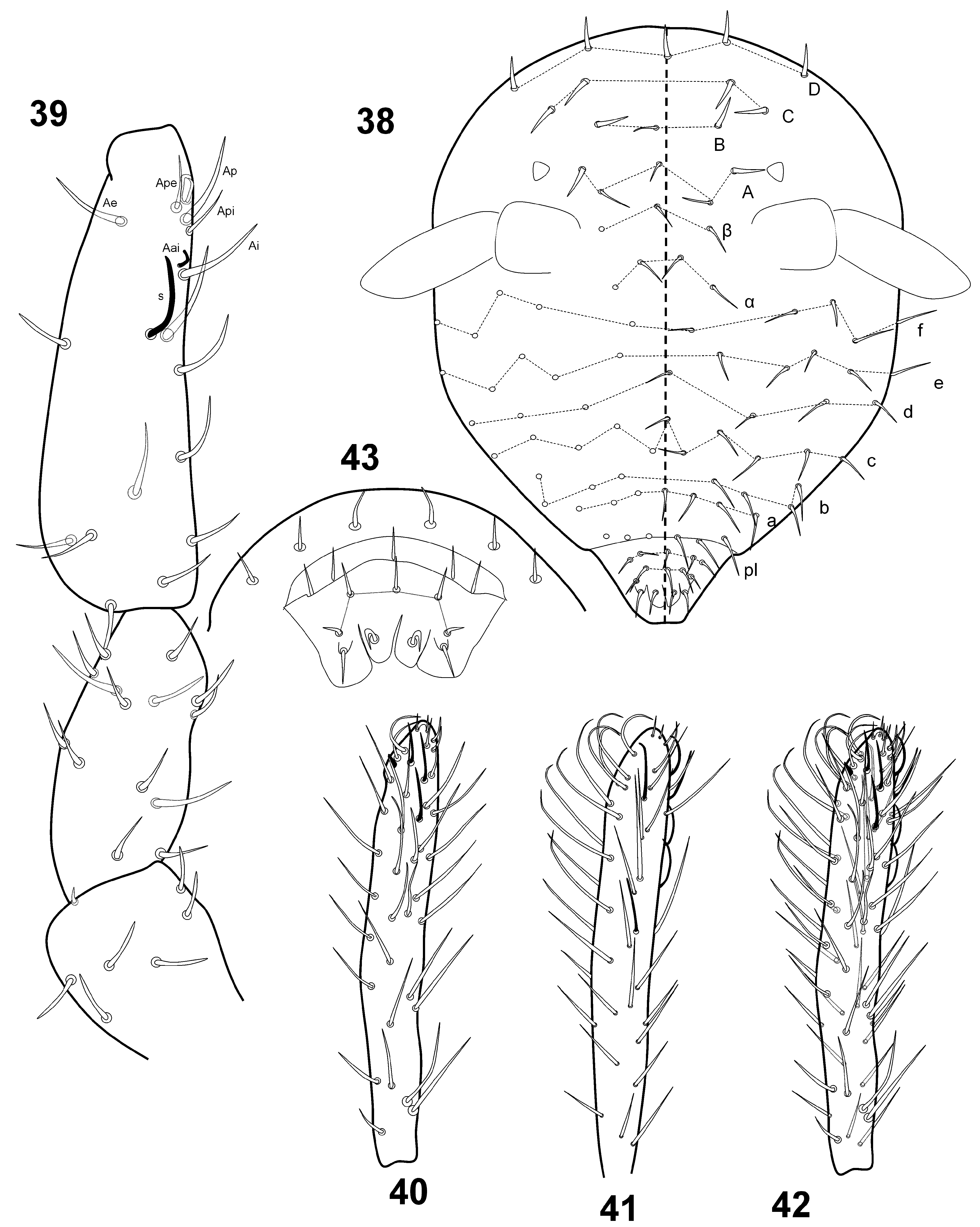
Description. Female: body 0.6 – 0.8 mm length, without pigmentation (Fig. 32). Head (Fig. 38). 1 + 1 very small eyes, unpigmented. Clypeal area with axial setae in row a, c and d. Interantennal area with axial seta in row β. Dorsal area with 3 axial setae in rows A, B and D. 13 setae of dorsal area are spine-like as in Fig. 38 (in row A: 1 + 1; B: 1 + 1; C: 2 + 2; D: axial and 2 + 2); others are not modified. Labrum with 6 prelabral setae and 5 / 5 / 4 labral setae as in Fig. 43. Antennae. 1.2 – 1.3 times as long as head. Antennal segments I, II, III, IV = 26 – 30, 50 – 60, 90 – 94, 140 – 152 micrometers. Ant I with 6 anterior and 1 posterior setae; Ant II with 14 setae, one of which in sub-basal posterior part of the segment is a little longer than others (Fig. 39). Ant III wider on its base (Fig. 35), with 15 normal setae, a long sensillum s; Ant III organ includes 2 sense rods located in a pit and Aai very short and curved rod-like sensilla, setae Api and Ape thin and shorter than others; seta Ae lies on one level with Ape and sense rods. Ant IV undivided (Figs 40 – 42). Legs (Figs 44 – 46). Foreleg (Fig. 44): precoxa with 1 seta; coxa with 1 seta; trochanter with 1 anterior, 2 internal and 1 posterior setae; femur with 12 setae, a 4 turned perpendicularly to the longitudinal axis of the segment. Tita: 3 setae FP present; seta FS missing; 9 setae in whorl I among which seta Ja curved and thickened; 8 setae in each of whorls II – V. Claw normal, with tunica, with inner tooth; empodium broad in its base, with a corner tooth, with empodial filament surpassing the tip of claw. Mid leg (Fig. 45): precoxa with 1 seta; coxa with 3 setae and 1 spine; trochanter with anterior trochanteral organ (a 1), 1 anterior (a 2), 1 internal (i 2) and 1 posterior simple setae; femur with 13 setae. Tita: 3 setae FP present; seta FS missing; 9 setae in whorl I; 8 setae in each of whorls II – IV; 7 setae in whorl V. Claw and empodium similar to fore claw. Hind leg (Fig. 46): precoxa with 1 seta; coxa with 3 anterior and 1 posterior setae and 1 spine; trochanter with anterior trochanteral organ (a 1), 1 anterior, 2 internal and 1 posterior simple setae; femur with 12 setae among which 2 posterior ones are very small. Tita chaetotaxy as in mid Tita but secondary seta FSa present. Claw broader and shorter than fore and mid claw, with tunica, with pair of small lateral teeth and 1 inner tooth; empodium longer than in foreleg and mid leg, with an hair not exceeding claw’s tip, with a tooth on the middle. VT with 1 + 1 subapical setulae. Tenaculum: ramus 3 - dentate, with basal appendage; anterior lobe with 1 subapical setula; posterior lobe reaching the tip of anterior lobe. Furca (Fig. 48). Manubrium with 4 + 4 dorso-lateral setae; dens chaetotaxy (16 seta and 2 spines): Anterior side bears setae: 3, 2, 1, 1; ve 1 B with similar size than ve 1 A and ve 1 C, external side with 1 apical spine and 3 spine-like setae (D 1, E 2 and E 3), internal side with 1 apical spine (L 1) and 1 spine-like seta (L 2). Dens less than 2 times as long as mucro. Mucro with serrated edges and spoon-like apex. Great abdomen (Fig. 47). Dorsal setae of mesothorax short and not modified, comparable with other anterior setae. Meso and metathorax with 1 spine a (Fig. 36). Trichobothria ABC form an angle about 90 0 and AB> BC. Row a and m on Abd I with 5 setae; 1 p setae of p-row is located below of trichobothrium A; central dorsal complex (1, 2 and 3) present (Vargovitsh, 2012); seta 3 is a sensillum. Seta b 1 lies below trichobothrium B; seta c 1 is a very thin microseta and lies in front of trichobothrium C, seta c 2 lies below the same trichobothrium. Posterior lateral complex with 5 setae and furca base complex with 6 setae and 1 sminthuroid seta. Posterior dorsal complex with 3 longitudinal rows of long spine-like setae as Fig. 34, two times in length as anterior ones. Ventral complex with 3 setae. Abd V with trichobothrium D, 2 sensilla and 2 setae (Fig. 47). Sixth abdominal segment (Fig. 37) character states of setae follow Zepellini (2011): a 0 (C 1) simple; a 1 and a 2 (C 2 and C 3) broadened at its base with small denticles from base to tip, a 3 (C 4) half-length than a 2 with similar denticles (Fig. 53), av 1 ’ (C 5) with the same length than a 3 but dentate at its base and with denticles to the tip (Fig. 51), av 1 (C 6) longer than av 1 ’ dentate at its base in one side and with denticles on the other (Fig. 52), av 2 – av 4 normal setae and denticulated (as all of the setae on this segment); cuticular spines absent. Subanal appendages (Figs 49 – 50): gutter-like with fringed apex and edges, with few denticles on its base. Bionomy and distribution. All specimens were collected from litter of cork-oak (Quercus suber) forests located in central-eastern Sicily within the SAC ITA 070005 ‘ Bosco di Santo Pietro’.
Giuga, Luca, Jordana, Rafael (2013): Three new species of Collembola from soils of Mediterranean cork-oak forests of Sicily (Italy). Zootaxa 3664 (2): 283-300, DOI: 10.11646/zootaxa.3664.2.9
FIGURES 47 – 53. Arrhopalites antonioi sp. nov.: 47, Th and Abd chaetotaxy; 48, dens; 49, female anal appendage, dorsal view; 50, female anal appendage, lateral view; 51, av 1 ’ seta of Abd VI; 52, av 1 seta of Abd VI; 53, a 3 seta of Abd VI.
Giuga, Luca, Jordana, Rafael (2013): Three new species of Collembola from soils of Mediterranean cork-oak forests of Sicily (Italy). Zootaxa 3664 (2): 283-300, DOI: 10.11646/zootaxa.3664.2.9
Diagnosis. Unpigmented; 1 + 1 eyes; trichobothria ABC form right angle opened forward and distance AB> BC; Antenna about 1.3 times of head; Ant IV without subsegments; 13 spine-like setae on head; tip of empodium of legs I and II exceeding the tip of corresponding claw; tenaculum with 1 setula; manubrium with 4 + 4 setae in dorsolateral position; dens with 3, 2, 1, 1, anterior setae and normal anterodistal seta; small abdomen without any cuticular spines, with dentate circumanal setae, and with gutter-like laterally weakly serrated anal appendages.
Giuga, Luca, Jordana, Rafael (2013): Three new species of Collembola from soils of Mediterranean cork-oak forests of Sicily (Italy). Zootaxa 3664 (2): 283-300, DOI: 10.11646/zootaxa.3664.2.9
Remarks. Among Arrhopalites, 8 species A. caecus Tullberg, 1871, A. coreanus Park & Kang, 2007, A. diversus Mills, 1934, A. harveyi Denis, 1933, A. millsi Delamare & Massoud, 1963, A. minutus Yosii, 1970, A. nivalis Yosii, 1966 and A. antonioi sp. nov. have 1 + 1 eyes, Ant. IV not segmented and bear spines on head. A. caecus, A. diversus and A. harveyi bear 16 spines on head; the others bear 10 – 14 spines: A. coreanus (10), A. millsi (14), A. minutus (13), A. nivalis (12), A. antonioi sp. nov. (13). Among last ones only A. antonioi sp. nov. has anal setae dentate at its base and with denticles to the tip. A. minutus and A. antonioi sp. nov. bear 13 spines on head; but A. minutus is different by having: female anal appendage spatulated and truncate on apex; anterior side of dens with 3,2,1,1,1 setae; 6 cuticular spines on Abd VI (2 + 2 on epiproct and 2 on each paraproct); furthermore all anal setae are heavily winged without spinulation.
Giuga, Luca, Jordana, Rafael (2013): Three new species of Collembola from soils of Mediterranean cork-oak forests of Sicily (Italy). Zootaxa 3664 (2): 283-300, DOI: 10.11646/zootaxa.3664.2.9
Etymology. This species is dedicated to zoologist Antonio Alicata who helped us in collecting the specimens.
Giuga, Luca, Jordana, Rafael (2013): Three new species of Collembola from soils of Mediterranean cork-oak forests of Sicily (Italy). Zootaxa 3664 (2): 283-300, DOI: 10.11646/zootaxa.3664.2.9
Type locality. Santo Pietro (Catania), Sicily, Italy. Coordinates: 37 ° 05 ' 59 " N, 14 ° 27 ' 52 " E; 240 m asl. Type material. Holotype (female) on slide MZNASI- 3 - 1, date: 26. ii. 2010. Paratypes of same date and locality as holotype: 4 specimens (2 females and 2 juveniles) on slides; 6 specimens (2 females and 4 juveniles) on stub for SEM. Holotype and 10 paratypes depostited in MZNA.
Giuga, Luca, Jordana, Rafael (2013): Three new species of Collembola from soils of Mediterranean cork-oak forests of Sicily (Italy). Zootaxa 3664 (2): 283-300, DOI: 10.11646/zootaxa.3664.2.9
Export occurrence data
Darwin Core Archive (ZIP)
CLASSIFICATION
Taxonomic Classification Tree

MULTIMEDIA
Media Files(3)
FIGURES 32 – 37. Arrhopalites antonioi sp. nov. SEM microphotographs: 32, habitus lateral view; 33, head spine; 34, great Abd posterior spine-like seta; 35, Ant. III; 36, Th II – III spine; 37, Abd VI chaetotaxy.
Imageimage/png© Giuga, Luca;Jordana, RafaelGiuga, Luca;Jordana, Rafael

IMAGES