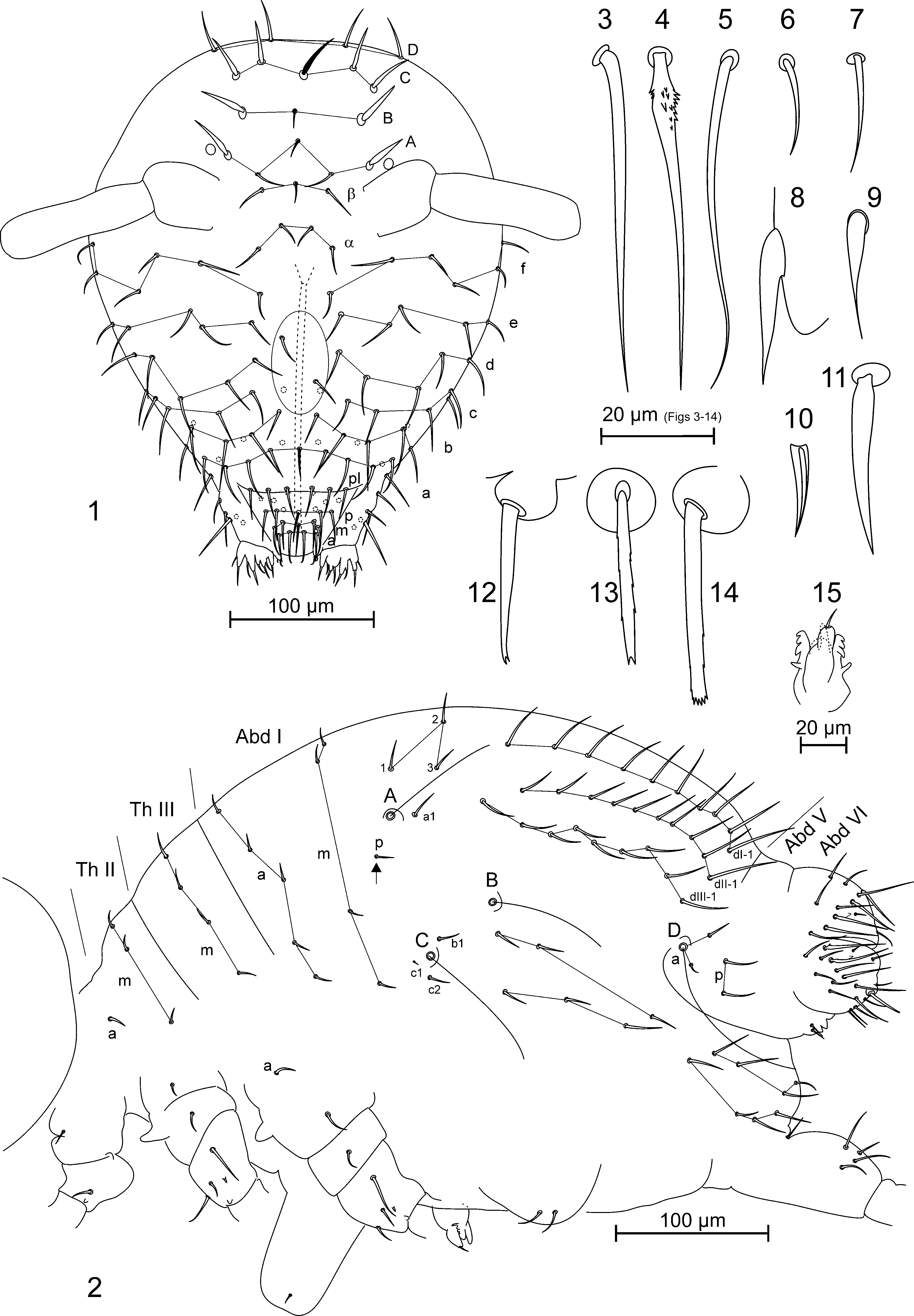
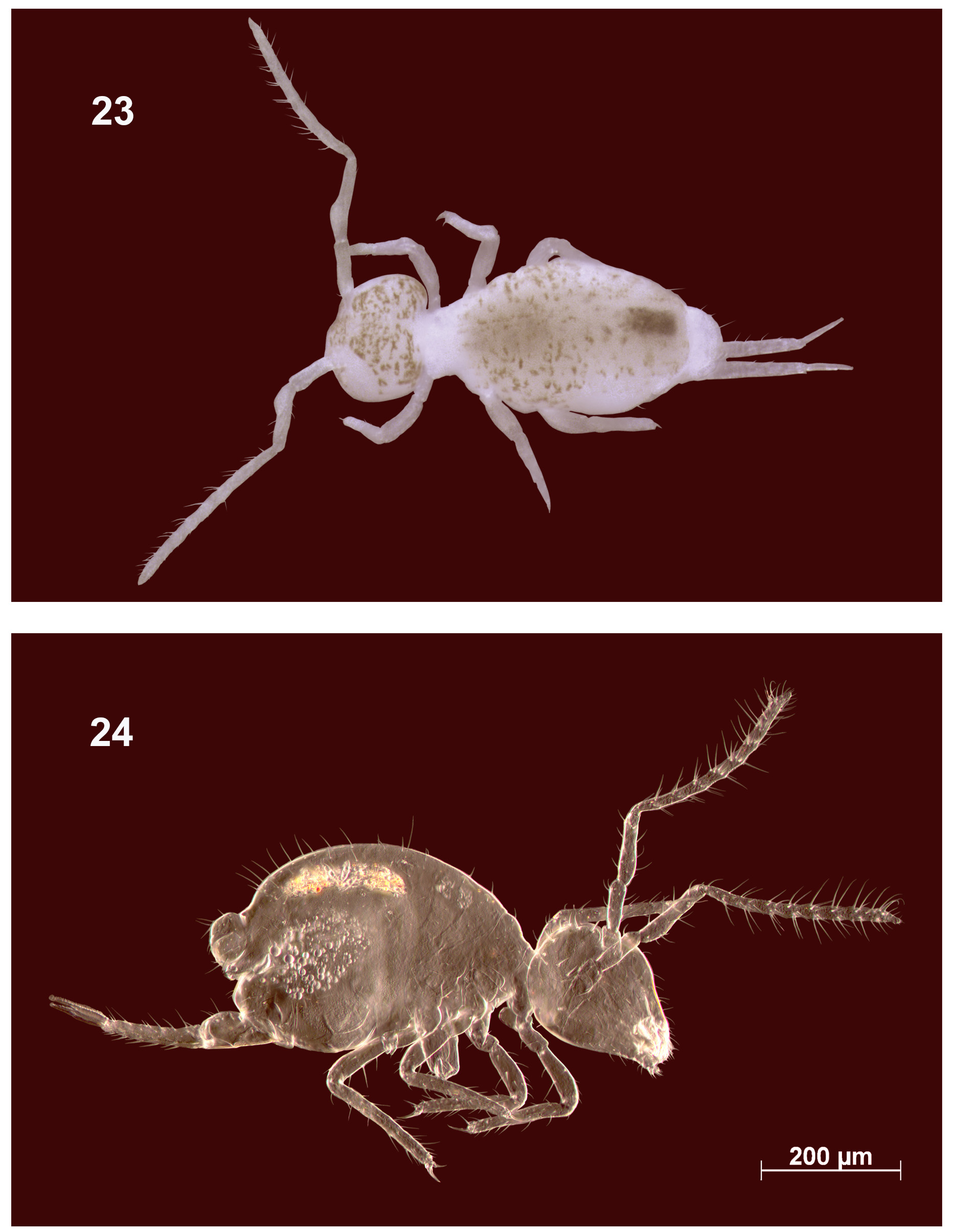
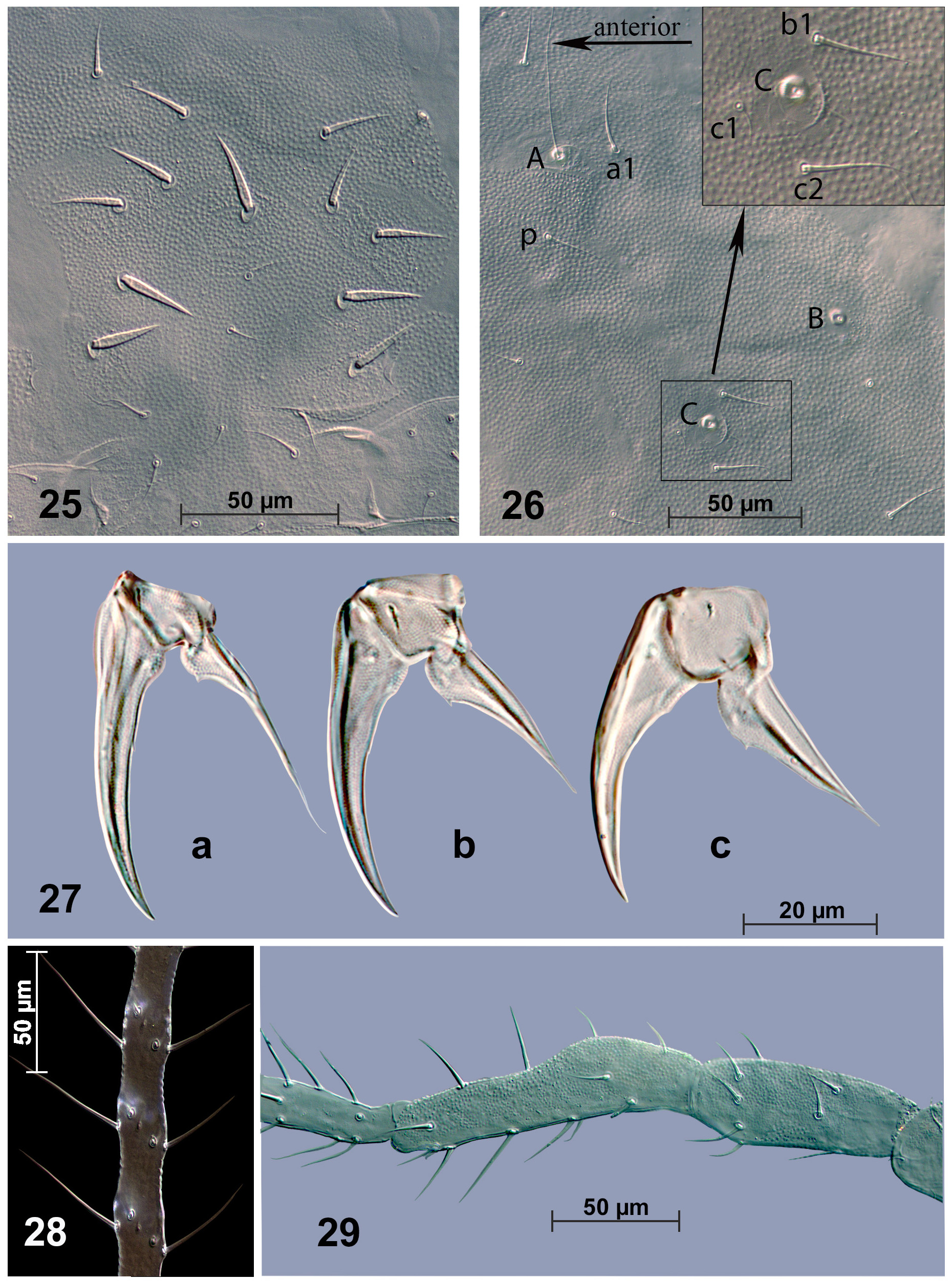
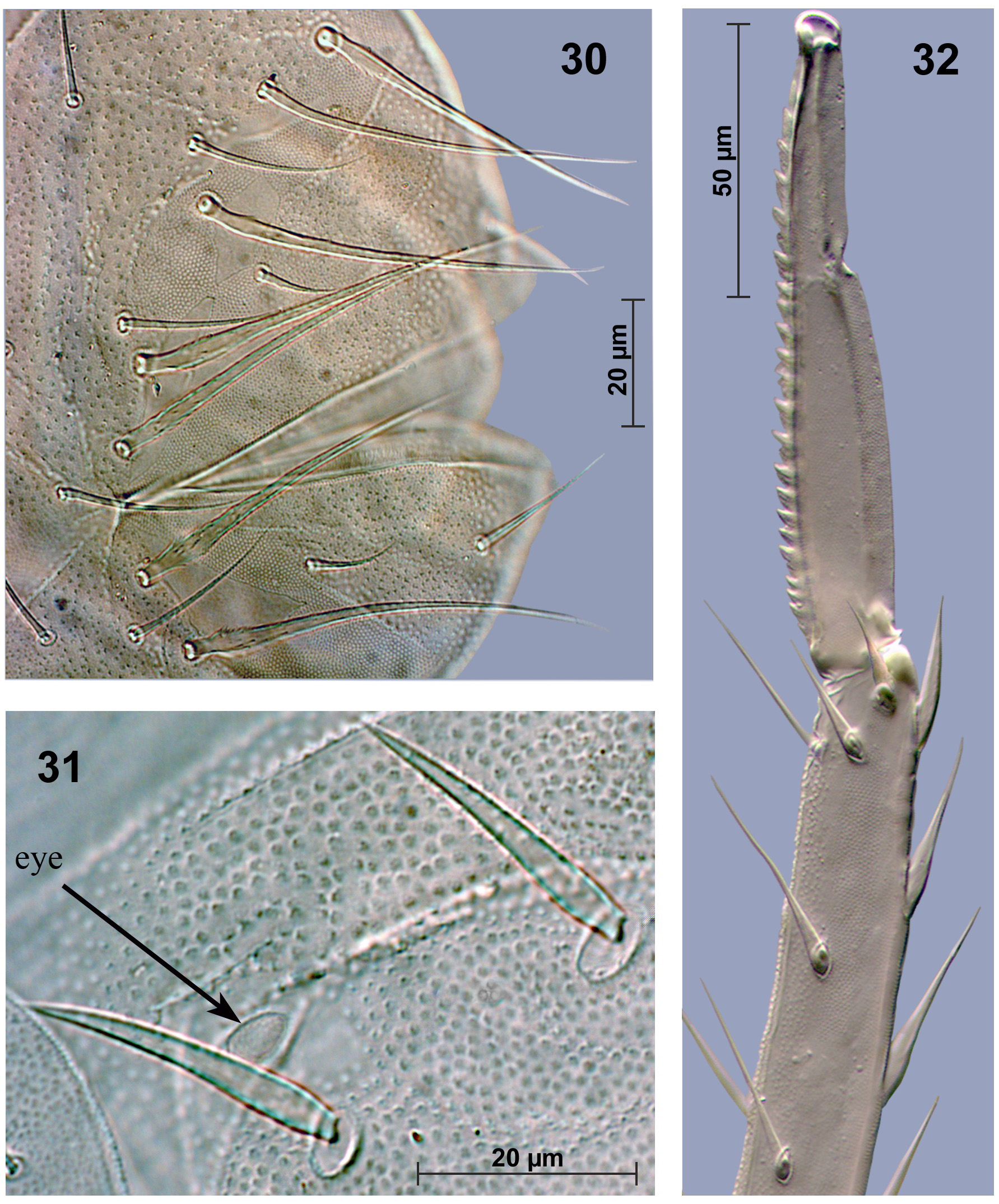
Description. Female: body length (without antennae and furca) about 0.9 mm, completely unpigmented or with spots of weak pale-brownish dorsal pigmentation (Fig. 23). Head (Figs 1, 11, 25, 31). Eyes 1 + 1, unpigmented. Labral / prelabral chaetotaxy: 4 5 5 / 6. Clypeal area (rows a to f) with axial seta in row a. Interantennal area (rows α and β) with axial seta in row β. Dorsal area (rows A to D): 3 axial setae in rows A, B and C; 9 setae are spine-like and with broadened sockets (in row A: 1 + 1, B: 1 + 1, C: 2 + axial + 2); row D with 2 + 2 thickened setae with normal sockets; other setae are not modified. Antenna (Figs 18, 28, 29): length about 2 × of head. Mean length ratio of antennal segments I: II: III: IV = 1: 2.3: 3.3: 8.2 (1: 2.1: 3: 7.8 in holotype). Ant I with 7 setae of which subapical one is microseta. Ant II with 14 setae. Ant III with subbasal swelling, 18 setae and 2 sense rods in separate pits. Ant IV usually indistinctly subdivided into 5 – 7 (pseudo) subsegments, separated from each other by 1 – 5 weakly developed and sometimes hardly visible annuli (Fig. 28); separations are better distinguished in the middle part of the segment and poorly on the basal and apical subsegments. Subsegmental formula depends on number of subsegments and if 6 subsegments present, then formula is: 1 + 4 + 1 = (A + M 1) + (M 2 – M 5) + (B). Ant IV bears 13 whorls of setae. Foreleg (Figs 2, 20): precoxae 1, 2 and coxa with 1, 0, 1 setae respectively. Trochanter with 3 anterior and 1 posterior setae; femur with 12 setae, a 4 turned perpendicularly to the longitudinal axis of the segment. Tibiotarsus normally with 44 setae: whorl I with 9 setae among which Ja curved and spine-like, each of whorls II – V with 8 setae and region F with 3 primary FP setae (e, ae, pe). Pretarsus with 1 anterior and 1 posterior setulae. Foot complex (Fig. 27 a). Claw: thin, without tunica, with small and often unnoticeable inner tooth and two pairs of indistinct lateral teeth, 3.8 – 4.5 × shorter than tibiotarsus (4.4 in holotype). Empodium: thin, with corner tooth, 1.4 – 1.8 × shorter than claw (1.5 in holotype). Mid leg (Figs 2, 21): precoxae 1 and 2 with 1, 1 setae respectively, precoxal process present, coxa with 3 setae and microsensillum. Trochanter with 3 simple setae and anterior trochanteral organ; femur with 13 setae, 2 posterior ones are shorter and thinner than others. Tibiotarsus normally with 43 setae: whorl I with 9 setae among which Ja is thick but not curved as in foreleg, whorls II – IV usually with 8 setae, whorl V with 7 setae (Vp absent), region F with 3 FP setae. Foot complex (Fig. 27 b). Claw: thin, without tunica, inner tooth very small or absent, 2 pairs of small rarely noticeable lateral teeth, 3.8 – 4.6 × shorter than tibiotarsus (4.6 in holotype). Empodium: somewhat broader than in foreleg, with corner tooth, 1.4 – 1.8 × (1.7 in holotype) shorter than claw. Hind leg (Figs 2, 10, 22): precoxae 1 and 2 with 1, 1 setae respectively, process on precoxa 1 present, coxa with 3 setae and microsensillum. Trochanter with anterior trochanteral organ, 3 anterior and 1 posterior simple setae; femur with 13 setae, 2 posterior ones as microsetae. Tibiotarsus normally with 44 setae as well as in foreleg but pattern is different: whorl I with 9 setae, whorls II – IV with 8 setae, whorl V with 7 setae (Vp absent), region F with 3 primary setae FP and secondary seta FSa. Foot complex (Fig. 27 c). Claw: relatively slender, without tunica, without or with vanishingly small inner tooth, with 2 pairs of rarely noticeable lateral teeth, 4.8 – 5.6 × shorter than tibiotarsus (5.2 in holotype). Empodium: broad, corner tooth present, 1.3 – 1.8 × (1.5 in holotype) shorter than claw. Mean lengths ratio of tibiotarsi I: II: III = 1: 1: 1.2 (in holotype 1: 1: 1.1). Ratio head: tibiotarsus I = 1.5 – 1.8 (1.6 in holotype). Ventral tube (Fig. 2) with 1 + 1 subapical setulae. Tenaculum (Fig. 15): each ramus with 3 teeth and a basal process; anterior lobe with 1 apical setula; tip of posterior lobe is approximately on one level with tip of anterior. Furca (Figs 8, 9, 19, 32): manubrium with 5 + 5 posterior setae, p 3 thin and short. Dens (24 setae): anterior side with 3, 2, 1, 1, 1 setae, Ia spine-like, other a and ae setae are heavy. Posterior side with setae Ie, Ii, IIIpi and IVpi moderately spine-like. Mucro (Fig. 32): posterior lamellae serrated with teeth separated from each other or partly accreted, anterior lamella developed, tip broadened and globular. Dens 1.5 – 1.8 × as long as mucro (1.8 in holotype). Great abdomen (Fig. 2): mesothorax with not modified dorsal setae (Fig. 6). Trichobothrial complex: ABC form about right or slightly sharp angle (67 ° – 91 °; 80 ° in holotype; mean — 77 °) and AB is 1.3 – 2.2 × longer than BC (1.8 in holotype; mean — 1.7). Single p seta of p - row of Abd I is located above the level of trichobothrium B; seta b 1 lies almost on line BC, closer to C; microseta c 1 (mean length = 5 μm) lies in front of and seta c 2 — below the trichobothrium C (Fig. 26). Posterior lateral complex with 3 + 3 and furca base complex with 8 setae. Central dorsal complex with 3 subequal setae (Fig. 7). Posterior dorsal complex with 25 – 29 setae, the longest of which (dI- 1 = 59 μm in holotype) is subequal to hind claw or a little longer (Fig. 5). Ventral complex with 2 (sometimes 1 or 3) setae. Fifth abdominal segment (Fig. 2) with 2 setae and trichobothrium D in row a, and 2 setae in row p. Genital field with 2 + 2 (sometimes 3 + 3) setae close to anterior margin of genital opening. Sixth abdominal segment (Figs 3, 4, 12 – 14, 17, 30): cuticular spines uncertain, at most 4 + 4 but often indistinct, incomplete or absent. Circumanal row with 7 broadened setae per side (including axial ms 1), some of them serrated near bases. Dorsal valve with 10 + 2 axial + 10 setae, seta ms 5 absent. Each of lateral valve bears 19 setae. Appendices anales (36 μm in holotype: Fig. 14): rod-like, apically narrowed (sometimes pointed) or as wide as shaft diameter, with apical and sometimes lateral serration, inserted into almost globular papilla. In total, normally 60 setae on Abd VI are present. Male (Figs 16, 24; Table 1): Chaetotaxy of Abd VI differs from females by shape (no broadened setae), and number (44 setae = 7 + 2 axial + 7 on dorsal valve and 14 + 14 on lateral valves). Genital opening is surrounded by 18 setulae. Variability. Ant IV differently subdivided (5 – 7) due to presence and distinctiveness of sutures (rings) between subsegments; in one specimen Ant IV is not subdivided at all. Set of tibiotarsal setae sometimes incomplete: in one female absence of IIa and IIIa on mid leg has been observed. Claws often with almost unnoticeable or absent inner tooth. In one female anterior surface of one dens with additional weak aberrant seta (3, 2, 1, 1, 1, 1). Cuticular spines on Abd VI uncertain or even absent at all. Female appendices anales may be differently serrated: apically with several teeth or bifurcated, laterally smooth or serrated (Figs 12 – 14). Bionomy and distribution. Described species inhabits aphotic zone of the cave between the first hall (about 30 m from entrance) and the terminal siphon lake (about 200 m from entrance) with water temperature 12.6 ° C and air temperature 13.0 ° C. It prefers humid wooden substratum near pools but also occurs on the water surface. The species coexists with two other representatives of Arrhopalitidae from the genus Pygmarrhopalites. Among ten collembolan species detected from the Psyrtskha Cave A. abchasicus sp. nov. possibly can be classified as a subdominant. At present the new species is only known from the single cave and has not been found yet in the huge main part of the large karstic system — Novoafonskaya Cave as well as in another sampled cave of the region — Anukhvinskaya Cave.
Vargovitsh, Robert S. (2013): Cavernicolous Arrhopalites abchasicus sp. nov. (Collembola: Symphypleona: Arrhopalitidae) from the West Caucasus with a key to the World species of the genus. Zootaxa 3666 (1), DOI: 10.11646/zootaxa.3666.1.2