
AnimaliaNot EvaluatedacceptedspeciesAccepted
Tetracanthella doftana
GBIF:119572809
ABOUT
Descriptions(4)
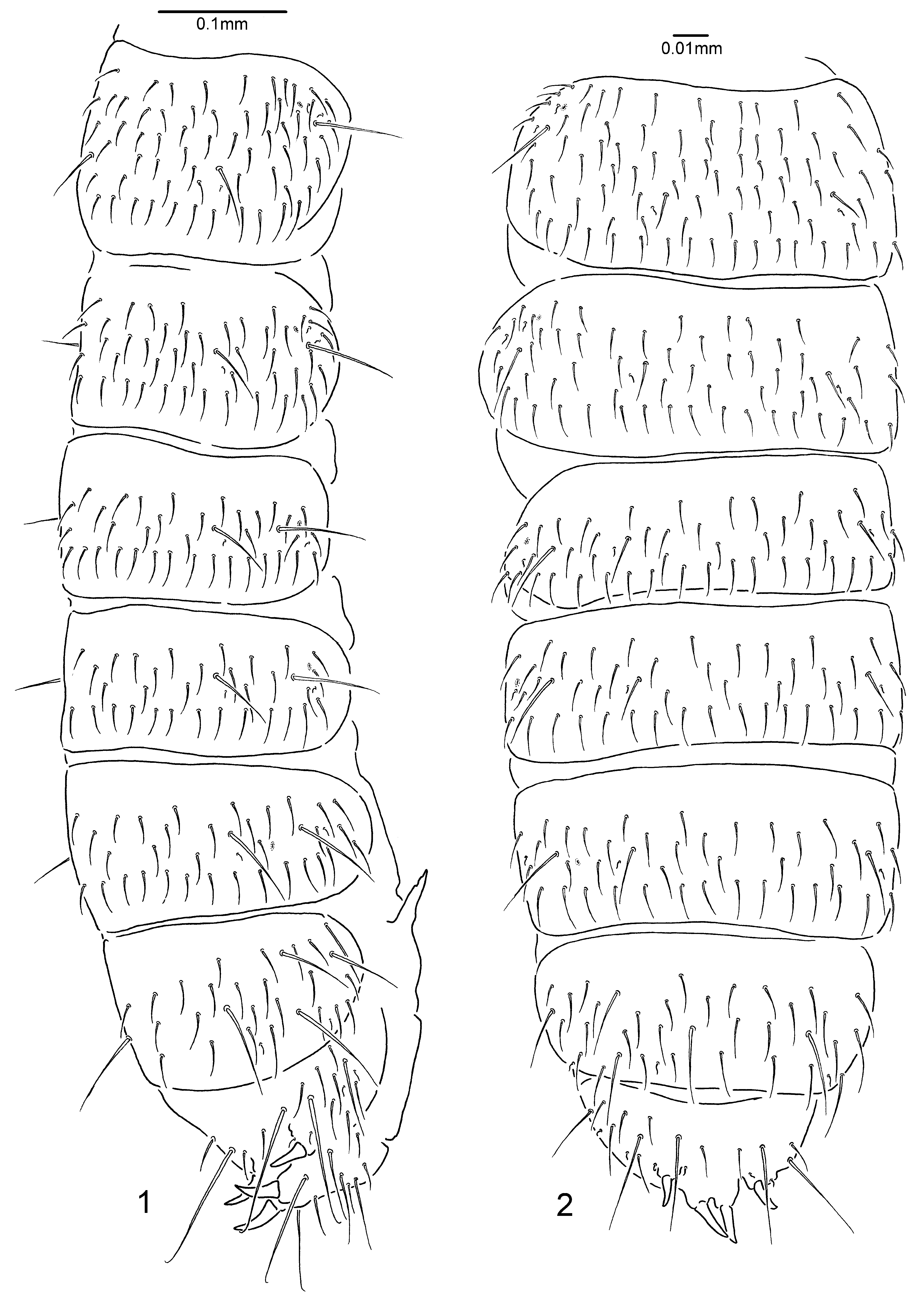
Description. Habitus typical of the genus Tetracantella. Body length (without antennae) 0.9 mm. Color of dorsal and ventral side of the body bluish-gray, including antennae. Dorsal integument reticulate with unequal polygons, some of them large and elongated (largest ones on abdominal tergum IV 20 times larger than diameter of mesochaeta socket, Fig. 8). Smooth fields absent. Dorsal chaetotaxy as in Figs 2 – 3. Head with 2 + 2 macrochaetae (ratio: lateral macrochaeta / macrochaeta in eye field = 1.4 – 1.7), chaeta ap present, 5 pp-chaetae between axial line and mesochaeta p 3. (Fig. 3). Macrochaetotaxy of thoracic tergum II – abdominal tergum III 2, 2 / 2, 2, 2 (Fig. 2). Ratio: dorsal macrochaeta / chaeta p 1 on thoracic tergum II – abdominal tergum III = 1.1 – 1.5, 1.1 – 1.5 / 1.2 – 1.9,1.2 – 1.7,1.5 – 2.0, ratio: lateral macrochaeta / chaeta p 1 on thoracic tergum II – abdominal tergum III = 2.6 – 3.1,2.1 – 3.1 / 2.0 – 2.6,2.0 – 2.6,1.9 – 2.3. Number of chaetae along median line of thoracic tergum II – abdominal tergum IV: 12, 8 / 4, 4, 4, 6 (Fig. 2). Abdominal tergum V with chaetae a 1 behind macrochaetae (Fig. 2). Number of sensilla on thoracic tergum II – abdominal tergum V: 3, 3 / 2, 2, 2, 2, 4 (Fig. 2). Median sensilla situated behind macrochaetae. Number of microsensilla on thoracic tergum II – abdominal tergum III: 1, 1 / 1, 1, 1 (Fig. 2). Ventral chaetae on thorax absent. Ventral tube with 3 + 3 laterodistal and 2 + 2 posterior chaetae. Furca long with bidentate mucro (Fig. 7). Dens about 1.7 – 1.9 times as long as inner edge of claw III, with 1 ventral (anterior) and 3 dorsal (posterior) chaetae. Anterior furcal subcoxa with 4 – 5, posterior with 3 – 4 chaetae (Fig. 7). Manubrium with 7 – 9 + 7 – 9 dorsal chaetae (Fig. 7). Retinaculum with 3 + 3 teeth and without chaeta (Fig. 7). Anal spines almost straight, fine and yellow on distinctly reticulated papilla (Fig. 2). Antennae equal or somewhat shorter than head. Two protruding apical lobes and numerous slender thin sensilla on dorsal side of antennal segment IV present. Apex of antenna without apical bulb, males without sensillum s’ on antennal segment III. Ocelli 8 + 8, G and H distinctly smaller than others (Fig. 3). Postantennal organ narrow and elliptical, with median constriction, about 2.2 – 2.5 times longer than the diameter of ocellus A (Fig. 3). Prelabral / labral chaetotaxy as 4 / 5, 5, 4. Labium with 4 basomedial and 5 basolateral chaetae, labial palp with 3 proximal chaetae. Labial papillae A-E with 1, 3, 0, 3, 5 guard chaetae respectively. Papilla E with small spine-like lateral process (l. p.). Papilla H (main hypostomal seta H in Fjellberg 1999) with 2 chaetae and small spine-like process. Mandibles typical of the genus. Maxilla with 6 lamellae. Maxillary outer lobe with 2 sublobal hairs (Fig. 4). Claw without inner tooth. Empodium about 0.5 times as long as inner edge of claw III (Fig. 6). Tibiotarsi dorsally with 1, 2, 2 slightly clavate distal chaetae (Fig. 6). Tibiotarsi I and II with 21 – 22 chaetae each, III with 22 – 25 chaetae. Stick-like chaetae x in males absent.
Fiera, Cristina, Konikiewicz, Marta, Skarżyński, Dariusz (2013): Tetracanthella doftana sp. nov. (Collembola, Isotomidae) from Romania, with a key to Carpathian Tetracanthella Schött, 1891. Zootaxa 3691 (4): 467-472, DOI: 10.11646/zootaxa.3691.4.6
Remarks. T. doftana sp. nov. belongs to T. pilosa group and shares numerous characters (bidentate mucro, dens with 1 ventral and 3 dorsal chaetae, retinaculum with 3 + 3 teeth and without chaeta, macrochaetotaxy 2 / 2, 2 / 2, 2, 2 and empodium about 0.5 times as long as inner edge of claw III) with T. andalusiaca Deharveng, 1987, described from Southern Spain (Cadiz, Sierra de Grazalema). They differ mainly by the number of sublobal hairs (T. doftana sp. nov. – 2, T. andalusiaca – 1, Fig. 5) and size of macrochaetae especially on thoracic terga II – III (T. doftana sp. nov. – Mdl / p 1 = 1.4, T. andalusiaca – Mdl / p 1 = 2, Figs 1 – 2). Moreover, they are remote geographically and this is important differential feature as the genus is characterized by a high degree of endemism (Deharveng 1987, Potapov 2001).
Fiera, Cristina, Konikiewicz, Marta, Skarżyński, Dariusz (2013): Tetracanthella doftana sp. nov. (Collembola, Isotomidae) from Romania, with a key to Carpathian Tetracanthella Schött, 1891. Zootaxa 3691 (4): 467-472, DOI: 10.11646/zootaxa.3691.4.6
Etymology. The new species is named after Doftana River in Romania.
Fiera, Cristina, Konikiewicz, Marta, Skarżyński, Dariusz (2013): Tetracanthella doftana sp. nov. (Collembola, Isotomidae) from Romania, with a key to Carpathian Tetracanthella Schött, 1891. Zootaxa 3691 (4): 467-472, DOI: 10.11646/zootaxa.3691.4.6
Type material. Holotype female on slide, Romanian Subcarpathians, Doftana Valley, near to a cliff from Brebu gorges, Prahova district, (45 ° 12 ' 31.1 '' N; 25 ° 44 ' 23.5 '' E), 537 m a. s. l., soil and mosses, 11. v. 2009, leg. C. Fiera. Paratypes: 3 females, 3 males, 5 juv. on slides, Romanian Subcarpathians, Doftana Valley, near to a cliff from Brebu gorges, Prahova district, (45 ° 12 ' 31.1 '' N; 25 ° 44 ' 23.5 '' E), 537 m a. s. l., soil and mosses, 11. v. 2009, vii. 2008, 26. iv. 2010, 27. iv. 2010, 4. viii. 2010, leg. C. Fiera. Holotype and 10 paratypes deposited in the collection of the Institute of Biology, Romanian Academy, Bucharest, Romania, 1 paratype deposited in the collection of the Department of Evolutionary Biology and Ecology, University of Wrocław, Poland.
Fiera, Cristina, Konikiewicz, Marta, Skarżyński, Dariusz (2013): Tetracanthella doftana sp. nov. (Collembola, Isotomidae) from Romania, with a key to Carpathian Tetracanthella Schött, 1891. Zootaxa 3691 (4): 467-472, DOI: 10.11646/zootaxa.3691.4.6
Export occurrence data
Darwin Core Archive (ZIP)
CLASSIFICATION
Taxonomic Classification Tree

MULTIMEDIA
Media Files(2)
FIGURES 1 – 2. Chaetotaxy of thoracic tergum II – abdominal tergum VI: 1, T. andalusiaca; 2, T. doftana sp. nov.
Imageimage/png© Fiera, Cristina;Konikiewicz, Marta;Skarżyński, DariuszFiera, Cristina;Konikiewicz, Marta;Skarżyński, Dariusz

FIGURES 3 – 8. T. doftana sp. nov.: 3, chaetotaxy of head; 4, maxillary outer lobe; 6, tibiotarsus III; 7, furca; 8, reticulation of integument in axial area of abd. IV; T. andalusiaca: 5, maxillary outer lobe.
Imageimage/png© Fiera, Cristina;Konikiewicz, Marta;Skarżyński, DariuszFiera, Cristina;Konikiewicz, Marta;Skarżyński, Dariusz
IMAGES