AnimaliaNot EvaluatedacceptedspeciesAccepted
Cladocarpus diana

Cladocarpus diana

Broch, 1918

GBIF:119583396

0year

ABOUT

Descriptions(6)

Cladocarpus diana: Vervoort 1966: 149. — Schuchert 2001: 138, fig. 118 A – D. — Bouillon et al. 2006: 283.
Altuna, Álvaro, Murillo, Francisco J., Calder, Dale R. (2013): Aglaopheniid hydroids (Cnidaria: Hydrozoa: Aglaopheniidae) from bathyal waters of the Flemish Cap, Flemish Pass, and Grand Banks of Newfoundland (NW Atlantic). Zootaxa 3737 (5): 501-537, DOI: 10.11646/zootaxa.3737.5.1

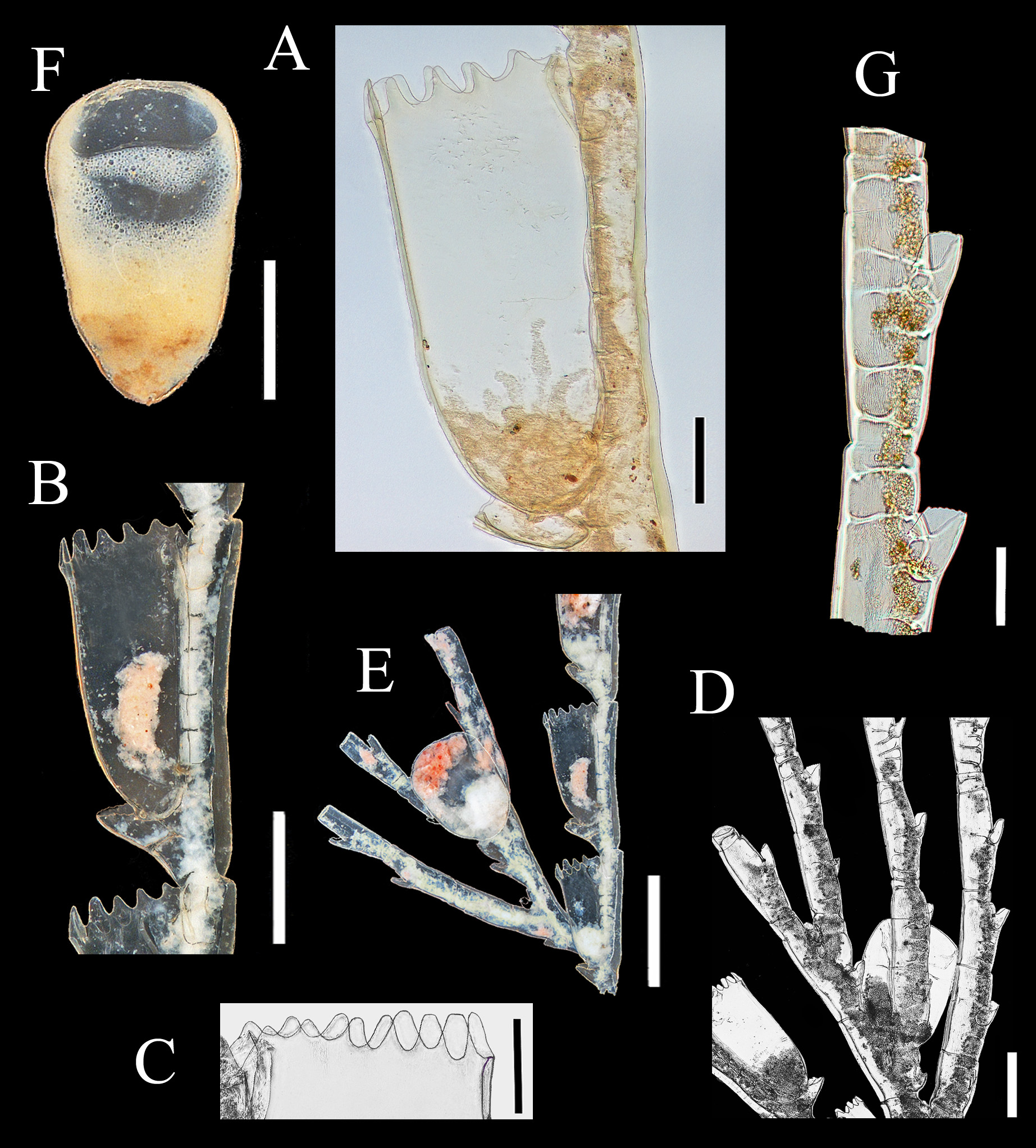
Description. Colonies up to 7.0 cm high and 2.5 cm wide, formed by a root-like hydrorhiza consisting of a tuft of tubules supporting a polysiphonic stem, thinning out to monosiphonic distally. Stem light brown, flaccid when out of liquid, 0.9 mm wide proximally and tapering distally; distal part sometimes slightly geniculated. No ramification. Main axial tube in front of stem and branches divided into 970 – 1200 µm long and 470 – 500 µm wide internodes by indistinct transverse nodes. Internodes with one apophysis more or less in middle, alternately right and left in successive internodes, giving rise to hydrocladia. Three nematothecae surrounding apophyses, one basal and two distal, one on each side. Accessory tubes scarce, parallel, with neither hydrothecae nor nematothecae. Hydrocladia up to 1.65 cm long, alternate, spaced, given off at slightly acute angles with stem and branches, divided into up to 12 thecate internodes by more or less well-marked transverse nodes. Internodes with 6 – 7 internal septa (occasionally absent), one hydrotheca, and three one-chambered nematothecae. Hydrothecae large, deep, shorter than corresponding cormidia, with almost parallel walls in side view, but widening distally in frontal view; long axis parallel to that of internode, with depth / width at rim = 2.07 – 2.28 (n = 25). Perisarc thin, with a longitudinal mesial thickening on abcauline side. Intrathecal septum arising from behind hydrotheca, projecting forwards into its lumen, very reduced, thin, frequently oblique. Hydrothecal rim at right angle with the segment, with 9 – 11 cusps separated by deep embayments. Cusps rounded, sometimes uneven, with first abcauline pair clearly less pointed than others and almost blunt distally (Figure 3 C). Mesial nematothecae adnate to hydrotheca except on first internode, where there is a distinct gap between distal end of nematotheca and hydrothecal base. Aperture as wide as hydrotheca when seen frontally, rim smooth to sinuous, sometimes with an embayment in middle; distal end extending for 1 / 10 – 1 / 11 of adaxial hydrothecal wall. Lateral supra-calycine nematothecae arising oblique from hydrocladium, partially adpressed to distal hydrothecal wall, with aperture at level of hydrothecal rim; margin finely crenulated. Phylactocarps up to 4.4 mm long, arising singly on hydrocladia, laterally from base of hydrotheca of first cormidium. They are formed by a first small internode devoid of nematothecae, followed by a jointed antler-shaped branched structure arching over the gonothecae. Branches normally three (occasionally up to four), each with a single row of nematothecae and some internal septa. Nematothecae with wide apertures and finely crenulated margins. Gonothecae 1 – 2 on each phylactocarp, attached by a small pedicel to points of ramification; obovate and curved distally, with lateral aperture tilted towards phylactocarp. Sex could not be ascertained.
Altuna, Álvaro, Murillo, Francisco J., Calder, Dale R. (2013): Aglaopheniid hydroids (Cnidaria: Hydrozoa: Aglaopheniidae) from bathyal waters of the Flemish Cap, Flemish Pass, and Grand Banks of Newfoundland (NW Atlantic). Zootaxa 3737 (5): 501-537, DOI: 10.11646/zootaxa.3737.5.1
Remarks. In material of the species described earlier, every phylactocarp divided dichotomously to form a structure of three branches (Broch 1918; Schuchert 2001). In some colonies examined here (NEREIDA 0610 RD 67), however, one of the branches may divide twice, resulting in a four-branch phylactocarp. The margin of the median inferior nematotheca is highly varied, although its position in relation to the hydrotheca is decidedly regular. Sometimes it is almost even, as depicted by Broch (1918), but at times it is deeply indented in the middle, roughly leaving two symmetric lobes and giving the impression of a bifid theca. Transitions between the two extremes occur. In most aglaopheniid species from the study area, the mesial nematotheca tapers distally when seen frontally, with its end rather thinner than its base. However, in C. diana the distal end is much wider than its base, being equal to the contiguous part of the hydrotheca. The position of the centrally placed nematotheca on the internodes of the main tube varies. Normally, it is close to the apophysis, but sometimes the internodes are longer and the nematotheca is distant from it and is close to the proximal node instead (NEREIDA 0610 RD 63). One colony from this station is particularly delicate, having a thin stem and only a few accessory tubules, the hydrocladia are quite distant, and there are only a few phylactocarps. In addition, a colony from the Flemish Cap (FC 07 L 165), the largest known to date (7.0 cm high), has the longest internodes and deepest hydrothecae (Table 4). Broch (1918) observed hydrothecae on an outer branch of a phylactocarp, and regarded it as an abnormality. A similar observation was noted in one phylactocarp from NEREIDA 0610 RD 67. Nomenclaturally, the specific name diana applied to this hydroid is taken to be a personal name formed as a noun in apposition. As such, the original spelling, Cladocarpus diana (first published as Cladocarpus Diana), is correct. While the Fourth Edition of the International Code of Zoological Nomenclature (ICZN) recommends avoidance of personal names as nouns in apposition (Recommendation 31 A) to avoid possible confusion over authorship of the accompanying generic name, changing the species-group name diana to dianae in this case would result in an incorrect subsequent spelling (ICZN Art. 33.3). Observed depth range: 600 – 1575 m. These are the shallowest and the deepest records, respectively, of the species, previously known only from European waters (south of Iceland) at depths of 1358 – 1504 m (Broch 1918).
Altuna, Álvaro, Murillo, Francisco J., Calder, Dale R. (2013): Aglaopheniid hydroids (Cnidaria: Hydrozoa: Aglaopheniidae) from bathyal waters of the Flemish Cap, Flemish Pass, and Grand Banks of Newfoundland (NW Atlantic). Zootaxa 3737 (5): 501-537, DOI: 10.11646/zootaxa.3737.5.1
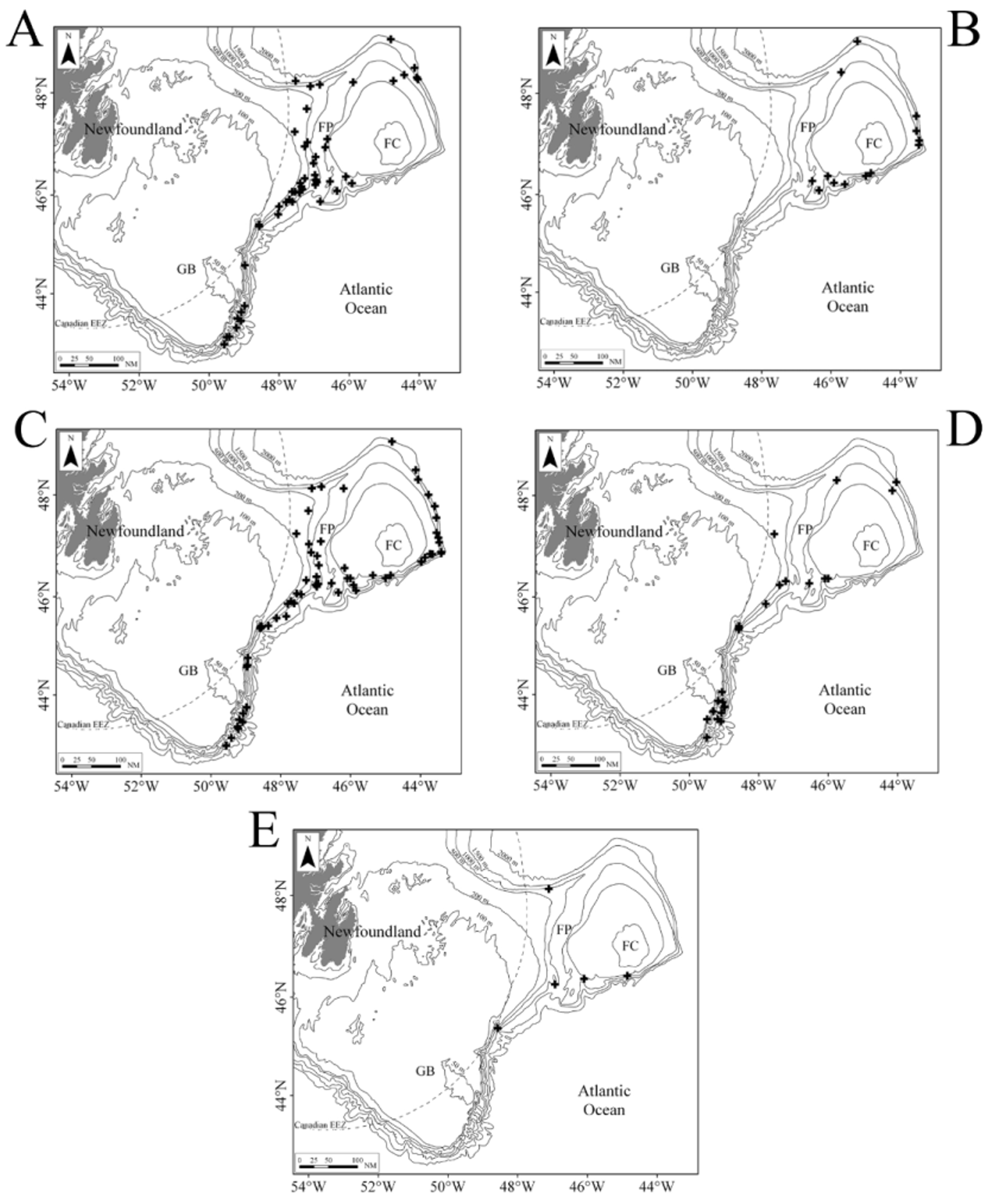
Distribution. Previously known only from two stations south of Iceland (Broch 1918, ca. 1355 – 1504 m; Schuchert 2001). This is the first record of Cladocarpus diana in the western Atlantic, with collections from the Flemish Cap and the Beothuk Knoll. Present records also constitute the southernmost reports of the species.
Altuna, Álvaro, Murillo, Francisco J., Calder, Dale R. (2013): Aglaopheniid hydroids (Cnidaria: Hydrozoa: Aglaopheniidae) from bathyal waters of the Flemish Cap, Flemish Pass, and Grand Banks of Newfoundland (NW Atlantic). Zootaxa 3737 (5): 501-537, DOI: 10.11646/zootaxa.3737.5.1
Fertile material. Collected in July 2007 (838 – 1216 m depth), June and July 2009 (1071 – 1575 m depth), and June 2010 (600 – 1486 m depth).
Altuna, Álvaro, Murillo, Francisco J., Calder, Dale R. (2013): Aglaopheniid hydroids (Cnidaria: Hydrozoa: Aglaopheniidae) from bathyal waters of the Flemish Cap, Flemish Pass, and Grand Banks of Newfoundland (NW Atlantic). Zootaxa 3737 (5): 501-537, DOI: 10.11646/zootaxa.3737.5.1
Material examined. FC 07 L 165, one fertile colony 7.0 cm high; FC 07 L 169, 3 fertile colonies, largest one 6.0 cm high; FC 07 L 171, one fertile colony 3.0 cm high; NEREIDA 0509 RD 15, 4 colonies, largest one 4.3 cm high, 3 fertile; NEREIDA 0509 RD 18, one fertile colony 4.7 cm high; NEREIDA 0509 RD 20, 5 colonies, largest one 5.8 cm high, 4 fertile; NEREIDA 0609 RD 36, one sterile fragment 1.5 cm high; NEREIDA 0609 RD 38, one sterile fragment 1.0 cm high; NEREIDA 0610 RD 62, 2 fertile colonies, largest one 2.7 cm high; NEREIDA 0610 RD 63, 2 fertile colonies, largest one 4.0 cm high, and a sterile fragment 1.4 cm high; NEREIDA 0610 RD 64, 3 colonies, largest 4.6 cm high, 2 fertile; NEREIDA 0610 RD 67, one fertile colony 5.0 cm high; NEREIDA 0610 RD 71, one sterile fragment 2.0 cm high.
Altuna, Álvaro, Murillo, Francisco J., Calder, Dale R. (2013): Aglaopheniid hydroids (Cnidaria: Hydrozoa: Aglaopheniidae) from bathyal waters of the Flemish Cap, Flemish Pass, and Grand Banks of Newfoundland (NW Atlantic). Zootaxa 3737 (5): 501-537, DOI: 10.11646/zootaxa.3737.5.1

Export occurrence data

Darwin Core Archive (ZIP)

CLASSIFICATION

Taxonomic Classification Tree

MULTIMEDIA

Media Files(2)

FIGURE 1. Distribution of the five aglaopheniid species in the study area. A) Aglaophenopsis cornuta (Verrill, 1879). B) Cladocarpus diana Broch, 1918. C) Cladocarpus formosus Allman, 1874. D) Cladocarpus integer (G. O. Sars, 1874). E) Nematocarpus ramuliferus (Allman, 1874). FC, Flemish Cap; FP, Flemish Pass; GB, Grand Banks.

Imageimage/png© Altuna, Álvaro;Murillo, Francisco J.;Calder, Dale R.Altuna, Álvaro;Murillo, Francisco J.;Calder, Dale R.

FIGURE 3. Cladocarpus diana Broch, 1918. A, B) Hydrothecae. C) Detail of hydrothecal rim showing cusps; note that the first abcauline pair is almost blunt distally. D, E) Phylactocarps with gonothecae. F) Gonotheca in frontal view. G) Detail of a phylactocarp, showing internal septa. Scale bar: A, C, G = 200 µm; B, D, F = 500 µm; E = 1000 µm. A, B, E, F = NEREIDA 0610 RD 63; C, D, E, G = NEREIDA 0610 RD 67.

Imageimage/png© Altuna, Álvaro;Murillo, Francisco J.;Calder, Dale R.Altuna, Álvaro;Murillo, Francisco J.;Calder, Dale R.

IMAGES

Gallery(2)

See Gallery

Occurrences with images

Source Information

Aglaopheniid hydroids (Cnidaria: Hydrozoa: Aglaopheniidae) from bathyal waters of the Flemish Cap, Flemish Pass, and Grand Banks of Newfoundland (NW Atlantic)

checklist

This dataset contains the digitized treatments in Plazi based on the original journal article Altuna, Álvaro, Murillo, Francisco J., Calder, Dale R. (2013): Aglaopheniid hydroids (Cnidaria: Hydrozoa: Aglaopheniidae) from bathyal waters of the Flemish Cap, Flemish Pass, and Grand Banks of Newfoundland (NW Atlantic). Zootaxa 3737 (5): 501-537, DOI: 10.11646/zootaxa.3737.5.1

Altuna Á, Murillo F J, Calder D R, plazi (2013). Aglaopheniid hydroids (Cnidaria: Hydrozoa: Aglaopheniidae) from bathyal waters of the Flemish Cap, Flemish Pass, and Grand Banks of Newfoundland (NW Atlantic). Plazi.org taxonomic treatments database. Checklist dataset https://doi.org/10.11646/zootaxa.3737.5.1 accessed via GBIF.org on 2026-06-17.

CC0Published 12/31/2013View dataset
GBIF Usage Key
119583396
Dataset Key
41270562-5823-432b-8263-aff0bd4d4e14
Origin
source
Backbone Key
2267283
Taxon ID
03AEB1110A42BD2199ACFE1CFA817FC7.taxon
Last Crawled
6/11/2026
Last Interpreted
6/11/2026