AnimaliaNot EvaluatedacceptedspeciesAccepted
Aglaophenopsis cornuta

Aglaophenopsis cornuta

(Verrill, 1879) Verrill, 1879

GBIF:119583401

0year

ABOUT

Descriptions(6)

Aglaophenia cornutus: Bonnevie 1899: 94. Aglaophenopsis cornuta: Nutting 1900: 120, pl. 30, fig. 6 – 9. — Whiteaves 1901: 28. — Broch 1910: 234. — Kindle & Whittaker 1917: 232. — Broch 1918: 77, fig. 39 a – b, fig. 40 a – d, fig. 41. — Jäderholm 1919: 11. — Fraser 1921: 177, fig. 102. — Kramp 1932 a: 56. — Kramp 1932 b: 20. — Kramp 1943: 44. — Fraser 1944: 395, pl. 85, fig. 382. — Vervoort 1972: 204. — Calder 1997 b: 88. — Henry 2001: 163.
Altuna, Álvaro, Murillo, Francisco J., Calder, Dale R. (2013): Aglaopheniid hydroids (Cnidaria: Hydrozoa: Aglaopheniidae) from bathyal waters of the Flemish Cap, Flemish Pass, and Grand Banks of Newfoundland (NW Atlantic). Zootaxa 3737 (5): 501-537, DOI: 10.11646/zootaxa.3737.5.1

Description. Colonies up to 28.7 cm high, formed by a broad hydrorhizal mass supporting a polysiphonic stem, up to 3.0 mm wide proximally, thinning out to monosiphonic distally. Stem rigid, thick, erect. Ramification in one plane, profuse, up to the fourth order. Branches almost opposite, arising at slightly acute angles, long, polysiphonic for most of their length, slightly tapering distally. Stem deep brown basally and light brown distally; branches also light brown. Main axial tube on front of stem and branches, divided into short internodes, 550 – 600 µm long. Successive internodes each with one apophysis alternately right and left, giving rise to branches and hydrocladia. Three nematothecae surrounding the apophyses: one basal and two distal. Accessory tubes numerous, with neither hydrothecae nor nematothecae. Hydrocladia alternate, up to 1.2 cm long, divided into up to 15 thecate internodes by more or less well-marked transverse nodes. Internodes with 2 – 9 internal septa, one hydrotheca, and three one-chambered nematothecae. Hydrotheca as long as the internode, large, conical in lateral view and somewhat oval to round in cross-section, with depth / width at rim = 1.08 – 1.48 (n = 25). Intrathecal septum inconspicuous, very small, arising from the adaxial wall of hydrotheca and projecting forwards in its lumen. A characteristic abcauline median keel with a sharp, hollow tip, arising above mesial nematotheca; strong, large, laterally compressed, slightly curved, extending 332 – 528 µm beyond level of hydrothecal margin, reaching end of mesial nematotheca of the following distal internode, or nearly so. Hydrothecal rim with 9 – 11 low cusps, including a small mesial tooth aligned with the keel. Mesial nematothecae extending for 1 / 3 – 1 / 2 the length of abaxial hydrothecal wall, slightly tapering distally, with wide aperture and crenulated rim, as well as a thickening of perisarc at its basis in the axil between the wall of the hydrotheca and the nematotheca; on first internode it is slightly displaced to one side. Lateral nematothecae arising from hydrocladium, partially attached to distal hydrothecal wall, with end slightly surpassing hydrothecal rim and crenulated margin. Phylactocarps forked (Y – shaped), segmented, up to 2.3 mm long, arising laterally from hydrothecal bases of proximal thecate internodes beside mesial nematotheca; not replacing nematotheca. Internal septa numerous. Segments short, carrying unpaired nematothecae with margin of aperture finely crenulated. Both branches with one terminal hydrotheca. Gonothecae borne on short pedicels, obovate, curved, arising singly from apophyses of stem and branches; aperture broadly oval to almost circular, latero-distal. Sex could not be ascertained.
Altuna, Álvaro, Murillo, Francisco J., Calder, Dale R. (2013): Aglaopheniid hydroids (Cnidaria: Hydrozoa: Aglaopheniidae) from bathyal waters of the Flemish Cap, Flemish Pass, and Grand Banks of Newfoundland (NW Atlantic). Zootaxa 3737 (5): 501-537, DOI: 10.11646/zootaxa.3737.5.1
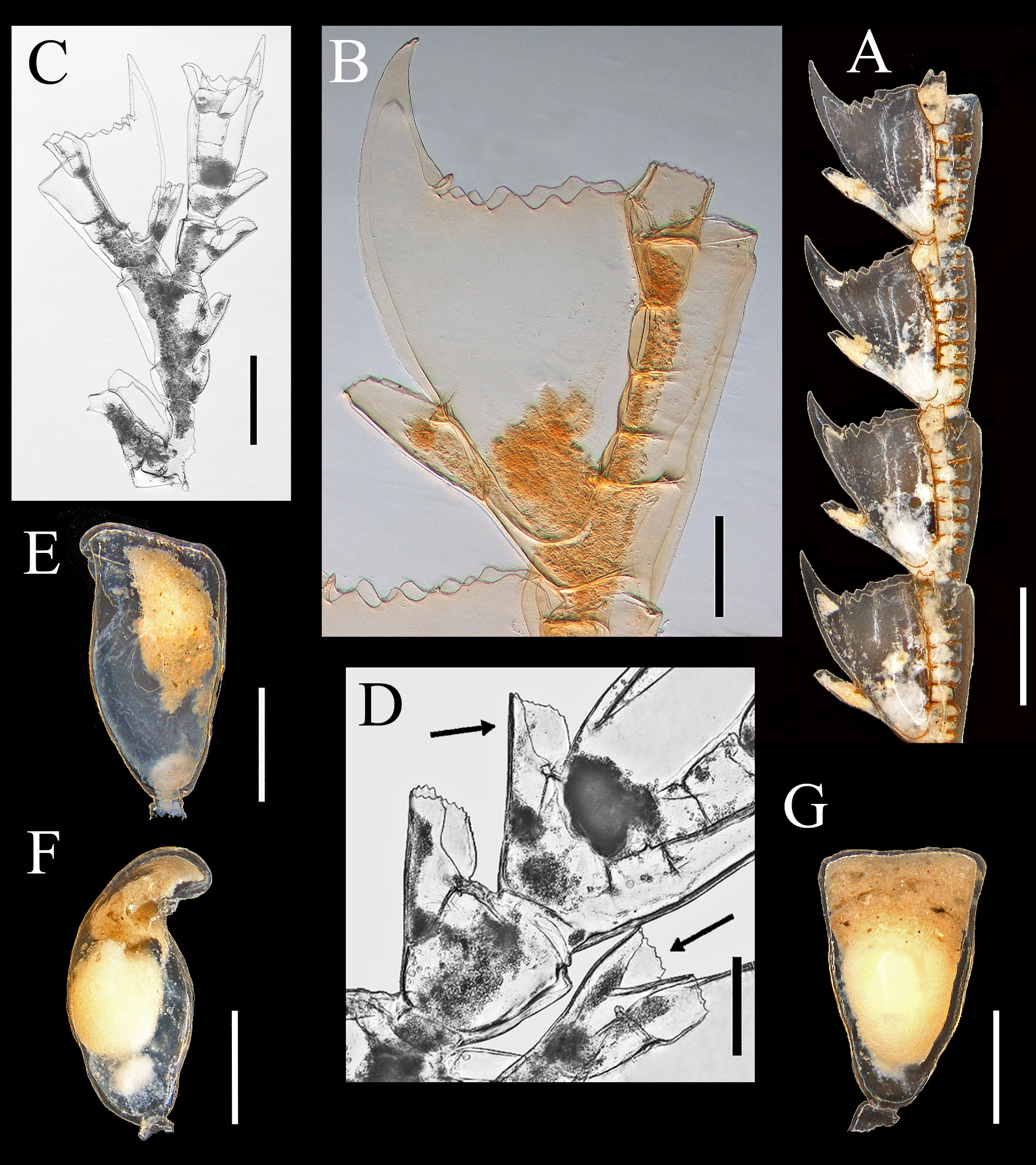
Remarks. This species is readily distinguished from others in the study area by the characteristic shape of its hydrothecae (Figure 2 A – C). Especially noteworthy is the presence of a pronounced median hydrothecal keel with thickened perisarc. Its tip normally reaches the base of the mesial nematotheca of the following internode, and sometimes also approaches its end. The variability of this keel was discussed by Broch (1918). Aglaophenopsis bonnevieae (Jäderholm, 1909), sometimes sympatric with A. cornuta in Greenland and subarctic waters of the northwestern Atlantic (see Kramp 1932 a; Schuchert 2001), likewise has a prominent, although somewhat less developed, hydrothecal keel. Moreover, its hydrotheca differs from that of A. cornuta in having a conspicuous intrathecal septum, and the hydrothecal rim is slightly crenulated rather than cusped. Paired nematothecae on the internodes of the main axial tube also occur in the upper axil of the apophyses rather than at its sides. Phylactocarps of A. bonnevieae also differ in being much more ramified and in having more hydrothecae. Hydrothecae of A. cornuta somewhat resemble certain species of Gymnangium Hincks, 1874, including the European G. montagui (Billard, 1912) and others from South Africa (see Millard 1975). However, the ‘ horn’ in such species of Gymnangium is a hypertrophied mesial nematotheca, while that of A. cornuta is a large median hydrothecal keel arising distal to the mesial nematotheca. The keel does not represent a highly modified median abcaulinar cusp of the hydrothecal margin because that cusp is both present and small. The margin of the median inferior nematotheca of the thecate internodes (and also of the terminal hydrothecae of the phylactocarp), is at times deeply indented in the middle, giving the impression of a twin theca (NEREIDA 0710 RD 79, Figure 2 D). Colonies with gonothecae on stem apophyses, unprotected by any phylactocarps, were found in samples from some stations (NEREIDA 0709 RD 49). Although originally assigned to Cladocarpus, this species has also been referred to Aglaophenopsis by several authors. According to Fraser (1944), phylactocarps of this species represent a modified mesial nematophore. In our material, however, the phylactocarp arises laterally from the base of a hydrotheca borne on a proximal thecate internode. It is situated beside a clearly distinct mesial nematotheca and does not replace it. Moreover, contrary to Fraser, both branches of the phylactocarp bear a terminal hydrotheca. The species was assigned to Cladocarpus (as C. cornutus) by both Bouillon et al. (2006) and Schuchert (2012 a). Observed depth range: 240 – 1885 m. The known maximum depth for the species is extended from 1200 m (Kramp 1932 a) to 1885 m. A neritic-bathyal species (Calder 1997 b).
Altuna, Álvaro, Murillo, Francisco J., Calder, Dale R. (2013): Aglaopheniid hydroids (Cnidaria: Hydrozoa: Aglaopheniidae) from bathyal waters of the Flemish Cap, Flemish Pass, and Grand Banks of Newfoundland (NW Atlantic). Zootaxa 3737 (5): 501-537, DOI: 10.11646/zootaxa.3737.5.1
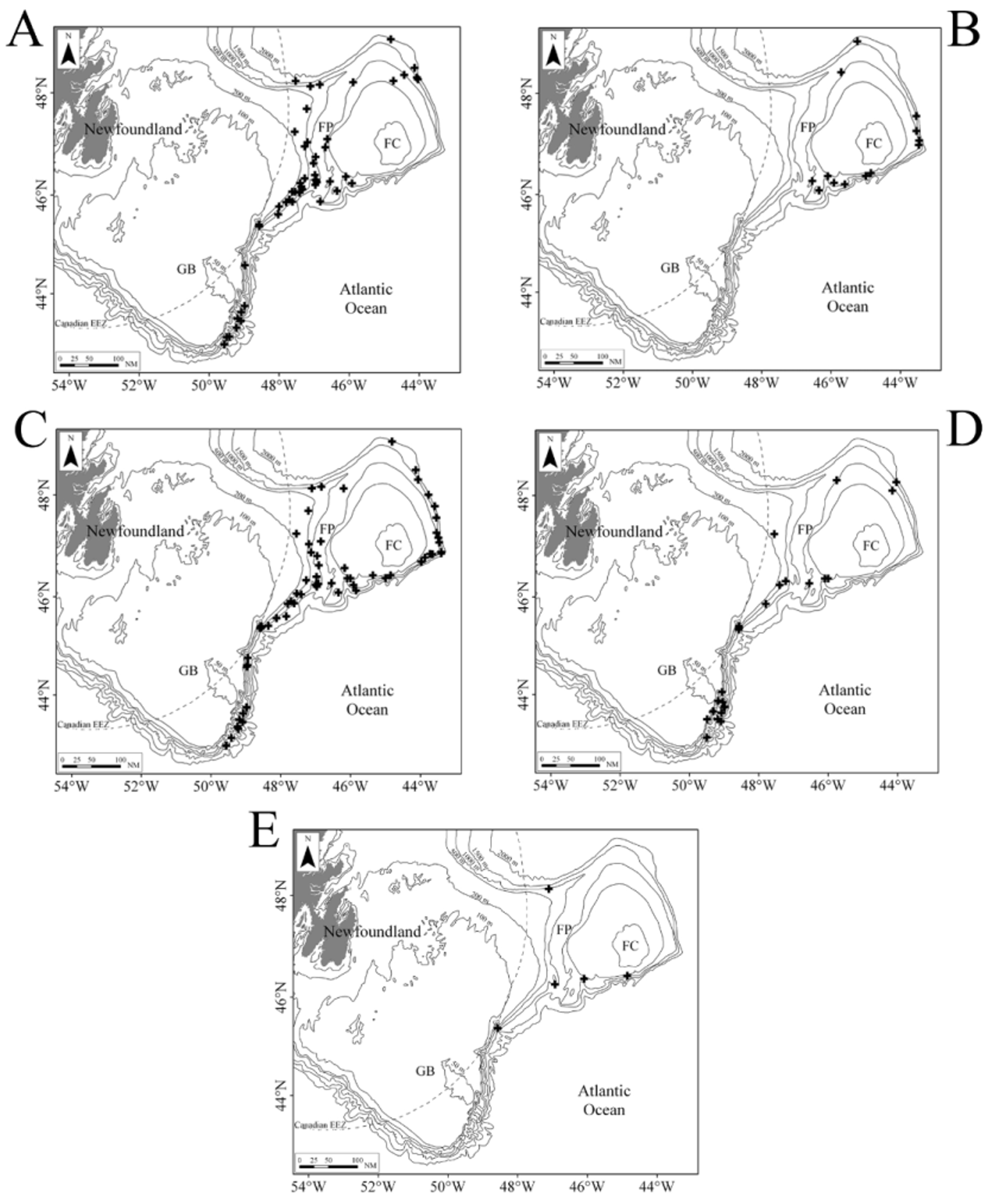
Distribution. A North Atlantic species known from Denmark Strait (Broch 1918, ca. 253 – 603 m; Schuchert 2001, 200 – 700 m), eastern Greenland (Broch 1918, ca. 260 – 621), southwest Greenland at 63 º 36 ’ N – 55 º 15 ’ W (1200 m) and 60 º 16 ’ N – 47 º 48 ’ W (135 m) (Kramp 1932 a), two stations in Bredefjord, south Greenland (Kramp 1932 b, 310 – 330 m and 700 m), Davis Strait (Levinsen 1893, ca. 188 – 544 m; Kramp 1913, 700 – 1055 m; Broch 1918, ca. 544 m), western Greenland (Broch 1918, ca. 1095 m), Baffin Bay (Jäderholm 1909, ca. 731 m), 72 ° 32 ’ N – 58 ° 05 ’ W (ca. 212 m), 60 º 27 ’ N – 48 º 31 ’ W (Vervoort 1972, 326 – 366 m), 53 ° 34 ’ N – 52 ° 01 ’ W (ca. 1792 m) and 52 ° 25 ’ N – 52 ° 12 ’ W (ca. 296 m) (Jäderholm 1919), eastern Canada (Kindle & Whittaker 1917, ca. 365 m, based on literature records), off northeast Newfoundland, 51 ° 22 ’ 30 ” N – 50 ° 31 ’ 30 ” W (Calder 1970, 457 m, as Cladocarpus cornutus), Flemish Cap, Flemish Pass, and Grand Banks (present study), Northeast Channel, south of Nova Scotia, at 42 ° 02 ’ N – 65 ° 36 ’ W (Henry 2001; personal communication, 24.11.2012), off Sable Island on Banquereau (Verrill 1879, ca. 365 m, first description; Nutting 1900; Whiteaves 1901; Fraser 1918, 1944), east of Gloucester (Massachusetts) (Fraser 1944, ca. 310 m). Not recorded further south by Henry et al. (2008), but there is a recent southern record from 53 º 56 ’ S – 63 º 51 ’ W (250 m) by El Beshbeeshy (2011).
Altuna, Álvaro, Murillo, Francisco J., Calder, Dale R. (2013): Aglaopheniid hydroids (Cnidaria: Hydrozoa: Aglaopheniidae) from bathyal waters of the Flemish Cap, Flemish Pass, and Grand Banks of Newfoundland (NW Atlantic). Zootaxa 3737 (5): 501-537, DOI: 10.11646/zootaxa.3737.5.1
Fertile material. Collected in August 2006 (240 – 1233 m depth), June and July 2007 (460 – 878 m depth), August 2008 (392 – 1198 m depth), from May to August 2009 (425 – 1885 m depth), and from June to August 2010 (345 – 1353 m depth).
Altuna, Álvaro, Murillo, Francisco J., Calder, Dale R. (2013): Aglaopheniid hydroids (Cnidaria: Hydrozoa: Aglaopheniidae) from bathyal waters of the Flemish Cap, Flemish Pass, and Grand Banks of Newfoundland (NW Atlantic). Zootaxa 3737 (5): 501-537, DOI: 10.11646/zootaxa.3737.5.1
Material examined. FN 3 L 06 L 51, 2 fertile colonies, largest one 9.5 cm high; FN 3 L 06 L 85, one fertile colony 7.0 cm high; FN 3 L 06 L 88, one fertile colony 10.5 cm high; FN 3 L 06 L 92, one fertile colony 15.0 cm high; PLA 07 L 61, one sterile colony 8.4 cm high; PLA 07 L 99, one sterile colony 10.0 cm high; PLA 07 L 107, one fertile colony 6 cm high; FC 07 L 74, one sterile colony 7.2 cm high; FC 07 L 133, one sterile colony 4.3 cm high; FC 07 L 153, one sterile colony 13.0 cm high; FC 07 L 171, one sterile fragment 1.6 cm high; FC 07 L 177, one sterile colony 5.5 cm high; FC 07 L 178, one fertile fragment 6.2 cm high; FN 3 L 08 L 88, 3 fertile colonies, largest one 21.0 cm high; FN 3 L 08 L 89, 3 fertile colonies, largest one 15.0 cm high; FN 3 L 09 L 80, one fertile colony 10.0 cm high; FN 3 L 09 L 89, one fertile colony 16.0 cm high; FN 3 L 10 L 35, one fertile colony 14.0 cm high; FN 3 L 10 L 57, one fertile colony 9.0 cm high; FN 3 L 10 L 87, one fertile colony 15.5 cm high; NEREIDA 0509 RD 4, one fertile colony 12.2 cm high; NEREIDA 0509 RD 6, 5 colonies, largest one 15.3 cm high, 2 of them fertile; NEREIDA 0509 RD 7, 6 colonies, up to 15.6 cm high, some fertile; NEREIDA 0609 RD 26, 2 sterile colonies, largest one 4.2 cm high; NEREIDA 0609 RD 27, 3 colonies, largest one 5.5 cm high, one fertile; NEREIDA 0609 RD 28, 2 fertile colonies, both 6.0 cm high; NEREIDA 0609 RD 41, 34 colonies, up to 11.3 cm high, some fertile; NEREIDA 0709 RD 49, 5 colonies, largest one 6 cm high, 2 fertile; NEREIDA 0709 RD 59, 2 fertile colonies, largest one 9.5 cm high; NEREIDA 0709 RD 60, one sterile colony 5.2 cm high; NEREIDA 0610 RD 62, one sterile colony 2.0 cm high; NEREIDA 0610 RD 67, one fertile colony 3.0 cm high; NEREIDA 0610 RD 71, one sterile fragment 2.2 cm high; NEREIDA 0610 RD 74, 23 colonies, up to 10.3 cm high, some fertile; NEREIDA 0710 RD 75, one sterile colony 6.0 cm high; NEREIDA 0710 RD 76, one fertile colony 8.7 cm high; NEREIDA 0710 RD 77, 2 sterile colonies, largest one 5.7 cm high; NEREIDA 0710 RD 78, one sterile colony 3.0 cm high; NEREIDA 0710 RD 79, one fertile colony 10.2 cm high; NEREIDA 0710 RD 80, 8 colonies, up to 8.4 cm high, some fertile; NEREIDA 0710 RD 87, one fertile colony 12.0 cm high; NEREIDA 0710 RD 88, 3 colonies, largest one 6.6 cm high, 2 fertile; NEREIDA 0710 RD 92, 2 sterile colonies, largest one 8.4 cm high; NEREIDA 0810 RD 97, 5 colonies, largest one 8.0 cm high, 3 fertile; NEREIDA 0810 RD 98, 4 colonies, largest one 8.4 cm high, one fertile; NEREIDA 0810 RD 99, 13 colonies, up to 8.5 cm high, some fertile; NEREIDA 0810 RD 100, 3 sterile colonies, largest one 9.0 cm high; NEREIDA 0810 RD 101, one sterile colony 9.1 cm high; NEREIDA 0810 RD 102, 2 colonies, largest one 7.8 cm high, one fertile; NEREIDA 0810 RD 103, 9 colonies, up to 18 cm high, some fertile; NEREIDA 0810 RD 104, 15 colonies, up to 28.7 cm high, some fertile.
Altuna, Álvaro, Murillo, Francisco J., Calder, Dale R. (2013): Aglaopheniid hydroids (Cnidaria: Hydrozoa: Aglaopheniidae) from bathyal waters of the Flemish Cap, Flemish Pass, and Grand Banks of Newfoundland (NW Atlantic). Zootaxa 3737 (5): 501-537, DOI: 10.11646/zootaxa.3737.5.1

Export occurrence data

Darwin Core Archive (ZIP)

CLASSIFICATION

Taxonomic Classification Tree

MULTIMEDIA

Media Files(2)

FIGURE 1. Distribution of the five aglaopheniid species in the study area. A) Aglaophenopsis cornuta (Verrill, 1879). B) Cladocarpus diana Broch, 1918. C) Cladocarpus formosus Allman, 1874. D) Cladocarpus integer (G. O. Sars, 1874). E) Nematocarpus ramuliferus (Allman, 1874). FC, Flemish Cap; FP, Flemish Pass; GB, Grand Banks.

Imageimage/png© Altuna, Álvaro;Murillo, Francisco J.;Calder, Dale R.Altuna, Álvaro;Murillo, Francisco J.;Calder, Dale R.

FIGURE 2. Aglaophenopsis cornuta (Verrill, 1879). A) Detail of a hydrocladium, including distalmost thecate internode. B) Hydrotheca. C) Phylactocarp; note the two distal hydrothecae, one on each branch. D) Detail of a phylactocarp showing mesial nematothecae adjacent to hydrothecae (arrows); one of them is double. E – G) Gonothecae, one of them (F) in lateral view showing curvature. Scale bar: A, C, E – G = 500 µm; B, D = 200 µm. A, E – G = NEREIDA 0810 RD 104; B = PLA 07 L 99; C, D = NEREIDA 0710 RD 79.

Imageimage/png© Altuna, Álvaro;Murillo, Francisco J.;Calder, Dale R.Altuna, Álvaro;Murillo, Francisco J.;Calder, Dale R.

IMAGES

Gallery(2)

See Gallery

Occurrences with images

Source Information

Aglaopheniid hydroids (Cnidaria: Hydrozoa: Aglaopheniidae) from bathyal waters of the Flemish Cap, Flemish Pass, and Grand Banks of Newfoundland (NW Atlantic)

checklist

This dataset contains the digitized treatments in Plazi based on the original journal article Altuna, Álvaro, Murillo, Francisco J., Calder, Dale R. (2013): Aglaopheniid hydroids (Cnidaria: Hydrozoa: Aglaopheniidae) from bathyal waters of the Flemish Cap, Flemish Pass, and Grand Banks of Newfoundland (NW Atlantic). Zootaxa 3737 (5): 501-537, DOI: 10.11646/zootaxa.3737.5.1

Altuna Á, Murillo F J, Calder D R, plazi (2013). Aglaopheniid hydroids (Cnidaria: Hydrozoa: Aglaopheniidae) from bathyal waters of the Flemish Cap, Flemish Pass, and Grand Banks of Newfoundland (NW Atlantic). Plazi.org taxonomic treatments database. Checklist dataset https://doi.org/10.11646/zootaxa.3737.5.1 accessed via GBIF.org on 2026-06-17.

CC0Published 12/31/2013View dataset
GBIF Usage Key
119583401
Dataset Key
41270562-5823-432b-8263-aff0bd4d4e14
Origin
source
Backbone Key
4282698
Taxon ID
03AEB1110A4EBD2099ACFA07FBF37911.taxon
Last Crawled
6/11/2026
Last Interpreted
6/11/2026