AnimaliaNot EvaluatedacceptedspeciesAccepted
Ceratomyxa pallida

Ceratomyxa pallida

Thelohan, 1895

GBIF:119594201

0year

ABOUT

Descriptions(1)

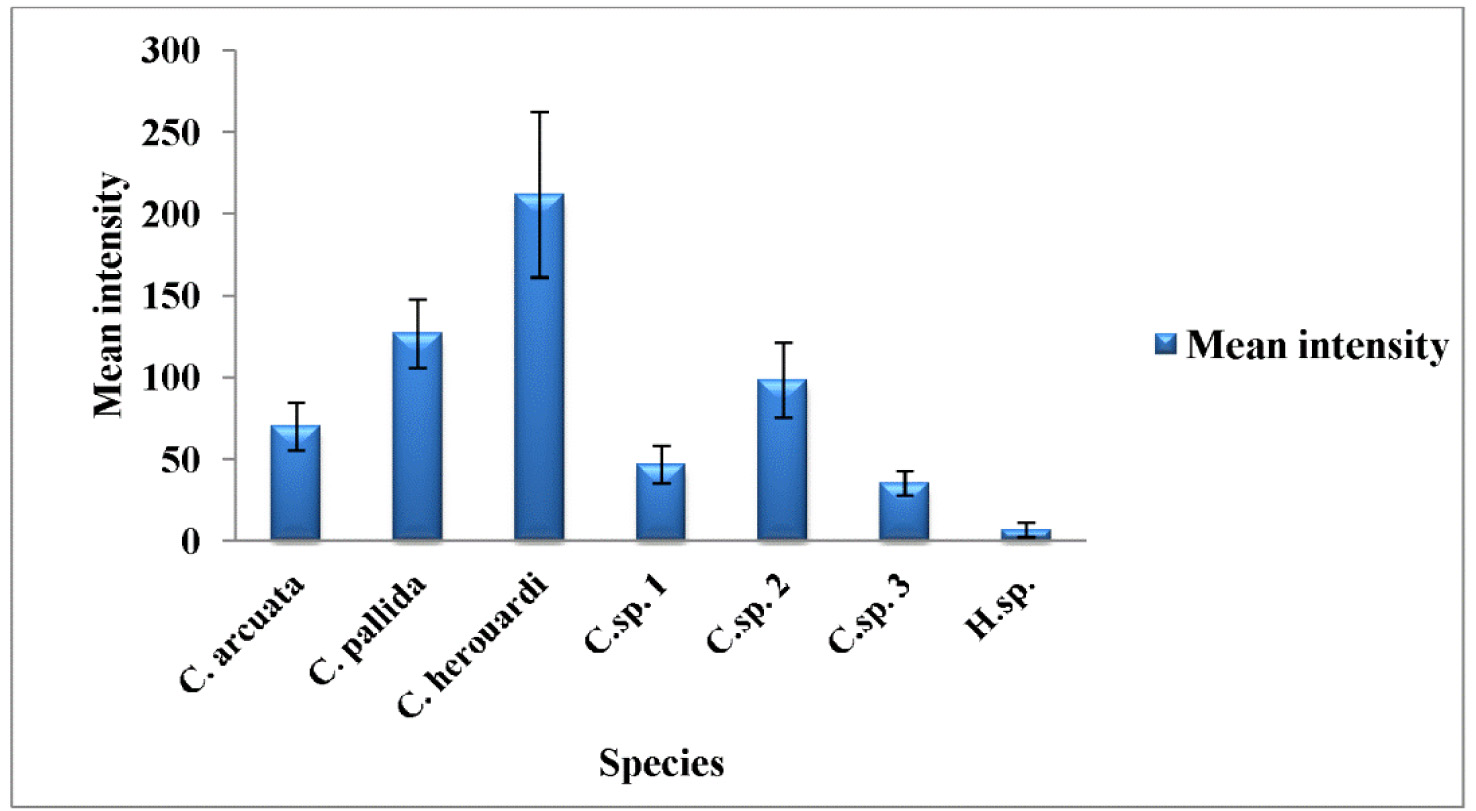
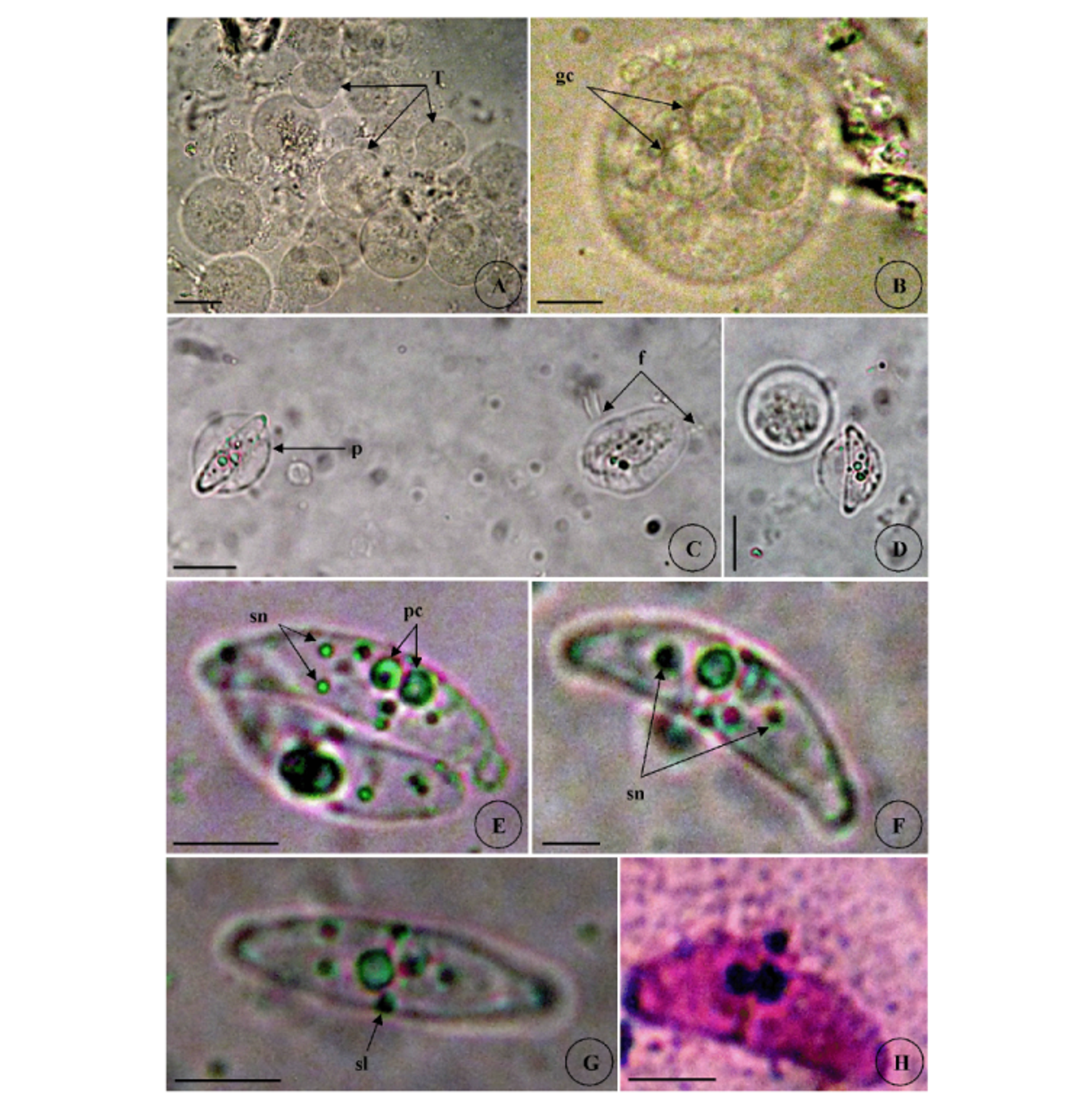
Type host: Sarpa salpa Linnaeus, 1758 goldline sea bream (Perciformes: Sparidae) Other host: Boops boops Linnaeus, 1758 bogue Type locality: Mediterranean off Monaco, France. Other localities: Mediterranean off Tunisia: Location 1: Gulf of Tunis (36 ° 45 ’ N, 10 ° 15 ’ E); Location 2: Bay of Bizerte (37 ° 20 ’ N, 9 ° 53 ’ E). Site of infection: Within gall bladder Prevalence: The overall prevalence is 20 % (66 / 330) (Fig. 9). At location 1, the prevalence of infection is 22.86 % (48 / 210) distributed as following, 03 / 2012: 13.3 % (4 / 30); 04 / 2012: 20 % (6 / 30); 05 / 2012: 30 % (9 / 30); 06 / 2012: 23.3 % (7 / 30); 07 / 2012: 20 % (6 / 30); 08 / 2012: 10 % (3 / 30); 05 / 2013: 40 % (8 / 20); 06 / 2013: 50 % (5 / 10). At location 2, the prevalence of infection is 15 % (18 / 120) distributed as following, 03 / 2013: 13.3 % (4 / 30); 04 / 2013: 13.3 % (4 / 30); 05 / 2013: 16.7 % (5 / 30); 06 / 2013: 16.7 % (5 / 30) (see Table 4). Mean intensity: 126.9 ± 20.8 spores / infected fish (++++++) (Fig. 10) (see Table 4). Type-material: Digitized photos of syntype spores were deposited in the parasitological collection of the Museum National d’Histoire Naturelle (MNHN), Paris, Coll. No. ZS 129. Description Vegetative stages. Numerous spherical trophozoïtes found often in massive groups with variety of size (Fig. 2 A). They were seen floating in the bile and contained within several refractile granules and inner generative cells (Fig. 2 A), Monosporic plasmodia (n = 30) (Figs. 2 C – D), mostly spherical to amoeboid, measuring 22.9 ± 2.1 (20 – 25) µm in diameter. The amoeboid plasmodia showed a pseudopodia extending from its periphery (Fig. 2 C) while other spherical seemed disadvantaged from any type of pseudopodia (Figs. 2 C, D) Spores (n = 30 fresh spores). Mature spores were slightly crescent-shaped with anterior margin convex and posterior slightly concave in sutural view (Figs. 2 E – F, H, 8 B), measuring 7.32 ± 0.61 (6.5 – 8) µm in length and 28 ± 1.5 (26 – 30) µm in thickness. Posterior angle was concave to straight 160.9 ± 4.6 (154 – 170 °). Two valves, roughly equal, smoothly ovoid in lateral view tapering gradually toward the end, which one rarely more attenuated than the other. Straight sutural line visible between valves. A binucleate sporoplasm with several visible sporolasmosomes occupied almost the entire spore cavity and rarely dispersed asymmetrically (Fig. 2 E). Polar capsules were almost spherical, 2.95 ± 0.47 (2.5 – 3.6) µm in length and 2.92 ± 0.39 (2.5 – 3.6) µm in width (n = 30). The polar filament formed four turns arranged along the longitudinal axis of the capsule. Remarks
Laamiri, Sayef (2014): New observations on Myxozoa of the goldline sea bream Sarpa salpa L. 1758 (Teleostei: Sparidae) from the Mediterranean coast of Tunisia. Zootaxa 3887 (2): 157-190, DOI: 10.11646/zootaxa.3887.2.3

Export occurrence data

Darwin Core Archive (ZIP)

CLASSIFICATION

Taxonomic Classification Tree

MULTIMEDIA

Media Files(3)

FIGURE 2. Photomicrographs of Ceratomyxa pallida from the gall bladder of Sarpa salpa. (A) Spherical trophozoïtes (T) in different size attached to each other in massive groups. (B) Spherical trophozoïte with numerous inner generative cells (gc). (C – D) monosporic plasmodia (p) with fine granular protoplasm, notice the presence of filopodia (f) at the amoeboid plasmodium. (E) Fresh mature spores in sutural view presenting the polar capsules (pc) and sporoplasm nuclei (sn). (F) Fresh mature spore in lateral view. (G) Fresh mature spore in apical view. (H) Mature spore stained with Giemsa showing the distinct spherical polar capsule with visible suture line. Scale bar = 20 µm in A, C – D; 10 µm in B, E – H.

Imageimage/png© Laamiri, SayefLaamiri, Sayef

FIGURE 9. Prevalence of species of myxozoans from 2 localities, Gulf of Tunis and Bay of Bizerte. The total prevalence determined within the pooled sample of 330 goldline sea bream (Sarpa salpa).

Imageimage/png© Laamiri, SayefLaamiri, Sayef

FIGURE 10. Mean intensity ± standard deviation of species of myxozoans infecting Sarpa Salpa.

Imageimage/png© Laamiri, SayefLaamiri, Sayef

IMAGES

Gallery(3)

See Gallery

Occurrences with images

Source Information

New observations on Myxozoa of the goldline sea bream Sarpa salpa L. 1758 (Teleostei: Sparidae) from the Mediterranean coast of Tunisia

checklist

This dataset contains the digitized treatments in Plazi based on the original journal article Laamiri, Sayef (2014): New observations on Myxozoa of the goldline sea bream Sarpa salpa L. 1758 (Teleostei: Sparidae) from the Mediterranean coast of Tunisia. Zootaxa 3887 (2): 157-190, DOI: 10.11646/zootaxa.3887.2.3

Abstract

A member of the Sparidae family, the goldline sea bream Sarpa salpa (Linnaeus, 1758) collected from the Gulf of Tunis and the Bay of Bizerte in Northeast Tunisia, Western Mediterranean, were examined for the myxozoan parasites. During the parasitological exposure, a total of 7 myxosporean are found including 6 coelozoic species belong to the genus Ceratomyxa Thélohan, 1892 infected the gallbladder of their host of which 3 known species have been previously described, C. arcuata Thélohan, 1892, C. pallida Thélohan, 1895 and C. herouardi Georgévitch, 1916 and 3 species seem different in morphology to Ceratomyxa spp already known from Mediterranean Sea or from other localities in the wide world. These species are Ceratomyxa sp. 1, Ceratomyxa sp. 2 and Ceratomyxa sp. 3. Only one histozoic species belongs to the genus Henneguya Thélohan, 1892, Henneguya sp. identified for the first time infecting the mesentery vessels of S. salpa. The myxosporean parasite C. arcuata Thélohan, 1892 is reported for the first time in Tunisian waters from the goldline sea bream which represents as new host records. In addition to the Monoparasitism, the phenomenon of Polyparasitism was observed between the current species in both sampling sites with two types: Biparasitism and Triparasitism. The most frequent Polyparasitism was a Biparasitism-type between C. herouardi and C. pallida with frequency 16.97%. For all the species, no serious pathogenic changes have been recorded in the host organ or in the outward appearance of the fish. Morphological features, site of infection into the host, parasite prevalence and mean intensity of each myxosporean found during this survey are determined and their taxonomic affinities to other species are discussed.

Key words: Myxozoan fauna, Ceratomyxa, Henneguya, Morphology, Taxonomy, Biparasitism, Triparasitism, Sarpa salpa, Sparidae, Mediterranean coast, Tunisia

Laamiri S, plazi (2014). New observations on Myxozoa of the goldline sea bream Sarpa salpa L. 1758 (Teleostei: Sparidae) from the Mediterranean coast of Tunisia. Plazi.org taxonomic treatments database. Checklist dataset https://doi.org/10.11646/zootaxa.3887.2.3 accessed via GBIF.org on 2026-06-16.

CC0Published 12/31/2014View dataset
GBIF Usage Key
119594201
Dataset Key
190e4917-516a-4032-809a-42471bf7a52c
Origin
source
Backbone Key
4346248
Taxon ID
038887C4FFC1FFDDB3BBFF1583E842C1.taxon
Last Crawled
6/11/2026
Last Interpreted
6/11/2026