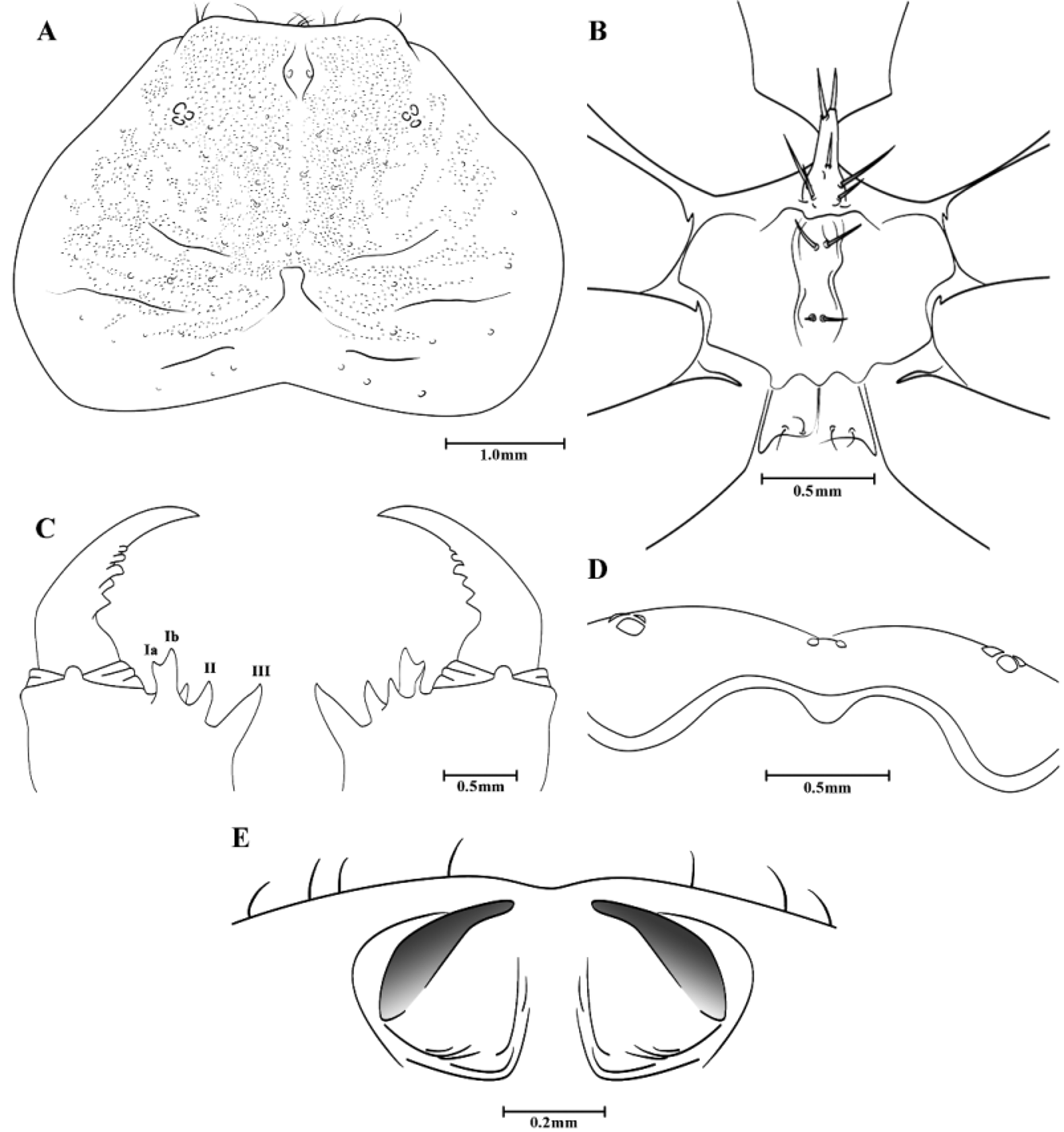
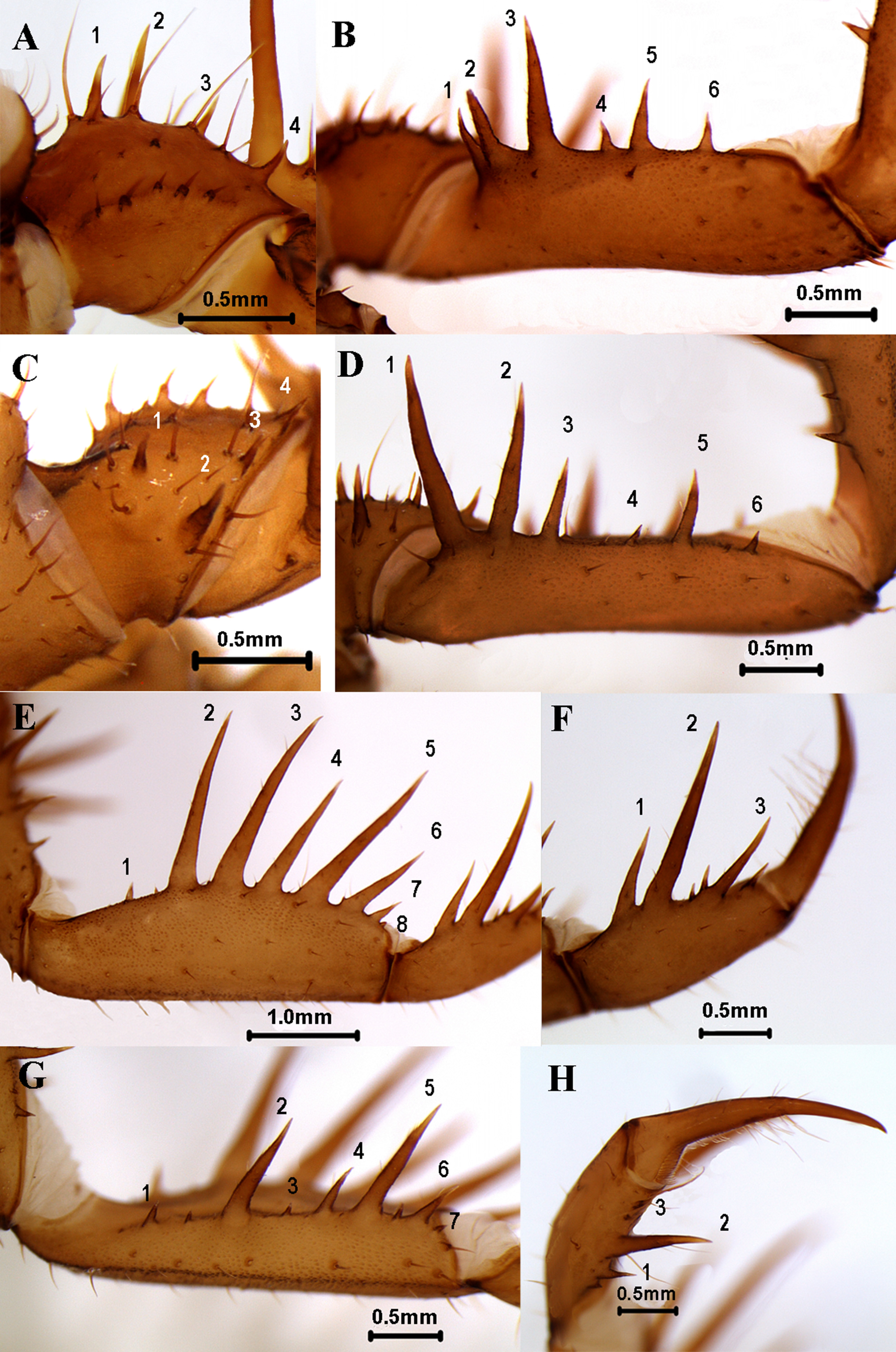
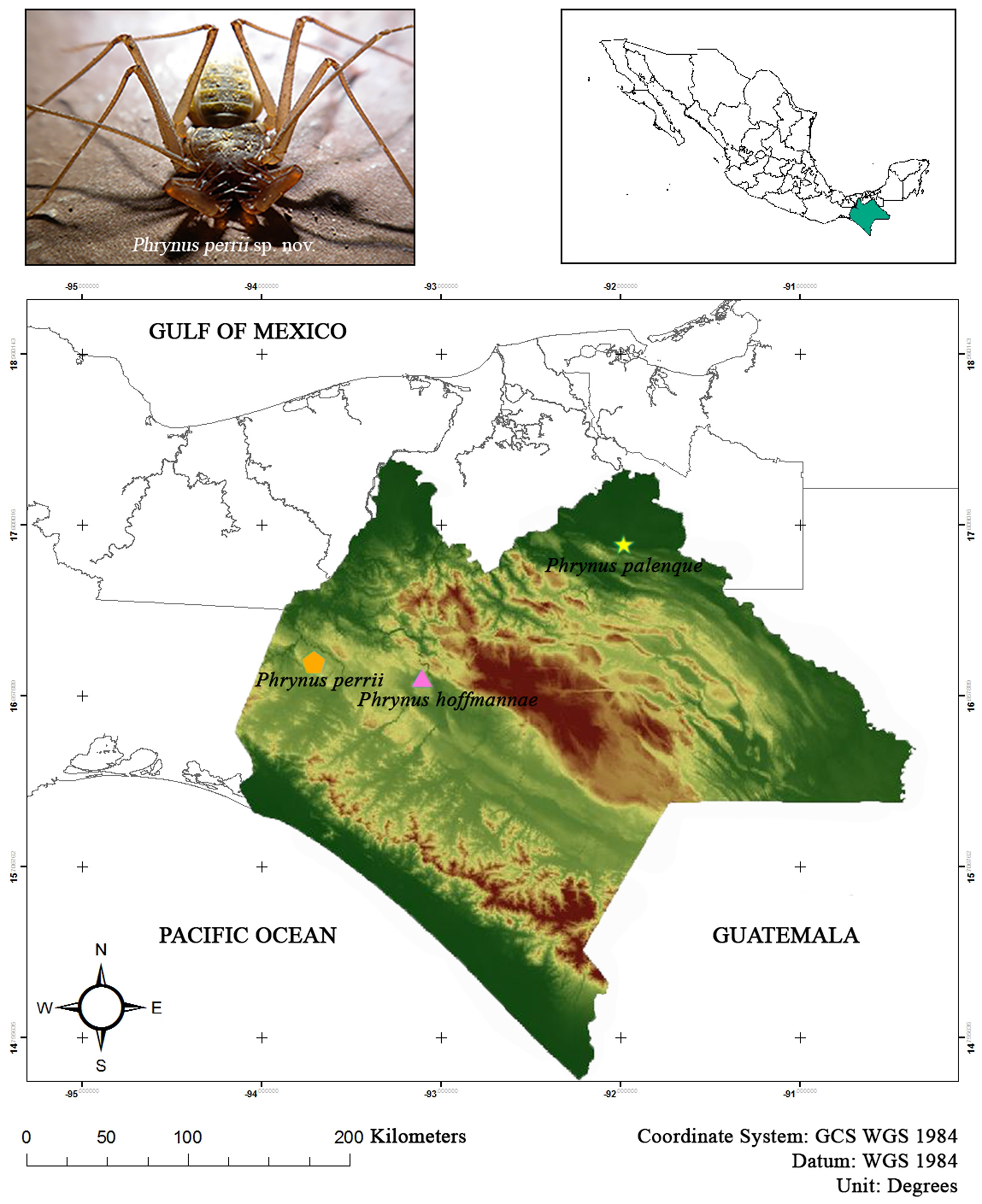
Discussion. Few organisms considered troglomorphic are really troglobites, this is further complicated when the ecology of organisms is unknown. Although most species of Phrynus can be found in caves (Weygoldt, 2000), they don´t show any troglomorphisms and are considered troglophyles and trogloxenes. Only Phrynus noeli was described as a troglobitic species by Armas & Perez (1994), because it was collected in a cave in western Cuba and shows adaptive characters to cavernicolous environment; however subsequently in two opportunities it has been found in epigean environments near the cave entrance, under rocks, in a similar habitat to a cave (“ Hoyo de los Helechos ”) (Armas, 2006 b), consisting of a very small, deep valley between the mountains, were the bottom does not get direct sunlight, it is cool and humid and the vegetation is mostly ferns (partly reminiscent of the first living habitat of a cave) (personal communication, Armas, 2014). Therefore, this species, although it is troglomorphic, should be considered a troglophile rather than a troglobite (sensu Racovitza, 2006). The new species described here was collected in the deep zone of the cave where there are no circadian fluctuations in temperature, and with the subterranean river flowing through the cave the relative humidity is almost constant throughout the year. Furthermore, the presence of troglomorphic features such as the ocular tubercle nearly obsolete and the small size of median eyes, the lack of pigmentation, and reduced sclerotization suggest a close association of P. perrii to the cave environment. In addition, environmental conditions outside the cave are very different than in the depths, with marked seasonality in temperature and rainfall making it unlikely for this species to survive outside the cave. However, further collection efforts in and around the cave are needed in order to correctly assess the ecological association of this species to the cave environment. Remarks. Phrynus noeli is cited as the only species in the genus with elongation of the legs (Armas & Perez, 1994), a common troglomorphisms in troglobitic arthropods, and the authors used this as another argument to support their initial interpretation that it is a troglobitic species adapted to the cavernicolous environment. However, comparisons with other species of the genus revealed no differences in the relative length of the appendices among other species of Phrynus, including Phrynus perrii. Something similar happens within the genus Paraphrynus, comparing between epigean versus troglomorphic species, watching only a slight difference in the elongation of appendages of some of the troglomorphic species. Nevertheless, examining material from the type localities of Paraphrynus chacmool and Paraphrynus chiztun not exhibit an elongation proportionately longer in contrast to the author of both species mentioned, “ The limbs, notably the first walking legs, are also proportionately longer ” (Rowland, 1973). This happens often with troglobitic species descriptions, mentioning the elongation of these appendages, where no comparative reference is given (see, Cokendolpher & Sissom, 2001; Baptista & Giupponi, 2002; Baptista & Giupponi, 2003). Hence, in amblypygids, the elongation of the appendages is not useful for assessing adaptation to caves, i. e., it does not appear as a distinctive troglomorphism. It is possible that leg length in amblypygids is under the same selective pressures inside and outside the caves, and an increase in leg length in troglobites would not make them any faster in their escape responses or in their prey-catching efforts.
Guzmán, Ali Abadallan, Joya, Daniel Chirivi, Francke, Oscar F. (2015): The first troglomorphic species of the genus Phrynus Lamarck, 1801 (Amblypygi: Phrynidae) from Mexico. Zootaxa 3920 (3): 474-482, DOI: 10.11646/zootaxa.3920.3.6