AnimaliaNot EvaluatedacceptedspeciesAccepted
Anomaloglossus tepequem

Anomaloglossus tepequem

GBIF:119599343

0

Synonyms

ABOUT

Descriptions(4)

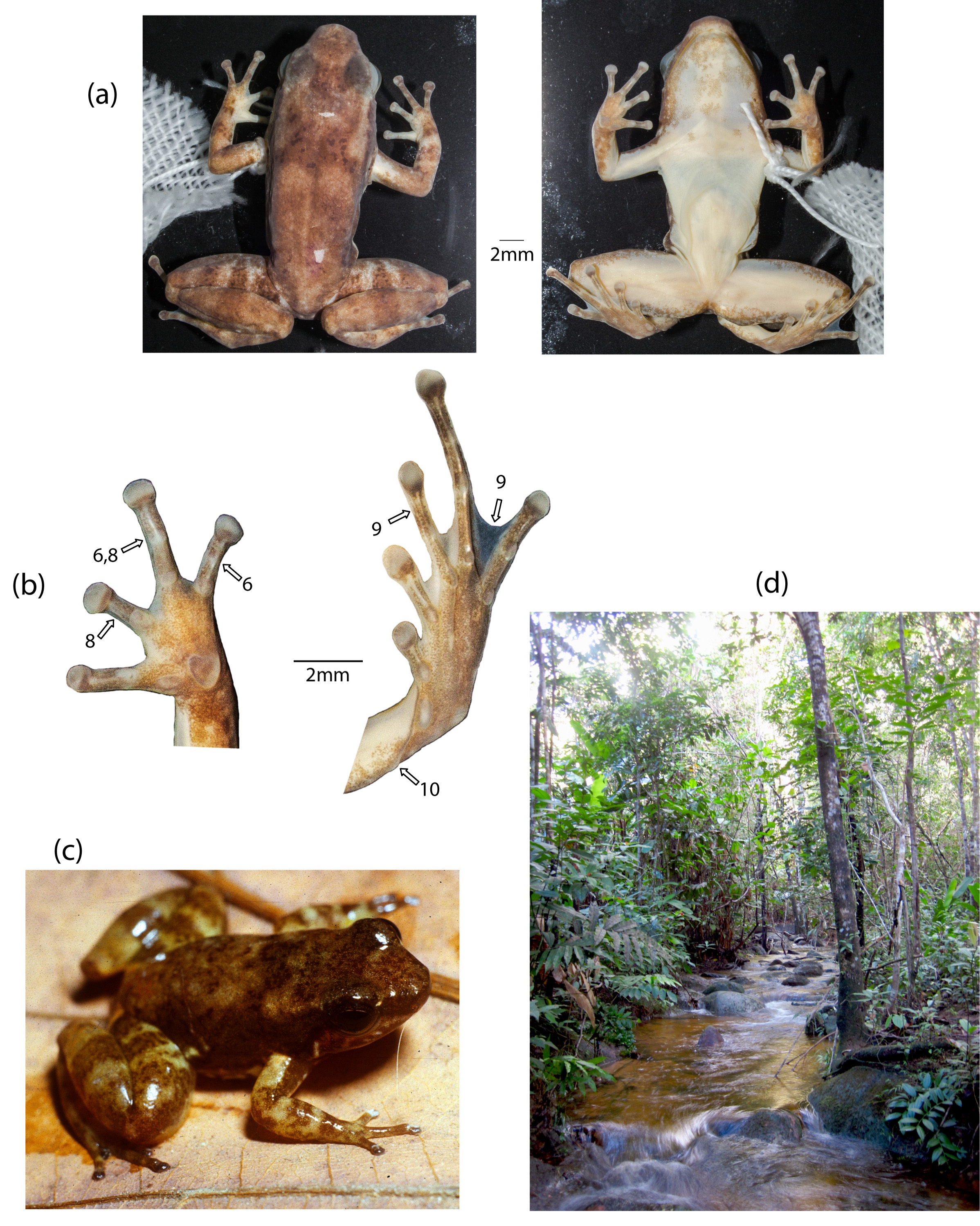
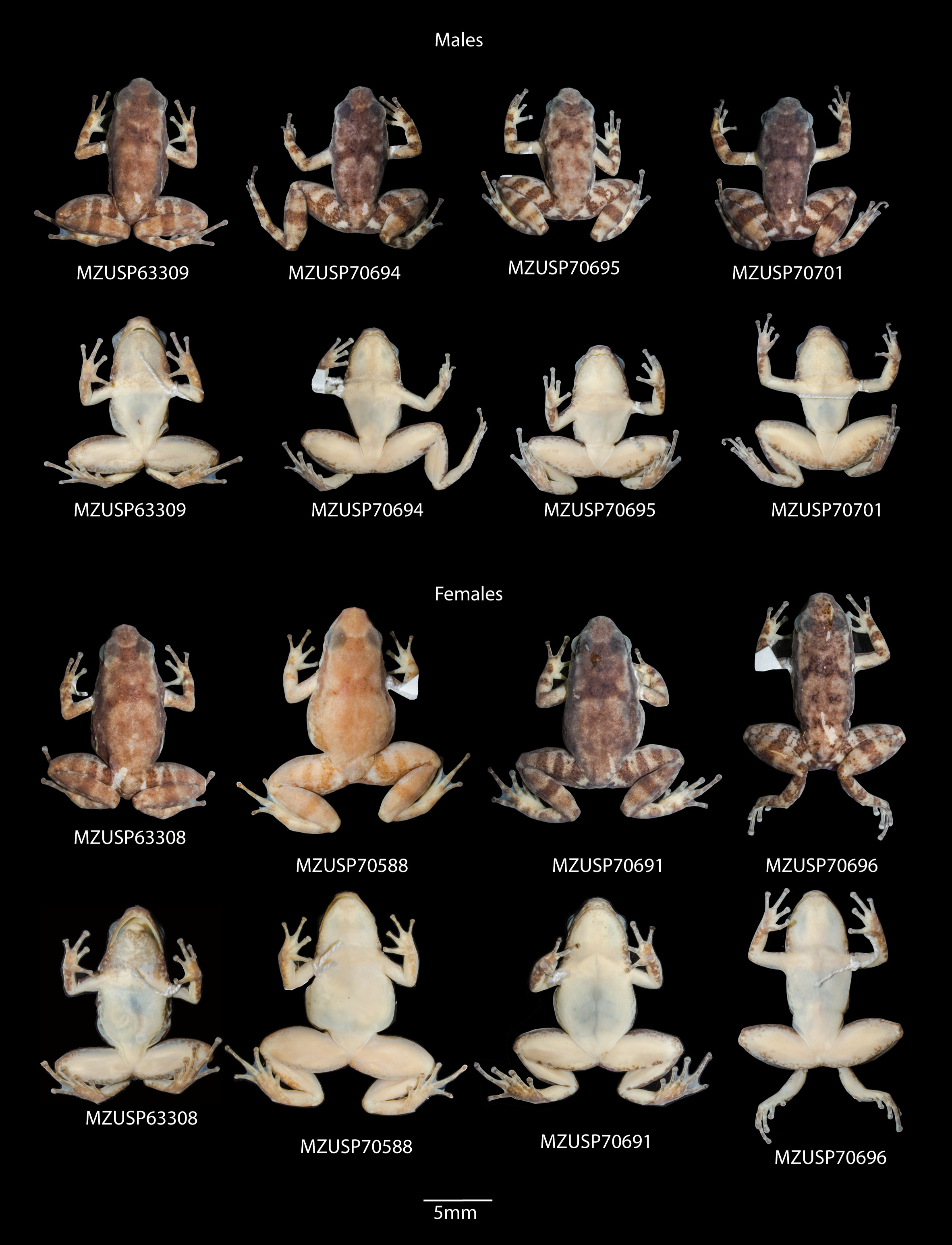
Description of holotype. An adult female of 21.7 mm SVL. Dorsal skin entirely smooth; ventral skin smooth (Fig. 3). Cloacal tubercles absent. Head wider than long. Snout bluntly pointed in lateral view, extending past the lower jaw, bluntly pointed in ventral and dorsal views. Nares located close to snout tip (EN 60 % of SL), directed posterolaterally; nares visible in frontal view, barely visible in dorsal and ventral view; IN 41 % of HW. Canthus rostralis well defined; loreal region straight, sloping outward to lip. IO 64 % of ED. SL 103 % of ED, 49 % of HL; EN 61 % of ED. Tympanic membrane inconspicuous, round, concealed posterodorsally by a diffuse supratympanic swelling; tympanic annulus visible; TYM 50 % of ED. Maxillary teeth present, small. Median lingual process elongate, longer than wide, tapered, bluntly pointed, reclined in pit. Hand moderate in size, 27 % of SVL, 81 % of HW. Relative length of fingers III> IV> I> II. Fingers unwebbed. Discs of fingers expanded, disc on Finger II, III, IV widest (state 2 sensu Grant et al. 2006), discs on Finger I correspond to state 1 (sensu Grant et al. 2006). Fingers with fringes [sensu Grant et al. (2006: 66 – 67); keel-like lateral folds sensu Myers & Donnelly (2008)], best developed on pre- and postaxial edges of Finger II and preaxial edge of Finger III (Fig. 3). Palmar tubercle large, rounded, slightly heart-shaped; thenar tubercle smaller, elliptical; one or two round to ovoid subarticular tubercles (one each on Fingers I and II, two each on Fingers III and IV, with distal tubercles on Finger III and IV inconspicuous). Tip of Finger IV distinctly surpassing the base of distal subarticular tubercle on Finger III when fingers appressed. No fleshy supracarpal fold atop wrist (Fig. 3). Hind limbs robust, moderately long, TIL 51 % of SVL. Relative lengths of appressed toes IV> III> V> II> I; Toe I short, slightly surpassing the base of subarticular tubercle of Toe II. Toe discs expanded, slightly larger than finger discs, largest on Toes II and IV. Feet moderately webbed; all toes with well developed folded, flapped fringing. Webbing formula I 0 + – 2 - II 1 - – 2 ½ III 2 – 3 - IV 3 - – 1 ½ V (Fig. 3). Inner metatarsal tubercle small, elliptical; outer metatarsal tubercle small, round, about half the size of inner tubercle. One to three round to ovoid subarticular tubercles (one each on Toes I and II, two each on Toes III and V, and three on Toe IV, with distal tubercle on Toe IV the smallest and less conspicuous). A strong outer metatarsal fold is present, coextensive with the fringe (sensu Grant et al. 2006) on the postaxial edge of Toe V and almost reaching the outer metatarsal tubercle. Tarsal keel strong, continuous with fringe along the outer edge of the first toe, straight or very weakly curved at proximal end, lacking pronounced elevation or tubercle proximally (Fig. 3). Colour of holotype in preservative. Dorsal ground colour brown with a dark brown interorbital bar followed by another dark brown “ M-shaped ” mark covering the scapular region. Dorsal surface of arm light brown with illdefined dark brown transverse bands on forearm and wrist and a cream upper arm; upper surface of leg light brown with well defined dark brown transverse bands on thigh, shank, and foot. Flanks dark brown, with some irregular spots and a few whitish irregular blotches on the lower part. A few white spots (covering small tubercles) form a broken oblique lateral stripe that extends from the groin midway along flank. No dorsolateral stripe. Upper lip brown, delimited by a clear line and with some whitish marks below eye; loreal region and side of head dark; small whitish stripe from arm insertion to tympanum. A dark brown stripe is present on the anterior edge of upper arm, tapering from arm insertion to forearm. Abdomen immaculate cream, throat with patches of melanophores. Ventral surface of upper arm whitish; ventral surface of forearm brown on postaxial side; ventral surface of thigh and shank whitish; rear of thigh and cloacal region brown. Paracloacal marks whitish. Palms and soles brown (Fig. 3). Measurements of holotype (in mm). SVL = 21.7; FA = 4.7; Ha = 5.9; TL = 10.5; FL = 9.9; HW = 7.3; HL = 7.1; ED = 3.4; EN = 2.1; IN = 3.0; SL = 3.5; IO = 2.2; TD = 1.7; WFD = 0.8; WTD = 0.8; ThL = 10.8; 1 FiL = 2.5. Variation. The type series comprises five adult females, three juvenile females, four adult males, and three juvenile males (Table 1). Except for the sexual dimorphism in size and throat colour pattern (see above), dorsal colour varies from light brown to chestnut-brown; dorsal pattern varies slightly in shape and conspicuousness; brown transverse bands on shanks vary from four to three in number, and also vary in conspicuousness with sometimes only the central band being visible; ventral colour variation remains subtle (Fig. 4).
Fouquet, Antoine, Souza, Sergio Marques, Sales Nunes, Pedro M., Kok, Philippe J. R., Curcio, Felipe Franco, Carvalho, Celso Morato De, Grant, Taran, Rodrigues, Miguel Trefaut (2015): Two new endangered species of Anomaloglossus (Anura: Aromobatidae) from Roraima State, northern Brazil. Zootaxa 3926 (2): 191-210, DOI: 10.11646/zootaxa.3926.2.2

Distribution and ecology. Anomaloglossus tepequem was observed and collected only twice, once in 1986 and again in 1992. This is a diurnal species associated with fast flowing streams (Fig. 3 d) and probably restricted to the slopes of Tepequém at> 500 m elevation. In 1992, it was one of the most common frog species in the area. Dozens of males were seen actively calling from the banks and upon stones along streams, and were frequently spotted at night sleeping on rocks or leaves above or near water. Additional diurnal and nocturnal investigations performed during five days in May 2011 by seven herpetologists at the same sites where the species was previously found failed to detect it, despite the fact that the time of the year and the weather conditions were favorable. SVL FA Ha TL FL HW HL ED A. tepequem Females A (n = 5) 22.90 4.86 6.06 11.10 10.02 7.54 7.06 3.26 sd 1.05 0.18 0.21 0.42 0.39 0.39 0.30 0.17 FemalesJ (n = 3) 18.87 4.40 5.33 10.30 9.20 6.70 6.37 2.83 sd 1.15 0.10 0.29 0.44 0.36 0.46 0.38 0.29 Males A (n = 4) 19.20 4.63 5.53 10.30 9.48 6.88 6.30 3.15 sd 0.86 0.36 0.36 0.22 0.45 0.22 0.16 0.10 Males J (n = 3) 16.43 3.80 4.37 8.87 7.93 6.10 5.57 2.57 sd 0.15 0.17 0.25 0.25 0.45 0.10 0.32 0.06 A. apiau Females A (n = 15) 20.16 4.29 5.05 9.55 8.72 7.27 6.31 2.89 sd 1.17 0.27 0.20 0.42 0.43 0.41 0.38 0.17 FemalesJ (n = 4) 15.48 3.63 4.10 7.85 7.15 5.65 5.13 2.23 sd 0.59 0.26 0.29 0.56 0.81 0.39 0.38 0.15 Males A (n = 14) 17.09 3.73 4.46 8.48 7.69 6.07 5.55 2.54 sd 0.99 0.16 0.22 0.52 0.52 0.27 0.35 0.18 Males J (n = 3) 14.53 3.43 3.87 7.70 6.50 5.37 4.80 2.23 sd 0.06 0.06 0.21 0.26 0.44 0.21 0.20 0.15 continued EN IN SL IO TD WFD WTD ThL 1 FiL A. tepequem Females A (n = 5) 2.16 3.02 3.58 2.30 1.40 0.74 0.80 11.55 2.49 sd 0.09 0.19 0.16 0.19 0.19 0.04 0.04 0.63 0.06 Females J (n = 3) 1.93 2.40 3.10 2.17 1.30 0.64 0.71 10.52 2.12 sd 0.06 0.17 0.46 0.06 0.17 0.09 0.02 0.59 0.20 Males A (n = 4) 1.80 2.83 3.20 2.25 1.33 0.72 0.76 10.84 2.34 sd 0.08 0.10 0.12 0.06 0.05 0.07 0.04 0.36 0.18 Males J (n = 3) 1.67 2.40 2.73 1.70 1.40 0.49 0.59 9.18 1.78 sd 0.06 0.17 0.15 0.10 0.26 0.08 0.03 0.40 0.13 A. apiau Females A (n = 15) 1.73 2.80 3.09 2.21 1.07 0.82 0.91 10.31 2.16 sd 0.08 0.17 0.27 0.13 0.10 0.08 0.10 0.39 0.18 Females J (n = 4) 1.35 2.20 2.40 1.78 0.85 0.59 0.66 8.70 1.75 sd 0.06 0.12 0.14 0.10 0.10 0.10 0.07 0.75 0.20 Males A (n = 14) 1.54 2.44 2.67 1.90 0.97 0.67 0.79 9.06 1.91 sd 0.13 0.15 0.17 0.15 0.08 0.08 0.07 0.47 0.18 Males J (n = 3) 1.30 2.20 2.27 1.70 0.77 0.56 0.67 7.49 1.55 sd 0.10 0.10 0.12 0.10 0.06 0.05 0.02 0.43 0.04
Fouquet, Antoine, Souza, Sergio Marques, Sales Nunes, Pedro M., Kok, Philippe J. R., Curcio, Felipe Franco, Carvalho, Celso Morato De, Grant, Taran, Rodrigues, Miguel Trefaut (2015): Two new endangered species of Anomaloglossus (Anura: Aromobatidae) from Roraima State, northern Brazil. Zootaxa 3926 (2): 191-210, DOI: 10.11646/zootaxa.3926.2.2
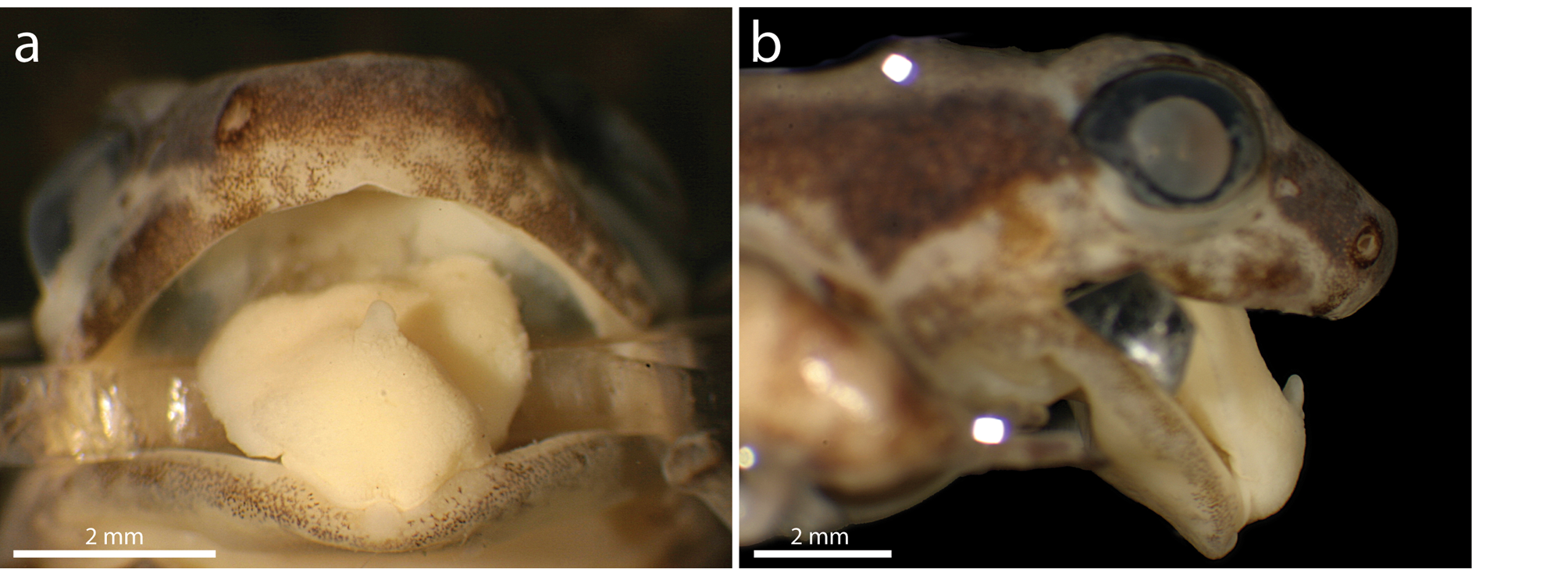
Etymology. The specific epithet is a noun in apposition and refers to the type locality (Tepequém, Roraima State, Brazil). Adult definition and diagnosis. (1) medium-sized Anomaloglossus (average male SVL = 19.2 mm [18.2 – 20.1, n = 4], average female SVL = 22.9 mm [21.7 – 24.5, n = 5]) (Table 1); (2) body robust; (3) skin on dorsum and venter smooth; (4) Finger II appears shorter than I when fingers are appressed, but actually Finger I is slightly shorter than II (4.2 vs. 4.4 mm in holotype) using the method of Kaplan (1997); (5) tip of Finger IV surpassing the base of the distal subarticular tubercle on Finger III when fingers appressed; (6) distal subarticular tubercle on Finger III and IV indistinct; (7) Finger III not swollen in males; (8) fingers with fringes particularly developed on preaxial edges of Fingers II and III; (9) toes moderately webbed, with well developed folded, flapped fringing (sensu Myers & Donnelly 2008); (10) tarsal keel well defined, straight or very weakly curved, at most weakly elevated proximally, not forming tubercle; (11) black arm gland in males (sensu Grant & Castro 1998, see also Grant et al. 2006) and cloacal tubercles absent; (12) pale paracloacal mark present; (13) dorsolateral stripe absent; (15) ventrolateral stripe absent; (16) oblique lateral stripe present, short, extending from inguinal region to approximately mid-flank; (17) sexual dichromatism in throat colour pattern present, throat evenly covered with darker and larger patches in all males and in some females but almost no pigmentation in most females; (18) no sexual dichromatism in abdomen colour pattern, which is immaculate cream; (19) iris with metallic pigmentation and pupil ring; (20) median lingual process (Fig. 2) longer than wide, tapered, bluntly pointed, smooth (nonpapillate), reclined in pit; (21) maxillary teeth present, small; (22) testes immaculate white, mature ova small (ca. 1 mm) yellowish brown. Morphological comparisons with congeneric species. Anomaloglossus tepequem is immediately distinguished from A. baeobatrachus (Boistel & de Massary 1999), A. beebei (Noble 1923), A. degranvillei (Lescure 1975), A. kaiei (Kok et al. 2006 b), A. leopardus (Ouboter & Jairam 2012), A. praderioi (La Marca 1996), A. rufulus (Gorzula 1988), A. roraima (La Marca 1996, Kok et al. 2013), A. stepheni (Martins 1989), and A. surinamensis (Ouboter & Jairam 2012) in having moderate toe webbing (toe webbing absent or basal in the aforementioned species).
Fouquet, Antoine, Souza, Sergio Marques, Sales Nunes, Pedro M., Kok, Philippe J. R., Curcio, Felipe Franco, Carvalho, Celso Morato De, Grant, Taran, Rodrigues, Miguel Trefaut (2015): Two new endangered species of Anomaloglossus (Anura: Aromobatidae) from Roraima State, northern Brazil. Zootaxa 3926 (2): 191-210, DOI: 10.11646/zootaxa.3926.2.2
Holotype. MZUSP 63310, an adult female collected by Márcio Martins, 20 July 1986 at ~ 700 m elevation at Tepequém, Roraima State, Brazil (3.750866 N, 61.705084 W). Paratopotypes (n = 14). MZUSP 63308 – 09, a female and a male, respectively, collected with the holotype by Márcio Martins. MZUSP 70692 – 95, 70701, 70703, six males, and MZUSP 70588, 70691, 70696 – 99, six females, collected by Miguel T. Rodrigues, Celso Morato de Carvalho, Dante Pavan, and Gabriel Skuk, 12 December 1992 (Table 1).
Fouquet, Antoine, Souza, Sergio Marques, Sales Nunes, Pedro M., Kok, Philippe J. R., Curcio, Felipe Franco, Carvalho, Celso Morato De, Grant, Taran, Rodrigues, Miguel Trefaut (2015): Two new endangered species of Anomaloglossus (Anura: Aromobatidae) from Roraima State, northern Brazil. Zootaxa 3926 (2): 191-210, DOI: 10.11646/zootaxa.3926.2.2

Export occurrence data

Darwin Core Archive (ZIP)

CLASSIFICATION

Taxonomic Classification Tree

MULTIMEDIA

Media Files(3)

FIGURE 2. The median lingual process of Anomaloglossus tepequem sp. nov. in anterior (a) and lateral (b) views (MZUSP 70691, adult female). Photographs by TG.

Imageimage/png© Fouquet, Antoine;Souza, Sergio Marques;Sales Nunes, Pedro M.;Kok, Philippe J. R.;Curcio, Felipe Franco;Carvalho, Celso Morato De;Grant, Taran;Rodrigues, Miguel TrefautFouquet, Antoine;Souza, Sergio Marques;Sales Nunes, Pedro M.;Kok, Philippe J. R.;Curcio, Felipe Franco;Carvalho, Celso Morato De;Grant, Taran;Rodrigues, Miguel Trefaut

FIGURE 3. (a) Holotype (MZUSP 63310) of Anomaloglossus tepequem sp. nov. in dorsal and ventral view. (b) Left hand and left foot in ventral view, numbers refer to the characters in the diagnosis. (c) Uncollected specimen in life photographed by MTR in December 1992 and (d) the stream were specimens were collected in 1992 (photograph by M. Texeira) in May 2011. Other photographs by AF.

Imageimage/png© Fouquet, Antoine;Souza, Sergio Marques;Sales Nunes, Pedro M.;Kok, Philippe J. R.;Curcio, Felipe Franco;Carvalho, Celso Morato De;Grant, Taran;Rodrigues, Miguel TrefautFouquet, Antoine;Souza, Sergio Marques;Sales Nunes, Pedro M.;Kok, Philippe J. R.;Curcio, Felipe Franco;Carvalho, Celso Morato De;Grant, Taran;Rodrigues, Miguel Trefaut

FIGURE 4. Eight paratypes (four females and four males) of Anomaloglossus tepequem sp. nov. in dorsal and ventral view. Photographs by AF.

Imageimage/png© Fouquet, Antoine;Souza, Sergio Marques;Sales Nunes, Pedro M.;Kok, Philippe J. R.;Curcio, Felipe Franco;Carvalho, Celso Morato De;Grant, Taran;Rodrigues, Miguel TrefautFouquet, Antoine;Souza, Sergio Marques;Sales Nunes, Pedro M.;Kok, Philippe J. R.;Curcio, Felipe Franco;Carvalho, Celso Morato De;Grant, Taran;Rodrigues, Miguel Trefaut

IMAGES

Gallery(3)

See Gallery

Occurrences with images

Source Information

Two new endangered species of Anomaloglossus (Anura: Aromobatidae) from Roraima State, northern Brazil

checklist

This dataset contains the digitized treatments in Plazi based on the original journal article Fouquet, Antoine, Souza, Sergio Marques, Sales Nunes, Pedro M., Kok, Philippe J. R., Curcio, Felipe Franco, Carvalho, Celso Morato De, Grant, Taran, Rodrigues, Miguel Trefaut (2015): Two new endangered species of Anomaloglossus (Anura: Aromobatidae) from Roraima State, northern Brazil. Zootaxa 3926 (2): 191-210, DOI: 10.11646/zootaxa.3926.2.2

Abstract

We describe two new species of Anomaloglossus from Roraima State, Brazil, that are likely endemic to single mountains currently isolated among lowland forest and savanna ecosystems. The first species, Anomaloglossus tepequem sp. nov. was collected in 1986 and 1992 along a single stream at> 500 m elevation on a tepui-like mountain named Tepequém, but was not detected during recent investigations. It is mainly diagnosed from other Anomaloglossus species by its well developed foot webbing, immaculate cream abdomen colouration and small body size (males: 18.2–20.1 mm, females: 21.7–24.5). The second species, Anomaloglossus apiau sp. nov. was found along several streams between 500 and 1400 m elevation on Serra do Apiaú, and is mainly diagnosed from congeners by its weakly webbed feet, males with swollen third finger and ventrolateral stripe formed by white dots, and its advertisement call; a long trill (up to almost 40 s) consisting of pairs of very short pulses. The discovery of these two apparently microendemic species suggests that additional Anomaloglossus species remain to be described in the Guiana Shield. Both species should be considered critically endangered given their seemingly reduced range size, association with highland habitat, and the anthropogenic pressure they currently face.

Key words: Amazonia, Amphibia, conservation, endemic, Guiana shield, taxonomy

Fouquet A, Souza S M, Sales Nunes P M, Kok P J R, Curcio F F, Carvalho C M D, Grant T, Rodrigues M T, plazi (2015). Two new endangered species of Anomaloglossus (Anura: Aromobatidae) from Roraima State, northern Brazil. Plazi.org taxonomic treatments database. Checklist dataset https://doi.org/10.11646/zootaxa.3926.2.2 accessed via GBIF.org on 2026-06-15.

CC0Published 12/31/2015View dataset
GBIF Usage Key
119599343
Dataset Key
442b1f0f-8903-453b-874d-455f9afc905c
Origin
source
Backbone Key
8614164
Taxon ID
03E9294CFF8BFFA5FF29FBA4FAEBF94C.taxon
Last Crawled
6/11/2026
Last Interpreted
6/11/2026