
AnimaliaacceptedgenusAccepted
Paracryptops
Pocock, 1891
GBIF:119600610
0datasets
0year
0
Descendants
0
Children
0
Species
ABOUT
Descriptions(4)
Diagnosis. Anterior margin of coxosternum with two rounded, segregated lobes; claws of prehensors short, barely extending beyond levels of inner margins of trochanteroprefemora, well separated from opposite member in resting position. Components. Five species have been described, some of which may be synonymous: P. w e b e r i, P. breviunguis, P. inexpectus, P. i n d i c u s, and P. spinosus.
Junior, Amazonas Chagas, Shelley, Rowland M. (2004): Rediscovery and redescription of the centipede Paracryptops inexpectus Chamberlin, 1914, with an account of the genus (Scolopendromorpha: Cryptopidae: Cryptopinae). Zootaxa 475: 1-8, DOI: 10.5281/zenodo.157786
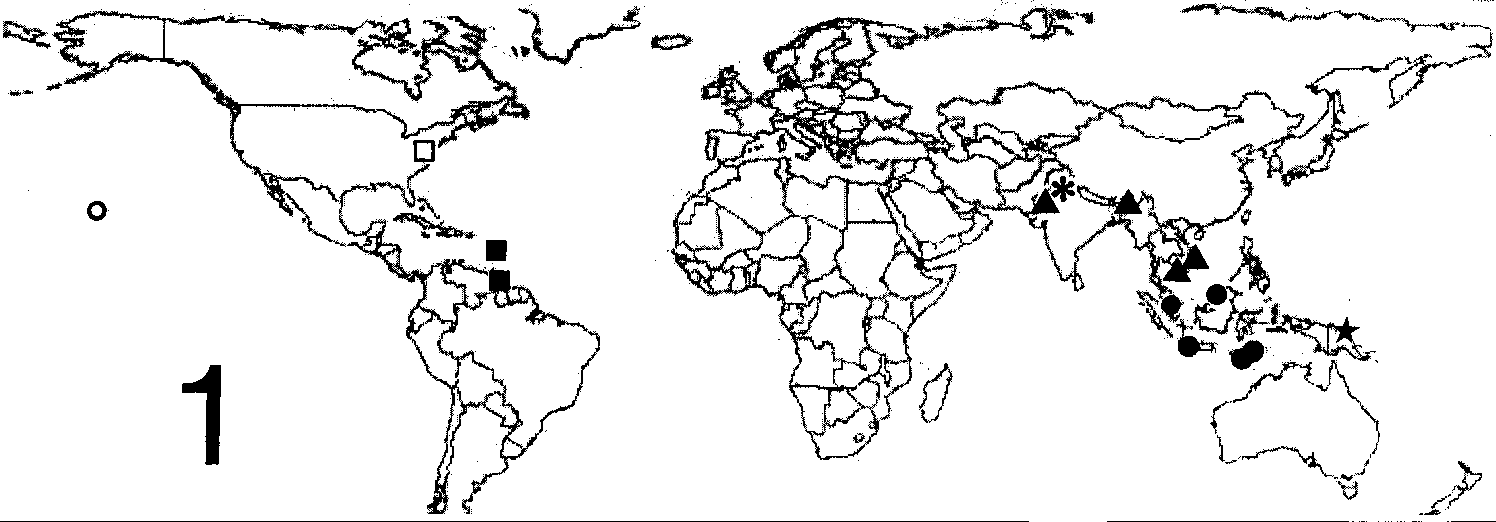
Remarks. Paracryptops is clearly a valid genus in the Cryptopinae; the lobed anterior margin of the coxosternum and the short prehensor claws are reliable generic characters (Pocock, 1891, 1894; Attems, 1930; Jangi & Dass, 1978). Only around 20 specimens total have been collected, and all the component species occur in southern / southeast Asia and the East Indies except for the isolated occurrence of P. inexpectus in the West Indies and northern South America, some 10,475 mi (16,752 km) to the east (Fig. 1). This distribution pattern suggests that P. inexpectus is an allochthonous species of anthropogenic origin rather than an indigenous New World taxon. As the largest community and only true city on Dominica, Roseau probably harbors a number of introduced centipede and millipede species, which typically predominate in urban environments, suggesting that the specimens of P. inexpectus are exogenous, although the source area is unknown. Likewise, the two localities of P. spinosus, Delhi and New Delhi, are large cities that surely harbor many introduced species, and the intercepted specimen of P. w e b e r i came from such a place, Singapore; indeed five of the 16 samples of Paracryptops (31 % of the total) came from urban environments, so the genus is intimately associated with man. Additionally, representatives of Paracryptops have twice been intercepted in quarantines, in Honolulu (from Singapore) and Washington, DC (from Guyana), and the type of P. spinosus was found under pots in a plant nursery, where it was likely carried by man. The distribution pattern of four species in southern / southeast Asia and one thousands of miles away in the eastern Caribbean and northeastern South America defies geographic logic unless the latter is introduced from the former area. This possibility is enhanced by the small size and cryptic nature of the centipedes, and the fact that, according to the descriptions, there are few differences between the species. We suspect that Paracryptops actually consists of less than five species, perhaps only one or two, that have been unknowingly introduced by man to other locations and then discovered and redescribed as new species. A full generic revision, including examinations and comparisons of all specimens, especially the types, is needed and would provide clues to the origins of the species, but this is beyond the scope of the present study. We therefore retain all five species and redescribe P. inexpectus based on the holotype and the two Dominican individuals.
Junior, Amazonas Chagas, Shelley, Rowland M. (2004): Rediscovery and redescription of the centipede Paracryptops inexpectus Chamberlin, 1914, with an account of the genus (Scolopendromorpha: Cryptopidae: Cryptopinae). Zootaxa 475: 1-8, DOI: 10.5281/zenodo.157786
Distribution. Southern and southeast Asia (India, Malaysia [Sabah vicinity], Vietnam, Singapore, Indonesia [Java, Flores, and Sumba], and Papua New Guinea); South America (Guyana); Lesser Antilles (Dominica) (Fig. 1). Schileyko (2002) also cited the genus from China, but a thorough search of the second author’s library did not produce a documentation from China, and we do not know the source of this citation. China should be deleted from the generic range until confirmed with a definite record.
Junior, Amazonas Chagas, Shelley, Rowland M. (2004): Rediscovery and redescription of the centipede Paracryptops inexpectus Chamberlin, 1914, with an account of the genus (Scolopendromorpha: Cryptopidae: Cryptopinae). Zootaxa 475: 1-8, DOI: 10.5281/zenodo.157786
Type species. P. weberi Pocock, 1891, by monotypy.
Junior, Amazonas Chagas, Shelley, Rowland M. (2004): Rediscovery and redescription of the centipede Paracryptops inexpectus Chamberlin, 1914, with an account of the genus (Scolopendromorpha: Cryptopidae: Cryptopinae). Zootaxa 475: 1-8, DOI: 10.5281/zenodo.157786
Export occurrence data
Darwin Core Archive (ZIP)
CLASSIFICATION
Taxonomic Classification Tree

HIERARCHY
Child Taxa(1)
MULTIMEDIA
Media Files(1)
FIGURE 1. Distribution of Paracryptops. Solid squares, P. inexpectus; triangles, P. i n d i c u s; asterisk, P. spinosus; dots, P. w e b e r i; star, P. breviunguis; open square, quarantine record of P. inexpectus; circle, quarantine record of P. w e b e r i. Some symbols represent two localities that are close together.
Imageimage/png© Junior, Amazonas Chagas;Shelley, Rowland M.Junior, Amazonas Chagas;Shelley, Rowland M.
IMAGES