
AnimaliaNot EvaluatedacceptedspeciesAccepted
Kassina wealii

Kassina wealii

GBIF:119600671

ABOUT

Descriptions(2)

Remarks. Hewitt (1927) incorrectly used the spelling Kassina wealii quinquevittata in the Plate legends (p. 415). In the type description an adult male with snout vent length 30 mm is referred to as the type [= holotype], we thus treat PEM A 6289 as the holotype. No additional type specimens are mentioned in the type description, but a smaller male is also illustrated with outstretched legs (Pl. XXIV, Fig. 4). This illustration fits PEM A 6288 (AMG 1320, same details as holotype), but this can only be considered additional material mentioned in the type description. The type description states that the type is “ in the South African Museum ”, but Hewitt appears to have changed his mind after the article was published and accessioned it into the AM. Lambiris (1988) questioned the type to be in PEM and not SAM, followed by Frost (2014). Lambiris (1988) further discussed the taxonomic history of the taxa and re-instated the name Semnodactylus Hoffman (1939) which is a senior synonym of Notokassina Drewes (1985).
Conradie, Werner, Branch, William R., Watson, Gillian (2015): Type specimens in the Port Elizabeth Museum, South Africa, including the historically important Albany Museum collection. Part 1: Amphibians. Zootaxa 3936 (1), DOI: 10.11646/zootaxa.3936.1.2
Holotype: PEM A 6289 (formerly AMG 1320); Cape Town, Western Cape Province, South Africa. W. Rose. Date not stated in original publication; original label reads 9 October 1925. Additional specimens: PEM A 6288 (formerly AMG 1320); same details as holotype.
Conradie, Werner, Branch, William R., Watson, Gillian (2015): Type specimens in the Port Elizabeth Museum, South Africa, including the historically important Albany Museum collection. Part 1: Amphibians. Zootaxa 3936 (1), DOI: 10.11646/zootaxa.3936.1.2

Export occurrence data

Darwin Core Archive (ZIP)

CLASSIFICATION

Taxonomic Classification Tree

MULTIMEDIA

Media Files(1)

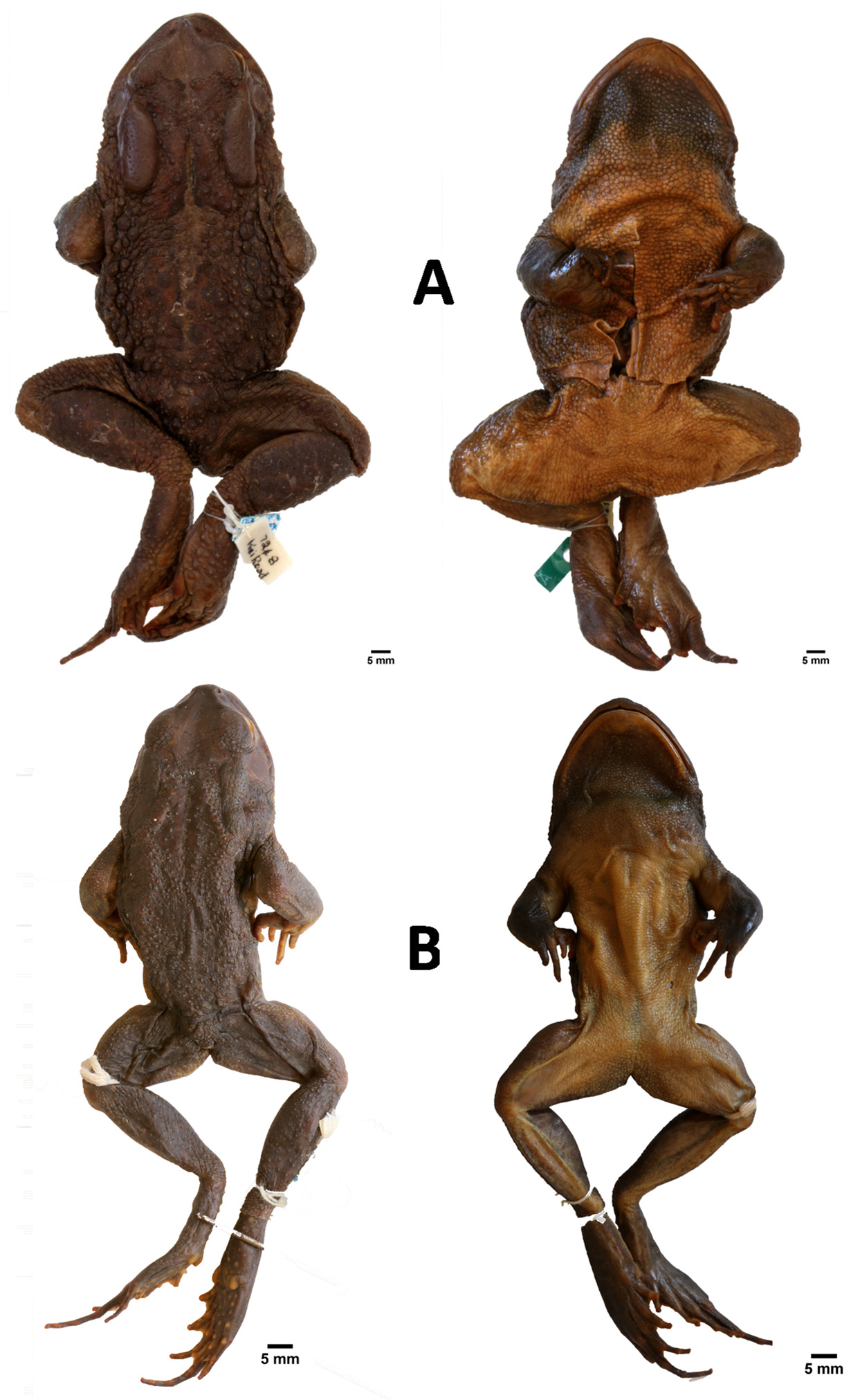
FIGURE 4. Family Bufonidae II: A—Lectotype of Bufo regularis pardalis (PEM A 837), B—Lectotype of Bufo regularis rangeri (PEM A 822).

Imageimage/png© Conradie, Werner;Branch, William R.;Watson, GillianConradie, Werner;Branch, William R.;Watson, Gillian

IMAGES

Gallery(1)

See Gallery

Occurrences with images

Source Information

Type specimens in the Port Elizabeth Museum, South Africa, including the historically important Albany Museum collection. Part 1: Amphibians

checklist

This dataset contains the digitized treatments in Plazi based on the original journal volume Conradie, Werner, Branch, William R., Watson, Gillian (2015): Type specimens in the Port Elizabeth Museum, South Africa, including the historically important Albany Museum collection. Part 1: Amphibians. Zootaxa 3936 (1), DOI: 10.11646/zootaxa.3936.1.2

Abstract

The Port Elizabeth Museum houses the consolidated herpetological collections of three provincial museums of the Eastern Cape, South Africa: the Port Elizabeth Museum (Port Elizabeth), the Amatole (previously Kaffarian) Museum (King Williams Town), and the Albany Museum (Grahamstown). Under John Hewitt, Albany Museum was the main centre of herpetological research in South Africa from 1910–1940, and he described numerous new species, many based on material in the museum collection. The types and other material from the Albany Museum are now incorporated into the Port Elizabeth Museum Herpetology collection (PEM). Due to the vague typification of much of Hewitt’s material, the loss of the original catalogues in a fire and the subsequent deterioration of specimen labels, the identification of this type material is often troublesome. Significant herpetological research has been undertaken at the PEM in the last 35 years, and the collection has grown to be the third largest in Africa. During this period, numerous additional types have been deposited in the PEM collection, generated by active taxonomic research in the museum. As a consequence, 43 different amphibian taxa are represented by 37 primary and 151 secondary type specimens in the collection. This catalogue provides the first documentation of these types. It provides the original name, the original publication date, journal number and pagination, reference to illustrations, current name, museum collection number, type locality, notes on the type status, and photographs of all holotypes and lectotypes. Where necessary to maintain nomenclatural stability, and where confused type series are housed in the PEM collection, lectotypes and paralectotypes are nominated.

Key words: Amphibia, Port Elizabeth Museum, Albany Museum, types

Conradie W, Branch W R, Watson G, plazi (2015). Type specimens in the Port Elizabeth Museum, South Africa, including the historically important Albany Museum collection. Part 1: Amphibians. Plazi.org taxonomic treatments database. Checklist dataset https://doi.org/10.11646/zootaxa.3936.1.2 accessed via GBIF.org on 2026-06-15.

CC0Published 12/31/2015View dataset
GBIF Usage Key
119600671
Dataset Key
60942119-aabc-4fba-b245-ac8441ca2397
Origin
source
Backbone Key
8584809
Taxon ID
2E7387E1EF1FFFA2FF76FC90FE3BFA3F.taxon
Last Crawled
6/11/2026
Last Interpreted
6/11/2026