
AnimaliaNot EvaluatedacceptedspeciesAccepted
Hyperolius raymondi

Hyperolius raymondi

Conradie, Branch & Tolley, 2013

GBIF:119600674

0year

ABOUT

Descriptions(2)

Remarks. Right thigh incision to remove tissue for genetic analysis in holotype, allotype and some of the paratypes. Conradie et al. (2013) also provide a re-description of the poorly known Hyperolius cinereus Monrad, 1937. GenSeq information listed in Table 2.
Conradie, Werner, Branch, William R., Watson, Gillian (2015): Type specimens in the Port Elizabeth Museum, South Africa, including the historically important Albany Museum collection. Part 1: Amphibians. Zootaxa 3936 (1), DOI: 10.11646/zootaxa.3936.1.2
Holotype: PEM A 10049; A dambo near expedition camp (7 ° 44 ' 39.2 " S; 19 ° 57 ' 16.8 " E, 813 m above sea level), Lagoa Carumbo, Lunda Norte Province, Angola; W. Conradie, W. R. Branch, P. Vaz Pinto, S. Baptista and N. Baptista, 30 April 2012. Allotype: PEM A 10066; same details as holotype. Paratypes (16): PEM A 10040 – 10048, 10050 – 10056; same details as holotype. Additional specimens: (a) PEM A 10057; Headwaters of Lovua, north of village Capaia (8 ° 20 ' 18.5 " S; 20 ° 14 ' 33 " E, 0820 AC, 154 m above sea level), Lunda Norte Province, Angola; P. Vaz Pinto, S. Baptista and N. Baptista, 5 May 2012. (b) PEM T 517; 2 tadpoles, Margins Lagoa Samokaza east of Lagoa Carumbo (7 ° 44 ' 18.0 " S; 19 ° 59 ' 13.0 " E, 0719 DB, 867 m above sea level), Lunda Norte Province, Angola; W. Conradie and W. R. Branch, 2 May 2012.
Conradie, Werner, Branch, William R., Watson, Gillian (2015): Type specimens in the Port Elizabeth Museum, South Africa, including the historically important Albany Museum collection. Part 1: Amphibians. Zootaxa 3936 (1), DOI: 10.11646/zootaxa.3936.1.2

Export occurrence data

Darwin Core Archive (ZIP)

CLASSIFICATION

Taxonomic Classification Tree

MULTIMEDIA

Media Files(3)

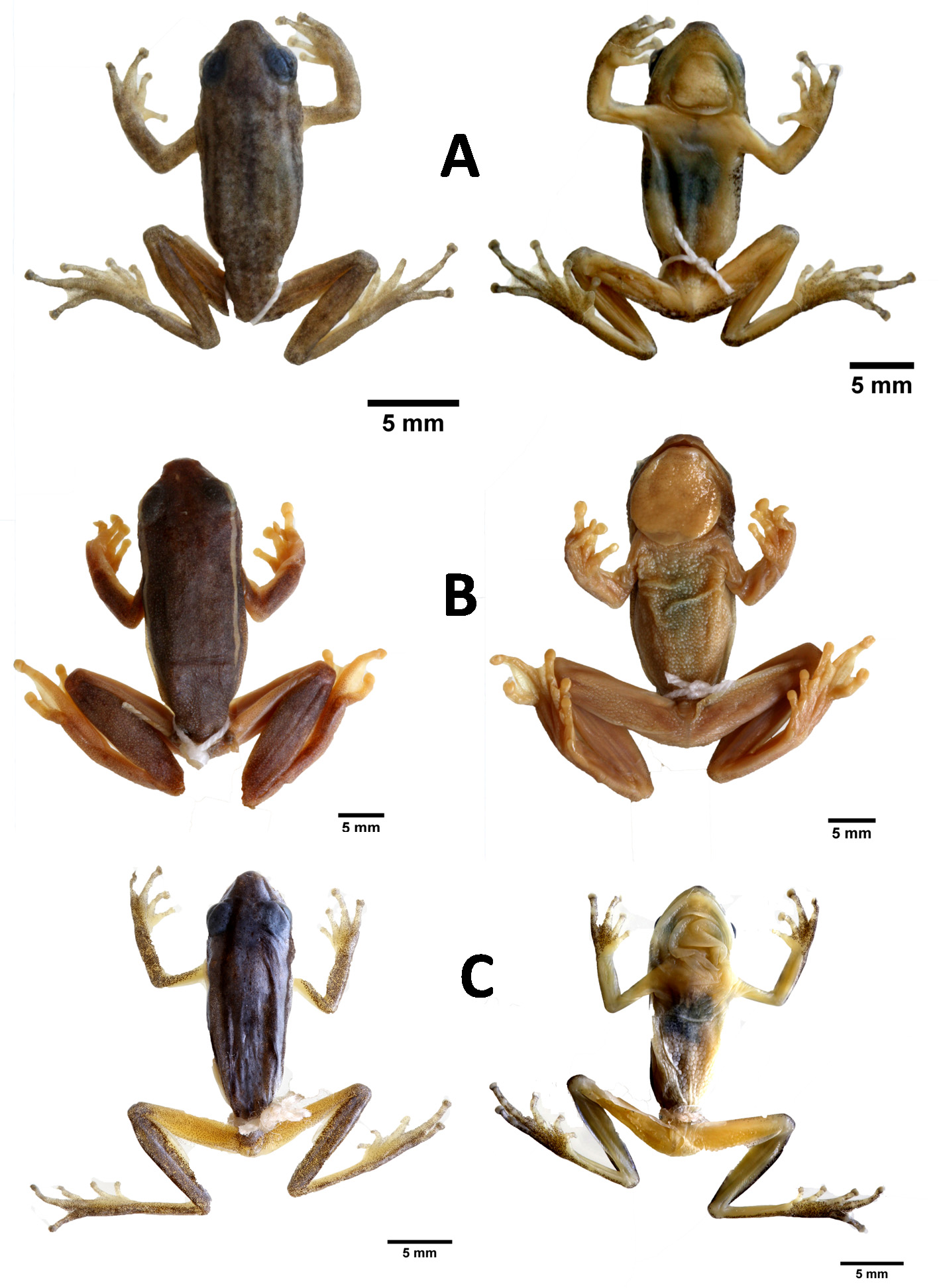
FIGURE 7. Family Hyperoliidae: A—Holotype of Hyperolius chelaensis (PEM A 9223), B—Lectotype of Hyperolius horstockii semidiscus (PEM A 4579), C—Holotype of Hyperolius raymondi (PEM A 10049).

Imageimage/png© Conradie, Werner;Branch, William R.;Watson, GillianConradie, Werner;Branch, William R.;Watson, Gillian
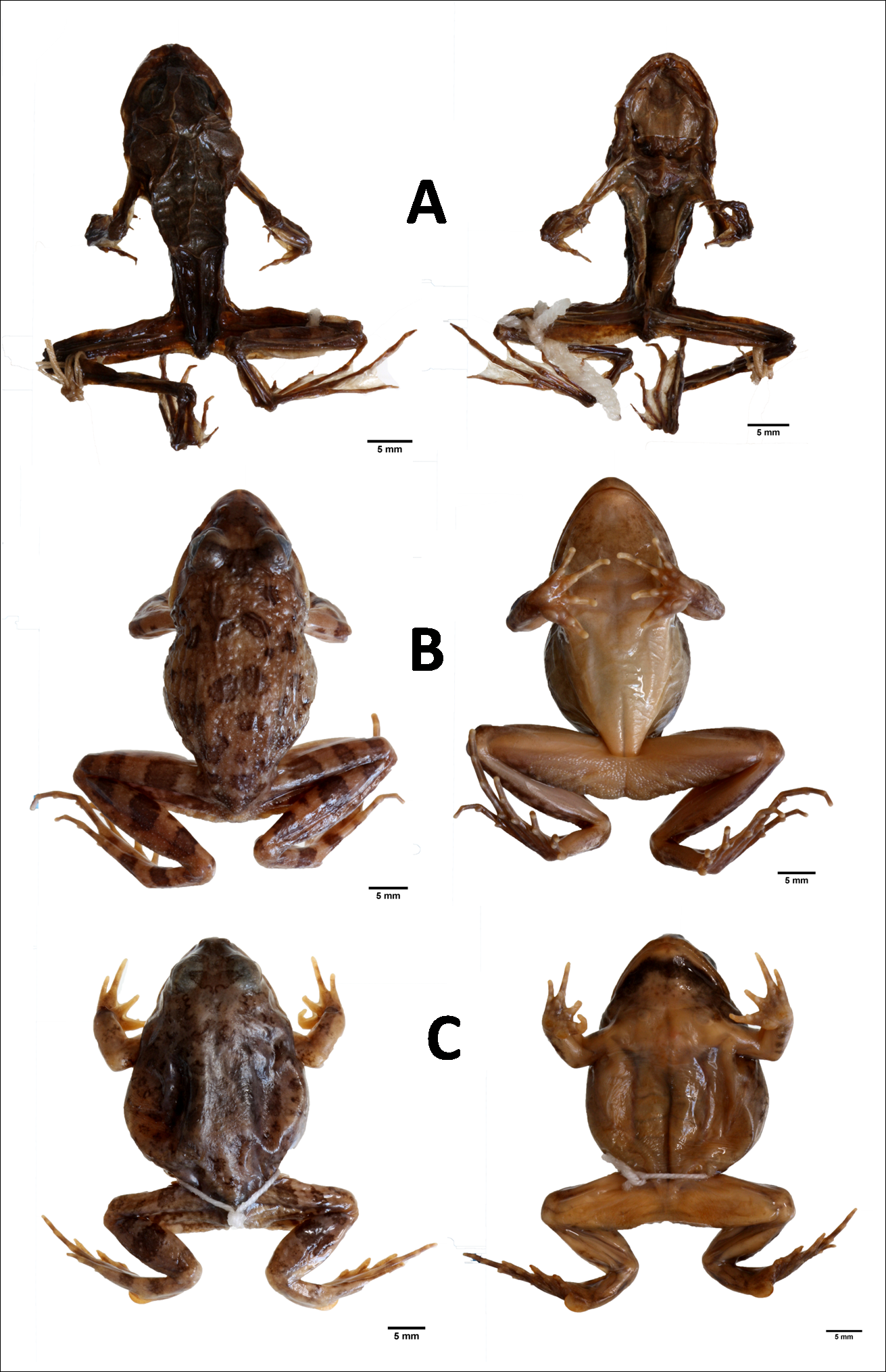
FIGURE 8. Family Pyxicephalidae III: A—Lectotype of Rana vertebralis (PEM A 1550), B—Holotype of Strongylopus springbokensis (PEM A 963), C—Holotype of Tomopterna tandyi (PEM A 2283).

Imageimage/png© Conradie, Werner;Branch, William R.;Watson, GillianConradie, Werner;Branch, William R.;Watson, Gillian

FIGURE 9. Family Pipidae: Holotype of Xenopus gilli (PEM A 1523).

Imageimage/png© Conradie, Werner;Branch, William R.;Watson, GillianConradie, Werner;Branch, William R.;Watson, Gillian

IMAGES

Gallery(3)

See Gallery

Occurrences with images

Source Information

Type specimens in the Port Elizabeth Museum, South Africa, including the historically important Albany Museum collection. Part 1: Amphibians

checklist

This dataset contains the digitized treatments in Plazi based on the original journal volume Conradie, Werner, Branch, William R., Watson, Gillian (2015): Type specimens in the Port Elizabeth Museum, South Africa, including the historically important Albany Museum collection. Part 1: Amphibians. Zootaxa 3936 (1), DOI: 10.11646/zootaxa.3936.1.2

Abstract

The Port Elizabeth Museum houses the consolidated herpetological collections of three provincial museums of the Eastern Cape, South Africa: the Port Elizabeth Museum (Port Elizabeth), the Amatole (previously Kaffarian) Museum (King Williams Town), and the Albany Museum (Grahamstown). Under John Hewitt, Albany Museum was the main centre of herpetological research in South Africa from 1910–1940, and he described numerous new species, many based on material in the museum collection. The types and other material from the Albany Museum are now incorporated into the Port Elizabeth Museum Herpetology collection (PEM). Due to the vague typification of much of Hewitt’s material, the loss of the original catalogues in a fire and the subsequent deterioration of specimen labels, the identification of this type material is often troublesome. Significant herpetological research has been undertaken at the PEM in the last 35 years, and the collection has grown to be the third largest in Africa. During this period, numerous additional types have been deposited in the PEM collection, generated by active taxonomic research in the museum. As a consequence, 43 different amphibian taxa are represented by 37 primary and 151 secondary type specimens in the collection. This catalogue provides the first documentation of these types. It provides the original name, the original publication date, journal number and pagination, reference to illustrations, current name, museum collection number, type locality, notes on the type status, and photographs of all holotypes and lectotypes. Where necessary to maintain nomenclatural stability, and where confused type series are housed in the PEM collection, lectotypes and paralectotypes are nominated.

Key words: Amphibia, Port Elizabeth Museum, Albany Museum, types

Conradie W, Branch W R, Watson G, plazi (2015). Type specimens in the Port Elizabeth Museum, South Africa, including the historically important Albany Museum collection. Part 1: Amphibians. Plazi.org taxonomic treatments database. Checklist dataset https://doi.org/10.11646/zootaxa.3936.1.2 accessed via GBIF.org on 2026-06-16.

CC0Published 12/31/2015View dataset
GBIF Usage Key
119600674
Dataset Key
60942119-aabc-4fba-b245-ac8441ca2397
Origin
source
Backbone Key
8667459
Taxon ID
2E7387E1EF1FFFA2FF76FF35FD6EFD7B.taxon
Last Crawled
6/11/2026
Last Interpreted
6/11/2026