
AnimaliaNot EvaluatedacceptedspeciesAccepted
Parartemia acidiphila

Parartemia acidiphila

GBIF:119625062

0

Synonyms

ABOUT

Descriptions(7)

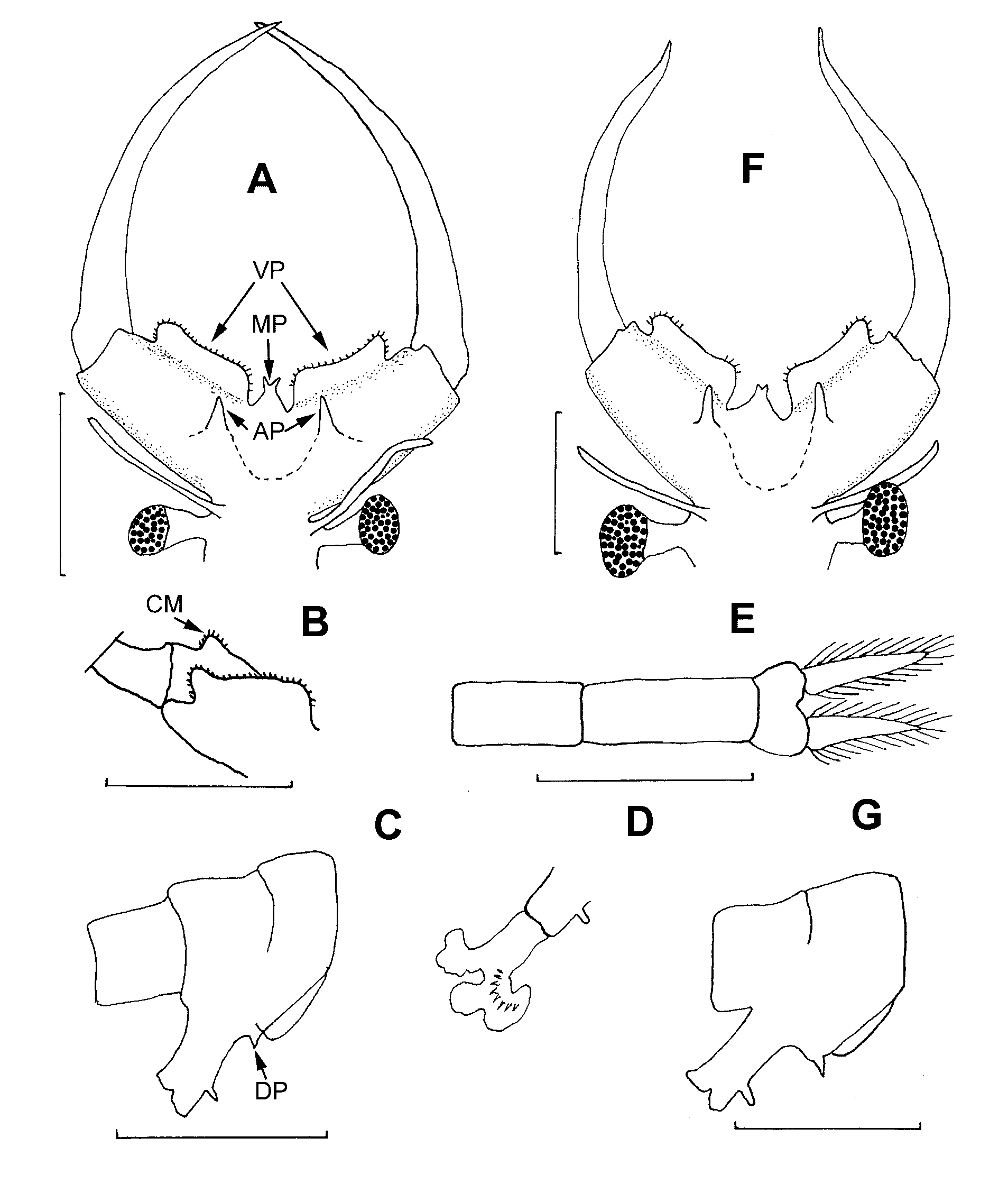
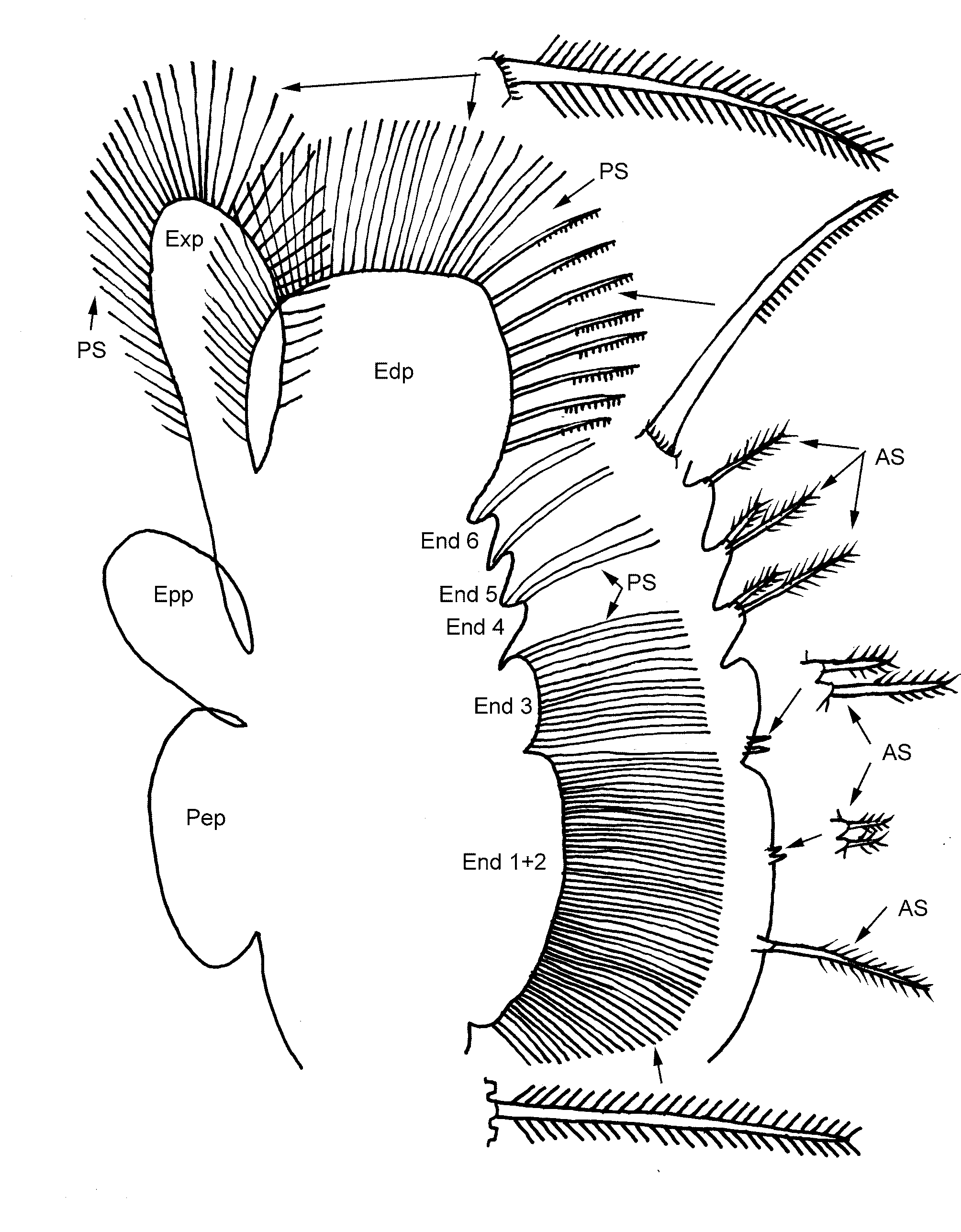
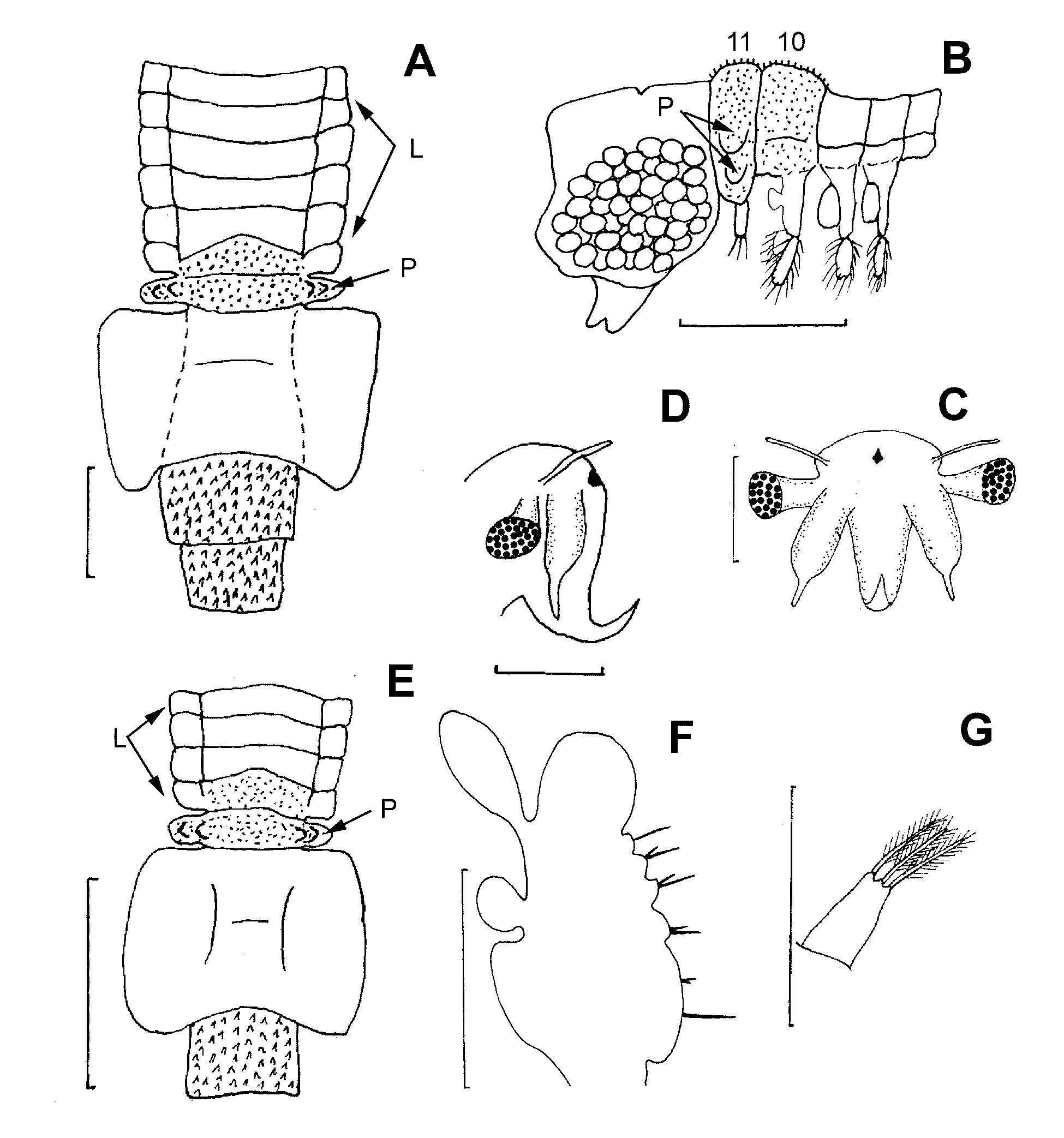
Description. Male. Length 13 mm (head + thorax 7 mm and abdomen 6 mm). First antenna filiform, about twice as long as eye plus peduncle (Fig. 1 A). Basal antennomeres of second antenna fused proximally at an angle of about 50 degrees from the body axis. Ventral margin with paired linear, ventral processes (VP, Fig. 1 A) clothed with small spines, spaced 1 – 2 times their length. Overall dimensions of these processes about 4 times longer than deep with lateral edge a little shorter than medial edge. Distal margin slightly concave, lateral corner produced and medial corner rounded but only slightly enlarged. Posterior surface of fused proximal antennomeres with a small conical mound (CM, Fig 1 B) slightly medial of the lateral corner of the frontal process. Medial process (MP, Fig 1 A) between ventral processes broad and triangular with a bifurcated apex. Anterior surface of proximal antennomeres with a basal elevated area on each side and terminating in a free, conical anterior process (AP, Figs 1 A, F) subequal in length to the medial process and about three times longer than basal width. Distal antennomere of second antenna curved medially, about 1.5 to 2 times the length of the proximal antennomere. Labrum lacking a spine. Thoracic segments with minor lateral lobes, all equal in size and proportions. Eleven pairs of thoracopods, variable in size with first two noticeably reduced in size but not in arrangement of its parts. Fifth thoracopod (Fig. 2) with endite 1 + 2 and 3 evenly curved, the former about three times the size of the latter. Endite 1 anterior seta about as long as adjacent posterior setae (shown enlarged in Fig. 2) and with a double pectin of strong setules on apical half. Endite 2 anterior seta very short, about same length as base of anterior seta 1. Its spine even shorter and both weakly setose apically. Endite 3 anterior seta about four times length of anterior setae 2; both it and its subequal spine weakly setose apically. Endites 1 to 3 with posterior setae long and thin, clothed with numerous short setules and numbering about 50 on endite 1 + 2 and 16 on endite 3. Endites 4 to 6 asymmetrical (i. e. distal edge shorter than proximal edge) and with 2 anterior + 3 posterior setae, 2 + 2 and 1 + 2 respectively. Anterior setae of unequal lengths, but shorter and stouter than posterior setae and with a double pectin of stout setules apically. Posterior setae with sparse setules. Endites clothed basally with small spines generally grouped in 3 – 5 s. Endopodite broadly rounded and bearing about 37 posterior setae, all based with a coronet of numerous (> 10) small spines. The first 7 or 8 of these setae (essentially those on the medial edge of the thoracopod) stouter and with a one-sided pectin on the distal half of setae, whereas the remaining setae thinner and closely feathered with setules. Exopodite elongate oval and bearing about 38 posterior setae similar to most on the endopodite. Epipodite oval shaped and praepipodite elongated oval shaped, both unadorned. Gonopods (Figs 1 C, G) paired, basal parts fused together and about twice the diameter of tubular free apical part. Basal part with a sharp spine apically and apical tube with a digitiform process subapically (DP, Fig. 1 C). Both processes subequal, unhooked and pointing anteriorly. No specimens with gonopod completely everted, but a partly everted one of a paratype (Fig. 1 D) with complex expansions with medial row of spines. Abdominal segments increasing in length and narrowing posteriorly from 1 to 6, particularly 5 and 6 (Fig. 1 E), so that last segment about twice length of first. Cercopods fringed with long setae on lateral and medial edges; length subequal to 6 th abdominal segment. Description. Female. Length 8.5 mm. Head (Figs 3 C, D) with first antenna filiform and a little shorter than the eye plus peduncle. Second antenna flattened, a little longer and wider than the eye plus peduncle and terminating in a markedly narrowed, bevelled acute apex. Naupliar eye prominent midway between the compound eyes. Labrum with a prominent recurved spine. Posterior thoracic segments (Figs 3 A, B), particularly those of 5 – 10 th segments expanded laterally into simple laminar squarish lobes (L, Figs 3 A, E). Segment 11 expanded separately into a broad blunt triangle and with surface sclerotised and denticulate. Dorsal surface of segment 10 also sclerotised and denticulate. Eleventh segment with two paired small rounded protuberances laterally, one dorsal to the other (P, Figs 3 A, B). Paired brood pouch (Figs 3 A, B) lying laterally to the genital segments. Anterior surface of pouch adpressed against 11 th thoracic segment, wider and with a squarish anteriolateral corner and then narrowing posteriorly. Pouches joined ventrally to a gonopore on a short tubular protrusion and each pouch with a small ventrolateral lobe. In mature ovigerous females, chamber pigmented dorsally and containing numerous smooth-surfaced eggs (at low magnifications). Eleven pairs of thoracopods, with 11 th pair reduced to two stubs, each bearing 3 plumose setae a little shorter than the stub (Fig. 3 G). Tenth thoracopod pair also reduced, with significantly fewer posterior setae and some reduction in size of endopodite and praepipodite (Fig. 3 F). Other thoracopods similar in structure to those of male, but generally with fewer posterior setae. Anterior setae as in 5 th thoracopod, but those of 2 nd and 3 rd endite larger. Abdominal segments papillate, otherwise proportions as in males.
Timms, Brian V, Hudson, Peter (2009): The brine shrimps (Artemia and Parartemia) of South Australia, including descriptions of four new species of Parartemia (Crustacea: Anostraca: Artemiina). Zootaxa 2248: 47-68, DOI: 10.5281/zenodo.190741
Synonymy. Parartemia sp f, Timms, 2004, p 24, Fig. 30; Timms, 2009 c, pp 215 – 225.
Timms, Brian V, Hudson, Peter (2009): The brine shrimps (Artemia and Parartemia) of South Australia, including descriptions of four new species of Parartemia (Crustacea: Anostraca: Artemiina). Zootaxa 2248: 47-68, DOI: 10.5281/zenodo.190741
Comments. Limited information on this species has been given in a key in Timms (2004) where it was referred to as species f. This publication specifically states “ for nomenclature purposes information given here on the new species of Parartemia do not constitute taxonomic descriptions. Characteristics given in the key are no more than a guide to the identity of the organisms. ” This species is also referred to as species f in a regional ecology (Timms, 2009 c). Variability. There is little difference in the morphology of P. acidiphila between and within sites in South Australia and Western Australia. The medial process can be tightly fitted between the ventral processes or well spaced with the divided apex being well expressed (Fig. 1 F) or just visible. The lateral lobe on the ventral transverse process is variously developed and its spination varies from almost smooth to dense. Many populations, but not all, in Western Australia have weakly lyrate second antennal distal antennomeres (Fig. 1 F). The female 11 th thoracic segment has variable surface structure so that the two raised areas on each side vary in size from indistinct to distinct mounds. It seems this character may be dependent on age, as its weak development was seen in younger females. Generally adult males are 11 – 14 mm in length and adult females 7 – 9 mm. Some specimens (e. g. those from Truslove Nature Reserve) are much larger than the type specimens, measuring 20 mm in males and 11 mm in females. Differential diagnosis. The most distinctive male feature is the second antennal medial process which is triangular and with a bifurcated apex; a unique morphology in Parartemia. It shares with only a few species, including P. triquestra n. sp. (see later), a small conical mound beneath the lateral edge of the ventral processes. The female thoracic segments lack dorsal and dorsolateral projections (cf. P. s e r v e n t y i, P.
Timms, Brian V, Hudson, Peter (2009): The brine shrimps (Artemia and Parartemia) of South Australia, including descriptions of four new species of Parartemia (Crustacea: Anostraca: Artemiina). Zootaxa 2248: 47-68, DOI: 10.5281/zenodo.190741
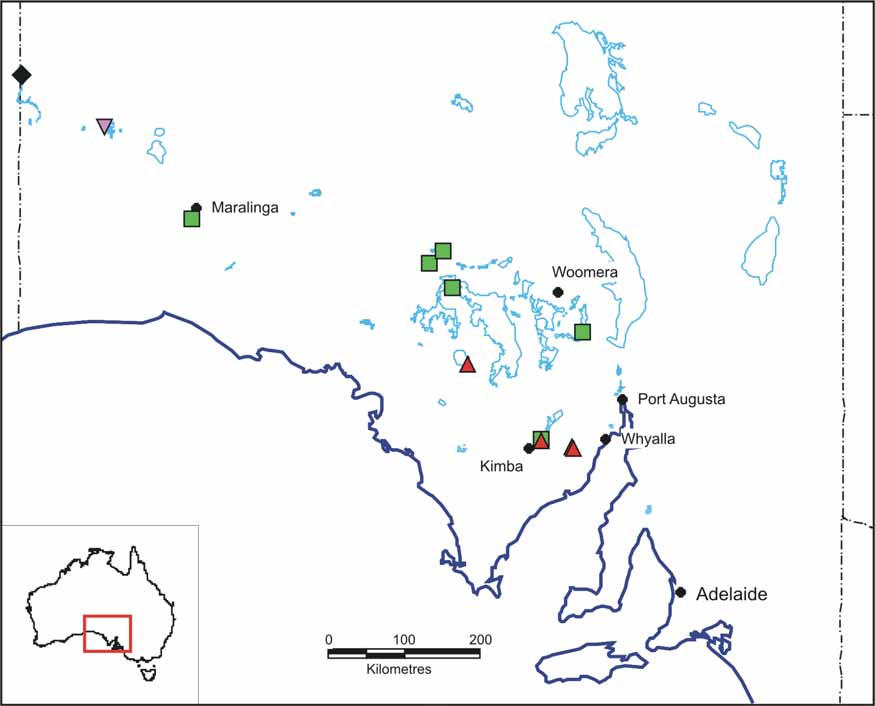
Distribution and ecology. Parartemia acidiphila lives in a few lakes on Eyre Peninsula and in the Gawler Ranges, South Australia (Fig. 4). It is more common in lakes in the Esperance hinterland of Western Australia (Timms, 2009 c). This is the second species shared between southern Western Australia and southern South Australia, the other being P. cylindrifera which is more widely spread in South Australia than this species. Parartemia acidiphila lives in acid saline lakes. In South Australia it has been recorded over a pH range of 3 – 4 (3 records) (P. Hudson, unpublished data), and in the Esperance hinterland in Western Australia from pH 3.4 to 7.4 (42 records) (Timms, 2009 c). Field salinity range is 68 – 217 g / l in South Australia and 35 – 210 g / l in Western Australia.
Timms, Brian V, Hudson, Peter (2009): The brine shrimps (Artemia and Parartemia) of South Australia, including descriptions of four new species of Parartemia (Crustacea: Anostraca: Artemiina). Zootaxa 2248: 47-68, DOI: 10.5281/zenodo.190741
Etymology. The specific name refers to its habitat of markedly acid waters.
Timms, Brian V, Hudson, Peter (2009): The brine shrimps (Artemia and Parartemia) of South Australia, including descriptions of four new species of Parartemia (Crustacea: Anostraca: Artemiina). Zootaxa 2248: 47-68, DOI: 10.5281/zenodo.190741
Type locality. “ Little Lake ” is a small (<1 ha) salt lake that fills episodically.
Timms, Brian V, Hudson, Peter (2009): The brine shrimps (Artemia and Parartemia) of South Australia, including descriptions of four new species of Parartemia (Crustacea: Anostraca: Artemiina). Zootaxa 2248: 47-68, DOI: 10.5281/zenodo.190741
Type material. Holotype. Male, SOUTH AUSTRALIA, Gawler Ranges, 32 km N of Yardea Homestead, “ Little Lake ” (32 o 05 ’ 40 ” E, 135 o 32 ’ 33 ’’ E), 16 November 1990, P. Hudson, SAM C 6787; Allotype. Female (ovigerous), same collecting data as holotype, SAM C 6789; Paratypes. Two males, two females, same collecting data as holotype, SAM C 6788; two males, two females, same collecting data as holotype, WAM 40315. Other material. SOUTH AUSTRALIA, Eyre Peninsula, Lake Gilles, (33 o 02 ’ 07 ” S, 136 o 36 ’ 00 ” E), 16 September 1990, P. Hudson, SAM C 6792; SOUTH AUSTRALIA, Eyre Peninsula, approx 42 km W of Whyalla, small salt lake near Sinclair Gap, (33 o 08 ’ 19 ” E, 137 o 04 ’ 14 ” E), P. Hudson, SAM 6790; SOUTH AUSTRALIA, Eyre Peninsula, approx 42 km W of Whyalla, another small salt lake near Sinclair Gap, (33 o 07 ’ 30 ” S, 137 o 03 ’ 38 ” E), 29 July 1990, P. Hudson, SAM 6791; 20 males, WESTERN AUSTRALIA, Esperance hinterland, lake on Guest Rd, (33 o 08 ’ S, 121 o 49 ’ E), 5 September 2004, B. V. Timms, WAM 40316; 10 males and 10 females, WESTERN AUSTRALIA, Esperance hinterland, lake on Ridley Rd East, (33 o 15 ’ S, 121 o 59 ’ E), 26 January 2007, B. V. Timms, WAM 40317; 5 males and 5 females, WESTERN AUSTRALIA, Esperance hinterland, Truslove Nature Reserve, (33 o 20 ’ S, 121 o 46 ’ E), 8 October 2008, B. V. Timms, WAM 40318.
Timms, Brian V, Hudson, Peter (2009): The brine shrimps (Artemia and Parartemia) of South Australia, including descriptions of four new species of Parartemia (Crustacea: Anostraca: Artemiina). Zootaxa 2248: 47-68, DOI: 10.5281/zenodo.190741

Export occurrence data

Darwin Core Archive (ZIP)

CLASSIFICATION

Taxonomic Classification Tree

MULTIMEDIA

Media Files(4)

FIGURE 1. Parartemia acidiphila n. sp. Male. A-E, Holotype “ Little Lake ”, SA; F-G from lake in Truslove Nature Reserve, Esperance hinterland, WA. A and F, anterior view of head with first and second antennae (VP = ventral processes, AP = anterior processes, MP = medial process); B, oblique view of inner edge of fused basal antennomere to show conical mound (CM) under the lateral corner of the ventral process; C and G, genital segments with gonopod bases and digitform processes (DP); D, partly expanded gonopod of a paratype; E, last two abdominal segments, telson and cercopods. Scale bars 1 mm.
Imageimage/png© Timms, Brian V;Hudson, PeterTimms, Brian V;Hudson, Peter

FIGURE 2. Parartemia acidiphila n. sp. Male, fifth thoracopod. Main diagram shows posterior setae (PS) and subsidiary diagram of endites shows the anterior setae (AS). Some setae enlarged. Key: End = endite, Edp = endopodite, Exp = exopodite, Epp = epipodite, Pep = praepipodite.
Imageimage/png© Timms, Brian V;Hudson, PeterTimms, Brian V;Hudson, Peter

FIGURE 3. Parartemia acidiphila n. sp. Female. A-C, F and G, Allotype “ Little Lake ”, SA; D-E from a lake in Truslove Nature Reserve, Esperance hinterland, WA. A, Dorsal view of last few thoracic segments, brood pouches and first two abdominal segments (L = lateral lobes; P = processes), B, lateral view of last few thoracic segments and brood pouch (P = processes); C, frontal view of head, D, lateral view of head; E, dorsal view of last few thoracic segments and brood pouch (L = lateral lobes; P = processes); F, G, Thoracopods 10 and 11 respectively. Scale bars 1 mm.
Imageimage/png© Timms, Brian V;Hudson, PeterTimms, Brian V;Hudson, Peter

FIGURE 4. Map of South Australia showing sites where the new species were found. Key: P. acidiphila n. sp. ˔; P. auriciforma n. sp. ˑ; P. triquetra n. sp. ♦; P. yarleeensis n. sp. ․.

Imageimage/png© Timms, Brian V;Hudson, PeterTimms, Brian V;Hudson, Peter

IMAGES

Gallery(4)

See Gallery

Occurrences with images

Source Information

The brine shrimps (Artemia and Parartemia) of South Australia, including descriptions of four new species of Parartemia (Crustacea: Anostraca: Artemiina)

checklist

This dataset contains the digitized treatments in Plazi based on the original journal article Timms, Brian V, Hudson, Peter (2009): The brine shrimps (Artemia and Parartemia) of South Australia, including descriptions of four new species of Parartemia (Crustacea: Anostraca: Artemiina). Zootaxa 2248: 47-68, DOI: 10.5281/zenodo.190741

Abstract

The Australian endemic brine shrimp Parartemia is more speciose than the literature suggests, with eight described species, four new ones added here from South Australia and many undescribed species elsewhere in Australia. P. acidiphila n. sp. occurs in acidic salinas on Eyre Peninsula, in the Gawler Ranges in South Australia and also in the Esperance hinterland, Western Australia, while P. auriciforma n. sp., P. triquetra n. sp. and P. yarleensis n. sp. occur in remote episodic salinas in western South Australia. Introduced Artemia franciscana and A. parthenogenetica are limited to present and defunct salt works; reports of Artemia beyond salt works in South Australia are enigmatic.

Key words: Taxonomy, biogeography, keys, salinas, Artemia

Timms B V, Hudson P, plazi (2009). The brine shrimps (Artemia and Parartemia) of South Australia, including descriptions of four new species of Parartemia (Crustacea: Anostraca: Artemiina). Plazi.org taxonomic treatments database. Checklist dataset https://doi.org/10.5281/zenodo.190741 accessed via GBIF.org on 2026-06-17.

CC0Published 12/31/2009View dataset
GBIF Usage Key
119625062
Dataset Key
144aa843-6e00-4665-a741-83ea62b1d36d
Origin
source
Backbone Key
6927358
Taxon ID
03C38793FFBD81477BDA3AECFE259A5B.taxon
Last Crawled
6/11/2026
Last Interpreted
6/11/2026