
Agrenia
GBIF:119627163
ABOUT
Descriptions(1)
Key to the species of Agrenia
1. Mucro withlateral seta absent ....................................................................................................................................... 2
- Mucro with lateral seta present..................................................................................................................................... 9
2. Ventral tube in adults with six or fewer anterior setae on each side............................................................................. 3
- Ventral tube in adults with ten or more anterior setae on each side.............................................................................. 7
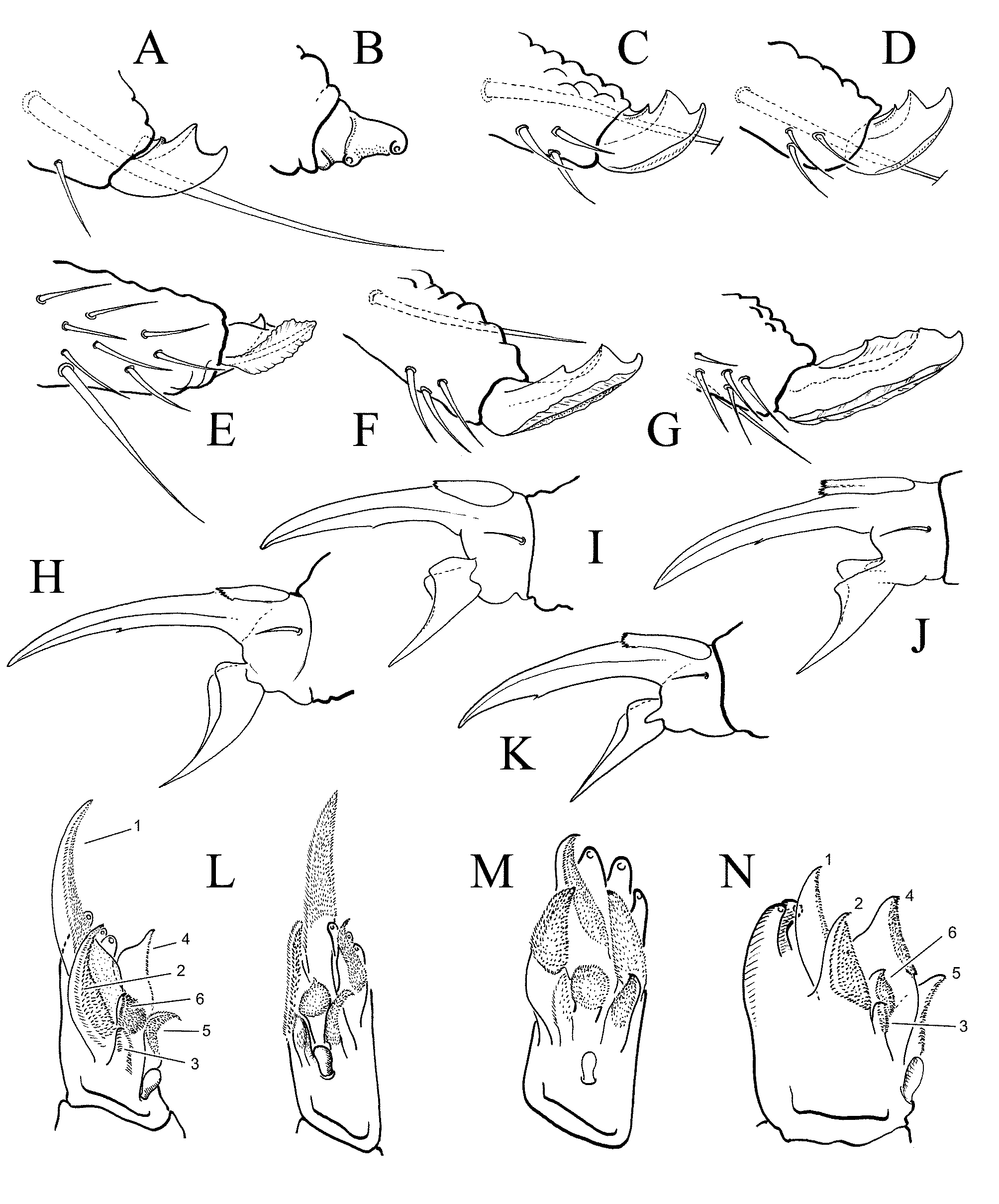
3. Subapical seta on dens reaching well beyond tip of mucro (Fig. 1 A) .......................................................................... 5
- Subapical seta on dens short, not reaching beyond tip of mucro (Figs. 1 E–G)........................................................... 4
4. Claws very long and slender, claw index 3.0 or more; body setae thin, sparse, uniform; outer dorsal lamella of mucro not prominent (Fig. 1 F) .................................................................................................. falcula n. sp. (Appalachians)
- Claws shorter, claw index less than 3.0; body setae strong, on head and thorax with mixed short and long setae; outer dorsal lamella of mucro high and distinct (Fig. 1 G)............................................. tarashchukae n. sp. (Appalachians)
5. Colour deep greenish black; ventral tube without anterior setae .................................................. atroviridis (Rockies)
- Colour olive; ventral tube with or without anterior setae ........................................................................................... 6
6. Antennae no more than 1.8 times the length of head diagonal; anterior setae on ventral tube usually absent, occa- sionally 1–2 on each side; claw index in summer specimens 2.1–2.5, in winter specimens 1.2–1.3 ............................. .......................................................................................................................................................... riparia (Holarctic)
- Antennae in adults more than 1.8 times the length of head diagonal, in large males up to 2.7 times as long; ventral tube usually with 4–5 anterior setae on each side, rarely absent; claw index 2.8–4.5 (summer) and 2.0–2.7 (winter)..
........................................................................................................................................ parkeri n. sp. (Appalachians) 7. Mucro elongate, apical tooth larger than subapical tooth (Fig. 6 B); maxilla with short, unmodified lamellae (Fig. 1 M) ............................................................................................................................................................................... 8 - Mucro short and compact, apical tooth not larger than subapical tooth (Fig. 1 A); maxilla with long, modified lamellae (Fig. 1 L) ............................................................................................................................. extrema n. sp. (Rockies)
8. Claws long and slender, claw index 2.8 or more; head markedly prognathous; abdominal setae of normal density ... ........................................................................................................................................... agilis (Pacific Coast Range)
- Claws shorter, shape normal; claw index 2.3 or less; head shape normal, not markedly prognathous; abdominal setae dense, Isotomurus -like ..................................................................................................................... cyanura (Rockies)
9. Ventral tube with fewer than 20 anterior setae on each side; setae along anterior edge of frontoclypeus normal, not differentiated into a "moustache" ............................................................................................................................... 10
- Ventral tube in adults with more than 30 anterior setae on each side; frontoclypeal field with a distinct "moustache" ................................................................................................................................................................ pilosa (Japan)
10. Mucro short and compact, with narrow ventral lamella .......................................................................................... 11
- Mucro elongate, with broad ventral lamella (as in Fig. 1 E–F) ............................................ lamellosa (Appalachians)
11. Body usually with some segments, or parts of segments, darker than rest; reproductive specimens unmodified ........ ............................................................................................................................................... bidenticulata (Holarctic)
- Body colour uniform, without distinctly darker sections; large reproductive specimens with modified setae on tip of abdomen .................................................................................................................................... polymorpha (Rockies)
Export occurrence data
Darwin Core Archive (ZIP)
CLASSIFICATION
Taxonomic Classification Tree

MULTIMEDIA
Media Files(2)
FIGURE 1. A-G, mucro shapes of Agrenia spp. A. A. extrema n. sp., lateral view; B. A. extrema n. sp., dorsal view; C. A. parkeri n. sp., winter form; D. A. parkeri n. sp., summer form; E. A. falcula n. sp., ventral view showing the broad ventral lamella; F. A. falcula n. sp., lateral view; G. A. tarashchukae n. sp. H-K, claws of hind legs. H. A. falcula n. sp.; I. A. tarashchukae n. sp.; J. A. parkeri n. sp., winter form; K. A. extrema n. sp. L-N, maxillae. L. A. extrema n. sp., ventral side (left) and inner side (right); M. A. agilis, inner side; N. A. falcula n. sp., ventral side.

IMAGES