
AnimaliaNot EvaluatedacceptedspeciesAccepted
Agrenia extrema
GBIF:119627167
ABOUT
Descriptions(5)
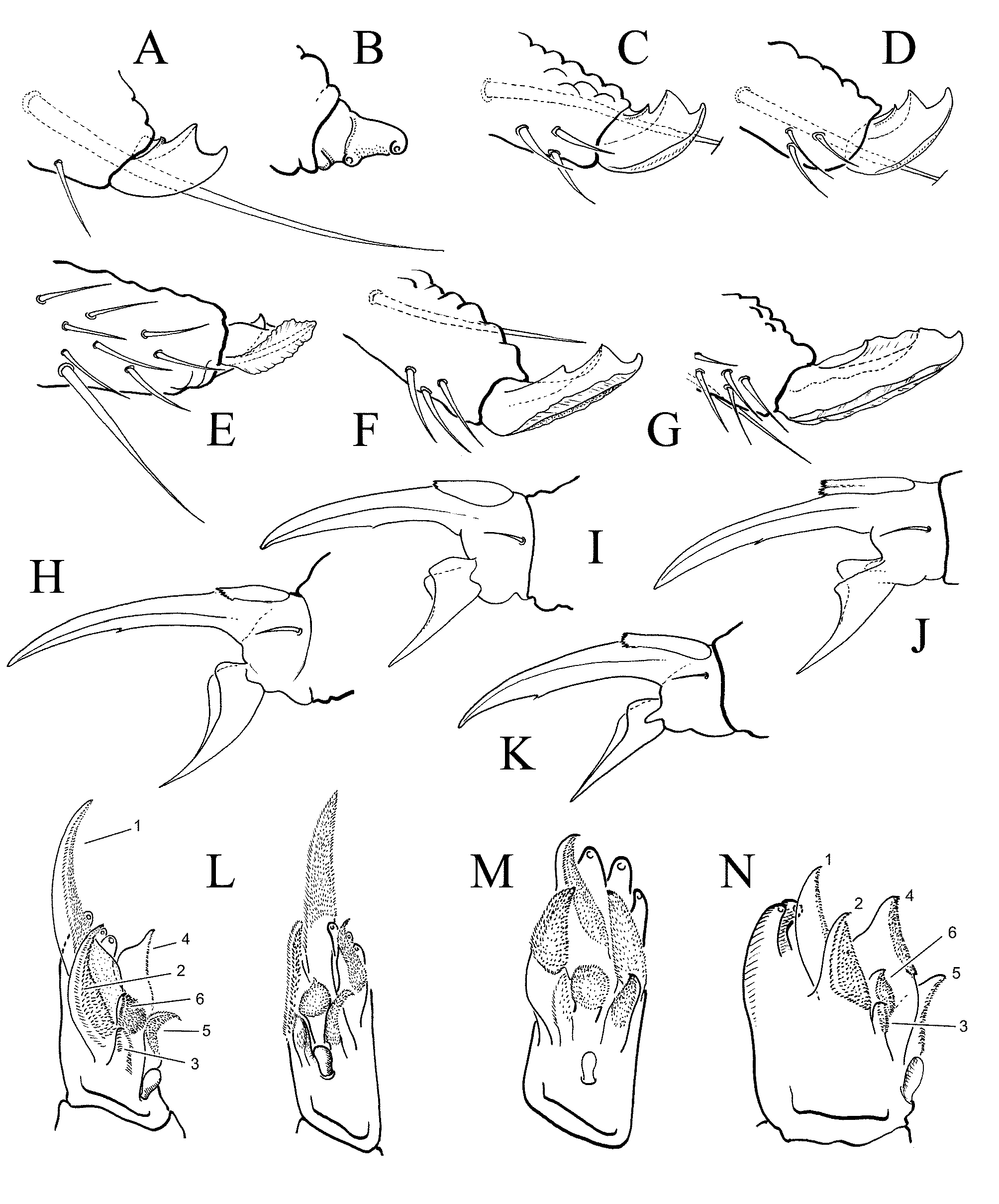
Description. Size up to 3.5 mm. Colour uniform, dark brownish green. Antennae, legs and furca paler. Antennae long and slender, up to twice the length of head diagonal. Ventroapical and inner side of Ant. IV with dense short, erect sensilla (Fig. 6 D). Head distinctly prognathous, frontoclypeal setae not differentiated. PAO oval, slightly longer than diameter of nearest ocellus. Maxilla (Fig. 1 L) with lamella 1 reaching far beyond tip of capitulum, with a dense fringe of short cilia along the edges, otherwise covered with fine denticles; lamella 2 reaching tip of capitulum, with short cilia along ventral edge, otherwise with short denticles that are stronger than on other lamellae; lamella 3 small, situated at base of lamella 2, with only a few denticles; lamellae 4 – 6 densely covered with fine denticles. Body setal vestiture short and fine, macrochaetae only developed on inner side of femora and on tip of abdomen. Ventral tube in adults with 3 – 10 anterior setae on each side and more than 30 lateral and 40 caudal setae in large specimens. Retinaculum with more than 25 setae. Claws slender, unguis with distinct inner tooth in the middle (Fig. 1 J). Claw index 1.8 – 2.0. Mucro short and compact, apical and subapical teeth subequal, small basolateral tooth present (Figs. 1 A, B). Mucronal seta absent. Males present, sexual dimorphism not observed (no reproductive males seen).
Fjellberg, Arne, Bernard, Ernest C. (2009): Review of Agrenia Börner, 1906 with descriptions of four new species from North America (Collembola, Isotomidae). Zootaxa 2306: 17-28, DOI: 10.5281/zenodo.275389
Discussion. This exceptionally large Agrenia is immediately recognised by the modified maxilla, in which lamella 1 is much longer than the capitulum. In other species lamella 1 either does not reach the capitulum tip, or only slightly bypasses it. Also, the presence of numerous short, erect sensilla on Ant. IV is unmatched by other species. All Agrenia spp. have these sensilla, but never as densely packed as in A. extrema.
Fjellberg, Arne, Bernard, Ernest C. (2009): Review of Agrenia Börner, 1906 with descriptions of four new species from North America (Collembola, Isotomidae). Zootaxa 2306: 17-28, DOI: 10.5281/zenodo.275389
Distribution and ecology. Alaska and Washington (see above). The remarkable habitat of this species (snow and icefields) and the long, delicate maxillary lamellae probably indicate a feeding habit based on sweeping organic particles from melt water on the glacial ice.
Fjellberg, Arne, Bernard, Ernest C. (2009): Review of Agrenia Börner, 1906 with descriptions of four new species from North America (Collembola, Isotomidae). Zootaxa 2306: 17-28, DOI: 10.5281/zenodo.275389
Etymology. The name reflects the extreme habitat and the unusual maxilla.
Fjellberg, Arne, Bernard, Ernest C. (2009): Review of Agrenia Börner, 1906 with descriptions of four new species from North America (Collembola, Isotomidae). Zootaxa 2306: 17-28, DOI: 10.5281/zenodo.275389
Type material. Holotype: Unreproductive male (slide), USA, Washington, Whatcom County, Easton Glacier, N 48 o 44 ' 38 '', W 121 o 50 ' 0 1, on snow, 4. VIII. 2002, P. Hartzell, coll. Paratypes: One male and one female (on two slides) from the type locality, same data. All types deposited in the National Museum of Natural History, Washington, D. C. Additional material from USA collected by P. Hartzell: Two specimens from Lower Curtis Glacier, Whatcom Co., Washington, on snow, 1,600 m., 6. VIII. 2002; six specimens from Columbia Glacier, Snohomish Co., Washington, 1,600 m, 4. VIII. 2002; four specimens from Shoup Glacier, Alaska, and two specimens from Ptarmigan Glacier, Alaska, summer 2003.
Fjellberg, Arne, Bernard, Ernest C. (2009): Review of Agrenia Börner, 1906 with descriptions of four new species from North America (Collembola, Isotomidae). Zootaxa 2306: 17-28, DOI: 10.5281/zenodo.275389
Export occurrence data
Darwin Core Archive (ZIP)
CLASSIFICATION
Taxonomic Classification Tree

MULTIMEDIA
Media Files(2)
FIGURE 1. A-G, mucro shapes of Agrenia spp. A. A. extrema n. sp., lateral view; B. A. extrema n. sp., dorsal view; C. A. parkeri n. sp., winter form; D. A. parkeri n. sp., summer form; E. A. falcula n. sp., ventral view showing the broad ventral lamella; F. A. falcula n. sp., lateral view; G. A. tarashchukae n. sp. H-K, claws of hind legs. H. A. falcula n. sp.; I. A. tarashchukae n. sp.; J. A. parkeri n. sp., winter form; K. A. extrema n. sp. L-N, maxillae. L. A. extrema n. sp., ventral side (left) and inner side (right); M. A. agilis, inner side; N. A. falcula n. sp., ventral side.
Imageimage/png© Fjellberg, Arne;Bernard, Ernest C.Fjellberg, Arne;Bernard, Ernest C.

IMAGES