
AnimaliaNot EvaluatedacceptedspeciesAccepted
Agrenia cyanura

Agrenia cyanura

Fjellberg, 1986

GBIF:119627170

0year

ABOUT

Descriptions(1)

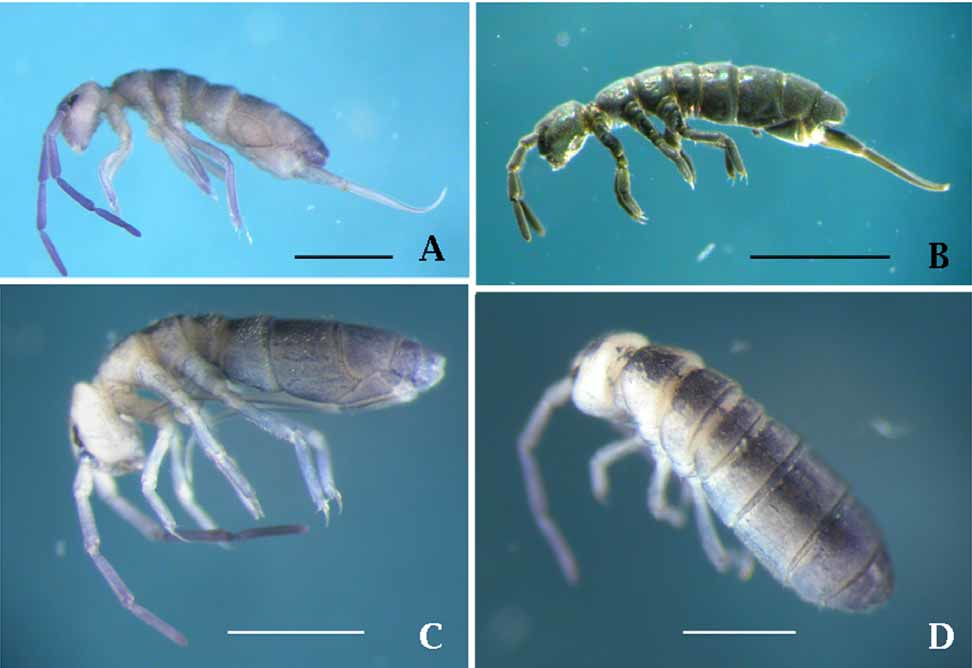
This species probably is widely distributed in the Rockies, with records from British Columbia, Idaho, Oregon, and Utah, living in wet moss along mountain streams. It is similar to A. agilis, but separated by head shape, which is normal and not prognathous, the stouter claws, and dense Isotomurus - like setal vestiture on the abdomen. Reproductive males may have short setae and a rugose cuticle on the thorax and anterior abdominal segments.
Fjellberg, Arne, Bernard, Ernest C. (2009): Review of Agrenia Börner, 1906 with descriptions of four new species from North America (Collembola, Isotomidae). Zootaxa 2306: 17-28, DOI: 10.5281/zenodo.275389

Export occurrence data

Darwin Core Archive (ZIP)

CLASSIFICATION

Taxonomic Classification Tree

MULTIMEDIA

Media Files(1)

FIGURE 3. Habitus of Agrenia spp. A. A. agilis; B. A. atroviridis; C. A. cyanura, lateral; (D) A. cyanura, dorsal. Scale bars = 1 mm.

Imageimage/png© Fjellberg, Arne;Bernard, Ernest C.Fjellberg, Arne;Bernard, Ernest C.

IMAGES

Gallery(1)

See Gallery

Occurrences with images

Source Information

Review of Agrenia Börner, 1906 with descriptions of four new species from North America (Collembola, Isotomidae)

checklist

This dataset contains the digitized treatments in Plazi based on the original journal article Fjellberg, Arne, Bernard, Ernest C. (2009): Review of Agrenia Börner, 1906 with descriptions of four new species from North America (Collembola, Isotomidae). Zootaxa 2306: 17-28, DOI: 10.5281/zenodo.275389

Abstract

The eight known species of Agrenia are reviewed and new distributional data are added. Two species groups are suggested for the genus: a bidenticulata -group with a mucronal seta and an agilis -group without a mucronal seta. Four new species of the second group are described from North America: A. falcula, A. parkeri, and A. tarashchukae from forest streams of the Appalachian Mountains in Tennessee, North Carolina, and New York, and A. extrema from glaciers in Washington and Alaska. The head of the maxilla is introduced as a useful character for separation of some species. A key to all species is given.

Key words: allometry, cyclomorphosis, Holarctic, key to species, sexual dimorphism

Fjellberg A, Bernard E C, plazi (2009). Review of Agrenia Börner, 1906 with descriptions of four new species from North America (Collembola, Isotomidae). Plazi.org taxonomic treatments database. Checklist dataset https://doi.org/10.5281/zenodo.275389 accessed via GBIF.org on 2026-06-15.

CC0Published 12/31/2009View dataset
GBIF Usage Key
119627170
Dataset Key
7a3b903a-74a1-4f72-ad57-487907b055c8
Origin
source
Backbone Key
8574295
Taxon ID
03E61F409351FFBA62C4FDE2DA9BFC72.taxon
Last Crawled
6/11/2026
Last Interpreted
6/11/2026