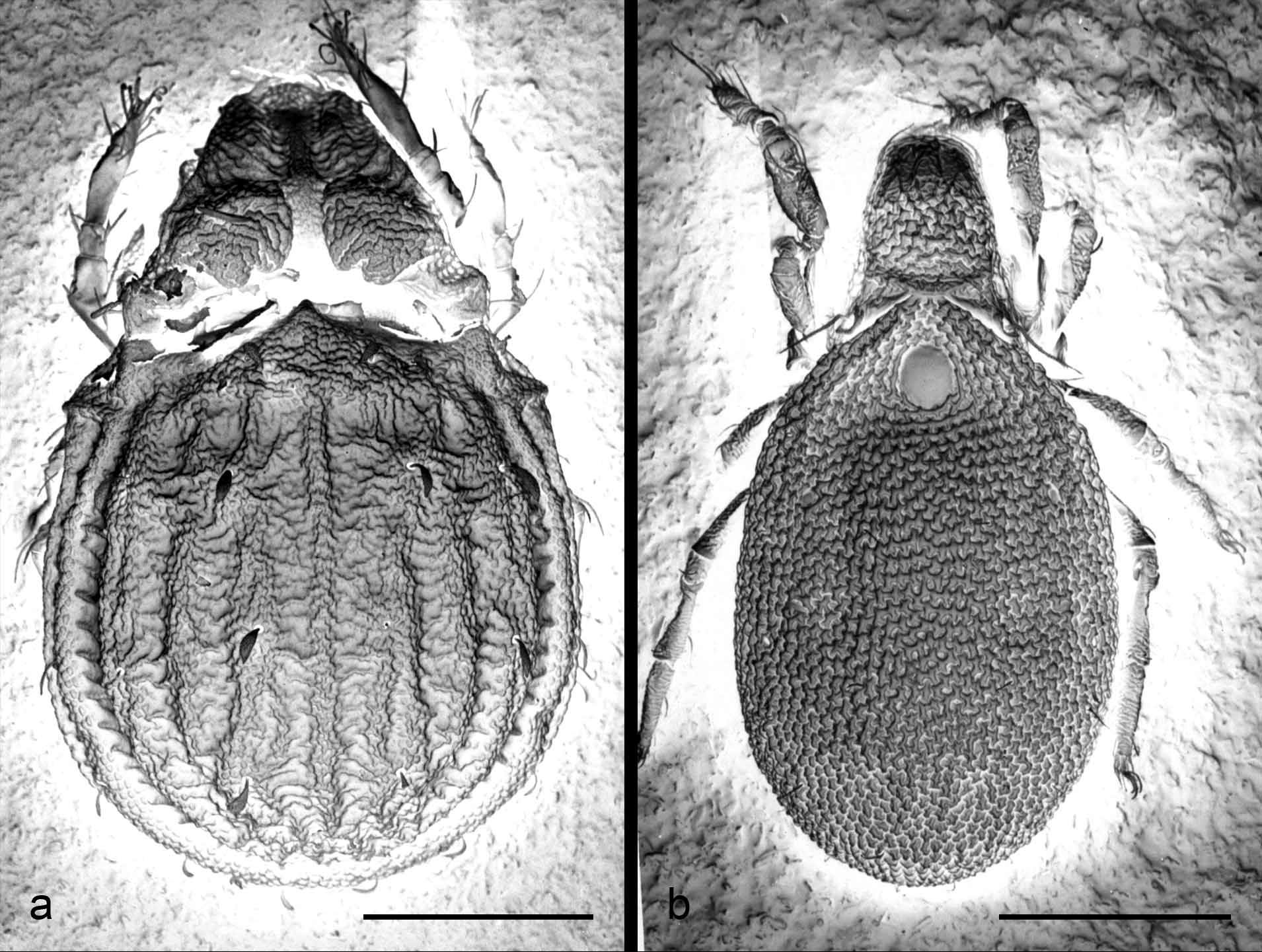
This dataset contains the digitized treatments in Plazi based on the original journal article Migliorini, Massimo (2009): Oribatid mite (Arachnida: Oribatida) coenoses from SW Sardinia *. Zootaxa 2318: 8-37, DOI: 10.5281/zenodo.192029
Abstract
Oribatid mite communities were investigated at five sites in SW Sardinia (Carbonia-Iglesias and Medio Campidano provinces) in three representative habitat types: holm oak (Quercus ilex) forest, cork oak (Quercus suber) forest and pineland (Pinus radiata and P. pinaster).
A total of 1,180 oribatid mite specimens, belonging to 67 different species, were extracted from soil samples. Significant differences in species diversity, abundance and Berger-Parker index of dominance were found among the different vegetation types throughout the sampling period, and non-metric multidimensional scaling (n-MDS) ordination confirmed a clear separation between the three coenoses, showing how oribatid assemblages are significantly affected by habitat evolution.
The faunistic knowledge of the oribatid mites of Sardinia is rather poor, the present research represents one of the first contributions for the main Sardinian island. Besides a majority of eurytopic and widespread species representing the main part of the edaphic communities in Mediterranean landscapes, some rare and characteristic species are recorded. They are remnants of the original populations of Sardinia and the western part of the Italian peninsula, resulting from the complex tectonic events that formed the western Mediterranean basin. Among these, Belorchestes gebennicus Grandjean, 1957 (Zetorchestidae), Microppia minus longisetosa Subías & Rodriguez, 1988, and Pluritrichoppia insolita Subías & Arillo, 1989 (Oppiidae) had never been collected in Italy, single individuals of Oxyoppioides and Thamnacarus probably belong to undescribed species, while Brachychthonius hirtus Moritz, 1976 (Brachychthoniidae), Mongaillardia aeoliana (Bernini, 1979) (Amerobelbidae), Berniniella aeoliana (Bernini, 1973), Lauroppia similifallax Subías & Minguez, 1986, Ramusella (Ramusella) gyrata (Mahunka & Paoletti, 1984) (Oppiidae) and Ophidiotrichus oglasae Bernini, 1975 (Oribatellidae) are new to the Sardinian fauna.
Key words: Oribatidae, soil fauna, faunistics, biogeography, population dynamics, Italy
Migliorini M, plazi (2009). Oribatid mite (Arachnida: Oribatida) coenoses from SW Sardinia *. Plazi.org taxonomic treatments database. Checklist dataset https://doi.org/10.5281/zenodo.192029 accessed via GBIF.org on 2026-06-19.