AnimaliaNot EvaluatedacceptedspeciesAccepted
Amazhomidia ducke

Amazhomidia ducke

GBIF:119632594

ABOUT

Descriptions(5)

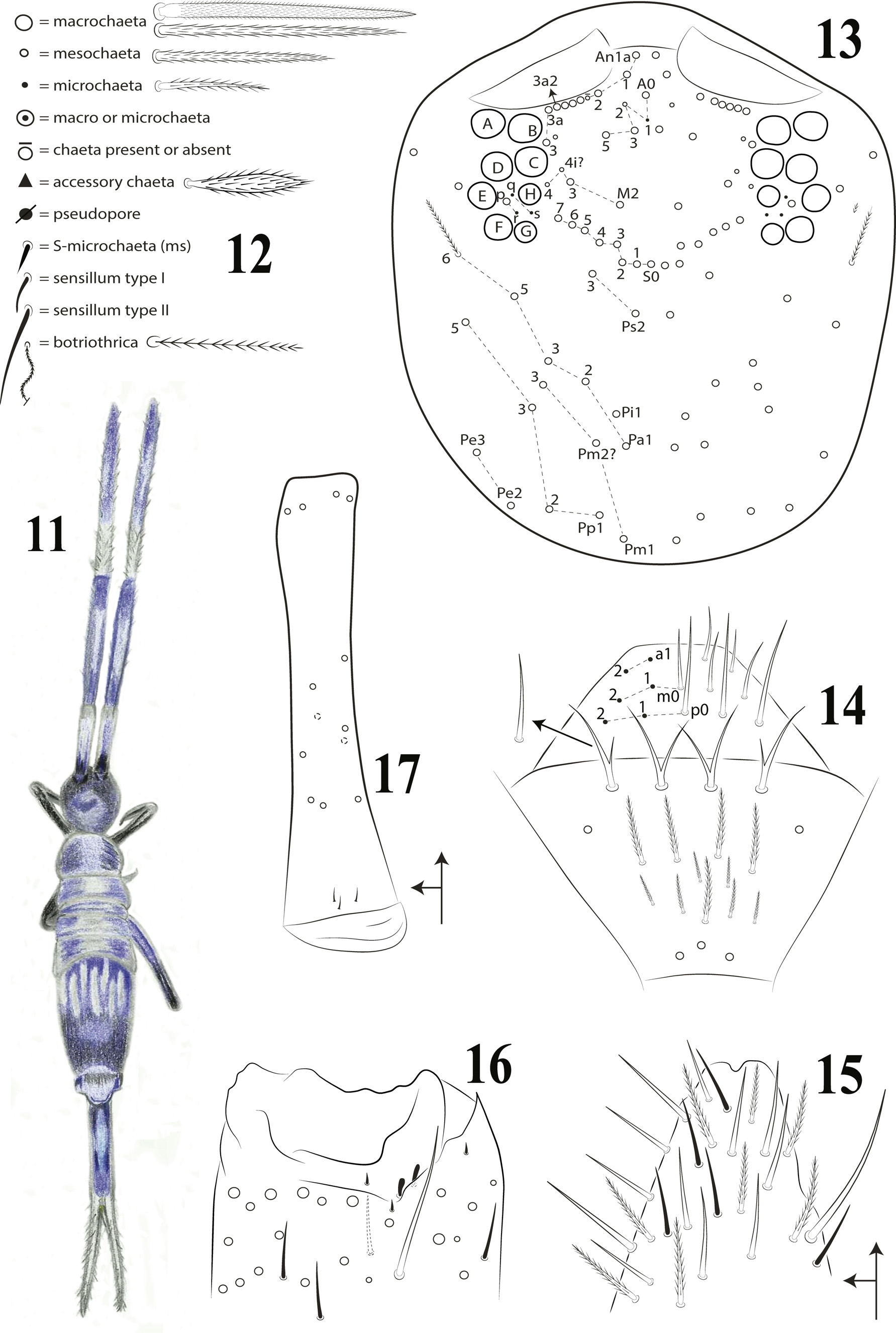
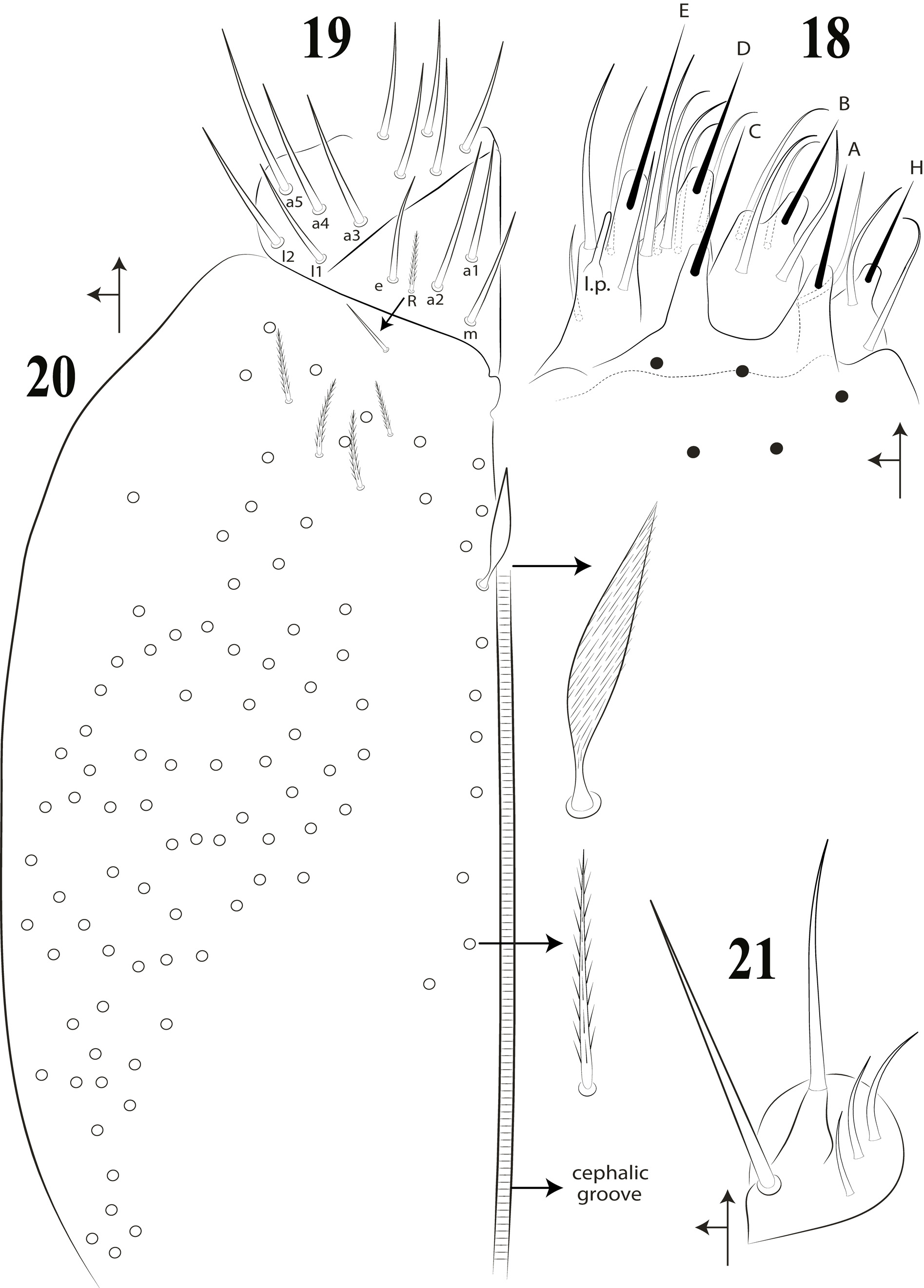
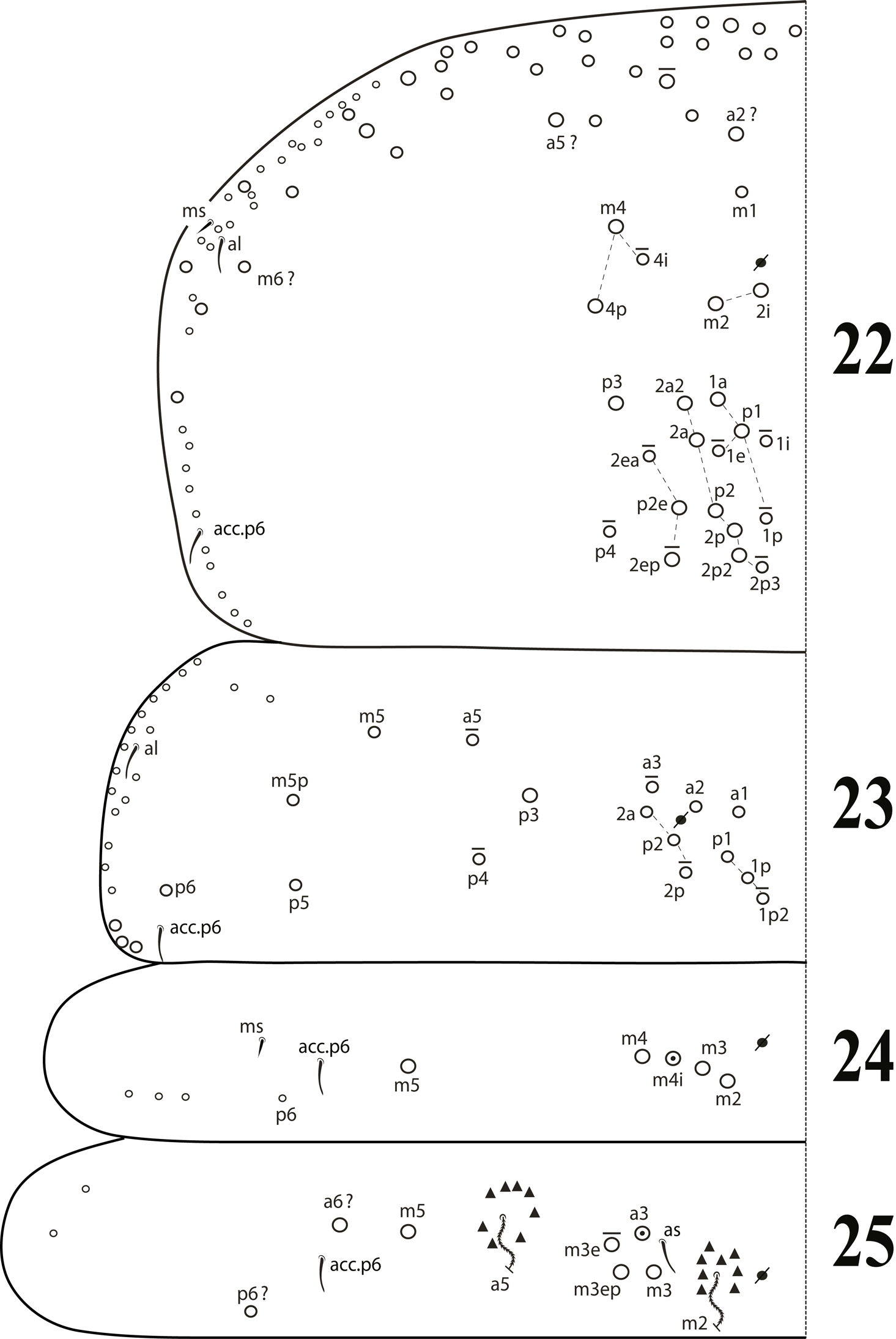
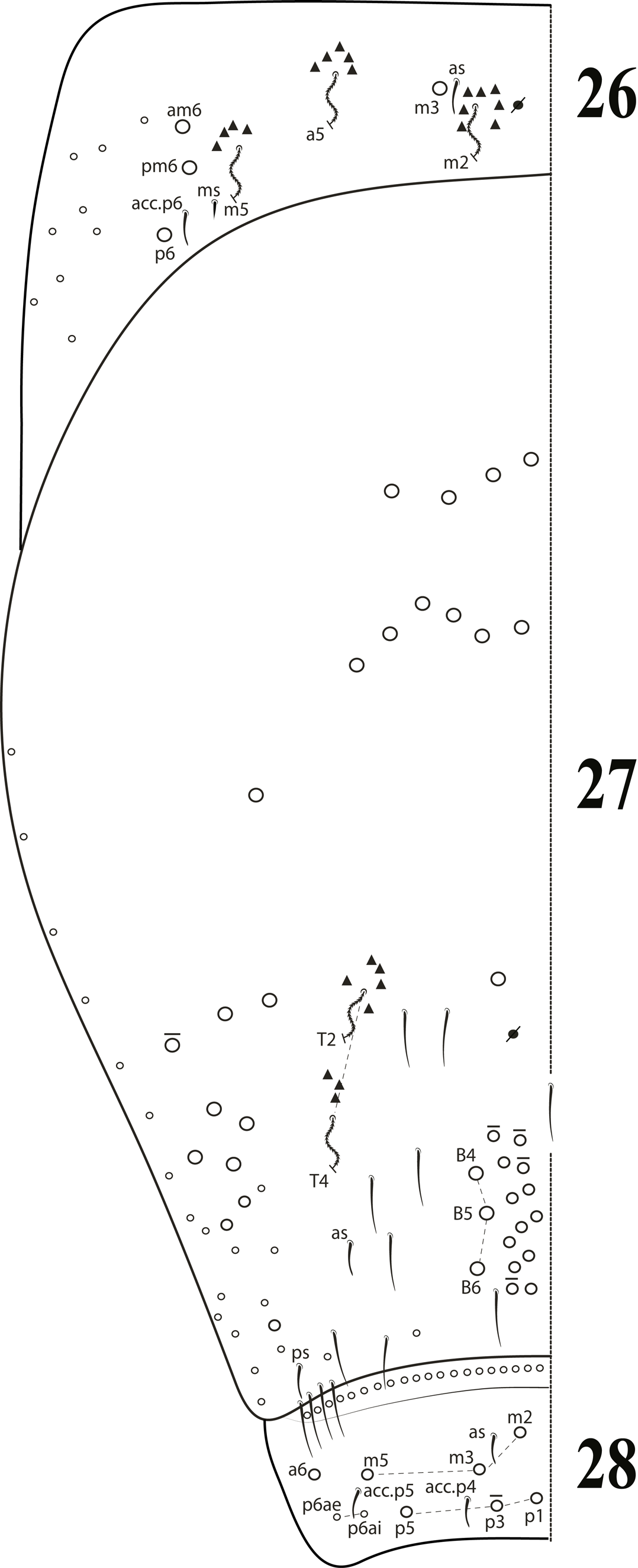
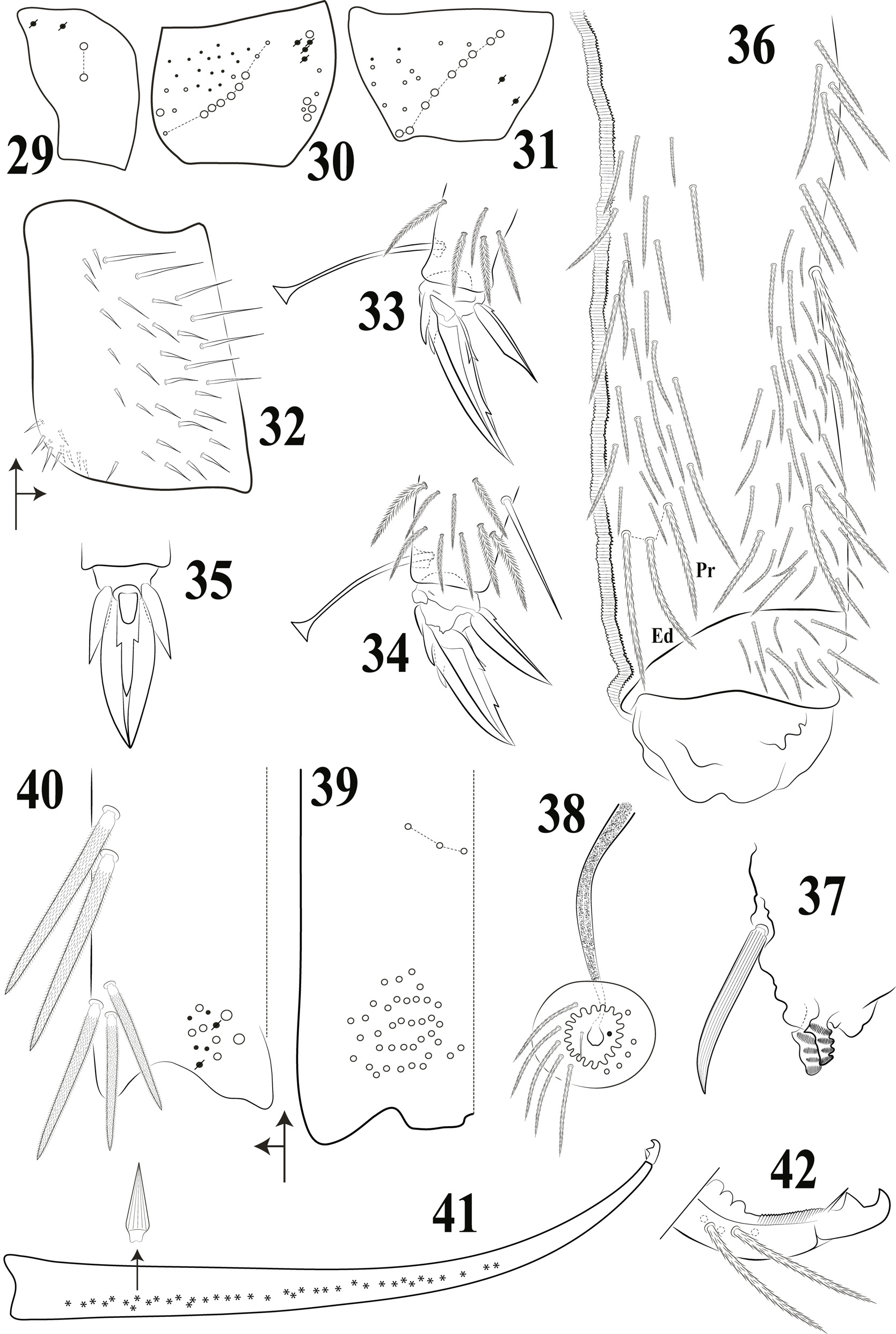
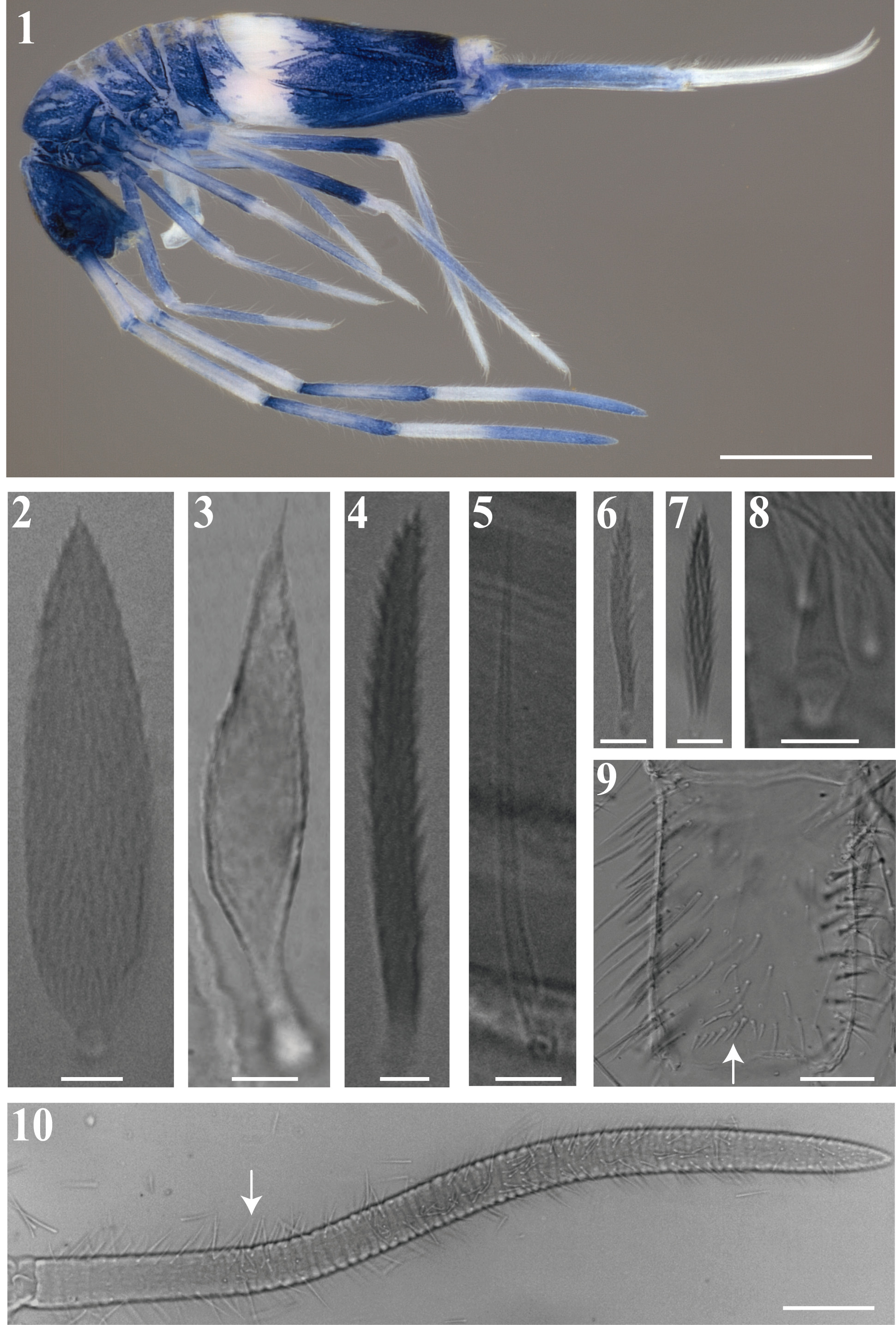
Description. Total length (head + trunk) of holotype 2.51 mm. Habitus typically entomobryid (Figs 1, 11). Specimen with dark blue pigment covering the distal half of Ant. IV and Ant. III, head, thorax and Abd. I – IV (except lateral Abd. III and anterior part of Abd. IV), slight lighter in middle of trunk, legs (except the articulations of femora with tibiotarsi and distal tibiotarsi) and manubrium, dorsal Th. II – Abd. III with irregular unpigmented areas (Figs 1, 11). Heavily striate apically pointed scales covering dorsum of the head, thorax and abdomen (Fig. 2). Antennae, legs, collophore and furcula without scales. Head. Antennae subequal to the length of body, antennal ratio as I: II: III: IV = 1: 1.4 – 1.7: 1.07 – 1.29: 2 – 2.21, holotype 1: 1.15: 1.18: 2.07 (Fig. 1). Ant. IV annulated, without apical bulb, with at least three types of chaetae: sblunt sensilla, ciliated and smooth chaetae (Figs 10, 15). Ant. III sense organ with 2 rods and 3 surrounding guard sensilla, with more 3 near s-blunt sensilla (Fig. 16). Ant. I dorsal face with 11 mac and three basal spiny smooth mic; ventral face with two mac (Fig. 17). Eyes 8 + 8, G and H smaller, other subequal, with 4 interocular chaetae, p as mac, q, r and s mic. Dorsal chaetotaxy as in Fig. 13: antennal series ‘ An’ with 10 – 11 chaetae; anterior series ‘ A’ with 5 chaetae, A 0, A 3 and A 5 as mac; medio-ocellar series ‘ M’ with 4 chaetae, M 2 and M 3 as mac; sutural series ‘ S’ with 8 mac (S 0 – 7); post-sutural series ‘ Ps’ with 2 mac (Ps 2 – 3); postoccipital internal series ‘ Pi’ with 1 mac (Pi 1); postoccipital anterior series ‘ Pa’ with 5 chaetae, Pa 1 – 3 and P 5 as mac, Pa 6 as bothriotrichum); postoccipital media series ‘ Pm’ with 3 mac (Pm 1, Pm 2?, Pm 3); postoccipital posterior ‘ Pp’ series with 4 mac (Pp 1 – 3, Pp 5); postoccipital external series ‘ Pe’ with 2 mac (Pe 2 – 3). Clypeus with 16 ciliated chaetae: 5 mac, 5 mes, and 6 mic. Four prelabral chaetae, internal pair with bifurcated chaetae, external pair smooth or bifurcated. Labral papilla absent. Labral formula 4, 5, 5, all smooth chaetae, four anterior (a 1 – 2), five median (m 0 – 2) and five posterior (p 0 – 2) (Fig. 14). Labial palp with five papillae (A – E), and with 0, 5, 0, 5, 4 guard chaetae, respectively; papilla E with lateral process (l. p.) finger-shaped with tip not reaching; H (main hypostomal chaeta) with two accessorial hypostomal chaetae (Fig. 18). Labium with five smooth proximal chaetae (Figs 18 – 19). Labial region with smooth chaeta (a 1 – 5, m, R (r), e, l 1 – 2), chaetae r smaller, ciliated, smooth or absent (Fig. 19). Cephalic groove with 1 + 1 scale-like chaeta and 10 ciliated chaetae; chaetae on posterior labium ciliated and subequal in size, with exception of four anterior smaller chaetae (Fig. 20). Maxillary out lobe with one apical, one subapical chaetae and 3 sublobal hairs on sublobal plate, subapical chaeta larger than apical one (Fig. 21). Thorax. Th. II chaetotaxy as in Fig. 22; anterior series with about 30 mac; medial series ‘ m’ with 5 – 6 central mac (m 4 i present or absent) and 3 lateral mac (m 6?) and two unnamed); posterior series ‘ p’ with 9 to 16 mac, p 1 i, p 1 p, p 1 e, p 2 p 3, p 2 ea, p 2 ep and p 4 present or absent. Tergite laterally with numerous chaetae, one ms, one anterolateral sens (al), and one accessory sens (acc. p 6), both type I. Th. III chaetotaxy as in Fig. 23; series ‘ a’ with 2 to 4 mac, a 3 and a 5 present or absent; series ‘ m’ with 2 mac (m 5 – 5 p); series ‘ p’ with 7 to 10 mac, p 1 p 2, p 2 p and p 4 present or absent. Numerous mes on the side of tergite plus one anterolateral sens (al) and one accessory sens (acc. p 6), both type I. Legs with subcoxa I with a row of two mac and two pseudopores; subcoxa II with one row of six mac and three mes, anteriorly with one mac plus four mes and 16 mic, posteriorly with four mac plus three mes and four pseudopores; subcoxa III with a row of 9 mac, anteriorly with 10 mes plus two mic, posteriorly with two pseudopores (Figs 29 – 31). Trochanteral organ with approximately 33 spine-like chaetae; anterior face with about 10 extra spine-like chaetae (Fig. 32). Unguis with three inner teeth, one paired basal and one unpaired medial; and a basal pair of large laterodorsal teeth. Unguiculi I – II weakly truncate, unguiculus III acuminate, all with one small proximal external tooth. Tenent hairs capitate with smooth edges (Figs 33 – 35). Tibiotarsus III with a smooth inner distal chaeta, near the empodium (Fig. 34). Abdomen. Abd. I chaetotaxy as in Fig. 24; series ‘ m’ with 4 – 5 mac, m 4 i present or absent; series ‘ p’ with 4 mes (p 6 and three unnamed); one ms and one accessory sens (acc. p 6) (ms external to sens). Abd. II chaetotaxy as in Fig. 25; series ‘ a’ with 3 chaetae, a 6? as mac, a 3 as mac or mic, a 5 as bothriotrichum with 8 accessory chaetae; series ‘ m’ with 4 – 5 chaetae, m 3, m 3 ep, m 3 e (present or absent) and m 5 as mac, m 2 as bothriotrichum with 8 accessory chaetae; series ‘ p’ with 1 mac (p 6?). Two sensilla present, one anterosubmedial (as) and one accessory (acc. p 6), both type I. Abd. III chaetotaxy as in Fig. 26; series ‘ a’ with 2 chaetae, am 6 as mac, a 5 as bothriotrichum with 5 accessory chaetae; series ‘ m’ with 4 chaetae, m 3 and pm 6 as mac, m 2 and m 5 as bothriotricha, respectively with 7 and 4 accessory chaetae; series ‘ p’ with one mac (p 6). Two sensilla present, one anterosubmedial (as) and one accessory (acc. p 6), both type I, plus one ms. Nine unnamed lateral mes present. Abd. IV chaetotaxy as in Fig. 27; anterior central region with two transverse rows of 6 and 4 mac respectively; 1 median central mac; posterior central with 12 – 16 mac, B 4 – 6 and 13 unnamed (four unnamed present or absent); series ‘ T’ with 2 bothriotricha (T 2 and T 4) and 8 surrounding accessory chaetae; lateral region with 10 – 11 mac and 20 mes. Two sensilla type I (as and ps), 12 sensilla type II, and 20 mes on posterior margin present. Abd. V chaetotaxy as in Fig. 28; series ‘ a’ with 1 mac (a 6); series ‘ m’ with 3 mac (m 2 – 3, m 5); posteroanterior series ‘ pa’ with 2 mes (p 6 ai and p 6 ae); series ‘ p’ with 2 – 3 mac (p 1, p 3, p 5), p 3 present or absent. Three sens as type I, one anterosubmedial (as) and two accessory sensilla (acc. p 4 and acc. p 5). Collophore. All chaetae ciliated; one side of anterior face with 28 chaetae; 3 as mac, line connecting proximal (Pr) and external-distal (Ed) mac oblique to medial furrow; lateral face with approximately 12 chaetae; posterior face with about 38 chaetae, one of them longer (Fig. 36). Tenaculum. With 4 + 4 teeth and 1 large, striated basal chaeta (Fig. 37). Genital plate. Male papillate with 5 + 5 surrounding ciliated chaetae and 1 + 1 inner smooth chaetae (Fig. 38). Furcula. Manubrium with ciliate chaetae; ventral side with 3 subapical chaetae, distal region with approximately 38 chaetae; lateral side with 5 long distal mac; manubrial plate (dorsal side) with 2 mac, 5 mes, 4 mic and 2 pseudopores (Figs 39 – 40). Dens dorsally with about 38 striated spines in an irregular row (Fig. 41). Mucro bidentate with a basal spine slightly longer than apex of the proximal tooth (Fig. 42).
Cipola, Nikolas Gioia, Morais, José Wellington De, Bellini, Bruno Cavalcante (2016): A new genus of Entomobryinae (Collembola, Entomobryidae) from Brazilian Amazon with body scales and dental spines. Zootaxa 4105 (3): 261-273, DOI: 10.11646/zootaxa.4105.3.3

Remarks. The dorsal chaetotaxy of A. ducke sp. nov. possesses several unique characters compared to its closest taxon, Sinhomidia bicolor (Yosii, 1965). The new species has Ps 3 mac and several extra mac in posterior region of head (absent in S. bicolor), absence of p 5 mac on Th. II (present in S. bicolor), presence of m 5 mac on Abd. I (absent in S. bicolor), and two extra lateral mac a 6? and p 6? on Abd. II (absent in S. bicolor), absence of m 7 mac on Abd. III (present in S. bicolor) and a different number and arrangement of mac on Abd. IV, with a second row of median-anterior mac (absent in S. bicolor), high number of median-posterior mac (up to 16 vs. 8 in S. bicolor) and low number of latero-anterior mac above T 2 bothriotrichum (1 vs. 9 in S. bicolor). Additional differences between the species are listed on the first two paragraphs of Amazhomidia gen nov. ‘ remarks’ and Table I.
Cipola, Nikolas Gioia, Morais, José Wellington De, Bellini, Bruno Cavalcante (2016): A new genus of Entomobryinae (Collembola, Entomobryidae) from Brazilian Amazon with body scales and dental spines. Zootaxa 4105 (3): 261-273, DOI: 10.11646/zootaxa.4105.3.3
Distribution and habitat. The new species was found in the Amazon Rainforest phytogeographic domain, Amazon state, Brazil, Good’s biogeographic zone 26, Neotropical Region, Highlands of Eastern Brazil: North Brazilian (Good 1974). The climate of the area following the Köppen-Geiger system is " Am " tropical wet (or monsoon) climate, characterized by wet and dry seasons (Kottek et al. 2006). The specimens were found in different land units between 60 and 140 m asl in the “ Reserva Ducke ”, most commonly in low-lying areas on wet litter, in the warmer times of the year (April to September) (Baccaro et al. 2008). Amazhomidia ducke sp. nov. was not found in other regions sampled from Brazilian Amazon, so it is possibly a locally species to this region.
Cipola, Nikolas Gioia, Morais, José Wellington De, Bellini, Bruno Cavalcante (2016): A new genus of Entomobryinae (Collembola, Entomobryidae) from Brazilian Amazon with body scales and dental spines. Zootaxa 4105 (3): 261-273, DOI: 10.11646/zootaxa.4105.3.3
Etymology. The new species is named after the type locality, " Ducke Reserve ", Amazonas, Brazil.
Cipola, Nikolas Gioia, Morais, José Wellington De, Bellini, Bruno Cavalcante (2016): A new genus of Entomobryinae (Collembola, Entomobryidae) from Brazilian Amazon with body scales and dental spines. Zootaxa 4105 (3): 261-273, DOI: 10.11646/zootaxa.4105.3.3
Type material. Holotype female on slide N ° COLLE 057 / INPA: Brazil, Amazonas, Manaus, Reserva Ducke, 02 ° 59 ’ S; 59 ° 55 ’ W, 23. ix – 04. xi. 2014, pitfall-traps, T Vicente coll. Paratypes on slides N ° COLLE 057 A – E / INPA, 4 males and 1 female, same data as holotype. Paratypes on slides N ° COLLE 057 F – H / INPA, 2 males, 1 female and 12 specimens in alcohol, same data as holotype, except 15. ix – 20. v. 2006, JLP Souza coll. Paratype on slide N ° COLLE 057 I / INPA, 1 male, same data as holotype, except 25 – 27. iii. 2013, dish trap, NG Cipola & MB Graça coll. Additional examined material: on alcohol, 1 specimen, Experimental farm of the Universidade Federal do Amazonas, 02 ° 39 ' 11 " S; 60 ° 06 ' 08 " W), 06 – 18. viii. 2010, pitfall traps, C Brito & JLP Souza coll.
Cipola, Nikolas Gioia, Morais, José Wellington De, Bellini, Bruno Cavalcante (2016): A new genus of Entomobryinae (Collembola, Entomobryidae) from Brazilian Amazon with body scales and dental spines. Zootaxa 4105 (3): 261-273, DOI: 10.11646/zootaxa.4105.3.3

Export occurrence data

Darwin Core Archive (ZIP)

CLASSIFICATION

Taxonomic Classification Tree

MULTIMEDIA

Media Files(6)

FIGURES 1 – 10. Amazhomidia ducke gen nov. sp. nov.: 1, habitus of a fixed specimen in ethanol (lateral view); 2 – 8, different shaped of scales and chaetae: 2, pointed scale, 3, scale-like chaetae of cephalic groove, 4, ciliated chaeta, 5, sens type II on Abd. IV, 6, ciliated microchaeta, 7, accessory chaeta of bothriotricha, 8, dental spine; 9, trochanter chaetotaxy, arrow indicates the extra spine-like chaetae of anterior face; 10, Ant. IV segment, arrow indicates the beginning of annulations. Scale bars: 1 (0.5 mm), 2 – 8 (0.005 mm), 9 (0.05 mm), 10 (0.1 mm).

Imageimage/png© Cipola, Nikolas Gioia;Morais, José Wellington De;Bellini, Bruno CavalcanteCipola, Nikolas Gioia;Morais, José Wellington De;Bellini, Bruno Cavalcante

FIGURES 11 – 17. Amazhomidia ducke gen nov. sp. nov.: 11, habitus (dorsal view); 12, symbols used in detailed chaetotaxy schemes; 13, dorsal cephalic chaetotaxy; 14, chaetotaxy of the clypeus, prelabrum and labrum; 15, apex of Ant. IV; 16, Ant. III organ and associated chaetae and sensilla; 17, chaetotaxy of Ant. I (dorsal view).

Imageimage/png© Cipola, Nikolas Gioia;Morais, José Wellington De;Bellini, Bruno CavalcanteCipola, Nikolas Gioia;Morais, José Wellington De;Bellini, Bruno Cavalcante

FIGURES 18 – 21. Amazhomidia ducke gen nov. sp. nov.: ventral head: 18, labial papillae and proximal chaetae; 19, labial region and proximal chaetae; 20, posterior labial chaetotaxy; 21, maxillary outer lobe and sublobal plate.

Imageimage/png© Cipola, Nikolas Gioia;Morais, José Wellington De;Bellini, Bruno CavalcanteCipola, Nikolas Gioia;Morais, José Wellington De;Bellini, Bruno Cavalcante

FIGURES 22 – 25. Amazhomidia ducke gen nov. sp. nov.: dorsal chaetotaxy: 22, Th. II; 23, Th. III; 24, Abd. I; 25, Abd. II.

Imageimage/png© Cipola, Nikolas Gioia;Morais, José Wellington De;Bellini, Bruno CavalcanteCipola, Nikolas Gioia;Morais, José Wellington De;Bellini, Bruno Cavalcante

FIGURES 26 – 28. Amazhomidia ducke gen nov. sp. nov.: dorsal chaetotaxy: 26, Abd. III; 27, Abd. IV; 28, Abd. V.

Imageimage/png© Cipola, Nikolas Gioia;Morais, José Wellington De;Bellini, Bruno CavalcanteCipola, Nikolas Gioia;Morais, José Wellington De;Bellini, Bruno Cavalcante

FIGURES 29 – 42. Amazhomidia ducke gen nov. sp. nov.: 29, subcoxa I; 30, subcoxa II; 31, subcoxa III; 32, trochanteral organ; 33 – 34, distal tibiotarsus and empodial complex (lateral view): 33, fore leg; 34, hind leg; 35, ventral view of hind empodial complex III; 36, collophore chaetotaxy (lateral view); 37, tenaculum (lateral view); 38, male genital plate and sperm duct; 39, distal manubrium (ventral view); 40, distal manubrium (dorso-lateral view); 41, dens and mucro (lateral view, showing dental spines distribution); 42, distal dens and mucro (lateral view).

Imageimage/png© Cipola, Nikolas Gioia;Morais, José Wellington De;Bellini, Bruno CavalcanteCipola, Nikolas Gioia;Morais, José Wellington De;Bellini, Bruno Cavalcante

IMAGES

Gallery(6)

See Gallery

Occurrences with images

Source Information

A new genus of Entomobryinae (Collembola, Entomobryidae) from Brazilian Amazon with body scales and dental spines

checklist

This dataset contains the digitized treatments in Plazi based on the original journal article Cipola, Nikolas Gioia, Morais, José Wellington De, Bellini, Bruno Cavalcante (2016): A new genus of Entomobryinae (Collembola, Entomobryidae) from Brazilian Amazon with body scales and dental spines. Zootaxa 4105 (3): 261-273, DOI: 10.11646/zootaxa.4105.3.3

Abstract

A new monotypic genus of Entomobryinae from Brazilian Amazon is described and illustrated. Amazhomidia gen. nov. is similar to other genera of the subfamily, especially to Sinhomidia Zhang, in presence of apically pointed scales on body dorsally and spines on dens. It differs from all other genera of Entomobryinae by the combination of: bifurcate prelabral chaetae, cephalic groove with scale-like chaetae and two transverse rows macrochaetae present on anterior central region of the abdominal IV segment. Amazhomidia ducke sp. nov., the type species of the new genus is described. An identification key to the genera of Entomobryidae with scales and dental spines is also provided.

Key words: chaetotaxy, neotropics springtails, Willowsiini, keys

Cipola N G, Morais J W D, Bellini B C, plazi (2016). A new genus of Entomobryinae (Collembola, Entomobryidae) from Brazilian Amazon with body scales and dental spines. Plazi.org taxonomic treatments database. Checklist dataset https://doi.org/10.11646/zootaxa.4105.3.3 accessed via GBIF.org on 2026-06-15.

CC0Published 12/31/2016View dataset
GBIF Usage Key
119632594
Dataset Key
18e768be-690b-4ac0-81f5-177cdee972a9
Origin
source
Backbone Key
8596885
Taxon ID
DB744E1C764AFFFAFF7AFF23C2EBFACB.taxon
Last Crawled
6/11/2026
Last Interpreted
6/11/2026