
AnimaliaNot EvaluatedacceptedspeciesAccepted
Aglaophamus lobatus

Aglaophamus lobatus

GBIF:119637377

ABOUT

Descriptions(4)

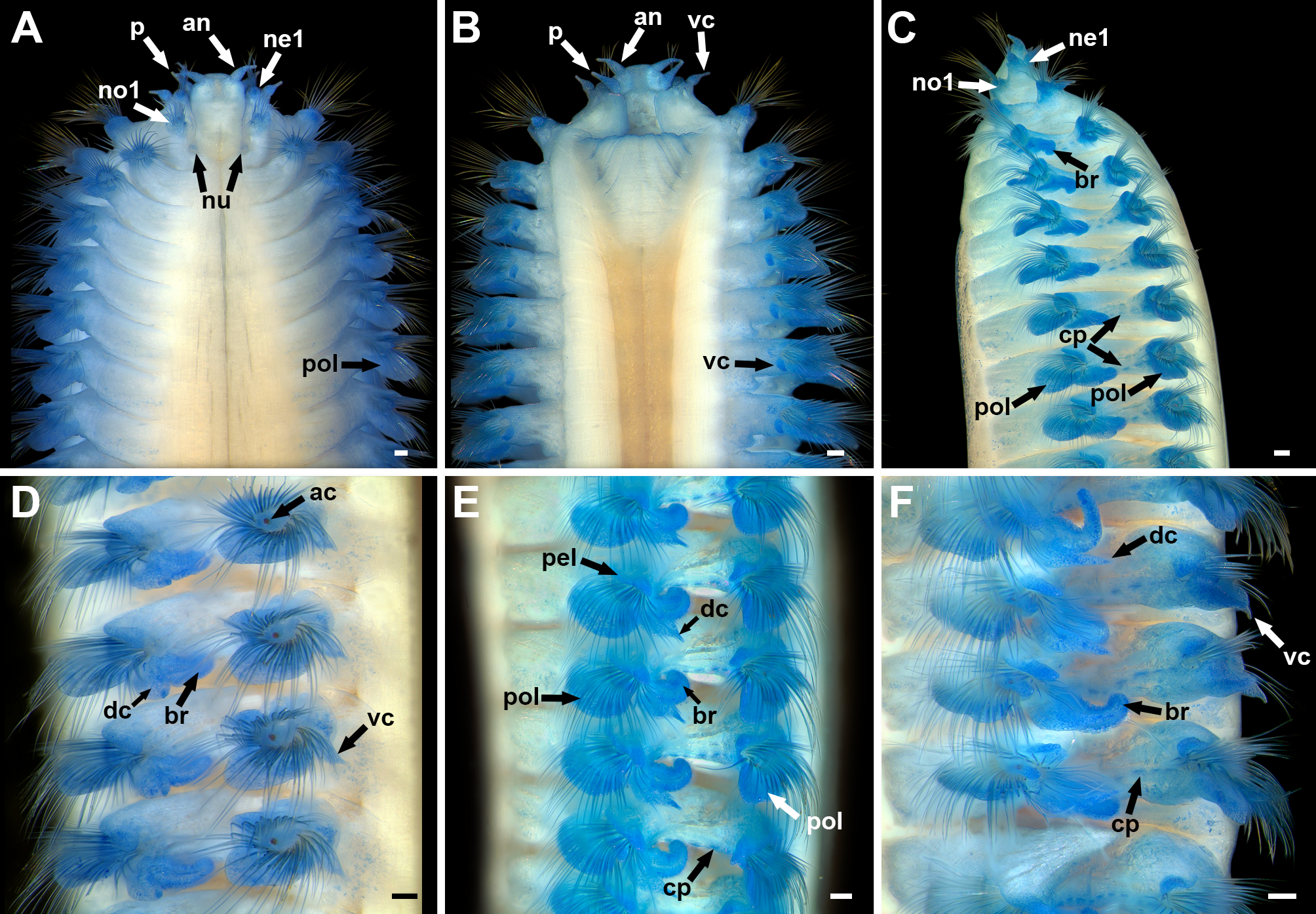
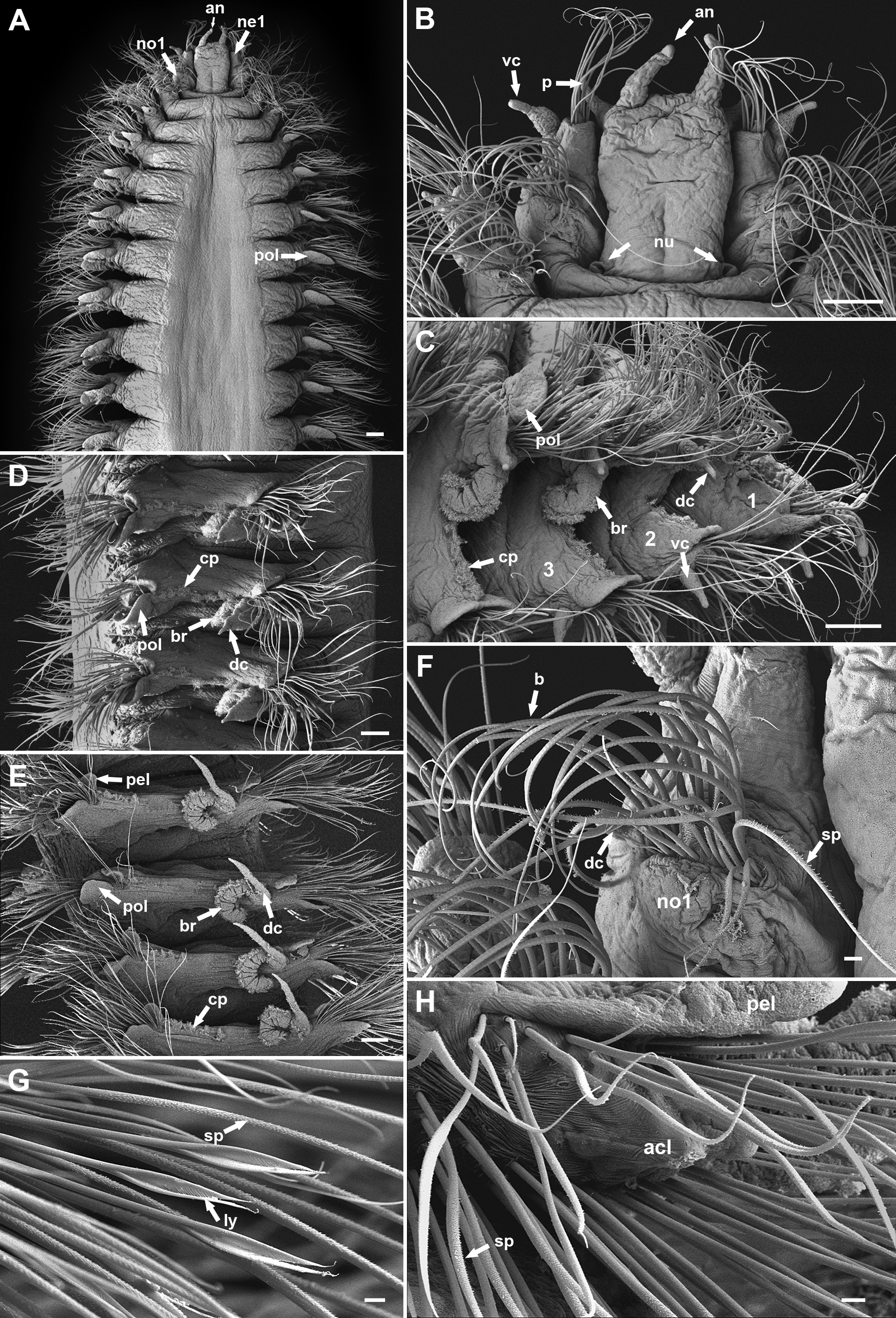
Description. Specimens range in size from 15 – 20 mm in length and 2 mm in width, with 51 – 67 chaetigers. Prostomium rectangular, 2 times longer than wide; antennae at anterolateral margins and palps ventral to antennae, all conically tapering with slightly swollen tips; nuchal pits round, at posterolateral prostomial margins (Figs 1 A, 2 A – B). Pair of subdermal eyes embedded dorsally midchaetiger 2, not visible through body wall. No pigment present on body or prostomium. Pharynx with 10 pairs of terminal bifid papillae, separated dorsally by gap, no single terminal papilla present, and 14 longitudinal rows of subterminal papillae, 4 – 8 per row; elongate middorsal subdistal pharyngeal papilla present, approximately 3 – 4 times length of other distalmost subterminal papillae. Verrucae present proximally on pharynx. First parapodia directed forward, slightly smaller than subsequent parapodia and with pyriform dorsal and ventral cirri (Fig. 2 A – B, F). Notopodia from chaetiger 2 onwards with well developed dorsal cirri, thin and scoop-shaped (foliose) and distally tapering, as long as notopodial postacicular lamellae (Figs 1 D, 2 D). Posteriorly, dorsal cirri becoming elongate and longer than postacicular lamellae (Fig. 2 E). Ventral cirri pyriform (Figs 1 B – D, 2 C). Parapodial postacicular lamellae anteriorly large, auricular; preacicular lamellae smaller, leaf-shaped (Figs 1 A, 1 D, 2 C). Interramal space widely V-shaped. Notopodial interramal branchiae starting on chaetiger 3, involute, ciliated, and filling approximately 1 / 2 of interramal space anteriorly (Figs 1 C, 2 C), up to 1 / 3 of interramal space in posterior segments (Figs 1 D – F, 2 D – E), continue to within last few posterior chaetigers. Neuropodial interramal branchiae absent. Parapodial acicular lobes acutely pointed (Fig. 2 H); aciculae golden-coloured, curved distally. Chaetae of 3 types: barred chaetae (Fig. 2 F) present in preacicular position in noto- and neuropodia; spinose chaetae present in postacicular position in both noto- and neuropodia (Fig. 2 F – G); and lyrate chaetae with equal rami in postacicular position (Fig. 2 G), present by chaetiger 4. Pygidial cirri are absent or missing.
Murray, Anna, Wong, Eunice, Hutchings, Pat (2015): Nephtyidae (Annelida: Phyllodocida) of Lizard Island, Great Barrier Reef, Australia. Zootaxa 4019 (1): 414-436, DOI: 10.11646/zootaxa.4019.1.16
Remarks. These specimens from Lizard Island most closely resemble A. lobatus Imajima & Takeda, 1985 from Japan, which also possesses involute notopodial interramal branchiae from chaetiger 3, large, “ flattened ” dorsal cirri, large foliose postacicular lamellae, 14 longitudinal rows of pharyngeal papillae, and with verrucae proximally on the pharynx, but differ slightly from the original description of A. lobatus by the presence of subdermal eyes (eyes are “ absent ” in A. lobatus), 10 pairs of terminal bifid pharyngeal papillae (A. lobatus has “ 22 rows (sic) of terminal papillae ”), more pharyngeal papillae in the subterminal rows (4 – 5 in A. lobatus), and a much more elongate single middorsal subterminal pharyngeal papilla (“ short ” in A. lobatus, and which we suspect may belong to one of the subterminal rows). The original description is of material collected in northern Japanese waters from 10 – 270 m with no habitat data provided. In contrast, the material from Lizard Island was collected in tropical waters from shallow subtidal depths, which appears to be a very different habitat. To date, also, there are no other records of A. lobatus from any location between northern Japan and northern Australia, giving the species a widely disjunct distribution. The specimens described by Imajima & Takeda (1985) were slightly smaller (up to 17 mm in length) and were incomplete (with up to 42 segments), so the morphological differences shown in the Lizard Island specimens may possibly be due to the size difference. For these reasons we have provided a comprehensive description and illustrations of the specimens from Lizard Island. At this stage we are tentatively referring them to A. lobatus until type material can be examined to confirm the identification. One of the specimens from Lizard Island was collected in 1978, which is prior to the original 1985 description of this species from Japan by Imajima & Takeda. Habitat. In depths of 10 – 270 m from Japanese waters; from Lizard Island, in sandy mud, sand and seagrass, in 14 – 24 m depth.
Murray, Anna, Wong, Eunice, Hutchings, Pat (2015): Nephtyidae (Annelida: Phyllodocida) of Lizard Island, Great Barrier Reef, Australia. Zootaxa 4019 (1): 414-436, DOI: 10.11646/zootaxa.4019.1.16
Distribution. Japan, Australia (Queensland: Lizard Island).
Murray, Anna, Wong, Eunice, Hutchings, Pat (2015): Nephtyidae (Annelida: Phyllodocida) of Lizard Island, Great Barrier Reef, Australia. Zootaxa 4019 (1): 414-436, DOI: 10.11646/zootaxa.4019.1.16
Material examined. Queensland, Lizard Island: AM W. 47230 (1), AM W. 46973 (5, 1 on SEM), MI QLD 2440; AM W. 46975 (2), MI QLD 2444; AM W. 46976 (2, 1 photographed), MI QLD 2441; AM W. 47502 (1), Watsons Bay, 400 m off Chinamans Ridge, 14 ° 40 ' S, 145 ° 27 ' E, sand with filamentous algae, 12 m, 13 Oct 1978.
Murray, Anna, Wong, Eunice, Hutchings, Pat (2015): Nephtyidae (Annelida: Phyllodocida) of Lizard Island, Great Barrier Reef, Australia. Zootaxa 4019 (1): 414-436, DOI: 10.11646/zootaxa.4019.1.16

Export occurrence data

Darwin Core Archive (ZIP)

CLASSIFICATION

Taxonomic Classification Tree

MULTIMEDIA

Media Files(2)

FIGURE 1. Aglaophamus cf. lobatus, specimen stained with methyl blue, AM W. 46976. A. Anterior end, dorsal view; B. Anterior end, ventral view; C. Anterior end, lateral view, branchiae starting from chaetiger 3; D. Anterior chaetigers, lateral view; E. Mid-body chaetigers, lateral view; F. Posterior chaetigers, lateral view. Abbreviations: ac = acicula, an = antenna, br = interramal branchia, cp = cilia patch, dc = dorsal cirrus, ne 1 = neuropodium 1, no 1 = notopodium 1, nu = nuchal pit, p = palp, pel = preacicular parapodial lobe, pol = postacicular parapodial lobe, vc = ventral cirrus. Scale bars: A – F = 0.1 mm.
Imageimage/png© Murray, Anna;Wong, Eunice;Hutchings, PatMurray, Anna;Wong, Eunice;Hutchings, Pat

FIGURE 2. Aglaophamus cf. lobatus, SEM photos of AM W. 46973. A. Anterior end, dorsal view; B. Prostomium and chaetigers 1 – 2, dorsal view; C. Chaetigers 1 – 4, lateral view; D. Chaetigers 10 – 12, lateral view; E. Posterior chaetigers, lateral view; F. Notopodium 1, right side, dorsal view, showing barred and spinose chaetae and dorsal cirrus; G. Lyrate and spinose chaetae; H. Notochaetae of parapodium 20. Abbreviations: an = antenna, acl = acicular lobe, b = barred chaeta, br = interramal branchia, cp = cilia patch, dc = dorsal cirrus, ly = lyrate chaeta, ne 1 = neuropodium 1, no 1 = notopodium 1, nu = nuchal pit, p = palp, pel = preacicular parapodial lobe, pol = postacicular parapodial lobe, sp = spinose chaeta, vc = ventral cirrus. Scale bars: A – F = 0.1 mm; G – H = 0.01 mm.

Imageimage/png© Murray, Anna;Wong, Eunice;Hutchings, PatMurray, Anna;Wong, Eunice;Hutchings, Pat

IMAGES

Gallery(2)

See Gallery

Occurrences with images

Source Information

Nephtyidae (Annelida: Phyllodocida) of Lizard Island, Great Barrier Reef, Australia

checklist

This dataset contains the digitized treatments in Plazi based on the original journal article Murray, Anna, Wong, Eunice, Hutchings, Pat (2015): Nephtyidae (Annelida: Phyllodocida) of Lizard Island, Great Barrier Reef, Australia. Zootaxa 4019 (1): 414-436, DOI: 10.11646/zootaxa.4019.1.16

Abstract

Seven species of the family Nephtyidae are recorded from Lizard Island, none previously reported from the Great Barrier Reef. Two species of Aglaophamus, four species of Micronephthys, one new and one previously unreported from Australia, and one species of Nephtys, were identified from samples collected during the Lizard Island Polychaete Workshop 2013, as well as from ecological studies undertaken during the 1970s and deposited in the Australian Museum marine invertebrate Collections. A dichotomous key to aid identification of these species newly reported from Lizard Island is provided.

Key words: Taxonomy, Queensland, polychaetes, dichotomous key

Murray A, Wong E, Hutchings P, plazi (2015). Nephtyidae (Annelida: Phyllodocida) of Lizard Island, Great Barrier Reef, Australia. Plazi.org taxonomic treatments database. Checklist dataset https://doi.org/10.11646/zootaxa.4019.1.16 accessed via GBIF.org on 2026-06-18.

CC0Published 12/31/2015View dataset
GBIF Usage Key
119637377
Dataset Key
03b4c763-a3d3-4624-9d31-2ba7a25fcc68
Origin
source
Backbone Key
2316840
Taxon ID
03A487E4396AAF1AFF615376FC82ACCD.taxon
Last Crawled
6/11/2026
Last Interpreted
6/11/2026