
AnimaliaNot EvaluatedacceptedspeciesAccepted
Micronephthys stammeri

Micronephthys stammeri

(Augener, 1932) Augener, 1932

GBIF:119637380

0year

0

Synonyms

ABOUT

Descriptions(4)

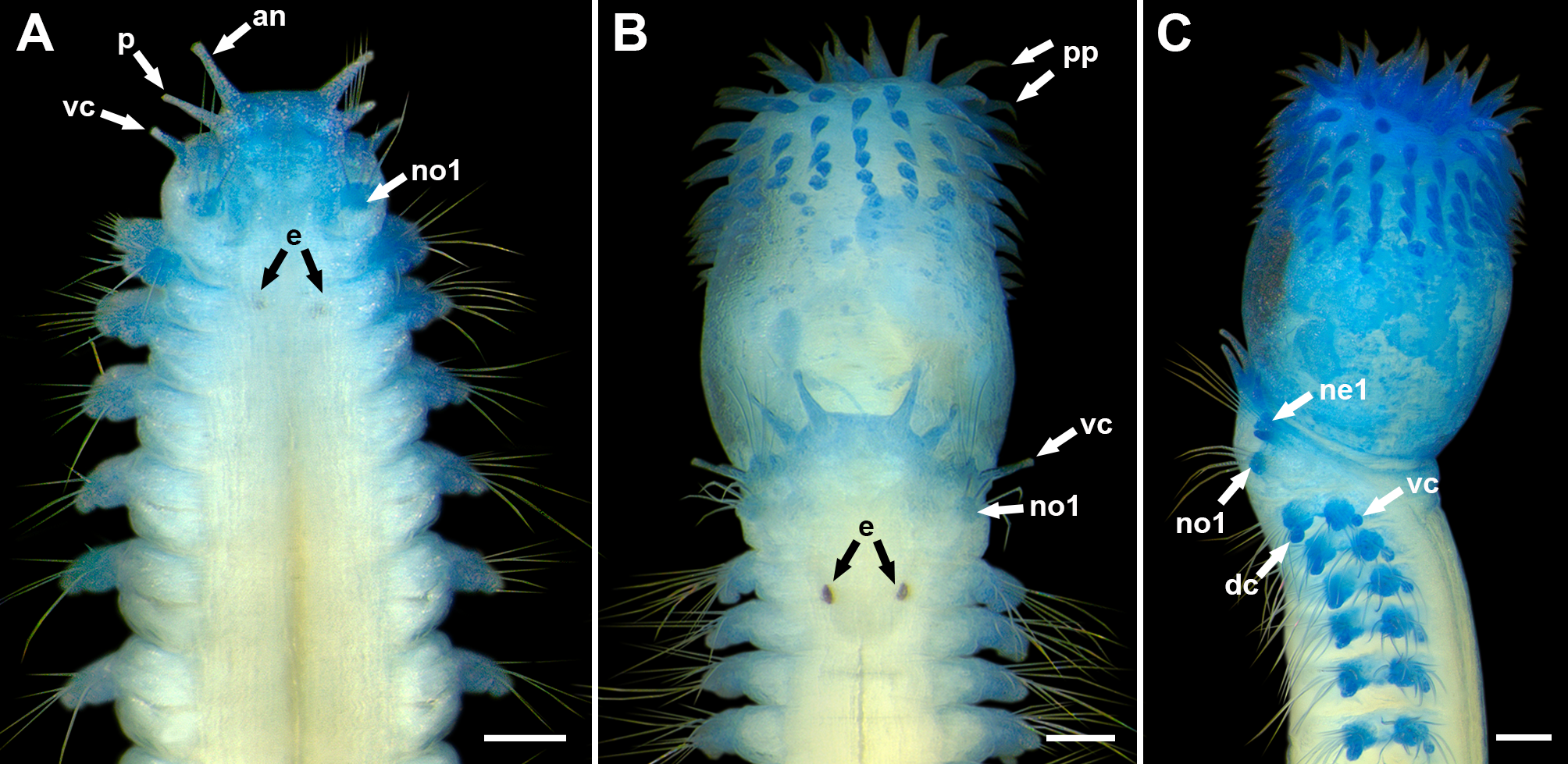
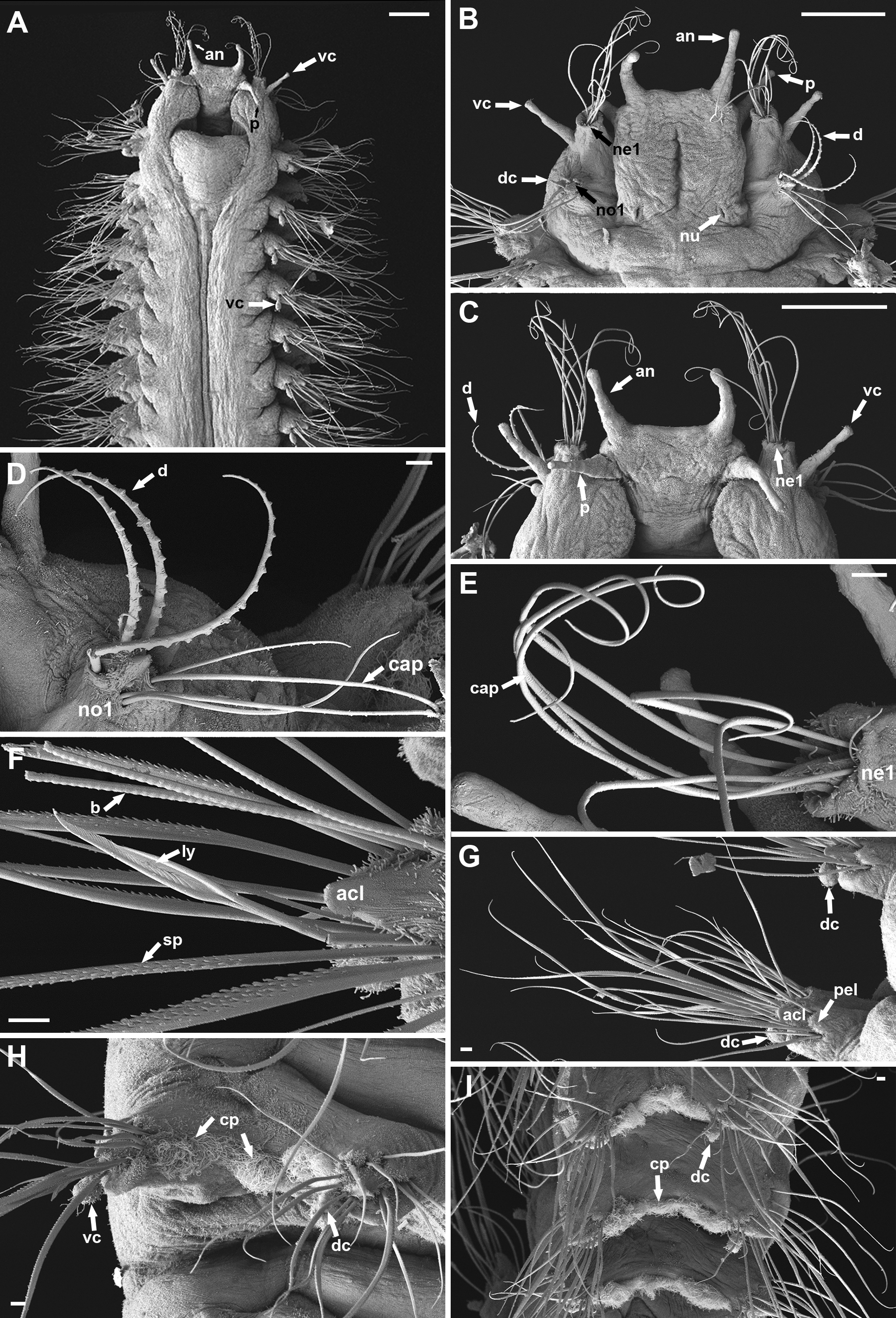
Description. Complete specimens up to 14 mm long, 1.4 mm wide, and> 60 chaetigers for longest specimens. Preserved specimens without pigment. Prostomium subquadrangular to subpentagonal in shape. Antennae and palps equal in length and cirriform with swollen tips (Figs 10 A, 11 A – C). Nuchal pits round and situated at posterior corners of prostomium. Two pairs of visible subdermal coalesced eyes present middorsally in chaetiger two (with pharynx everted, Fig. 10 B) or in anterior part of chaetiger 3, (with pharynx not everted, Fig. 10 A); (Fig. 11 B). Pharynx with 9 pairs of terminal bifid papillae with a single middorsal terminal papilla, and 20 – 22 subdistal longitudinal rows of 5 – 9 elongate papillae, which diminish in size and continue proximally as rows of minute papillae (Fig. 10 B – C); elongate middorsal and midventral subdistal papillae absent; verrucae absent proximally. Ventral cirri of chaetiger 1 similar in length and form to antennae, dorsal cirri minute, papillae-like (Figs 10 C, 11 C – D); subsequent ventral cirri short, ovoid, dorsal cirri larger than those of chaetiger 1, subspherical (Figs 10 C, 11 A, 11 G – I). Acicular lobes conical, pre- and postchaetal lobes rudimentary (Fig. 11 G – H). Aciculae tips curved. Five types of chaetae: thick, dentate chaetae present on first notopodia only (Fig. 11 D); capillary chaetae present in noto- and neuropodia of first chaetiger only (Fig. 11 D – E); barred chaetae in preacicular position of all following parapodia (Fig. 11 F); spinose chaetae in postacicular position of all following parapodia (Fig. 11 F), and lyrate chaetae with unequal rami in postacicular position (Fig. 11 F) from chaetiger 4. Interramal cirri absent, ciliated patches present between parapodial rami, posteriorly continuous (Fig. 11 H – I). Pygidium with short filiform cirrus, equal in length to last segment.
Murray, Anna, Wong, Eunice, Hutchings, Pat (2015): Nephtyidae (Annelida: Phyllodocida) of Lizard Island, Great Barrier Reef, Australia. Zootaxa 4019 (1): 414-436, DOI: 10.11646/zootaxa.4019.1.16
Remarks. Ravara et al. (2010 b), redescribed M. stammeri from specimens collected from the type locality (Adriatic Sea) as the holotype has been lost (Banse 1959). They also synonymised M. maryae San Martin, 1982, with M. stammeri, and assigned Rainer & Kaly’s (1988) Australian specimens identified as M. maryae to M. stammeri, with doubts, due to Rainer & Kaly’s description of the Australian specimens having 14 longitudinal rows of subdistal pharyngeal papillae, instead of 20 – 22 rows which M. stammeri possesses. After examination of Rainer & Kaly’s specimens from Western Australia, it is impossible to confirm any pharyngeal features, as the three specimens are now badly damaged and the pharynx is missing from all. It is possible that the Western Australian specimens represent another species altogether, as Rainer & Kaly stated that the “ proximal region ” of the pharynx had “ 14 rows of subdistal papillae …. up to 17 in each row ”, a feature that is not consistent with M. stammeri, or with the Lizard Island specimens. The inclusion of M. cf. stammeri in the key to Australian Nephtyidae in Dixon- Bridges et al. (2014, p. 515) was based on Ravara’s synonymy of M. maryae with M. stammeri, and even though the specimens are no longer identifiable, the differences between M. stammeri and the description of Rainer & Kaly’s specimens alone should have discounted the presence of M. stammeri in Australia. However, the specimens from Lizard Island are consistent with the redescription of M. stammeri by Ravara et al. (2010 b), except that they are larger, and lyrate chaetae are present from chaetiger 4 rather than 3, so we are tentatively assigning them to this species. As there is a valid uncertainty whether Rainer & Kaly’s specimens from Western Australia are M. stammeri, or may represent another species altogether, we report this species for the first time from Australia, at Lizard Island. With such a geographically disjunct distribution reported for Micronephthys stammeri, it may be, however, that it represents a suite of cryptic species, the identity of which may only be resolved by the use of genetic analysis of “ populations ” in conjunction with morphological data. Habitat. In Lizard Island waters, from sand, sandy mud, and sediment associated with seagrass and algae, in intertidal and subtidal shallow water.
Murray, Anna, Wong, Eunice, Hutchings, Pat (2015): Nephtyidae (Annelida: Phyllodocida) of Lizard Island, Great Barrier Reef, Australia. Zootaxa 4019 (1): 414-436, DOI: 10.11646/zootaxa.4019.1.16
Distribution. Adriatic Sea, Mediterranean Sea, Japan, Marshall Islands, Australia (Queensland: Lizard Island).
Murray, Anna, Wong, Eunice, Hutchings, Pat (2015): Nephtyidae (Annelida: Phyllodocida) of Lizard Island, Great Barrier Reef, Australia. Zootaxa 4019 (1): 414-436, DOI: 10.11646/zootaxa.4019.1.16
Material examined. Queensland, Lizard Island: AM W. 44021 (1), MI QLD 2340; AM W. 45036 (2), AM W. 45157 (4), AM W. 45502 (1), MI QLD 2441; AM W. 45173 (2), AM W. 46972 (many, 2 photographed), MI QLD 2440; AM W. 45474 (1), MI QLD 2444; AM W. 45501 (2), MI QLD 2443; AM W. 46980 (3, 1 on SEM), MI QLD 2432; AM W. 46982 (1), MI QLD 2431; AM W. 47228 (10), 100 m off Mangrove Beach, 14 ° 40 ' S, 145 ° 28 ' E, sand, 3.6 m, 11 Oct 1978. Comparative material examined. Specimens identified by Rainer & Kaly (1988: 696 – 698, fig. 5) as Micronephthys maryae: Western Australia, Northwest Shelf, CSIRO North-West Shelf Project, FRV " Soela ": AM W. 200668 (1), 19 ° 58 ' 48 " S, 117 ° 51 ' 24 " E, 41 m, 26 Oct 1983; AM W. 200669 (1), 19 ° 59 ' 12 " S, 118 ° 04 ' 00 " E, 32 m, 10 Dec 1982; AM W. 200670 (3), 19 ° 04 ' 18 " S, 119 ° 00 ' 36 " E, 82 m, 1 Sep 1983.
Murray, Anna, Wong, Eunice, Hutchings, Pat (2015): Nephtyidae (Annelida: Phyllodocida) of Lizard Island, Great Barrier Reef, Australia. Zootaxa 4019 (1): 414-436, DOI: 10.11646/zootaxa.4019.1.16

Export occurrence data

Darwin Core Archive (ZIP)

CLASSIFICATION

Taxonomic Classification Tree

MULTIMEDIA

Media Files(2)

FIGURE 10. Micronephthys stammeri, two specimens stained with methyl blue from AM W. 46972. A. Anterior end, dorsal view; B. Anterior end, dorsal view, pharynx everted; C. Anterior end, lateral view. Abbreviations: an = antenna, dc = dorsal cirrus, e = eye, ne 1 = neuropodium 1, no 1 = notopodium 1, p = palp, pp = pharyngeal papillae, vc = ventral cirrus. Scale bars: A – C = 0.1 mm.
Imageimage/png© Murray, Anna;Wong, Eunice;Hutchings, PatMurray, Anna;Wong, Eunice;Hutchings, Pat

FIGURE 11. Micronephthys stammeri, SEM photos of AM W. 46980. A. Anterior end, ventral view; B. Prostomium and chaetigers 1 – 2, dorsal view; C. Prostomium and chaetiger 1, ventral view; D. Dentate and capillary notochaetae of chaetiger 1; E. Capillary neurochaetae of chaetiger 1; F. Notochaetae of chaetiger 14; G. Notopodia of chaetigers 14 – 15, dorsal view; H. Chaetiger 14, lateral view; I. Posterior chaetigers, lateral view. Abbreviations: acl = acicular lobe, an = antenna, b = barred chaeta, cap = capillary chaeta, cp = cilia patch, d = dentate chaeta, dc = dorsal cirrus, ly = lyrate chaeta, ne 1 = neuropodium 1, no 1 = notopodium 1, nu = nuchal pit, p = palp, pel = preacicular parapodial lobe, sp = spinose chaeta, vc = ventral cirrus. Scale bars: A – C = 0.1 mm, D – I = 0.01 mm.

Imageimage/png© Murray, Anna;Wong, Eunice;Hutchings, PatMurray, Anna;Wong, Eunice;Hutchings, Pat

IMAGES

Gallery(2)

See Gallery

Occurrences with images

Source Information

Nephtyidae (Annelida: Phyllodocida) of Lizard Island, Great Barrier Reef, Australia

checklist

This dataset contains the digitized treatments in Plazi based on the original journal article Murray, Anna, Wong, Eunice, Hutchings, Pat (2015): Nephtyidae (Annelida: Phyllodocida) of Lizard Island, Great Barrier Reef, Australia. Zootaxa 4019 (1): 414-436, DOI: 10.11646/zootaxa.4019.1.16

Abstract

Seven species of the family Nephtyidae are recorded from Lizard Island, none previously reported from the Great Barrier Reef. Two species of Aglaophamus, four species of Micronephthys, one new and one previously unreported from Australia, and one species of Nephtys, were identified from samples collected during the Lizard Island Polychaete Workshop 2013, as well as from ecological studies undertaken during the 1970s and deposited in the Australian Museum marine invertebrate Collections. A dichotomous key to aid identification of these species newly reported from Lizard Island is provided.

Key words: Taxonomy, Queensland, polychaetes, dichotomous key

Murray A, Wong E, Hutchings P, plazi (2015). Nephtyidae (Annelida: Phyllodocida) of Lizard Island, Great Barrier Reef, Australia. Plazi.org taxonomic treatments database. Checklist dataset https://doi.org/10.11646/zootaxa.4019.1.16 accessed via GBIF.org on 2026-06-15.

CC0Published 12/31/2015View dataset
GBIF Usage Key
119637380
Dataset Key
03b4c763-a3d3-4624-9d31-2ba7a25fcc68
Origin
source
Backbone Key
2317062
Taxon ID
03A487E43966AF0EFF6151D4FF0AAFD8.taxon
Last Crawled
6/11/2026
Last Interpreted
6/11/2026