AnimaliaNot EvaluatedacceptedspeciesAccepted
Antonbruunia sociabilis

Antonbruunia sociabilis

GBIF:119639813

0

Synonyms

ABOUT

Descriptions(4)

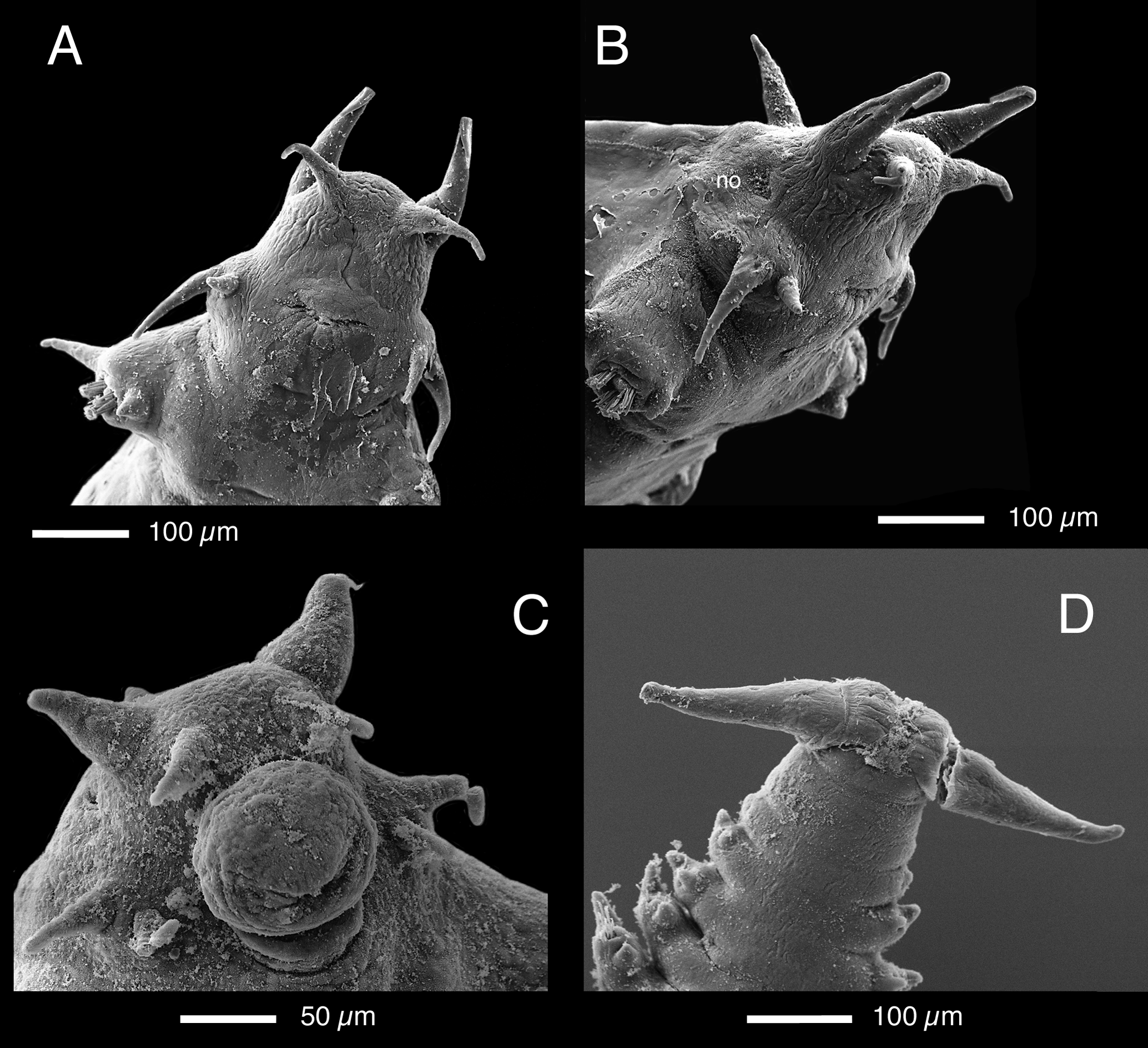
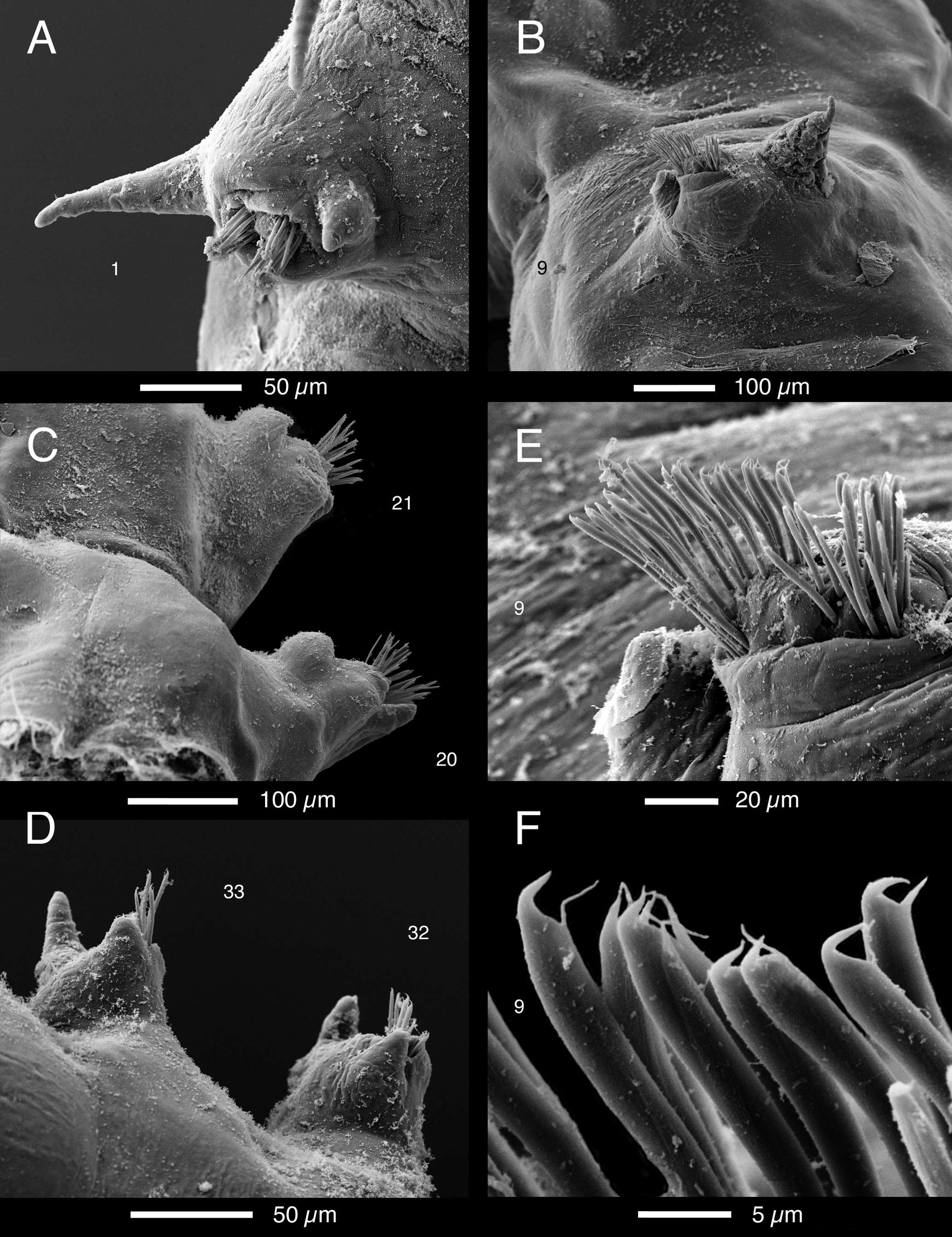
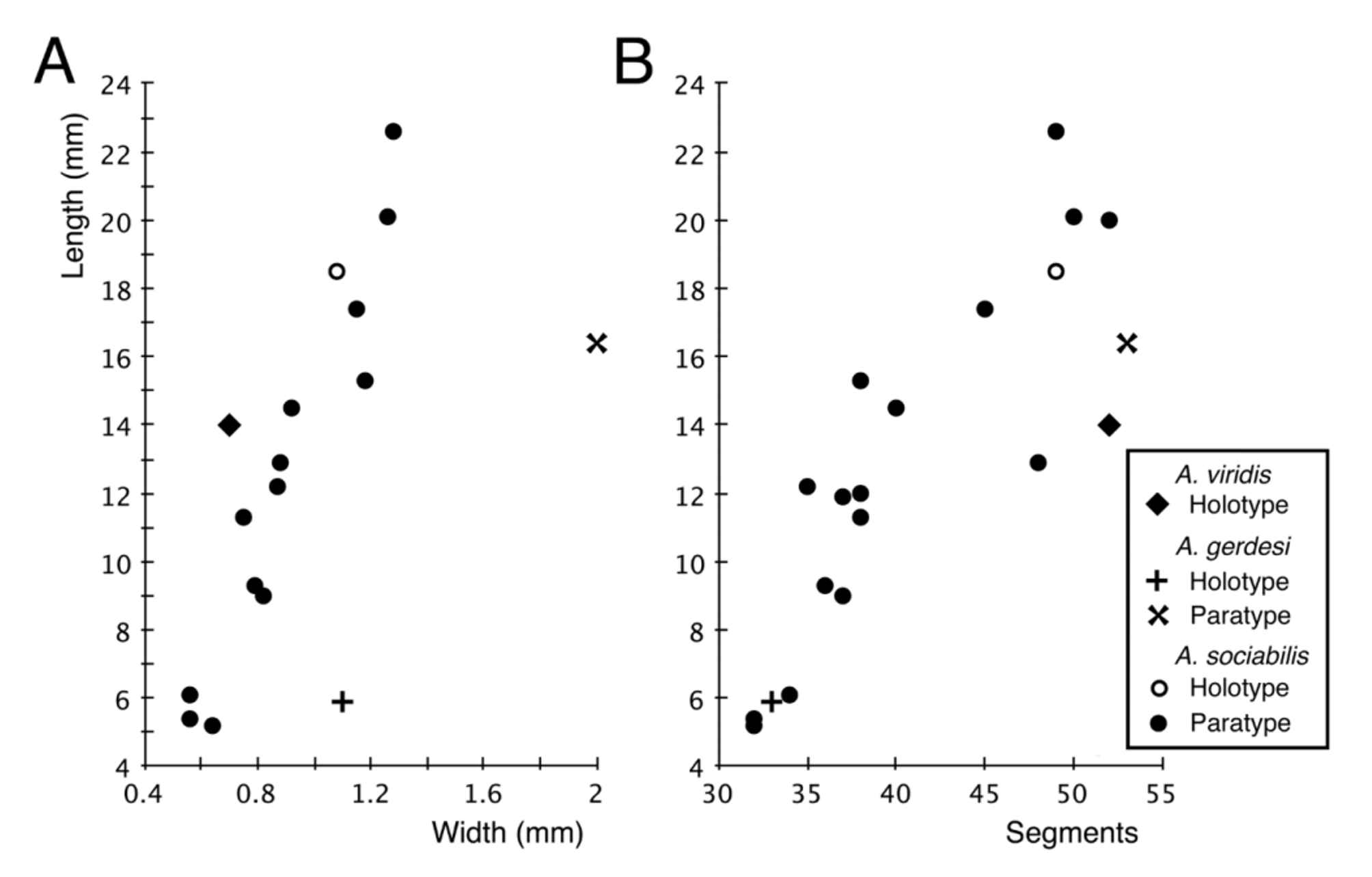
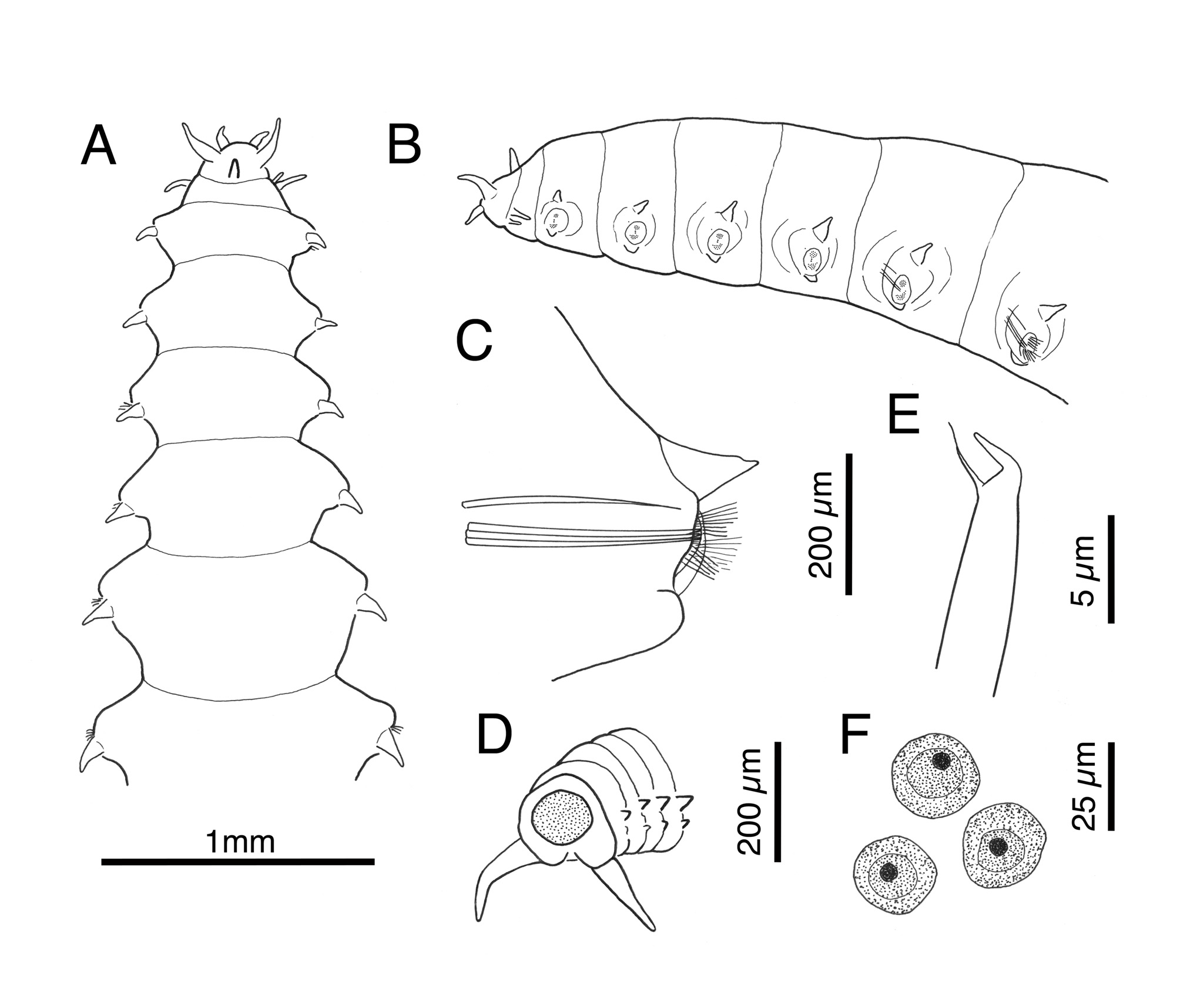
Description. Holotype entire, maximum width 1.08 mm (including parapodia), 18.5 mm long for prostomium and 48 segments. Paratypes ranging from 0.56 – 1.28 mm wide, 5.2 – 22.6 mm long, and 32 – 52 segments. Body long and slender, dorsally arched and ventrally flat, lacking ventral groove. Head and anterior 5 segments narrow; segments thereafter rapidly increasing in size (Fig. 1 A – B), reaching maximum in anterior third of body, rapidly decreasing in posterior region. Cuticle smooth and shiny on best preserved specimens. Pygidium lobulate, ventro-laterally with single pair of tapered pygidial cirri (Figs 1 D, 2 D). Prostomium subtrapezoidal, with rounded anterior margin, lacking eyes (Fig. 1 A). Pair of antero-ventral palps, somewhat conical, basally expanded and distally tapered. Pair of antero-dorsolateral antennae, of similar shape to palps, but broader and longer (Fig. 2 A – B). Median antenna of similar size and shape to palps, arising mid-dorsally near posterior margin of prostomium (Fig. 1 A, B). Nuchal organs elliptical ciliated grooves, positioned dorsolaterally between posterior prostomium and anterior margin of segment 1 (Fig. 2 B). Peristomium ventrally fused with prostomium and segment 1; delineation between prostomium and segment 1 only distinct dorsally and laterally. Mouth ventral, transverse, slit-like (Fig. 2 A – B). Two pairs of tapered tentacular cirri on segment 1, superior cirri 1.5 to 2 times as long as inferiors; parapodia and chaetae lacking. Pharynx muscular, axial, short and narrow, occupying anterior three segments; proboscis short and bulbous when extruded (Fig. 2 C), jaws lacking. Gut tubular, with markedly wider lumen from anterior to middle of chaetiger 3. Gut caecae from chaetiger 3 as pair of small lateral pouches; caecae increase in size over following 2 – 3 chaetigers, extending into parapodia. By chaetiger 6 or 7, distally tapered caecae reach into posterior parts of parapodia, just below dorsal cirri; caecae decrease in size in posterior half to third of body. Gut caecae revealed through methyl green staining; caecae appearing as opaque white unstained masses either side, extending laterally into the parapodia. Parapodia simple, short cuff-like, lacking any marked pre- or post-chaetal structures. Dorsal cirri above or slightly dorso-posterior to parapodia; cirri somewhat conical with broad bases and tapering cirriform tips of variable extension (Figs 1 A – C & 3 A – B). Ventral cirri positioned below or slightly posterior to neurochaetae. Ventral cirri of anterior and posterior parapodia short, conical with bluntly pointed tips (Fig. 3 A, D). Those of median body larger, more rounded, or rounded with tiny sharply pointed tips (Figs 1 C, 3 C). Anterior parapodia supported by two parallel, robust and distally pointed neuroaciculae; increasing to three aciculae by about chaetiger 6 or 7. Single notoaciculae with sharply tapering tips arise separate from neuroaciculae (Fig. 1 C). Each notoacicula directed forward into anterior part of parapod, tip ending anterior to and level with uppermost neurochaetae, well in advance of dorsal cirrus (Fig. 1 B, C); in slide preparations notoacicula may seem closer to dorsal cirrus than reality. Neurochaetae numerous in anterior and mid body region, disposed in two bundles; superior bundle compact, inferior bundle broader with chaetae extending more dorsally around acicular lobe on posterior side (Figs 1 B, 3 E). Number of chaetae similar in each bundle, usually slightly more in inferior bundle; two bundles together totalling about 30 – 35 chaetae in anterior parapodia, but increasing to 45 – 50 in parapodia of largest segments. Separation between superior and inferior bundles disappears in posterior parapodia, and number of chaetae decreases to less than five or six on posteriormost segments. Posteriormost 4 – 6 segments of smallest specimens have rudimentary parapodia and no chaetae. Neurochaetae slender, shafts smooth, each with strongly bent distal tooth and longer slender and delicate secondary spine, space between tooth and spine angular (Figs 1 E, 3 F); primary teeth all pointing dorsally (Fig. 3 E). Reproduction. Largest specimens, longer than about 15 mm clearly female with small (ca. 25 µm diameter) oocytes in parapodia and loose in coelom (Fig. 1 F). Several specimens between approximately 11 and 15 mm appear to be immature females. Sex of smaller specimens not determined. Colour. Preserved specimens white. Colour of live animals not known. Methyl Green staining. Glandular staining variable, most pronounced on the larger specimens. Band of speckles occurring behind the mouth and behind the ventral tentacular cirri. Ventrally, anterior 9 or 10 chaetigers with two widely separated, and interrupted, parallel lines of stain. These lines linked in posterior part of each chaetiger by broad transverse band, producing repetitive H-pattern of stain on anterior venter. The transverse band disappears on following chaetigers, and only two broken parallel lines remain. Other staining associated with the parapodia. Ventral staining patch present at base, as vertical line on body just anterior to each parapod, and as vertical patch on its anterior face. Similar, but more sparse speckled areas on posterior face of parapod. Sparse speckles of stain evident on basal part of dorsal cirri and on body dorsal to parapodia; mid-dorsal region unstained. Pygidial lobes surrounding anus stained. Morphometrics. The morphological attributes measured (width, length, number of segments) for A. sociabilis sp. nov. were strongly correlated: width and length (Fig. 4 A), r = 0.957, p <0.0001, n = 14; segments and length (Fig. 4 B), r = 0.894, p <0.0001, n = 17; segments and width (not figured), r = 0.806, p = 0.0002, n = 14.
Mackie, Andrew S. Y., Oliver, P. Graham, Nygren, Arne (2015): Antonbruunia sociabilis sp. nov. (Annelida: Antonbruunidae) associated with the chemosynthetic deep-sea bivalve Thyasira scotiae Oliver & Drewery, 2014, and a re-examination of the systematic affinities of Antonbruunidae. Zootaxa 3995 (1), DOI: 10.11646/zootaxa.3995.1.4

Remarks. Hartman & Boss (1965) and Quiroga & Sellanes (2009) referred to all Antonbruunia prostomial appendages as antennae. The two antero-ventral prostomial appendages are here considered to be palps, while the two larger antero-dorsolateral organs are the lateral antennae. This is consistent with their positions on the prostomium in literature associated with Antonbruunidae (Fauchald 1977; Pleijel & Dahlgren 1998; Pleijel 2001 c; Aguado et al. 2013) and putative related families, Pilargidae (Pettibone 1966; Fitzhugh & Wolf 1990; Fauchald & Rouse 1997; Glasby 1993, 2000; Pleijel 2001 b) and Nautiliniellidae (Pleijel 2001 a; Fauchald & Rouse 1997; Aguado & Rouse 2011; Aguado et al. 2013). However, as Glasby (1993) pointed out, the true nature of the anteroventral appendages in Antonbruunia “ must remain in doubt until better material is available to conduct histological study. ” Antonbruunia sociabilis sp. nov. is morphologically most similar to A. viridis. Segment 1, bearing the tentacular cirri, is well-defined dorsally and laterally as a distinct ring behind the prostomium. The palps and antennae are relatively slender tapering to narrow tips, median antennae and palps of similar size. Both have slender cirriform anal cirri. In A. gerdesi, the tentacular cirri are more anteriorly positioned below / lateral to the prostomium, and segment 1 is dorsally reduced and narrow. All the anterior appendages are more robust, and the median antenna is similar to the lateral antennae in size and shape. The anal cirri are very robust also. Its body form seems altogether wider (Fig. 4 A), though some caution must be exercised here due to potential differences attributable to fixation treatments; A. gerdesi material was removed from its bivalve host and then fixed in 10 % formalin prior to transfer in 70 % ethanol, while A. sociabilis was preserved inside its host when the latter was preserved directly in 70 % ethanol. Antonbruunia viridis was likewise removed live from its host, but fixing and preservation were not reported.
Mackie, Andrew S. Y., Oliver, P. Graham, Nygren, Arne (2015): Antonbruunia sociabilis sp. nov. (Annelida: Antonbruunidae) associated with the chemosynthetic deep-sea bivalve Thyasira scotiae Oliver & Drewery, 2014, and a re-examination of the systematic affinities of Antonbruunidae. Zootaxa 3995 (1), DOI: 10.11646/zootaxa.3995.1.4
Etymology. The species name sociabilis (L.), disposed to companionship, relates to the tendency for numerous individuals of the new species to live together. Further, it does honour to Roger Bamber, the most sociable of men.
Mackie, Andrew S. Y., Oliver, P. Graham, Nygren, Arne (2015): Antonbruunia sociabilis sp. nov. (Annelida: Antonbruunidae) associated with the chemosynthetic deep-sea bivalve Thyasira scotiae Oliver & Drewery, 2014, and a re-examination of the systematic affinities of Antonbruunidae. Zootaxa 3995 (1), DOI: 10.11646/zootaxa.3995.1.4
Material examined. NE Atlantic: Scotland, Hatton-Rockall Basin, FRV Scotia, cruise 0712 S, Station S 12283 a, 57 ° 57 ’ N 15 ° 33 ’ W, 1187 - 1200 m, Jackson 460 Otter trawl, 23 June 2012. Antonbruunia removed from among arborescent lateral body pouches of three Thyasira scotiae types (NMW- Z. 2012.074.4 - 5); eight, nine, and two specimens, last including holotype (NMW-Z. 2012.074.6) and one paratype (NMW-Z. 2012.074.7). Remaining types. Four paratypes (NMW-Z. 2012.074.8), one paratype (NMW-Z. 2012.074.9 dissected), one paratype (NMW-Z. 2012.074.10 SEM), six paratypes (NMW-Z. 2012.074.11) and one paratype (NMW- Z. 2012.074.12 SEM). Four specimens were selected for sequencing; one voucher (NMW-Z. 2012.074.13) yielded the sequences registered with GenBank (Table 1).
Mackie, Andrew S. Y., Oliver, P. Graham, Nygren, Arne (2015): Antonbruunia sociabilis sp. nov. (Annelida: Antonbruunidae) associated with the chemosynthetic deep-sea bivalve Thyasira scotiae Oliver & Drewery, 2014, and a re-examination of the systematic affinities of Antonbruunidae. Zootaxa 3995 (1), DOI: 10.11646/zootaxa.3995.1.4

Export occurrence data

Darwin Core Archive (ZIP)

CLASSIFICATION

Taxonomic Classification Tree

MULTIMEDIA

Media Files(4)

FIGURE 1. Antonbruunia sociabilis sp. nov. (A, B & D, Holotype NMW-Z. 2012.074.6; C & E, Paratype NMW-Z. 2012.074.9; F, Largest paratype NMW-Z. 2012.074.8). A, anterior region, dorsal view; B, Anterior region, lateral view; C, parapod, chaetiger 16, anterior view; D, Posterior region; E, neuropodial chaeta, distal region, chaetiger 17; F, oocytes.

Imageimage/png© Mackie, Andrew S. Y.;Oliver, P. Graham;Nygren, ArneMackie, Andrew S. Y.;Oliver, P. Graham;Nygren, Arne

FIGURE 2. Antonbruunia sociabilis sp. nov. (A, B & D, NMW-Z. 2012.074.10; C, NMW-Z. 2012.074.12). A, Anterior region, ventral view; B, Anterior region, antero-lateral view (no = nuchal organ); C, Anterior region, ventral view, showing protruded proboscis; D, Pygidium, ventral view.

Imageimage/png© Mackie, Andrew S. Y.;Oliver, P. Graham;Nygren, ArneMackie, Andrew S. Y.;Oliver, P. Graham;Nygren, Arne

FIGURE 3. Antonbruunia sociabilis sp. nov. (NMW-Z. 2012.074.10). A, Chaetiger 1, antero-ventral view; B, Chaetiger 9, antero-ventral view; C, Chaetigers 20 and 21, antero-ventral view; D, Chaetigers 32 and 33, postero-ventral view; E, Parapodium, ventral cirrus and chaetae, chaetiger 9, anterior view; F, Chaetae, chaetiger 9, from upper posterior part of subacicular bundle.

Imageimage/png© Mackie, Andrew S. Y.;Oliver, P. Graham;Nygren, ArneMackie, Andrew S. Y.;Oliver, P. Graham;Nygren, Arne

FIGURE 4. Morphometric relationships for Antonbruunia sociabilis sp. nov., and type material of A. viridis and A. gerdesi.

Imageimage/png© Mackie, Andrew S. Y.;Oliver, P. Graham;Nygren, ArneMackie, Andrew S. Y.;Oliver, P. Graham;Nygren, Arne

IMAGES

Gallery(4)

See Gallery

Occurrences with images

Source Information

Antonbruunia sociabilis sp. nov. (Annelida: Antonbruunidae) associated with the chemosynthetic deep-sea bivalve Thyasira scotiae Oliver & Drewery, 2014, and a re-examination of the systematic affinities of Antonbruunidae

checklist

This dataset contains the digitized treatments in Plazi based on the original journal volume Mackie, Andrew S. Y., Oliver, P. Graham, Nygren, Arne (2015): Antonbruunia sociabilis sp. nov. (Annelida: Antonbruunidae) associated with the chemosynthetic deep-sea bivalve Thyasira scotiae Oliver & Drewery, 2014, and a re-examination of the systematic affinities of Antonbruunidae. Zootaxa 3995 (1), DOI: 10.11646/zootaxa.3995.1.4

Abstract

Antonbruunia sociabilis sp. nov., an abundant endosymbiont of Thyasira scotiae from a putative sulphidic ‘seep’ in the Hatton-Rockall Basin (1187–1200 m), North-East Atlantic Ocean, is described. The new species is compared with A. viridis and A. gerdesi from the West Indian Ocean and South-East Pacific Ocean respectively. The three species can be distinguished using a suite of morphological characters, and are associated with geographically separated chemosynthetic bivalve molluscs from different families (Thyasiridae, Lucinidae, Vesicomyidae) living in sediments at different depths. New morphological features are recognized for Antonbruunia and a re-assessment of its systematic affinities indicates a close relationship with the Pilargidae. Previous suggestions of an affiliation with the Nautiliniellidae, recently incorporat- ed into the Calamyzinae (Chrysopetalidae), were not supported. The apparent morphological similarities between the two groups are indicative of convergence related to their shared relationships with chemosynthetic bivalves. The first molecular analyses of Antonbruunia (16S and 18S rDNA) clearly indicate that a close relationship to Pilargidae (represented by Ancistrosyllis sp. and Sigambra sp.) is more likely than an affinity to Calamyzinae (represented by Calamyzas amphictenicola, Natushima sp., and Vigtorniella sp.).

Key words: Polychaete, mollusc, symbiosis, NE Atlantic, morphology, molecular analyses, relationships

Mackie A S Y, Oliver P G, Nygren A, plazi (2015). Antonbruunia sociabilis sp. nov. (Annelida: Antonbruunidae) associated with the chemosynthetic deep-sea bivalve Thyasira scotiae Oliver & Drewery, 2014, and a re-examination of the systematic affinities of Antonbruunidae. Plazi.org taxonomic treatments database. Checklist dataset https://doi.org/10.11646/zootaxa.3995.1.4 accessed via GBIF.org on 2026-06-15.

CC0Published 12/31/2015View dataset
GBIF Usage Key
119639813
Dataset Key
afa7c45c-d55e-4dd0-9595-9b5d4af9d55a
Origin
source
Backbone Key
8031018
Taxon ID
03F987E90C6BFFB7FF139C50FD60FF73.taxon
Last Crawled
6/11/2026
Last Interpreted
6/11/2026