
AnimaliaNot EvaluatedacceptedspeciesAccepted

Tympanocryptis gigas
Mitchell, 1948
GBIF:119643901
0year
ABOUT
Descriptions(6)
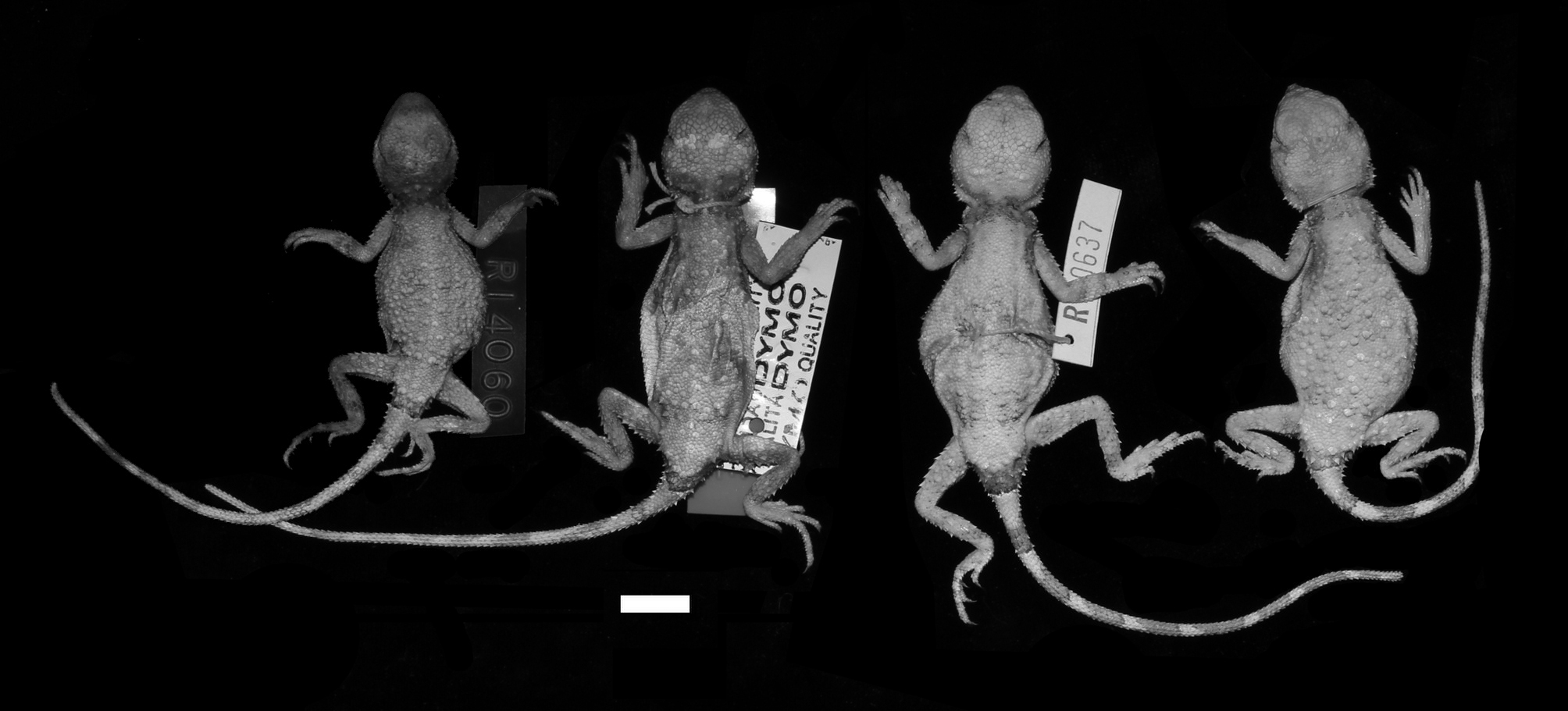
Description. A medium-sized (to 66.5 mm SVL), robust dragon; moderate head with blunt snout; short neck; moderately gracile limbs, ArmL % SVL — 0.179 (0.010), LegL % SVL — 0.228 (0.016); gracile digits; short tail. Head small, HeadL % SVL — 0.310 (0.010), HeadW % SVL — 0.251 (0.009), HeadD % SVL — 0.160 (0.010); neck ~ 3 / 4 of widest part of head; snout short, SnoutL % HeadL — 0.252 (0.010); snout straight or convex when viewed laterally, narrowing to blunt tip; canthus defined but rounded, forming continuous line with projecting brow ridge; nostril located below canthus in enlarged scale, opening projecting dorsally and posteriorly; eye moderate, EyeL % HeadL — 0.236 (0.011); eyes with laterally-projecting scaly eyelids forming a fringe, projecting past brow when viewed dorsally; tympana covered with fine scales, bordered by scattered enlarged scales with spines; scales on snout rugose, occasionally with feeble unaligned keels; scales on crown slightly larger with feeble unaligned keels; scales on back of head small with few variably-sized low scattered spines; rostral scale ~ 2 times wider than tall; 11 – 13 supralabial scales, 4 – 5 rows of scales above supralabial row, keeled, uppermost row slightly larger with larger keels and continuing to temporal region, forming edge of eye socket; loosely defined cluster of enlarged spines at posterior and lateral corners of head; mental 1.5 times long as wide; 13 – 14 infralabials with low keels; 4 – 5 rows of scales below infralabials with low keels with parallel to angle of jaw, creating a slightly terraced appearance; gulars kite shaped and smooth; prominent gular fold. Body slightly dorsoventrally compressed, rectangular or slightly ovoid in dorsal view with widest part ~ 1 – 2 times wider than neck and pelvis; TrunkL % SVL — 0.487 (0.049); dorsum with heterogeneous scales in size and shape; largest scales with sharp spines angled 10 – 30 ° posteriorly and ~ 2 – 4 times larger than smallest scales; large dorsal scales with spines scattered, not occurring in transversely-aligned clusters; smaller dorsal scales smooth or rugose, not occurring in regular rows; dorsolateral edge of pelvis occasionally with a cluster of enlarged spines at posterior edge where skin is fused to bone; ventral scales homogeneous, approximately half the size of large dorsal scales, kite-shaped and arranged in diagonal rows; ventral scales smooth, or at most with raised midline (no keels or spines protruding beyond posterior edge of scale). Limbs largely covered in elongate kite or teardrop-shaped scales with prominent low keels, spine usually protruding beyond distal edge of scale, interspersed with occasional small unkeeled scales; arms and legs moderately long, ArmL % SVL — 0.179 (0.010), LegL % SVL — 0.228 (0.016); scales on dorsal surface of upper arm large with keels usually not aligning; keels of dorsal scales on lower arm tending to align, often forming lines that extend to hand and fingers; keels of ventral scales mostly aligned forming lines along the length of the arm to palmar surfaces; scales on underside of digit with two rows of spiny lamellae; claw long and recurved, lower portion terminating with circular opening, upper portion continuing past ultimate lamellae to form sharp claw; finger length: 4> 3> 2 = 5> 1; scales on legs kite or teardrop-shaped; tops of upper and lower leg with heterogeneous non-aligned scales, elsewhere with low keels that align and extend to feet and toes; scales at insertion of limb to body small, rectangular and lacking keels; anterior edge of thigh with row of enlarged scales; abrupt transition from dorsal to posterior edge of leg (large to small scales); scales on underside of toes as for fingers; toe length: 4 >> 3> 2 = 5> 1. Pre-cloacal pores 2, set among 5 scales, positioned anterior to distal edges of cloaca, midway between anterior and posterior edge of leg; tail relatively long and thin with blunt tip, TailL % SVL — 1.453 (0.128); scattered enlarged scales aligning along most of the length of the tail to terminus; lateral surfaces of tail base with short protruding spines. Coloration and pattern. In life (from only known photo, Fig. 5 B), ground color light brown; limbs slightly darker brown with faint banding; snout and top of head above eyes light brown, followed by grayish band at back of head, above covered tympanum light brown; nuchal region dark brown with three pale longitudinal markings (one at midline, other two behind covered tympanum); dorsum with central oblong darker blotch, edged with medium brown and with black-tipped spines; dark brown band anterior to legs; pelvic region gray; tail with 10 alternating dark brown and pale bands. In preservative (Fig. 9), most specimens have lost almost all coloration and have faded to a pale yellow or white, except for the tail (except for WAM R 19111 which is a brownish-black likely owing to preservation); tails with 8 – 10 dark bands; on the posterior edge of the dark bands in three individuals (WAM R 40655, R 40637, R 80823), there is an indication of a very thin dark band followed by a thin white band, and in the latter two individuals the dark mid-dorsal and hindlimb bands are discernible; in WAM R 40655 the three pale, dark-edged neck streaks are visible, otherwise the nuchal region is a dark brown; ventral surfaces pale, with no dark bands encircling tail (except for WAM R 19111). Ecology and habitats. Unknown.
Doughty, Paul, Kealley, Luke, Shoo, Luke P., Melville, Jane (2015): Revision of the Western Australian pebble-mimic dragon species-group (Tympanocryptis cephalus: Reptilia: Agamidae). Zootaxa 4039 (1): 85-117, DOI: 10.11646/zootaxa.4039.1.3
Diagnosis. Distinguished from other Tympanocryptis by the following combination of character states: presence of two pre-cloacal pores, lack of longitudinal stripes on the dorsum, presence of scattered enlarged scales with raised spines, snout convex, scales on snout rugose with at most feeble keels, rostral width ~ 2 times height, row of enlarged scales at anterior and dorsal edge of thigh, scales on dorsal surface of thigh heterogeneous and not aligned, ventrals smooth, and brown ground color with large dark blotches in center of dorsum and anterior to legs, tail with alternating dark and pale bands, posterior edge of dark bands with narrow black and white bands.
Doughty, Paul, Kealley, Luke, Shoo, Luke P., Melville, Jane (2015): Revision of the Western Australian pebble-mimic dragon species-group (Tympanocryptis cephalus: Reptilia: Agamidae). Zootaxa 4039 (1): 85-117, DOI: 10.11646/zootaxa.4039.1.3
Remarks. Based on its distinctive morphology compared to other T. cephalus species-group members, we have herein raised T. cephalus gigas to a full species — T. gigas. We have, however, lingering doubts as to its inclusion in this species-group. Notably, average body size is much larger than the other species considered here (Appendix 3), although sample sizes for T. gigas remain small. Significantly, the dorsal scalation appears to diverge from typical T. cephalus group members, as the enlarged scales with spines tend not to occur in conspicuous transverse rows. These differences highlight the need for tissue for genetic analyses to confidently place this taxon within the Tympanocryptis species-group. At present, however, we suggest leaving T. gigas in the T. cephalus species-group (an unofficial, convenient taxonomic unit) until further evidence is available.
Doughty, Paul, Kealley, Luke, Shoo, Luke P., Melville, Jane (2015): Revision of the Western Australian pebble-mimic dragon species-group (Tympanocryptis cephalus: Reptilia: Agamidae). Zootaxa 4039 (1): 85-117, DOI: 10.11646/zootaxa.4039.1.3
Distribution. Gascoyne region, Western Australia (Fig. 1). The three original type specimens were listed as being from ‘ between the Ashburton and Gascoyne Rivers, W. A. ’ Other records from the WAM collection are from Yinnietharra and Williambury Stations, and Wandagee. A record from Bernier Island (WAM R 19111) is somewhat dubious as this is a sandy habitat that is quite different from mainland habitats where other T. gigas and other Tympanocrptis species frequent. An old specimen from Lyndon (WAM R 8832) could not be found.
Doughty, Paul, Kealley, Luke, Shoo, Luke P., Melville, Jane (2015): Revision of the Western Australian pebble-mimic dragon species-group (Tympanocryptis cephalus: Reptilia: Agamidae). Zootaxa 4039 (1): 85-117, DOI: 10.11646/zootaxa.4039.1.3
Etymology. Mitchell (1948) did not explicitly provide an etymology in his description of this taxon as a subspecies of T. cephalus. However, the word gigas is a Latinized version of the Greek gantos for ‘ giant’, presumably in reference to this taxon’s relatively large body size to T. cephalus. We treat gigas as a noun in apposition. Comparisons with other species. Tympanocryptis gigas is most likely to be confused with T. diabolicus sp. nov. and T. pseudopsephos sp. nov., as the latter species occur to the north in the Pilbara or east to the northern Goldfields regions of Western Australia. Tympanocryptis gigas is distinguished from T. diabolicus sp. nov. by possessing scattered enlarged scales on dorsum not arranged in rows (versus enlarged scales in short transverse rows), keels on dorsal surface of upper arm not aligned, ventrals smooth (versus with low keels), enlarged row of scales at front of thigh not forming a conspicuous ridge, scales on top of thigh heterogeneous and keels not aligned, and larger average body size. Tympanocryptis gigas can be distinguished from T. pseudopsephos sp. nov. by larger body size, oblong (versus rotund) body shape, convex snout (versus concave), possessing scattered enlarged scales on dorsum not arranged in rows (versus enlarged scales in short transverse rows), enlarged row of scales at front of thigh not forming a conspicuous ridge, and heterogeneous scales on upper surface of thigh.
Doughty, Paul, Kealley, Luke, Shoo, Luke P., Melville, Jane (2015): Revision of the Western Australian pebble-mimic dragon species-group (Tympanocryptis cephalus: Reptilia: Agamidae). Zootaxa 4039 (1): 85-117, DOI: 10.11646/zootaxa.4039.1.3
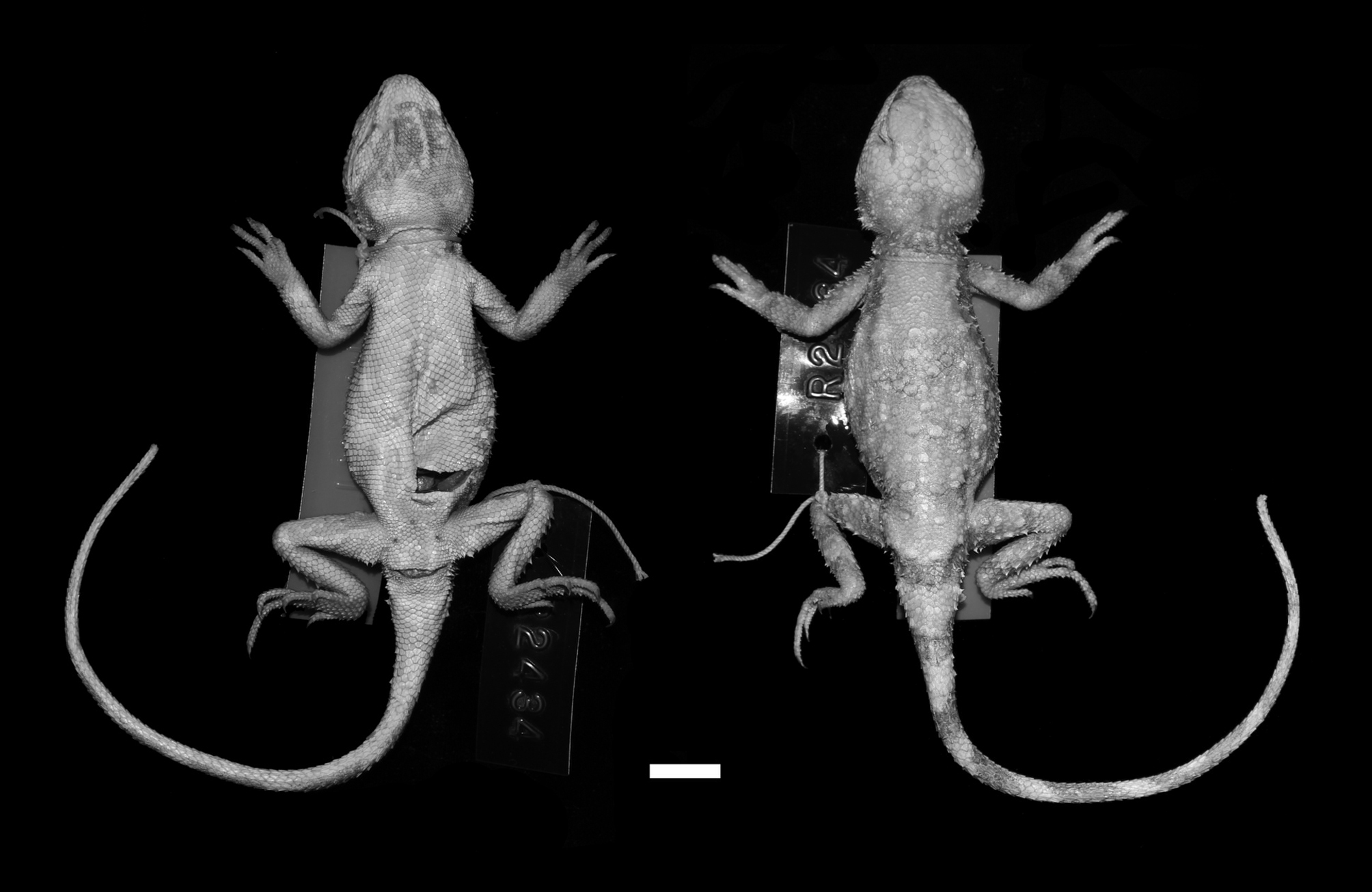
Holotype. SAMA R 2434, from between Ashburton and Gascoyne Rivers, Western Australia (presumed lost). Paratypes. SAMA R 2434, two specimens, as for holotype. Taxonomic history and neotype designation. Mitchell (1948) erected T. cephalus gigas for a population of large-bodied animals in the Gascoyne region of Western Australia, with the type locality of ‘ between the Ashburton and Gascoyne Rivers, W. A. ’ (an area approximately 100,000 km 2). Although he only examined three specimens, he believed the consistent differences in several characters, the large body size, and its occurrence in an ecologically different area merited at least subspecific designation. In a paper on the T. lineata species-group, Storr (1982) synonomized T. cephalus gigas with T. cephalus based on a larger sample of specimens, including some near the type location of T. cephalus. He concluded, ‘ These specimens do not differ substantially from those elsewhere; the attempt to divide cephala (sic) into subspecies is therefore abandoned’ (p. 65). The holotype and two paratypes of T. cephalus gigas all bear the same South Australian Museum registration number — SAMA R 2434. The holotype has been missing since 1976 (Houston 1976; M. Hutchinson, pers. comm.), and is presumed lost or destroyed. The two paratypes from the same series, however, are extant and are clearly labeled as such with ‘ 2434 ’ and ‘ PARATYPE’ on Dymo tags (Fig. 8). Of these two specimens, the male is 66.5 mm SVL and is in relatively good condition, whereas the female is 57.0 mm SVL and is in poorer condition with damage to the dorsum resulting in large discolored patches (Fig. 9). To stabilize use of the name Tympanocryptis gigas (elevated from a currently synonomized subspecies of T. cephalus), we designate as neotype the male and larger of the two paratype specimens. We also provide new South Australian Museum numbers (provided below) for the neotype and the remaining paratype to avoid any confusion with the missing holotype, which remains as SAMA R 2434. Neotype. SAMA R 68044 (male), collected from ‘ between the Ashburton and Gascoyne Rivers, W. A. ’; originally one of two paratypes with the number SAMA R 2434. Paratype. SAMA R 68045 (female), details as for neotype; originally one of two paratypes with the number SAMA R 2434.
Doughty, Paul, Kealley, Luke, Shoo, Luke P., Melville, Jane (2015): Revision of the Western Australian pebble-mimic dragon species-group (Tympanocryptis cephalus: Reptilia: Agamidae). Zootaxa 4039 (1): 85-117, DOI: 10.11646/zootaxa.4039.1.3
Export occurrence data
Darwin Core Archive (ZIP)

MULTIMEDIA
Media Files(4)
FIGURE 1. Distribution map of the Tympanocryptis cephalus species-group in Western Australia.
Imageimage/png© Doughty, Paul;Kealley, Luke;Shoo, Luke P.;Melville, JaneDoughty, Paul;Kealley, Luke;Shoo, Luke P.;Melville, Jane

FIGURE 5. Photographs in life of Tympanocryptis cephalus species-group members (left to right, top to bottom): a) T. cephalus (photo—G. Harold), b) T. gigas (M. Peterson), c) T. diabolicus sp. nov. (M. Peterson), d) T. fortescuensis sp. nov. (G. Harold), e) T. pseudopsephos sp. nov. — plain form (G. Harold), f) T. pseudopsephos sp. nov. — with charcoal wash on dorsum (G. Harold).
Imageimage/png© Doughty, Paul;Kealley, Luke;Shoo, Luke P.;Melville, JaneDoughty, Paul;Kealley, Luke;Shoo, Luke P.;Melville, Jane
IMAGES