
AnimaliaNot EvaluatedacceptedspeciesAccepted
Euherdmania fasciculata

Euherdmania fasciculata

Monniot F., 1983

GBIF:120692823

0year

ABOUT

Descriptions(1)

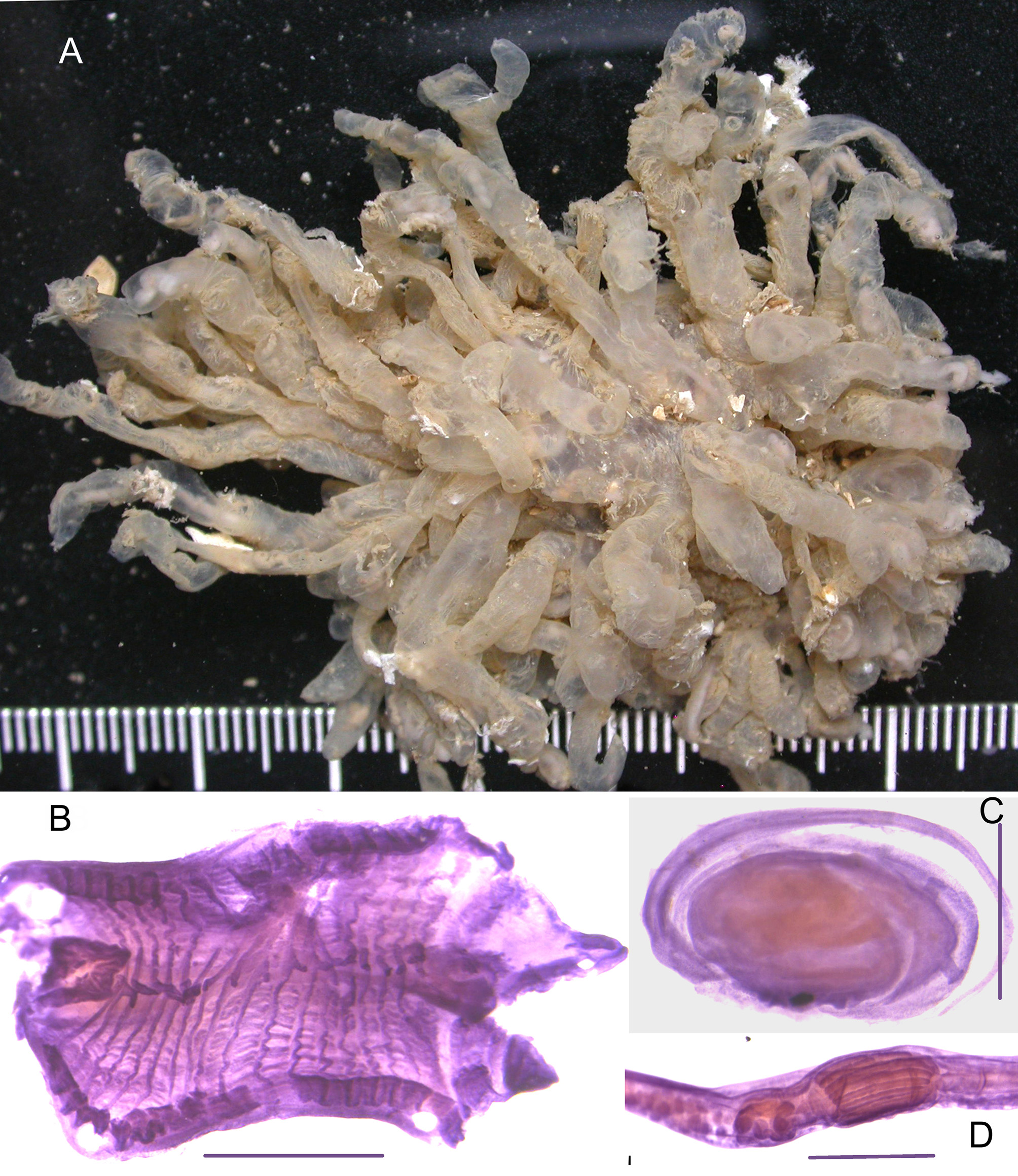
Stations. SR 4; SR 8; SR 11; SR 23; SD 8; SS 1; SS 3; SS 10; SS 11; SS 12; SC 12; SC 13; SD 12. The colonies are abundant at 4 – 6 m depth. They make bushes of long narrow and soft lobes united at their base (Fig. 3 A), each lobe containing a single zooid. All characters correspond to the original description of Caribbean specimens. The branchial sac (Fig. 3 B) has from 12 to 18 rows of stigmata in zooids of the same colony. The stomach is long and cylindrical with 10 deep folds (Fig. 3 D). Numerous testis lobes are distributed along the whole length of the post-abdomen. The ovary lies among the testis lobes at some distance from the gut. The larvae 0.9 mm long (Fig. 3 C) are incubated inside the oesophagus area. They have 2 adhesive papillae and lack any lateral ectodermal vesicle. Paiva et al (2015) described a colony from the northeastern Brazil which obviously belongs to E. fasciculata. The genus Euherdmania is not a common genus in western Atlantic with only 3 other species: E. areolata Millar 1978 from the Guyana shelf also has thin ramified lobes but is totally coated with sand and differs also by more rows of stigmata and an areolated stomach wall. E. morgani Millar & Goodbody 1974 from Jamaica has colonies in large capitate lobes each containing numerous embedded zooids. E. vitrea Millar 1961 from Brazil has colonies in thick cushions each with numerous zooids.
Monniot, Françoise (2016): Ascidians (Tunicata) of the French Guiana Expedition. Zootaxa 4114 (3): 201-245, DOI: 10.11646/zootaxa.4114.3.1

Export occurrence data

Darwin Core Archive (ZIP)

CLASSIFICATION

Taxonomic Classification Tree

MULTIMEDIA

Media Files(1)

FIGURE 3. Euherdmania fasciculata. A, colony; B, branchial sac; C, larva; D, stomach. Scale bars B = 1 mm; C = 0.5 mm; D = 1 mm.

Imageimage/png© Monniot, FrançoiseMonniot, Françoise

IMAGES

Gallery(1)

See Gallery

Occurrences with images

Source Information

Ascidians (Tunicata) of the French Guiana Expedition

checklist

This dataset contains the digitized treatments in Plazi based on the original journal article Monniot, Françoise (2016): Ascidians (Tunicata) of the French Guiana Expedition. Zootaxa 4114 (3): 201-245, DOI: 10.11646/zootaxa.4114.3.1

Abstract

Ascidians were collected along the shore of Iles du Salut and deeper on the slope in a program of evaluation of the biodiversity in Guiana. Most of the samples belong to already known species from the Caribbean area and Brazilian coast. The colonial forms dominate. The 6 new species have been dredged deeper than 50m but not found by SCUBA divers. In spite of an intensive sampling, the ascidian diversity in Guiana is low with 36 species recorded. This is the result of the abundance of sediment suspended in the water and uniformly deposited on all substrates which affects filtration rate and limits the settling of the ascidian larvae.

Key words: Tunicata, Ascidians, French Guiana, new species

Monniot F, plazi (2016). Ascidians (Tunicata) of the French Guiana Expedition. Plazi.org taxonomic treatments database. Checklist dataset https://doi.org/10.11646/zootaxa.4114.3.1 accessed via GBIF.org on 2026-06-15.

CC0Published 12/31/2016View dataset
GBIF Usage Key
120692823
Dataset Key
23e20931-307e-416c-ab19-00d57933e67d
Origin
source
Backbone Key
2329606
Taxon ID
A25D4D00D64976207BF3FF6D7C4FFD09.taxon
Last Crawled
6/11/2026
Last Interpreted
6/11/2026