
AnimaliaNot EvaluatedacceptedspeciesAccepted
Distaplia bermudensis
Van Name, 1902
GBIF:120692829
0year
ABOUT
Descriptions(1)
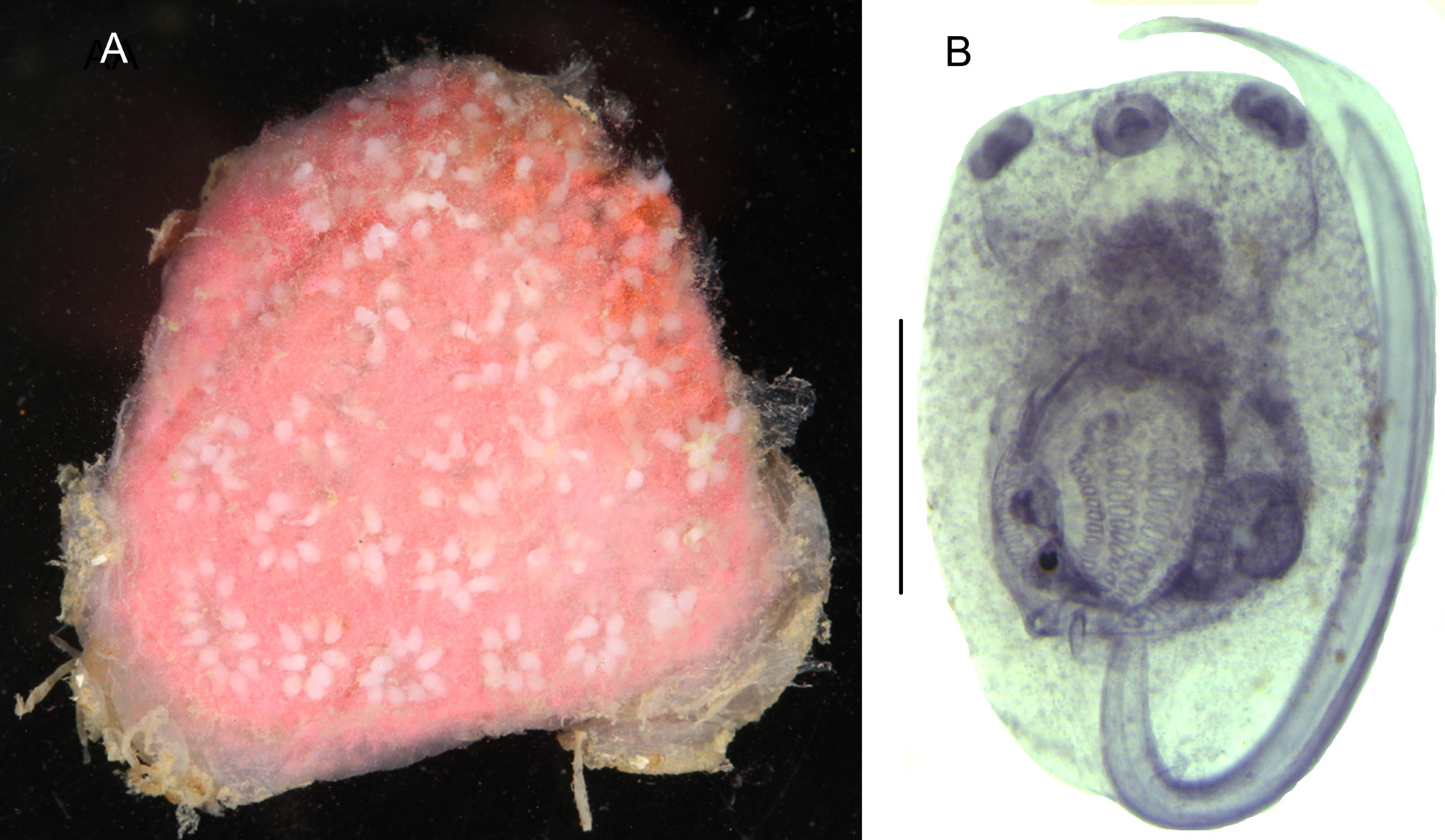
Stations. SR 5; SR 8; SR 12; SR 13; SR 14; SR 19; SR 20; SS 2; SS 4; SS 5; SS 10; SS 11; SS 12; SB 2; SB 3; SC 7; SC 9; SD 8. Numerous colonies with varied shapes, in cushions or sheets, were settled on all kinds of substrates, some on ascidians. The tunic is very soft, pale or greyish in formalin but of a bright pink in life. (Fig. 11 A). The surface tunic is easily torn and often in shreds. The zooids are arranged in stellate systems. The atrial languet is simple or with a dented tip above a wide open siphon. The 4 rows of stigmata are crossed by a parastigmatic vessel. The stomach is round with a smooth wall. A large oocyte is placed against a clump of testis vesicles inside the gut loop. One or 2 larvae are appended in a thoracic pouch. They are 1.2 mm in length with a tail in a half circle (Fig. 11 B). This shallow species is widely distributed in Bermuda, Florida, Caribbean islands and Brazil (Rocha et al. 2005) and recently introduced in the Mediterranean (Mastrototaro and Brunetti 2006).
Monniot, Françoise (2016): Ascidians (Tunicata) of the French Guiana Expedition. Zootaxa 4114 (3): 201-245, DOI: 10.11646/zootaxa.4114.3.1
Export occurrence data
Darwin Core Archive (ZIP)
CLASSIFICATION
Taxonomic Classification Tree

IMAGES