
AnimaliaNot EvaluatedacceptedspeciesAccepted
Musicodamon atlanteus
Fage, 1939
GBIF:124483383
0year
ABOUT
Descriptions(2)
Fage (1939) described this monotypic genus based on the discovery of two female specimens, deposited in the Muséum national d’histoire naturelle Paris, MNHN, collected in the region of Tata [about 700 m a. s. l.] in Morocco, and confirmed the generic status later (Fage 1954), as did Weygoldt (1997) and Prendini et al. (2005). Its remarkable stridulatory organs are the main reason for its separated status (Fage 1939; Lawrence 1969; Weygoldt 1997, 2000 b). Weygoldt (2000 a, 2000 b) for the first time reported males and confirmed its presence “ is still common at the type locality ” (Weygoldt 2000 a: 29) – without giving the year of this observation. Weygoldt (2000 a: 29) also added two new records from Algeria (Hoggar = Ahaggar, about 1400 m a. s. l.; Tassili-n-Ajjer = Tassili-n-Ajjer, about 1100 m a. s. l.). Prendini et al. (2005) gave coordinates for the material they used in their phylogenetic study near Tata in July 1999, collected by S. Huber (again collected by S. Huber in 2015: Fig. 3 – 4). Prendini et al. (2005: 231) wrote “ several specimens were collected during this and two further visits “. Prendini et al. (2005) confirmed the generic status of Musicodamon but without a fixed position in the relationships of the genera, “ Phrynichodamon and Musicodamon, which were the most unstable in the present analyses, and the matter warrants further investigation ” (Prendini et al. 2005: 224). The specification by Harvey (2013) about the type locality is misleading, because Guelmim-Es Semara was the name of an administrative region and the town Guelmim (of which Harvey used the co-ordinates) is not situated near Tata. Habitat. Caves and deep rock fissures, sometimes found in houses.
Blick, Theo, Seiter, Michael (2016): Whip spiders (Amblypygi, Arachnida) of the Western Palaearctic — a review. Zootaxa 4161 (4): 586-592, DOI: 10.11646/zootaxa.4161.4.11
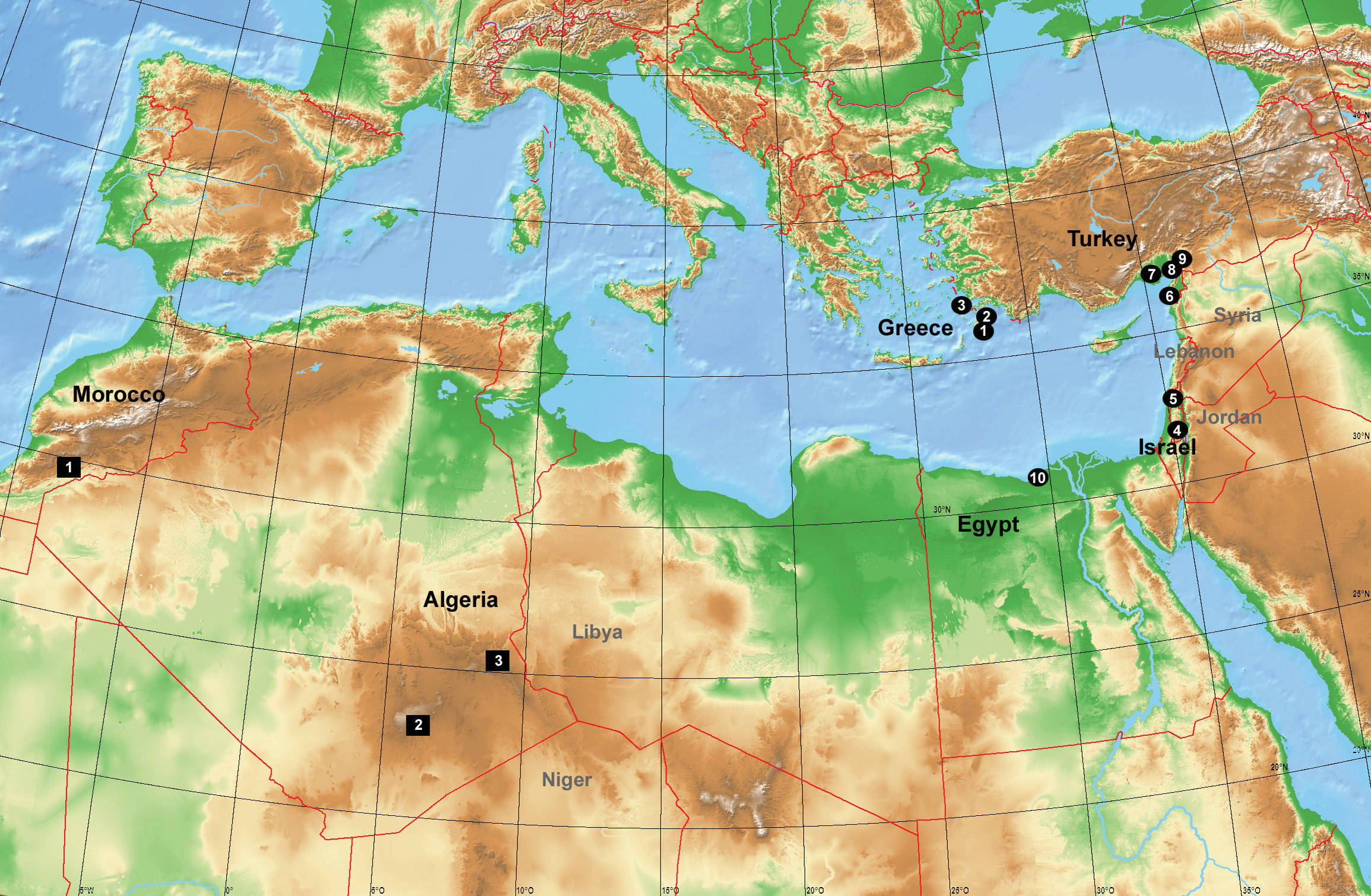
Distribution. Morocco and Algeria (Fig. 6). It is a relict species from a more humid past in northern Africa 5.000 – 11.000 years ago (e. g., Jolly et al. 1998, deMenocal & Tierney 2012) and it is unclear, how far its present distribution extends into the north-western African mountains (Weygoldt 2000 a). The sites in Algeria (Tab. 1: nos. 2 – 3) are close to Libya and Niger (maximal distance 200 km). The known sites are situated between 700 m a. s. l. and 1400 m a. s. l. and cover a wide area in north-western Africa (Fig. 6). Weygoldt (2000 a: 132) assumes: “ Musicodamon from Morocco and Algeria cope with the desert environment by retreating into places where the conditions are not xeric. It is most likely that they are relicts that have survived the disappearance of forests. ”
Blick, Theo, Seiter, Michael (2016): Whip spiders (Amblypygi, Arachnida) of the Western Palaearctic — a review. Zootaxa 4161 (4): 586-592, DOI: 10.11646/zootaxa.4161.4.11
Export occurrence data
Darwin Core Archive (ZIP)
CLASSIFICATION
Taxonomic Classification Tree

MULTIMEDIA
Media Files(1)
FIGURE 6. Map of the Mediterranean records of Amblypygi: Charinus ioanniticus (dots with nos. 1 – 10) and Musicodamon atlanteus (squares with nos. 1 – 3) (map: http: // maps-for-free. com) - no. 1 is the type locality of each species.
Imageimage/png© Blick, Theo;Seiter, MichaelBlick, Theo;Seiter, Michael
IMAGES