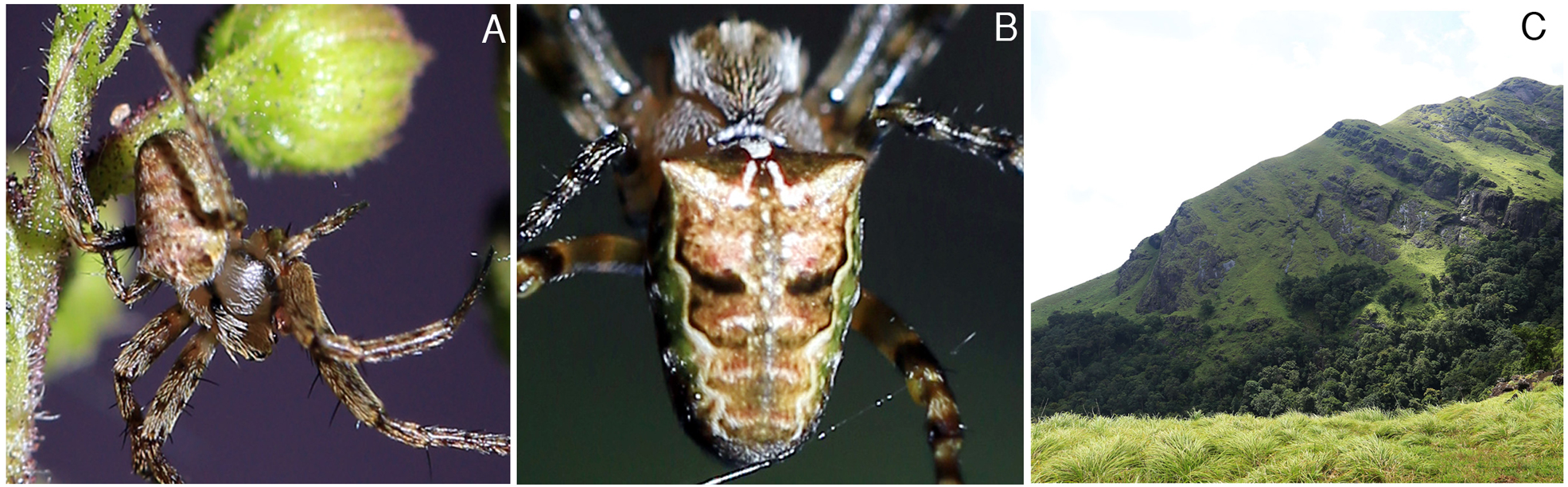
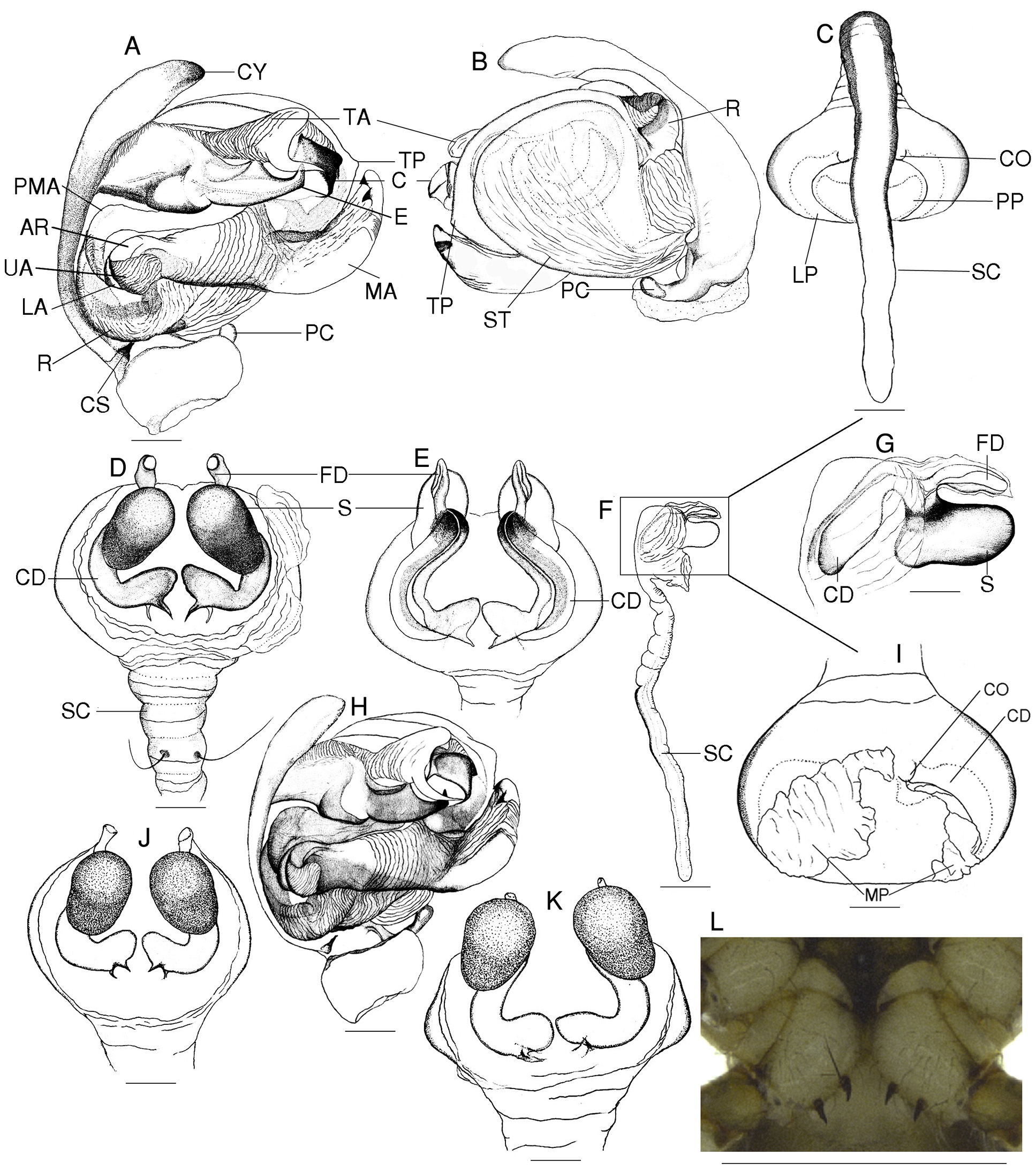
Description. Male (ADSH 912710 A). Carapace pear-shaped. Fovea cross – shaped. Single bristle behind each PLE. Chelicerae with four promarginal and three retromarginal teeth. Abdomen subtriangular, with less prominent humeral humps than that of females, with inconspicuous ventral inverted U-shaped white pattern and with paired conspicuous white spots antero-lateral to the spinnerets. Leg I with coxal spur and corresponding femoral groove on leg II; coxae of leg IV ventrally with paired stout setae; leg formula 1> 2> 4> 3. Pedipalp (Figs 2 A – B). Cymbium with a baso-prolateral spur (Fig. 2 A). Paracymbium simple, retrolaterally curved, lying in close contact with subtegulum (Figs 2 A – B). Tegulum with prominent tegular protrusion (Figs 2 A – B). Median apophysis massive with bulbous basal arch, distal half cup-shaped with two apical tips (Fig. 2 A). Radix with dorsally visible apical part (Fig. 2 B). Terminal apophysis with a sinuous base and an unsclerotized tip (Fig. 2 A). Embolus with medio-prolateral protrusion, with sclerotized tip directed at twelve o’ clock position in ventral view (Fig. 2 A). Paramedian apophysis with spatula-like tip (Fig. 2 A). Conductor broad, ovate with sclerotized tip (Fig. 2 A). Dimensions: Total length 5.22. Carapace length 2.44, width 2.07. Eye diameter: ALE 0.10, AME 0.13, PLE 0.11, PME 0.13. Eye interdistances: AME – AME 0.16, AME – ALE 0.21, PME – PME 0.12, PME – PLE 0.38, PLE – ALE 0.03. Abdomen length 2.78, width 2.27. Pedipalp: femur 0.43, patella + tibia 0.44, tarsus 0.97, total 1.84. Leg I: femur 2.76, patella + tibia 3.17, metatarsus 1.65, tarsus 0.83, total 8.41. Leg II: femur 2.29, patella + tibia 2.66, metatarsus 1.60, tarsus 0.79, total 7.34. Leg III: femur 1.50, patella + tibia 1.43, metatarsus 0.85, tarsus 0.55, total 4.33. Leg IV: femur 2.13, patella + tibia 2.22, metatarsus 1.51, tarsus 0.69, total 6.55. Variation (range): TL 4.98 – 5.52; CL 2.26 – 2.44; CW 2.04 – 2.21; AL 2.72 – 3.07; AW 2.03 – 2.27; N = 3. Female (ADSH 912710 A). In most details like male except the followings: brown bristle behind each PLE absent. Fovea Y- shaped. Cheliceral promarginal teeth equally spaced. Abdomen subtriangular with prominent humeral humps and conspicuous ventral inverted U-shaped white pattern and with paired white spots antero-lateral to spinnerets. Leg formula 1> 4> 2> 3. Genitalia (Figs 2 C – G): Epigymum medially wide composed of paired elongated lateral plates and a posterior oval plate, all remained fused antero-medially (Fig. 2 C). Scape elongated, straight, with conspicuous wrinkles basally (Fig. 2 F), wide at base (Fig. 2 C). Copulatory openings medium-sized, crescent-like, medially placed (Fig. 2 C). Copulatory ducts sclerotized. Spermathecae reniform, confronting each other in dorsal view (Figs 2 D, G). Fertilization ducts short, originate apically to copulatory ducts (Figs 2 D – E, G). Dimensions: Total length 7.87. Carapace length 2.94, width 2.73. Eye diameter: ALE 0.12, AME 0.15, PME 0.14, PLE 0.12. Eye interdistances: AME – AME 0.18, AME – ALE 0.48, PME – PME 0.14, PME – PLE 0.59, PLE – ALE 0.07. Abdomen length 4.93, width 3.93. Palp: femur 0.92, patella + tibia 1.06, tarsus 1.13, total 3.11. Leg I: femur 3.56, patella + tibia 4.18, metatarsus 2.40, tarsus 0.93, total 11.07. Leg II: femur 3.07, patella + tibia 3.45, metatarsus 2.18, tarsus 0.93, total 9.63. Leg III: femur 1.94, patella + tibia 1.91, metatarsus 1.19, tarsus 0.70, total 5.74. Leg IV: femur 3.23, patella + tibia 3.39, metatarsus 2.32, tarsus 0.85, total 9.79. Variation (range): TL 6.33 – 7.87; CL 2.37 – 2.94; CW 2.28 – 2.73; AL 3.81 – 4.93; AW 2.74 – 3.93; N = 9.
Paul, Jimmy, Sankaran, Pradeep M., Joseph, Mathew M., Sebastian, Pothalil A. (2016): The male of the orb-weaving spider Plebs mitratus (Simon, 1895) and a redescription of the female (Araneae, Araneidae). Zootaxa 4179 (1): 103-106, DOI: 10.11646/zootaxa.4179.1.4