
AnimaliaNot EvaluatedacceptedspeciesAccepted
Bathykorus bouilloni

Bathykorus bouilloni

GBIF:124956139

ABOUT

Descriptions(4)

Synonymy. “ Unidentified narcomedusa ” in Raskoff et al. 2005. “ Narcomedusa ” in Holland 2006. “ New Narcomedusa ” in Raskoff et al. In press. “ Narcomedusae sp. nov. ” in Kosobokova & Hopcroft In press. “ new narcomedusa ” in Bluhm et al. In press.
Raskoff, Kevin A. (2010): Bathykorus bouilloni: a new genus and species of deep-sea jellyfish from the Arctic Ocean (Hydrozoa, Narcomedusae, Aeginidae). Zootaxa 2361: 57-67, DOI: 10.5281/zenodo.193628
Diagnosis. Generic Diagnosis
Raskoff, Kevin A. (2010): Bathykorus bouilloni: a new genus and species of deep-sea jellyfish from the Arctic Ocean (Hydrozoa, Narcomedusae, Aeginidae). Zootaxa 2361: 57-67, DOI: 10.5281/zenodo.193628
Etymology. The generic name Bathykorus references the habitat and shape of the species. Bathy (Greek; from bathus, depth or deep) refers to the deep-sea habitat of the species, and korus (Greek; helmet) refers to the helmet-like shape of the bell. The specific epithet of bouilloni is named in honor of the late Dr. Jean Bouillon, (1926 – 2009). Dr. Bouillon’s studies spanned over 60 years, and described 17 families, 34 genera, and 114 species. His work and his generous sprit continue to enlighten and inspire generations of biologists.
Raskoff, Kevin A. (2010): Bathykorus bouilloni: a new genus and species of deep-sea jellyfish from the Arctic Ocean (Hydrozoa, Narcomedusae, Aeginidae). Zootaxa 2361: 57-67, DOI: 10.5281/zenodo.193628
Type material. The holotype and four paratype specimens have been deposited at the Smithsonian, National Museum of Natural History, Invertebrate Zoology Collection. USNM 1125360 Holotype, station 5, Canada Basin (73 º 22 ' N; 153 º 36 ' W), 4 July 2005 at 1607 m depth. USNM 1125361, Paratypes, station 8, Canada Basin (74 º 34 ’ N; 151 º 56 ' W), 11 July 2005 at 1514 m depth; four specimens.
Raskoff, Kevin A. (2010): Bathykorus bouilloni: a new genus and species of deep-sea jellyfish from the Arctic Ocean (Hydrozoa, Narcomedusae, Aeginidae). Zootaxa 2361: 57-67, DOI: 10.5281/zenodo.193628

Export occurrence data

Darwin Core Archive (ZIP)

CLASSIFICATION

Taxonomic Classification Tree

MULTIMEDIA

Media Files(4)

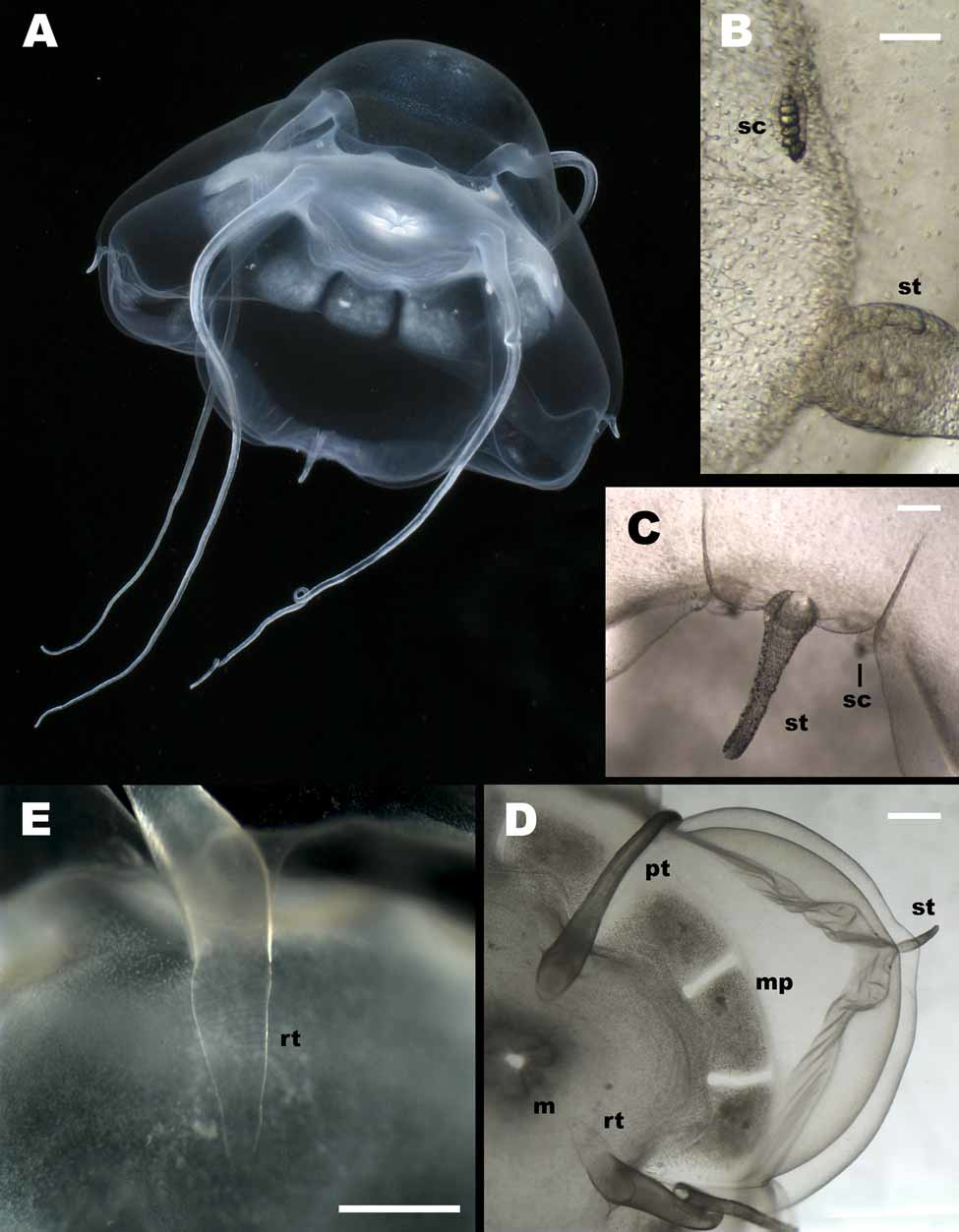
FIGURE 1. Bathykorus bouilloni. All photographs obtained from a live specimen. A. Entire swimming medusa showing the positions of the primary and secondary tentacles, as well as the three interradial manubrial pouches per quadrant. B. Close up view of the base of the secondary tentacle and statocyst showing the 7 statoliths. sc, statocyst; st, secondary tentacle (scale bar = 200 µm). C. Close up view of the entire secondary tentacle (scale bar = 200 µm). D. Aboral view of one full quadrant of the medusa. m, mouth; mp, manubrial pouch; pt, primary tentacle; st, secondary tentacle; rt, tentacular root (scale bar = 1000 µm). E. Close up of the primary tentacular root (rt) (scale bar = 1000 µm).
Imageimage/png© Raskoff, Kevin A.Raskoff, Kevin A.

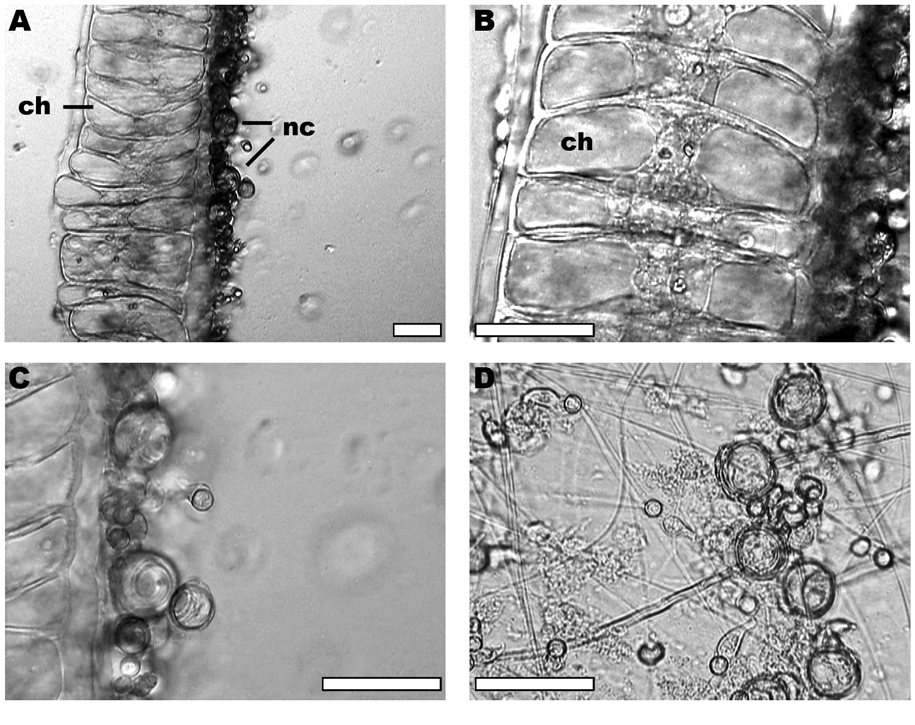
FIGURE 2. Cnidome of Bathykorus bouilloni. A. Primary tentacle showing the characteristic endodermal chordal cells (ch) inside the tentacle and the asymmetrical distribution of the nematocysts on the aboral (right) side of the tentacle (nc). B. Close up view of chordal cells and cellular matrix at the core of the tentacle. C. Undischarged nematocysts on tentacle showing the two main size classes. Coiled threads can be seen inside the capsules. D. Discharged large and small apotrichous isorhizae nematocysts. All scale bars = 50 µm.
Imageimage/png© Raskoff, Kevin A.Raskoff, Kevin A.

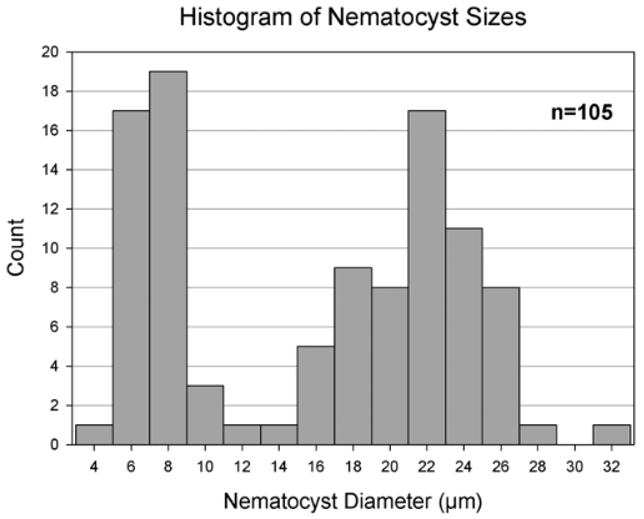
FIGURE 3. Histogram of nematocyst sizes in Bathykorus bouilloni. Nematocyst diameters (n = 105) were measured from a random assortment of microscopic video stills taken of a live specimen. There are two statistically different size classes (Mann-Whitney rank sum, P = <0.001).
Imageimage/png© Raskoff, Kevin A.Raskoff, Kevin A.

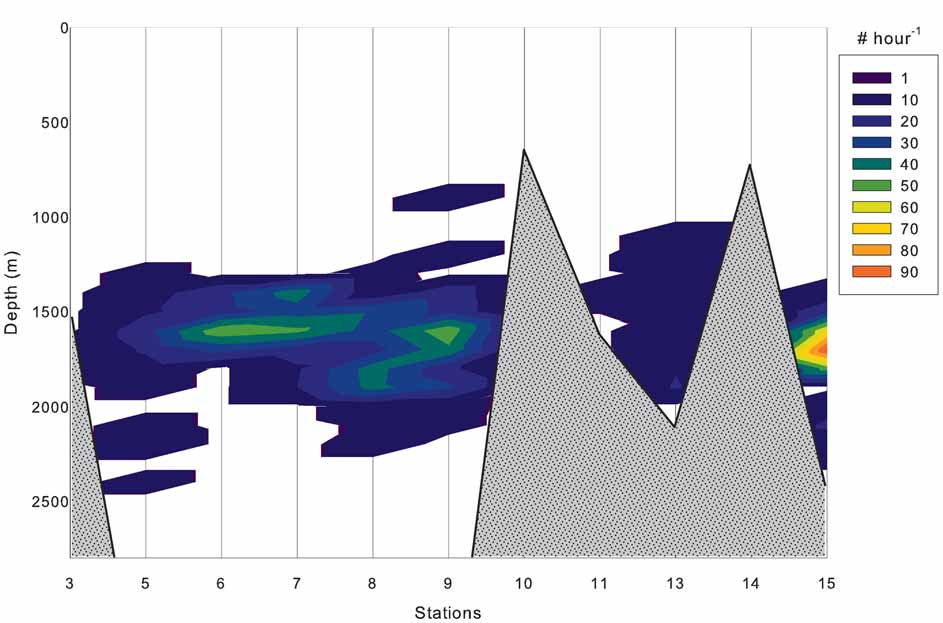
FIGURE 4. Horizontal and vertical distribution of Bathykorus bouilloni in the Canada Basin, Northwind Ridge and Chukchi Plateau Region, summer 2005. The number of individuals observed per hour by the ROV is presented in 100 m depth bin intervals, from the surface to the maximum depth achieved for a particular station (see Table 1). The bottom depth, when within the ROV’s depth range, is shown in gray.

Imageimage/png© Raskoff, Kevin A.Raskoff, Kevin A.

IMAGES

Gallery(4)

See Gallery

Occurrences with images

Source Information

Bathykorus bouilloni: a new genus and species of deep-sea jellyfish from the Arctic Ocean (Hydrozoa, Narcomedusae, Aeginidae)

checklist

This dataset contains the digitized treatments in Plazi based on the original journal article Raskoff, Kevin A. (2010): Bathykorus bouilloni: a new genus and species of deep-sea jellyfish from the Arctic Ocean (Hydrozoa, Narcomedusae, Aeginidae). Zootaxa 2361: 57-67, DOI: 10.5281/zenodo.193628

Abstract

A new genus and species of a common deep-water narcomedusa is described from the Arctic Ocean. The species has four primary tentacles, four secondary tentacles, with three interradial manubrial pouches in each quadrant. A revision and taxonomic key of the family Aeginidae is presented to account for the new genus. Detailed information on its finescale vertical and horizontal distributions show that it occurs in a fairly narrow depth range between 1400–2000 meters. The species was observed 423 times at eleven stations, demonstrating that new species can be common in the underexplored regions of the ocean.

Key words: Jellyfish, ROV, biodiversity, vertical distribution, Cnidaria, medusae, Canada Basin, Northwind Ridge, Chukchi Plateau

Raskoff K A, plazi (2010). Bathykorus bouilloni: a new genus and species of deep-sea jellyfish from the Arctic Ocean (Hydrozoa, Narcomedusae, Aeginidae). Plazi.org taxonomic treatments database. Checklist dataset https://doi.org/10.5281/zenodo.193628 accessed via GBIF.org on 2026-06-17.

CC0Published 12/31/2010View dataset
GBIF Usage Key
124956139
Dataset Key
34e5a0a8-8181-48cb-bc9e-daa3d2fd89fb
Origin
source
Backbone Key
6180410
Taxon ID
3D24C725E73DFFF6FF06F890FE14FA24.taxon
Last Crawled
6/11/2026
Last Interpreted
6/11/2026