
AnimaliaNot EvaluatedacceptedspeciesAccepted
Bathykorus bouilloni

Bathykorus bouilloni

GBIF:124956141

ABOUT

Descriptions(2)

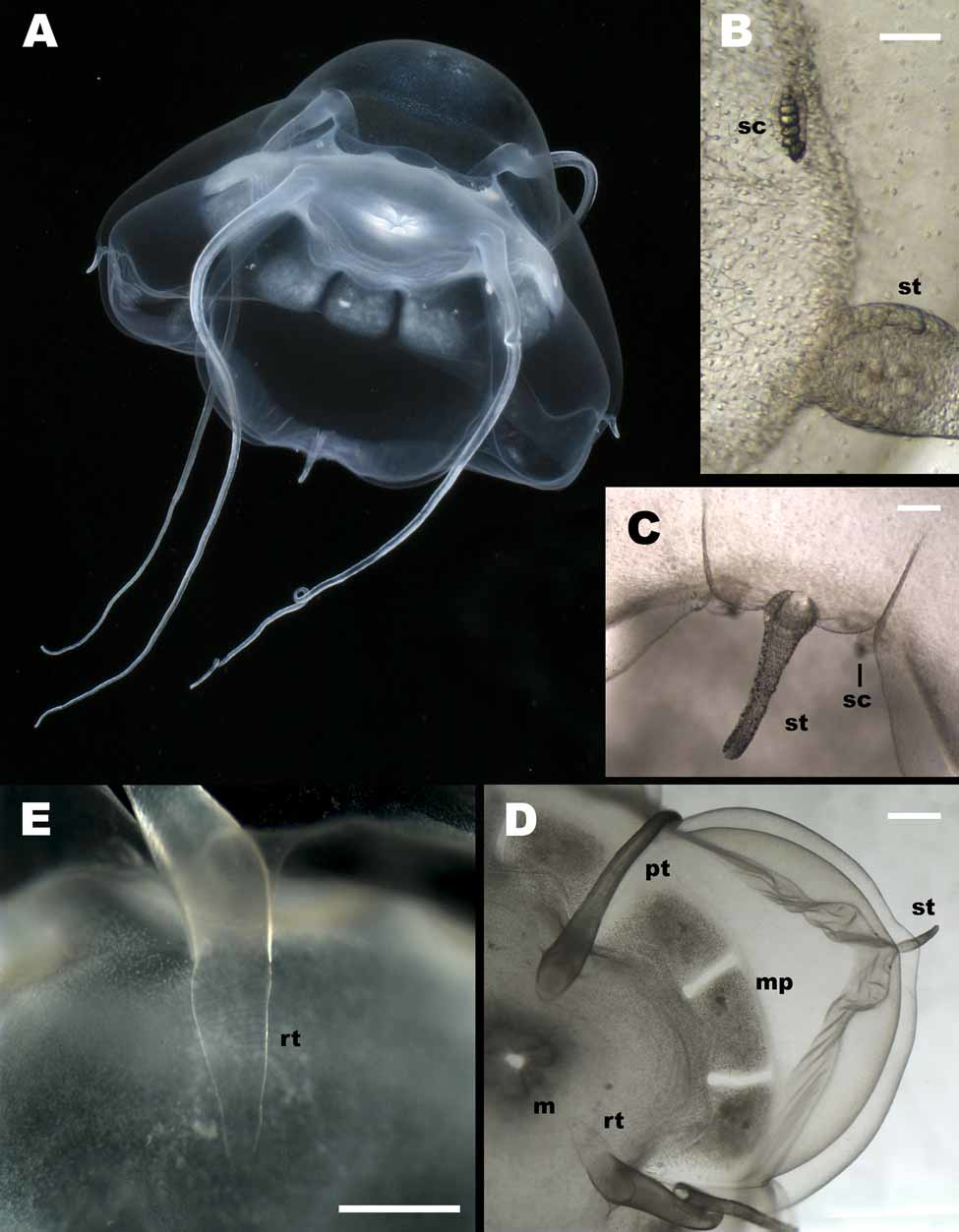
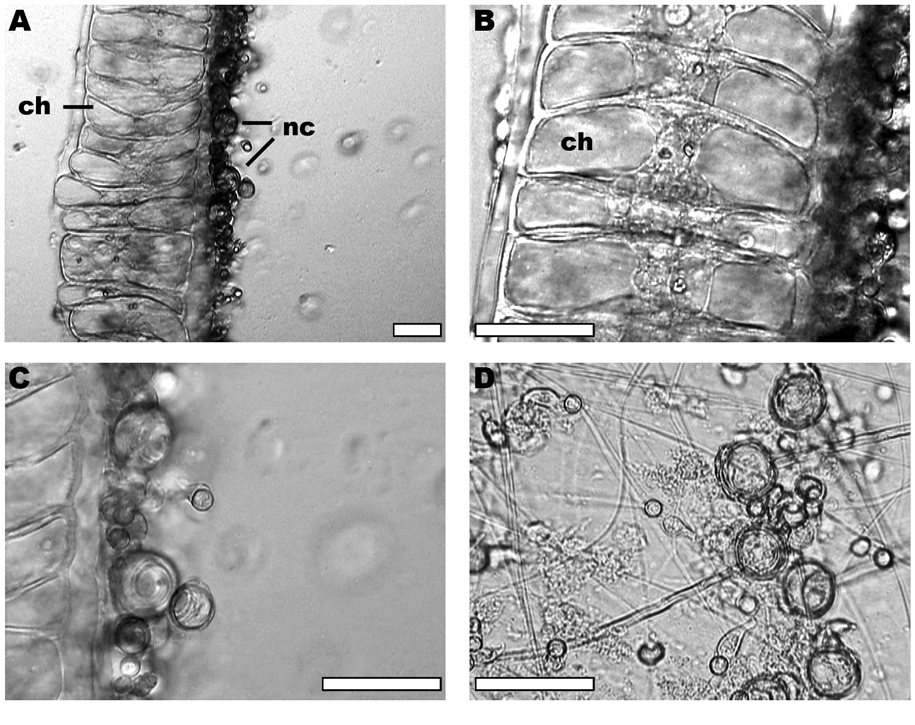
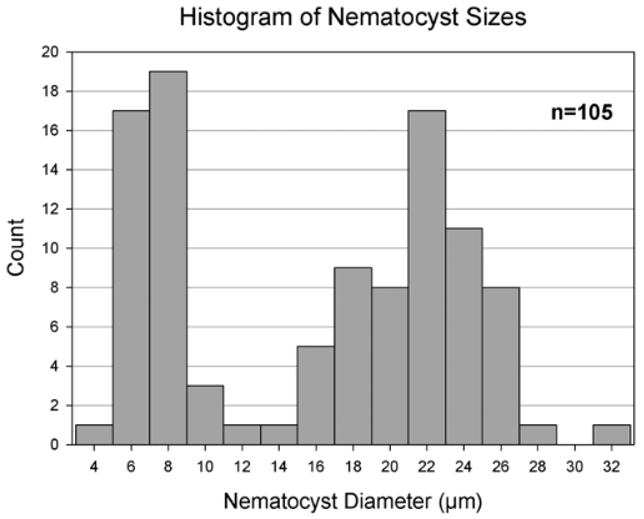
Tentacles. There are four primary, solid, noncontractile tentacles which originate above the umbrellar margin and peronia (one specimen of 25 collected was found with five tentacles) that are two to three times as long as the medusa is wide. These primary tentacles have deep endodermal tentacular roots that anchor into the mesoglea through the exumbrellar surface (Figure 1 E). On the margin of the bell there is one secondary tentacle per quadrant hanging free from the edge of the lappet (one specimen was found with two secondary tentacles in a single quadrant) (Figure 1 C & D). The core of the tentacles is made of very large vacuolated endodermal chordal cells (Figure 2 A & B). Subumbrella. The mouth is simple and circular, but can fold into irregular patterns with muscular movement. The mouth extends into a wide and flat gastric cavity that leads into the interradial manubrial pouches, a feature characteristic of the Aeginidae. There are typically three manubrial pouches per primary tentacle (Figure 1 D), although one specimen was observed with four pouches in one of its quadrants. There are an equal number of simple canals to the tentacles (usually four) which quickly bifurcate into the peripheral and peronial canals which follow along the margin of each interradial lappet. It was not determined if the canals are hollow, or solid as is common for some narcomedusae. Statocysts. There are typically two free hanging, ecto-endodermic statocysts found in each quadrant, one on each side of the secondary tentacle. In one specimen there were two secondary tentacles in a quadrant and there were three statocysts, alternating with the tentacles. The statocysts have 5 – 7 statoliths in each cluster (Figure 1 B). They appear to be similar to the “ closed ” marginal sensory clubs found in Sigiweddellia benthopelagica (Cuninidae; Bouillon et al. 2001), but it is unclear based on their drawings and description. In Bathykorus bouilloni the hanging statocysts are not found within distinct pockets in the ectoderm, as is seen in S. benthopelagica. Cnidome. Cnidocysts are found in an asymmetrical pattern on the main tentacles such that the dense collection of cnidocysts are on the aboral (exumbrellar) side of the tentacles (Figure 2 A & B). This is the side that would contact prey when the tentacles are held aloft in their typical foraging position. There were very few cnidocysts found on the oral side of the tentacles. The cnidome mainly consists of two different sizes of cnidocysts, with two major size fractions of nematocysts found, as is typically described for other narcomedusae (Carré et al. 1989; Purcell & Mills 1988) (Figure 2 C & D). Both of these nematocyst types appear to be apotrichous isorhizas. The large macroisorhizas had a diameter of 22.6 µm ± 0.44 (Mean ± SE; N = 65), while the smaller sized microisorhizas had a diameter of 8.3 µm ± 0.19 (Mean ± SE; N = 40), with these differences (Figure 3) statistically significant (P = <0.001) using a Mann-Whitney rank sum test. Gonads. Although 25 specimens were examined, no obvious mature gonads were observed under a dissection microscope at up to 100 x magnification. Although some thickened, dense tissue was found in the distal area of the interradial manubrial pouches, no definitive determination was made of its type. Either the population was immature at this time of the year, or the gonads are not obvious and a careful compound microscopic exploration is needed.
Raskoff, Kevin A. (2010): Bathykorus bouilloni: a new genus and species of deep-sea jellyfish from the Arctic Ocean (Hydrozoa, Narcomedusae, Aeginidae). Zootaxa 2361: 57-67, DOI: 10.5281/zenodo.193628
Discussion. Modification to Aeginidae The family Aeginidae is now modified to include species that have between one and four interradial manubrial pouches between each primary tentacle. A new diagnosis and key to genera, based on Bouillon et al. 2006, is provided.
Raskoff, Kevin A. (2010): Bathykorus bouilloni: a new genus and species of deep-sea jellyfish from the Arctic Ocean (Hydrozoa, Narcomedusae, Aeginidae). Zootaxa 2361: 57-67, DOI: 10.5281/zenodo.193628

Export occurrence data

Darwin Core Archive (ZIP)

CLASSIFICATION

Taxonomic Classification Tree

MULTIMEDIA

Media Files(3)

FIGURE 1. Bathykorus bouilloni. All photographs obtained from a live specimen. A. Entire swimming medusa showing the positions of the primary and secondary tentacles, as well as the three interradial manubrial pouches per quadrant. B. Close up view of the base of the secondary tentacle and statocyst showing the 7 statoliths. sc, statocyst; st, secondary tentacle (scale bar = 200 µm). C. Close up view of the entire secondary tentacle (scale bar = 200 µm). D. Aboral view of one full quadrant of the medusa. m, mouth; mp, manubrial pouch; pt, primary tentacle; st, secondary tentacle; rt, tentacular root (scale bar = 1000 µm). E. Close up of the primary tentacular root (rt) (scale bar = 1000 µm).
Imageimage/png© Raskoff, Kevin A.Raskoff, Kevin A.

FIGURE 2. Cnidome of Bathykorus bouilloni. A. Primary tentacle showing the characteristic endodermal chordal cells (ch) inside the tentacle and the asymmetrical distribution of the nematocysts on the aboral (right) side of the tentacle (nc). B. Close up view of chordal cells and cellular matrix at the core of the tentacle. C. Undischarged nematocysts on tentacle showing the two main size classes. Coiled threads can be seen inside the capsules. D. Discharged large and small apotrichous isorhizae nematocysts. All scale bars = 50 µm.
Imageimage/png© Raskoff, Kevin A.Raskoff, Kevin A.

FIGURE 3. Histogram of nematocyst sizes in Bathykorus bouilloni. Nematocyst diameters (n = 105) were measured from a random assortment of microscopic video stills taken of a live specimen. There are two statistically different size classes (Mann-Whitney rank sum, P = <0.001).

Imageimage/png© Raskoff, Kevin A.Raskoff, Kevin A.

IMAGES

Gallery(3)

See Gallery

Occurrences with images

Source Information

Bathykorus bouilloni: a new genus and species of deep-sea jellyfish from the Arctic Ocean (Hydrozoa, Narcomedusae, Aeginidae)

checklist

This dataset contains the digitized treatments in Plazi based on the original journal article Raskoff, Kevin A. (2010): Bathykorus bouilloni: a new genus and species of deep-sea jellyfish from the Arctic Ocean (Hydrozoa, Narcomedusae, Aeginidae). Zootaxa 2361: 57-67, DOI: 10.5281/zenodo.193628

Abstract

A new genus and species of a common deep-water narcomedusa is described from the Arctic Ocean. The species has four primary tentacles, four secondary tentacles, with three interradial manubrial pouches in each quadrant. A revision and taxonomic key of the family Aeginidae is presented to account for the new genus. Detailed information on its finescale vertical and horizontal distributions show that it occurs in a fairly narrow depth range between 1400–2000 meters. The species was observed 423 times at eleven stations, demonstrating that new species can be common in the underexplored regions of the ocean.

Key words: Jellyfish, ROV, biodiversity, vertical distribution, Cnidaria, medusae, Canada Basin, Northwind Ridge, Chukchi Plateau

Raskoff K A, plazi (2010). Bathykorus bouilloni: a new genus and species of deep-sea jellyfish from the Arctic Ocean (Hydrozoa, Narcomedusae, Aeginidae). Plazi.org taxonomic treatments database. Checklist dataset https://doi.org/10.5281/zenodo.193628 accessed via GBIF.org on 2026-06-19.

CC0Published 12/31/2010View dataset
GBIF Usage Key
124956141
Dataset Key
34e5a0a8-8181-48cb-bc9e-daa3d2fd89fb
Origin
source
Backbone Key
6180410
Taxon ID
3D24C725E73CFFF5FF06F895FE73F916.taxon
Last Crawled
6/11/2026
Last Interpreted
6/11/2026