
AnimaliaNot EvaluatedacceptedspeciesAccepted
Cnemidophorus lemniscatus

Cnemidophorus lemniscatus

(Linnaeus, 1758) Linnaeus, 1758

GBIF:125093199

0year

ABOUT

Descriptions(2)

Pertinent taxonomic references. Linnaeus (1758), Duméril & Bibron (1839), Cope (1876), Boulenger (1885), Gorman (1970), Lowe et al. (1970), Vanzolini (1970), Peccinini (1971), Hoogmoed (1973), Peccinini- Seale & Frota-Pessoa (1974), Hoogmoed & Lescure (1975), Cole (1979), Cunha (1981), Walker (1986), McCrystal & Dixon (1987), Frost & Wright (1988), Dessauer & Cole (1989), Peccinini-Seale (1989), Sites et al. (1990), Vyas et al. (1990), Cole & Dessauer (1993), Ávila-Pires (1995), Markezich et al. (1997), Reeder et al. (2002), Colli et al. (2003 b), Ugueto et al. (2009), Ugueto & Harvey (2010), Myers et al. (2011), Harvey et al. (2012), Giugliano et al. (2013), McCranie & Hedges (2013). Taxonomic remarks. McCranie & Hedges (2013) studied Cnemidophorus lemniscatus in Central America, northern Colombia and northern Venezuela, described one new species and elevated three others. Since we examined the specimens before this paper appeared, in order to restrict our data to C. leminscatus s. s. we considered only specimens from Venezuela east of the Orinoco river.
Ribeiro-Júnior, Marco A., Amaral, Silvana (2016): Catalogue of distribution of lizards (Reptilia: Squamata) from the Brazilian Amazonia. III. Anguidae, Scincidae, Teiidae. Zootaxa 4205 (5): 401-430, DOI: 10.11646/zootaxa.4205.5.1
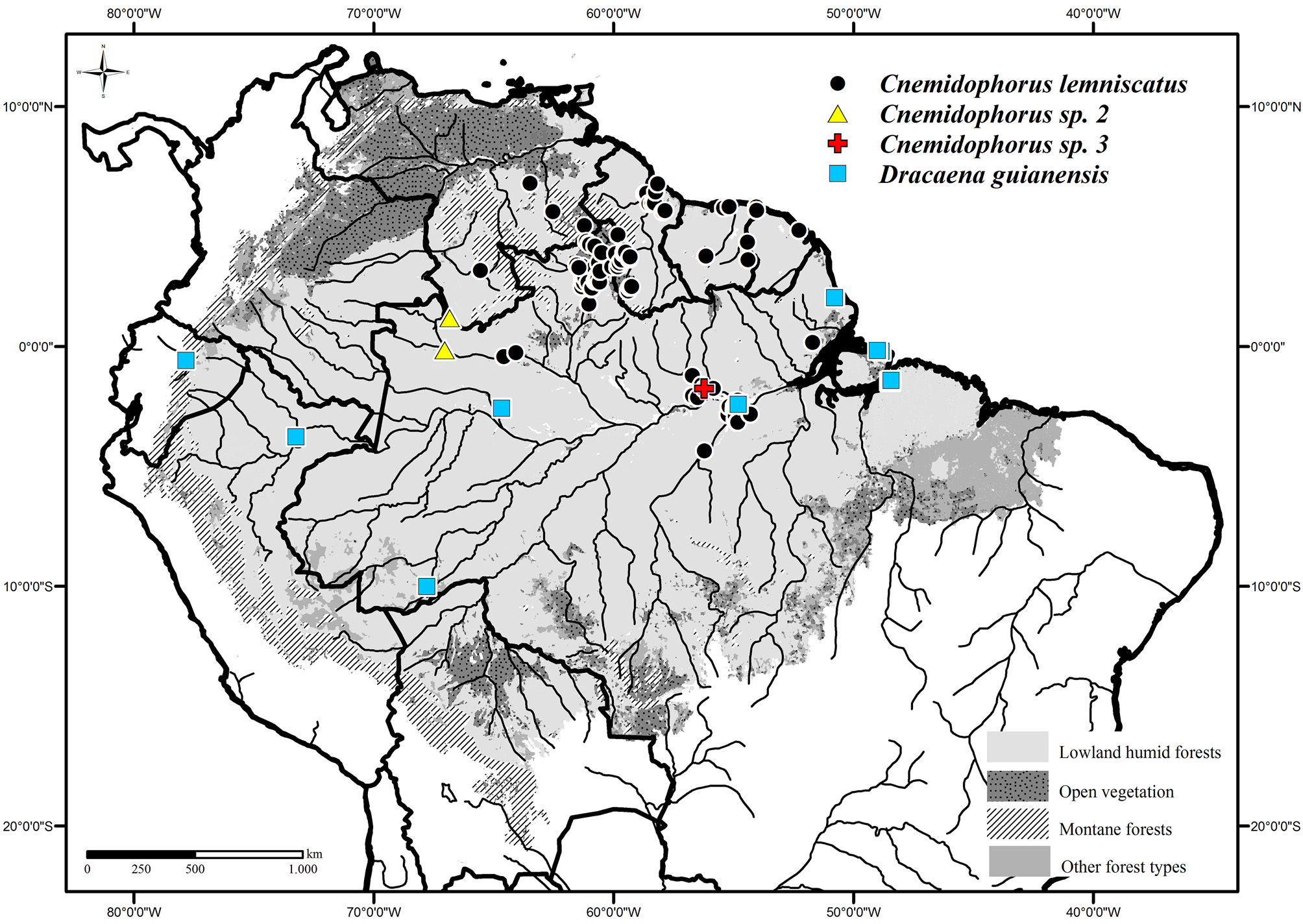
Distribution and habitat. Cnemidophorus lemniscatus is endemic to eastern Amazonia, occurring in Venezuela, Guyana, Suriname, French Guiana, and Brazil, in open formations mostly on north of the Amazon River, but also along the lower Tapajós River (Fig. 6). In Brazil it is known from the states of Amapá, Pará, Amazonas, and Roraima. Cnemidophorus lemniscatus is sexually dimorphic, terrestrial, and diurnal, inhabits open vegetation environments, mainly on sandy soil, and perianthropic situations (e. g., agricultural fields, roads, around and inside cities), where it is found on the open ground, among grasses, near bushes, and occasionally low on the vegetation (Cunha 1981; Magnusson et al. 1986; Ávila-Pires 1995; Vitt & Carvalho 1995; Vitt et al. 1997 b, 1999; Mesquita & Colli 2003; Montgomery et al. 2011).
Ribeiro-Júnior, Marco A., Amaral, Silvana (2016): Catalogue of distribution of lizards (Reptilia: Squamata) from the Brazilian Amazonia. III. Anguidae, Scincidae, Teiidae. Zootaxa 4205 (5): 401-430, DOI: 10.11646/zootaxa.4205.5.1

Export occurrence data

Darwin Core Archive (ZIP)

CLASSIFICATION

Taxonomic Classification Tree

MULTIMEDIA

Media Files(1)

FIGURE 6. Distribution of examined material of Cnemidophorus lemniscatus, Cnemidophorus sp. 2, Cnemidophorus sp. 3, and Dracaena guianensis.

Imageimage/png© Ribeiro-Júnior, Marco A.;Amaral, SilvanaRibeiro-Júnior, Marco A.;Amaral, Silvana

IMAGES

Gallery(1)

See Gallery

Occurrences with images

Source Information

Catalogue of distribution of lizards (Reptilia: Squamata) from the Brazilian Amazonia. III. Anguidae, Scincidae, Teiidae

checklist

This dataset contains the digitized treatments in Plazi based on the original journal article Ribeiro-Júnior, Marco A., Amaral, Silvana (2016): Catalogue of distribution of lizards (Reptilia: Squamata) from the Brazilian Amazonia. III. Anguidae, Scincidae, Teiidae. Zootaxa 4205 (5): 401-430, DOI: 10.11646/zootaxa.4205.5.1

Abstract

We present distribution data of all Anguidae, Scincidae, and Teiidae lizards known from the Brazilian Amazonia, totaling 29 species-level taxa, belonging to 14 genera. This represents 11 more species-level taxa than previously reported for these families in this area. Data were based on literature and 46,806 specimens deposited in three North American and eight Brazilian museums, including the main collections harboring Amazonian material. Most species (~55%) are endemic to Amazonia. Except for Ameiva ameiva, that is present in several environments and domains, non-endemic species are either associated with open dry (semideciduous) forest or open vegetation (savanna) enclaves in Amazonia, occupying similar environments outside Amazonia, gallery forests within the Cerrado, or present disjunct populations in the Atlantic Forest. As a whole, six taxa are widespread in Amazonia, four are restricted to eastern Amazonia, four to western Amazonia, three to southwestern Amazonia, one to northern Amazonia, and seven to the southern peripheral portion of Amazonia. Besides, two species present apparently more restricted, unique distributions. Only three species have a distribution that is congruent with one of the areas of endemism (AE) recognized for other organisms (birds and primates), of which two occur in AE Guiana and one in AE Inambari.

Key words: Anguidae, Brazilian Amazonia, distribution, lizards, Scincidae, Teiidae

Ribeiro-Júnior M A, Amaral S, plazi (2016). Catalogue of distribution of lizards (Reptilia: Squamata) from the Brazilian Amazonia. III. Anguidae, Scincidae, Teiidae. Plazi.org taxonomic treatments database. Checklist dataset https://doi.org/10.11646/zootaxa.4205.5.1 accessed via GBIF.org on 2026-06-15.

CC0Published 12/31/2016View dataset
GBIF Usage Key
125093199
Dataset Key
0545c3cc-d1d6-4709-99ab-ff5c6915a542
Origin
source
Backbone Key
5227564
Taxon ID
03C087CC4856FF9CFF4AFEDEFD3329EA.taxon
Last Crawled
6/11/2026
Last Interpreted
6/11/2026