AnimaliaacceptedgenusAccepted
Cavellina

Cavellina

GBIF:127639203

ABOUT

Descriptions(5)

1964 Ostracode indet. G 5; Magne: pl. 19, figs. 62 – 63. 1982 Silenites? sp. G Magne, 1964; Milhau: 21, pl. 4, fig. 102 1985 Cavellina? wahlensis nov. sp.; Coen: pl. 5, figs. 9 – 10. 1988 Cavellina? wahlensis Coen; Milhau: 485, pl. 55, fig. 22. 1988 Silenites? sp. G Magne, 1964; Milhau: 487, pl. 56, fig. 46. 1993 Cavellina? wahlensis Coen; Kasimi: pl. 16, fig. 27. 2013 Cavellina? wahlensis Coen; Maillet: 84, pl. X, figs. 14 – 15. 2013 Cavellina? wahlensis Coen; Casier in Casier & Préat: 488, pl. IV, fig. 3.
Maillet, Sebastien, Milhau, Bruno, Vreulx, Michel, Posada, Luis-Carlos Sánchez De (2016): Givetian ostracods of the Candás Formation (Asturias, North-western Spain): taxonomy, stratigraphy, palaeoecology, relationship to global events and palaeogeographical implications. Zootaxa 4068 (1): 1-78, DOI: 10.11646/zootaxa.4068.1.1
Description. Medium-sized carapace with a sub-triangular rounded outline in lateral view. Carapace very flat in dorsal view. The larger RV slightly overlaps the LV on the whole outline. Hmax: median; Lmax: 1 / 3 ventral; Wmax: slightly ventral. Very arched and convex dorsal margin. Slightly concave ventral margin. Well rounded anterior and posterior margins, more convex ventrally. Anterior and posterior parts of the carapace symmetric. Surface smooth.
Maillet, Sebastien, Milhau, Bruno, Vreulx, Michel, Posada, Luis-Carlos Sánchez De (2016): Givetian ostracods of the Candás Formation (Asturias, North-western Spain): taxonomy, stratigraphy, palaeoecology, relationship to global events and palaeogeographical implications. Zootaxa 4068 (1): 1-78, DOI: 10.11646/zootaxa.4068.1.1
Diagnosis. Coen (1985, p. 17 – 18).
Maillet, Sebastien, Milhau, Bruno, Vreulx, Michel, Posada, Luis-Carlos Sánchez De (2016): Givetian ostracods of the Candás Formation (Asturias, North-western Spain): taxonomy, stratigraphy, palaeoecology, relationship to global events and palaeogeographical implications. Zootaxa 4068 (1): 1-78, DOI: 10.11646/zootaxa.4068.1.1
Discussion. A questionable Cavellina with an atypical very flat and large carapace for this genus. As frequently seen in cavellinids, a sexual dimorphism is known in this species (see Coen 1985). Occurrence. Lower to Middle Givetian (Trois-Fontaines, Névremont and Mont d’Haurs Fms), Ardenne (Flohimont, Cul d’Houille, Jemelle and Aisemont sections), Middle Givetian (Candás Fm, mb B), Asturias (Peran- Perlora section); Givetian, Boulonnais.
Maillet, Sebastien, Milhau, Bruno, Vreulx, Michel, Posada, Luis-Carlos Sánchez De (2016): Givetian ostracods of the Candás Formation (Asturias, North-western Spain): taxonomy, stratigraphy, palaeoecology, relationship to global events and palaeogeographical implications. Zootaxa 4068 (1): 1-78, DOI: 10.11646/zootaxa.4068.1.1
Material. 10 specimens (6 C, 2 V, 2 F).
Maillet, Sebastien, Milhau, Bruno, Vreulx, Michel, Posada, Luis-Carlos Sánchez De (2016): Givetian ostracods of the Candás Formation (Asturias, North-western Spain): taxonomy, stratigraphy, palaeoecology, relationship to global events and palaeogeographical implications. Zootaxa 4068 (1): 1-78, DOI: 10.11646/zootaxa.4068.1.1

Export occurrence data

Darwin Core Archive (ZIP)

CLASSIFICATION

Taxonomic Classification Tree

MULTIMEDIA

Media Files(1)

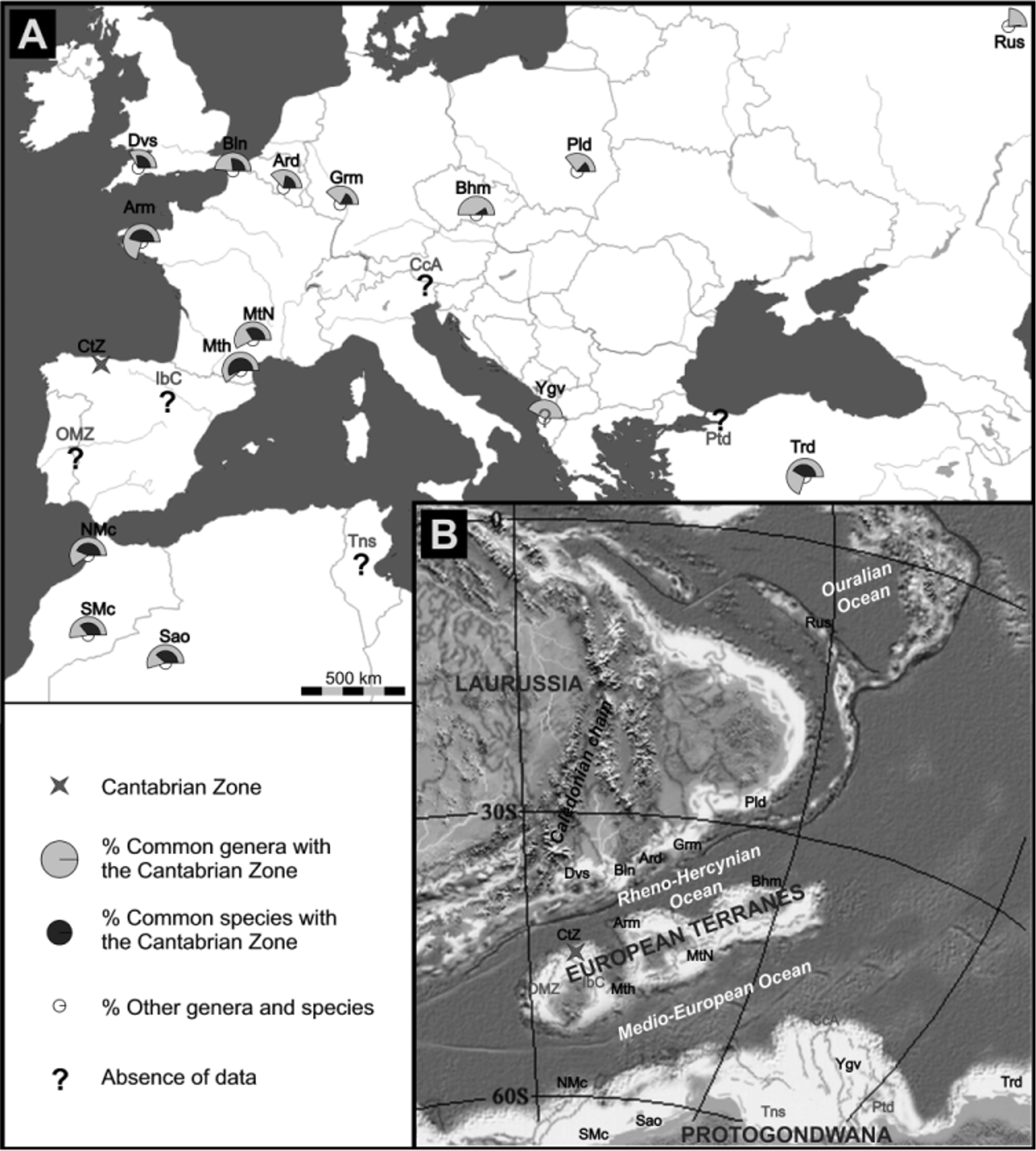
FIGURE 6. Faunal relations and Middle Devonian palaeogeographic reconstruction. Abbreviations: Ard: Ardenne (Namur and Dinant Synclinoria); Arm: Armorican Massif; Bhm: Bohemian Massif; Bln: Boulonnais; CcA: Carnic Alps; Ctz: Cantabrian Zone; Dvs: Devonshire; Grm: Germany (Eifel, Ruhr, Sauerland, Bergisches Land, Thuringia, Harz); IbC: Iberian Cordillera; Mth: Mouthoumet Massif; MtN: Montagne Noire; NMc: North Morocco (Doukkala, Meseta); OMZ: Ossa Morena Zone; Pld: Poland (Holy Cross Mountains, Pomerania); Ptd: Pontides; Rus: Russia (Volga and Urals areas; Baschkiria); Sao: Saoura; SMc: South Morocco (Anti-Atlas, Tafilalt); Tns: Tunisia; Trd: Taurides; Ygv: Ex-Yugoslavia (Serbia). For the reviewed literature on Givetian ostracods of those areas, see text. A. Faunal affinities between the Cantabrian Zone and other places in Europe and neighbouring areas during the Givetian; B. Middle Devonian palaeogeographic reconstruction (adapted from Blakey 2007).

Imageimage/png© Maillet, Sebastien;Milhau, Bruno;Vreulx, Michel;Posada, Luis-Carlos Sánchez DeMaillet, Sebastien;Milhau, Bruno;Vreulx, Michel;Posada, Luis-Carlos Sánchez De

IMAGES

Gallery(1)

See Gallery

Occurrences with images

Source Information

Givetian ostracods of the Candás Formation (Asturias, North-western Spain): taxonomy, stratigraphy, palaeoecology, relationship to global events and palaeogeographical implications

checklist

This dataset contains the digitized treatments in Plazi based on the original journal article Maillet, Sebastien, Milhau, Bruno, Vreulx, Michel, Posada, Luis-Carlos Sánchez De (2016): Givetian ostracods of the Candás Formation (Asturias, North-western Spain): taxonomy, stratigraphy, palaeoecology, relationship to global events and palaeogeographical implications. Zootaxa 4068 (1): 1-78, DOI: 10.11646/zootaxa.4068.1.1

Abstract

Asturian ostracods of the Givetian carbonate Candás Formation are documented for the first time from the Peran-Perlora and Carranques reference sections. More than 1,200 specimens were extracted from 44 samples by means of the hot acetolysis method. In all, 75 taxa are described herein, of which 21 are formally described and one, Evlanella peranensis Maillet n. sp., is new. All the taxa are marine benthic and belong to the Eifelian Mega-Assemblage. The assemblages recognized are representative of semi-restricted to shallow open-marine palaeoenvironments above the storm wave base. The stratigraphical distribution of the taxa shows a strong faunal renewal in the top of the Candás Formation. Long-ranging taxa found at the base of the formation, of which many are known from the base of the Middle Devonian, disappear within the base of the member C and are replaced above, around the Middle/Upper Givetian boundary, by more cosmopolitan taxa characteristic of the Frasnian. The lower half of the member C is also characterized both by unstable environments and occurrence of some short-ranging opportunistic ostracod taxa. This renewal within shallow water ostracod communities is probably a consequence of the global Taghanic Biocrisis, leading world-widely to extinctions in several faunal groups. Faunal affinities with Givetian ostracod taxa reported in other areas of the world reflect the commonly accepted palaeogeographical patterns. Close relations between the Cantabrian Zone (NW-Spain), the Armorican Massif (W- France), the Mouthoumet Massif (S-France) and North Africa (Morocco and Algeria) suggest a narrow oceanic space between the western European terranes and the northern Gondwanan margin that involves an advanced phase of closure of the Medio-European Ocean.

Key words: Middle Devonian, new species, faunal renewal, systematic, Taghanic Biocrisis

Maillet S, Milhau B, Vreulx M, Posada L S D, plazi (2016). Givetian ostracods of the Candás Formation (Asturias, North-western Spain): taxonomy, stratigraphy, palaeoecology, relationship to global events and palaeogeographical implications. Plazi.org taxonomic treatments database. Checklist dataset https://doi.org/10.11646/zootaxa.4068.1.1 accessed via GBIF.org on 2026-06-16.

CC0Published 12/31/2016View dataset
GBIF Usage Key
127639203
Dataset Key
b9c1e3a3-e591-4b34-9f30-d6d88a230673
Origin
source
Backbone Key
3239327
Taxon ID
03B94C39E8564B69FF22F8A9FDBFFCBE.taxon
Last Crawled
6/11/2026
Last Interpreted
6/11/2026
