AnimaliaNot EvaluatedacceptedspeciesAccepted
Cavellina rhenana

Cavellina rhenana

Krommelbein, 1954

GBIF:127639205

0year

ABOUT

Descriptions(4)

Description. Medium-sized sub-oval carapace, stocky in tecnomorphs and more elongated in heteromorphs. The larger RV overlaps the LV on whole outline, slightly anteriorly and more clearly ventrally, dorsally and posteriorly. Hmax at 1 / 3 posterior in tecnomorphs, more anterior in heteromorphs; Lmax slightly ventral; Wmax at 1 / 3 posterior. Lmax equivalent to about 2 Hmax. Slightly convex dorsal margin, anteriorly oblique (also posteriorly oblique in heteromorphs). Straight to slightly concave ventral margin. Dorsal and ventral margins almost parallel. Regularly convex, well rounded anterior margin. Well rounded posterior margin. Posterior part of the carapace higher than the anterior one. Surface slightly reticulated. Slightly anterior adductorial sulcus, more or less marked.
Maillet, Sebastien, Milhau, Bruno, Vreulx, Michel, Posada, Luis-Carlos Sánchez De (2016): Givetian ostracods of the Candás Formation (Asturias, North-western Spain): taxonomy, stratigraphy, palaeoecology, relationship to global events and palaeogeographical implications. Zootaxa 4068 (1): 1-78, DOI: 10.11646/zootaxa.4068.1.1

cf. 1954 a Cavellina rhenana nov. sp.; Krömmelbein: 250 – 251, pl. 1, fig. 3. cf. 1983 a Sulcella rhenana (Krömmelbein); Milhau: 351, pl. 1, figs. 7 – 8. cf. 1985 Cavellina rhenana Krömmelbein; Coen: 18, pl. 5, figs. 5 – 8. cf. 1985 Sulcella rhenana (Krömmelbein); Lethiers et al.: 66 – 67, pl. 9, figs. 6 – 7. cf. 1988 Sulcella rhenana (Krömmelbein); Milhau: 487, pl. 56, fig. 13. cf. 2009 Cavellina rhenana Krömmelbein; Casier & Préat: 96, pl. 5, fig. 3. non 2011 b Cavellina cf. rhenana Krömmelbein; Casier in Casier et al.: 111 – 113, pl. 2, fig. 13. cf. 2013 Cavellina rhenana Krömmelbein; Casier & Maillet in Casier et al.: 264, fig. 9 B. 2013 Cavellina cf. rhenana Krömmelbein; Maillet: 85, pl. X, figs. 18 – 19. cf. 2013 b Cavellina rhenana Krömmelbein; Maillet et al.: fig. 5 K. cf. 2013 c Cavellina rhenana Krömmelbein; Maillet et al.: figs. 2 A – K. PLATE II. Ostracods from the type-area of the carbonate Candás Formation. For samples stratigraphic position, see Figure 3. 1 – 2. Evlanella peranensis Maillet n. sp., tecnomorph (1), N 2, LV (C. O. F. L. S. 1126); heteromorph (2), N 2, slightly oblique dorsal view (C. O. F. L. S. 1127); 3. Poloniella cf. claviformis (Kummerow, 1953), I 6, RV (C. O. F. L. S. 806); 4 – 5. Punctoprimitia cf. europaea Weyant, 1967, adult (4), II 1, LV (C. O. F. L. S. 808); juvenile (5), II 1, LV (C. O. F. L. S. 809); 6. Cavellina? wahlensis Coen, 1985, tecnomorph, G 1, LV (C. O. F. L. S. 812); 7 – 8. Cavellina cf. rhenana Krömmelbein, 1954, heteromorph (7), M 2, LV (C. O. F. L. S. 817); tecnomorph (8), M 2, LV (C. O. F. L. S. 816); 9 – 10. Uchtovia refrathensis (Krömmelbein, 1954), tecnomorph (9), M 2, LV (C. O. F. L. S. 827); heteromorph (10), M 2, LV (C. O. F. L. S. 1128); 11. Knoxiella? sp. P 1, I 6, LV (C. O. F. L. S. 830); 12. Cryptophyllus sp. P 1, II 1, LV? (C. O. F. L. S. 857); 13. Cryptophyllus sp. P 2, O 5, RV? (C. O. F. L. S. 858); 14. Cryptophyllus sp. P 3, Q 8, internal mould, LV? (C. O. F. L. S. 860); 15. Cryptophyllus sp. P 4, M 3, LV? (C. O. F. L. S. 838); 16. Roundyella? sp. indet., I 3, LV? (C. O. F. L. S. 786); 17. Cytherellina aff. brassicalis Becker, 1965, I 6, RV (C. O. F. L. S. 872); 18. Cytherellina cf. dubia (Kummerow, 1953), G 1, RV (C. O. F. L. S. 873); 19. Cytherellina cf. groosae (Coen, 1985), B 10, RV (C. O. F. L. S. 874); 20. Cytherellina cf. perlonga (Kummerow, 1953), B 10, RV (C. O. F. L. S. 876); 21. Cytherellina? sp. P 1, A 9, RV (C. O. F. L. S. 881); 22. Cytherellina sp. indet., Q 8, RV (C. O. F. L. S. 882); 23. Punctomosea? sp. indet., Q 8, RV (C. O. F. L. S. 893); 24. Polyzygia beckmanni beckmanni Krömmelbein, 1954, V 14, RV (C. O. F. L. S. 899); 25. Polyzygia insculpta insculpta Becker, 1964, II 1, RV (C. O. F. L. S. 901); 26 – 27. Polyzygia neodevonica neodevonica (Matern, 1929), adult (26), Q 8, RV (C. O. F. L. S. 902); juvenile (27), M 2, LV (C. O. F. L. S. 903); 28 a, b. Polyzygia symmetrica symmetrica Gürich, 1896, Q 8, RV (a) and dorsal view (b) (C. O. F. L. S. 907).
Maillet, Sebastien, Milhau, Bruno, Vreulx, Michel, Posada, Luis-Carlos Sánchez De (2016): Givetian ostracods of the Candás Formation (Asturias, North-western Spain): taxonomy, stratigraphy, palaeoecology, relationship to global events and palaeogeographical implications. Zootaxa 4068 (1): 1-78, DOI: 10.11646/zootaxa.4068.1.1
Discussion. These specimens show a carapace with features close to C. rhenana Krömmelbein, 1954, except that this one is much more elongate. A marked sexual dimorphism is observed, as usual in cavellinids. Not enough specimens were collected to observe the specific variation as known in C. rhenana (Maillet et al. 2013 c). Occurrence. Middle Givetian (Candás Fm, mb C), Asturias (Peran-Perlora section).
Maillet, Sebastien, Milhau, Bruno, Vreulx, Michel, Posada, Luis-Carlos Sánchez De (2016): Givetian ostracods of the Candás Formation (Asturias, North-western Spain): taxonomy, stratigraphy, palaeoecology, relationship to global events and palaeogeographical implications. Zootaxa 4068 (1): 1-78, DOI: 10.11646/zootaxa.4068.1.1
Material. 3 specimens (3 C).
Maillet, Sebastien, Milhau, Bruno, Vreulx, Michel, Posada, Luis-Carlos Sánchez De (2016): Givetian ostracods of the Candás Formation (Asturias, North-western Spain): taxonomy, stratigraphy, palaeoecology, relationship to global events and palaeogeographical implications. Zootaxa 4068 (1): 1-78, DOI: 10.11646/zootaxa.4068.1.1

Export occurrence data

Darwin Core Archive (ZIP)

CLASSIFICATION

Taxonomic Classification Tree

MULTIMEDIA

Media Files(3)

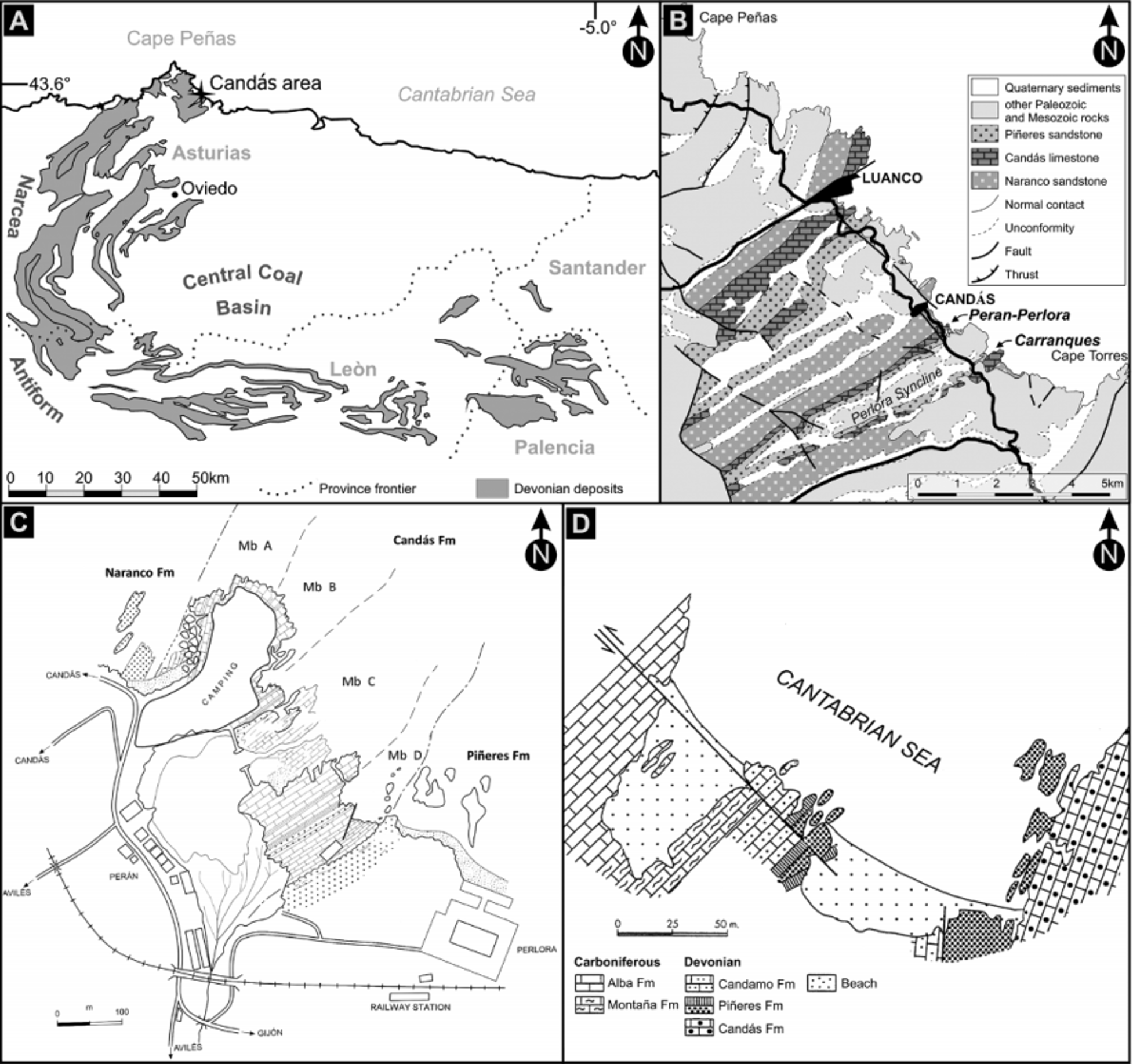
FIGURE 1. Location maps of the studied area. A. Devonian deposits cropping out in the Cantabrian Zone (adapted from García-Alcalde et al. 2012); B. Simplified geological map of the Luanco-Candás area showing the Naranco, the Candás and the Piñeres Fms (modified from García-López et al. 2002), with location of the Peran-Perlora and Carranques sections; C. Detailed location map of the Peran-Perlora section (adapted from García-López et al. 2002); D. Detailed location map of the Carranques section (adapted from Fernández et al. 1996).

Imageimage/png© Maillet, Sebastien;Milhau, Bruno;Vreulx, Michel;Posada, Luis-Carlos Sánchez DeMaillet, Sebastien;Milhau, Bruno;Vreulx, Michel;Posada, Luis-Carlos Sánchez De

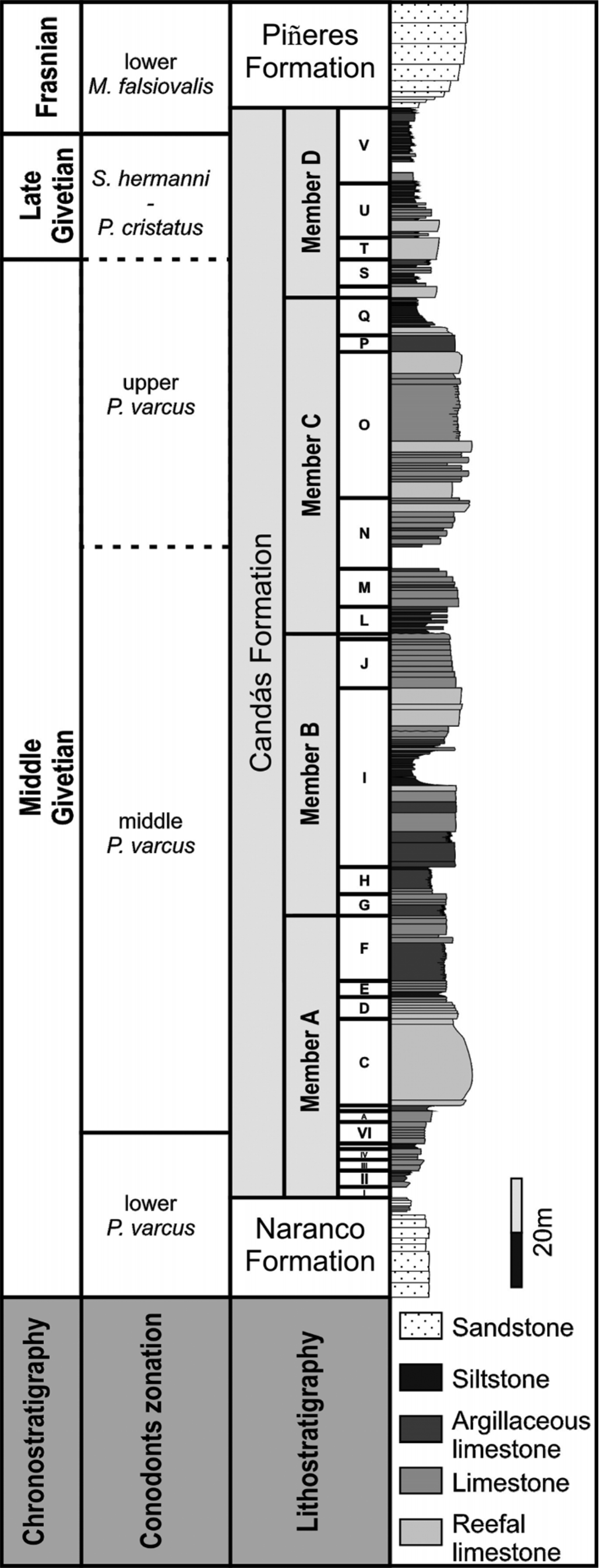
FIGURE 2. Simplified stratigraphical column of the Candás Formation, standard conodont zonation and chronostratigraphy (according to García-Alcalde et al. 1979; García-López 1986 and García-López et al. 2002).

Imageimage/png© Maillet, Sebastien;Milhau, Bruno;Vreulx, Michel;Posada, Luis-Carlos Sánchez DeMaillet, Sebastien;Milhau, Bruno;Vreulx, Michel;Posada, Luis-Carlos Sánchez De

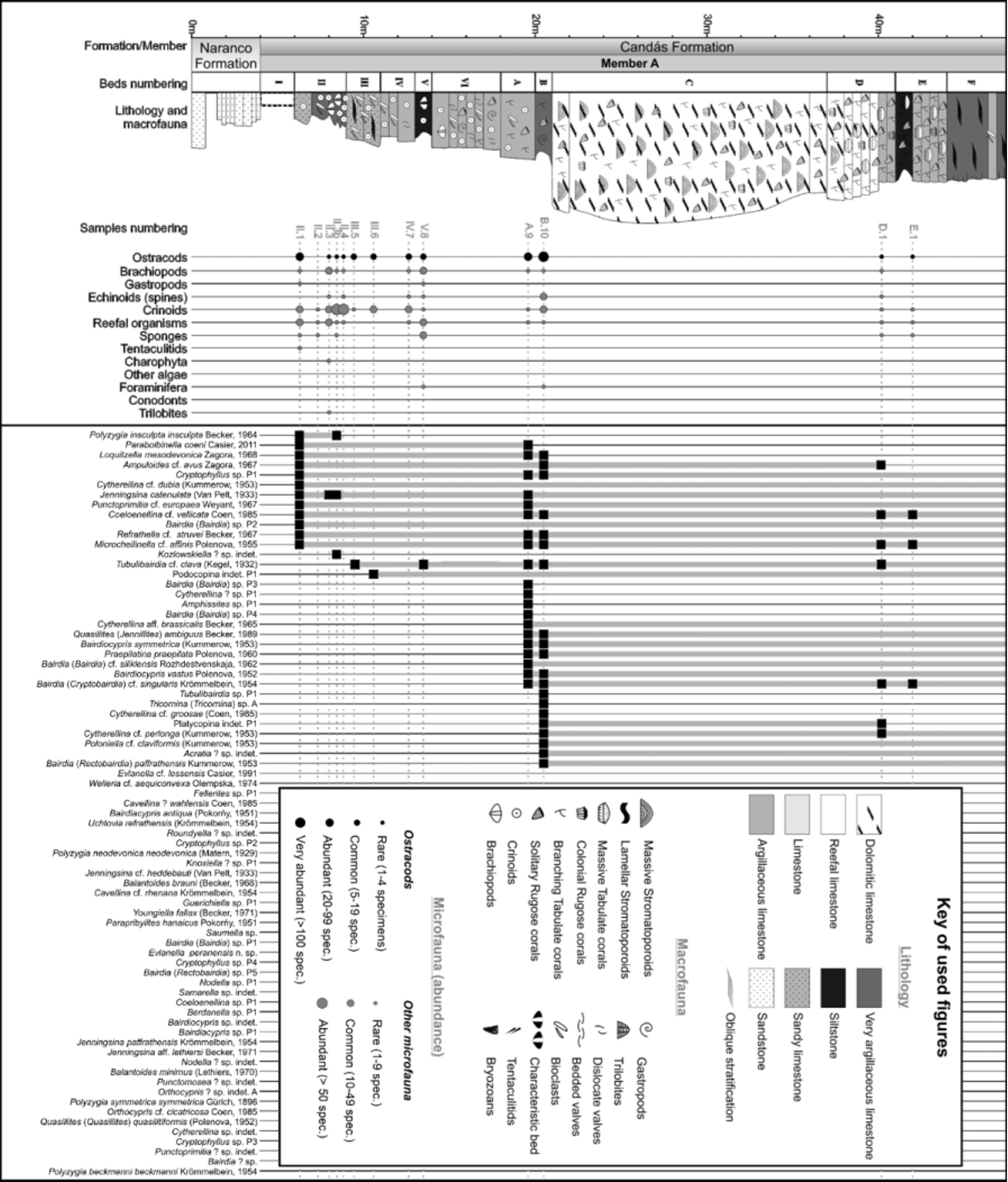
FIGURE 3. Stratigraphical distribution of ostracod taxa through the Candás Formation in the Peran-Perlora and Carranques sections. Samples numbers are replaced on a detailed stratigraphical column of the series, on which macro- and microfaunas’ occurrences are indicated.

Imageimage/png© Maillet, Sebastien;Milhau, Bruno;Vreulx, Michel;Posada, Luis-Carlos Sánchez DeMaillet, Sebastien;Milhau, Bruno;Vreulx, Michel;Posada, Luis-Carlos Sánchez De

IMAGES

Gallery(3)

See Gallery

Occurrences with images

Source Information

Givetian ostracods of the Candás Formation (Asturias, North-western Spain): taxonomy, stratigraphy, palaeoecology, relationship to global events and palaeogeographical implications

checklist

This dataset contains the digitized treatments in Plazi based on the original journal article Maillet, Sebastien, Milhau, Bruno, Vreulx, Michel, Posada, Luis-Carlos Sánchez De (2016): Givetian ostracods of the Candás Formation (Asturias, North-western Spain): taxonomy, stratigraphy, palaeoecology, relationship to global events and palaeogeographical implications. Zootaxa 4068 (1): 1-78, DOI: 10.11646/zootaxa.4068.1.1

Abstract

Asturian ostracods of the Givetian carbonate Candás Formation are documented for the first time from the Peran-Perlora and Carranques reference sections. More than 1,200 specimens were extracted from 44 samples by means of the hot acetolysis method. In all, 75 taxa are described herein, of which 21 are formally described and one, Evlanella peranensis Maillet n. sp., is new. All the taxa are marine benthic and belong to the Eifelian Mega-Assemblage. The assemblages recognized are representative of semi-restricted to shallow open-marine palaeoenvironments above the storm wave base. The stratigraphical distribution of the taxa shows a strong faunal renewal in the top of the Candás Formation. Long-ranging taxa found at the base of the formation, of which many are known from the base of the Middle Devonian, disappear within the base of the member C and are replaced above, around the Middle/Upper Givetian boundary, by more cosmopolitan taxa characteristic of the Frasnian. The lower half of the member C is also characterized both by unstable environments and occurrence of some short-ranging opportunistic ostracod taxa. This renewal within shallow water ostracod communities is probably a consequence of the global Taghanic Biocrisis, leading world-widely to extinctions in several faunal groups. Faunal affinities with Givetian ostracod taxa reported in other areas of the world reflect the commonly accepted palaeogeographical patterns. Close relations between the Cantabrian Zone (NW-Spain), the Armorican Massif (W- France), the Mouthoumet Massif (S-France) and North Africa (Morocco and Algeria) suggest a narrow oceanic space between the western European terranes and the northern Gondwanan margin that involves an advanced phase of closure of the Medio-European Ocean.

Key words: Middle Devonian, new species, faunal renewal, systematic, Taghanic Biocrisis

Maillet S, Milhau B, Vreulx M, Posada L S D, plazi (2016). Givetian ostracods of the Candás Formation (Asturias, North-western Spain): taxonomy, stratigraphy, palaeoecology, relationship to global events and palaeogeographical implications. Plazi.org taxonomic treatments database. Checklist dataset https://doi.org/10.11646/zootaxa.4068.1.1 accessed via GBIF.org on 2026-06-18.

CC0Published 12/31/2016View dataset
GBIF Usage Key
127639205
Dataset Key
b9c1e3a3-e591-4b34-9f30-d6d88a230673
Origin
source
Taxon ID
03B94C39E8504B68FF22FC52FB8AFDD5.taxon
Last Crawled
6/11/2026
Last Interpreted
6/11/2026