
AnimaliaNot EvaluatedacceptedspeciesAccepted
Aetea arcuata
Winston & Hayward, 2012
GBIF:127640085
0year
0
Synonyms
ABOUT
Descriptions(4)
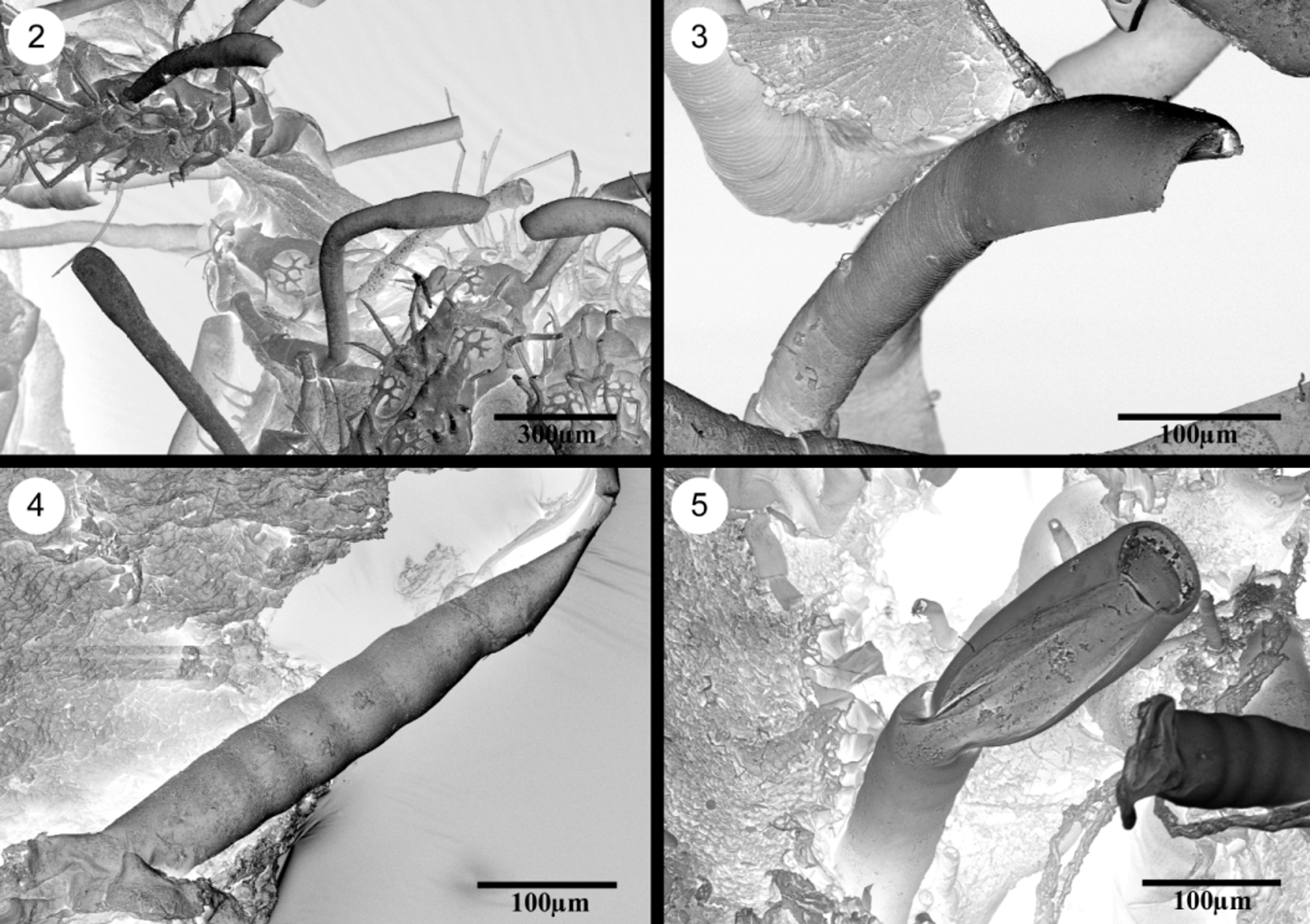
Description. Colony of uniserial chains of autozooids, creeping, delicate, white, from which erect tubular portions arise. Basal portion creeping, slender and slightly punctate. Tubular portion arising from dilations of basal region; erect stems almost ringed, narrowed proximally and curved distally, about 0.494 – 0.865 mm (0.659 ± 0.098) long and 0.049 – 0.074 mm (0.059 ± 0.006) wide; frontal membrane curved proximally and truncate distally, occupying one side of the scoop-shaped head region at the distal third of stalk, about 0.185 – 0.241 mm (0.212 ± 0.018) long. Basal surface of membranous area with several small pseudopores. Zoeciules absent. Ovisacs with reddish embryos at the distal end of zooid, distal to orifice, placed on dorsal surface of the scoop-shaped area.
Vieira, Leandro M., Almeida, Ana C. S., Winston, Judith E. (2016): Taxonomy of intertidal cheilostome Bryozoa of Maceió, northeastern Brazil. Part 1: Suborders Inovicellina, Malacostegina and Thalamoporellina. Zootaxa 4097 (1): 59-83, DOI: 10.11646/zootaxa.4097.1.3
Remarks. Species of Aetea are often found on the surface of shells, algae and other colonial invertebrates, such as bryozoans and hydroids. Species of the genus are distinguished by the size of the raised stalk region, size and shape of the distal ‘ head’ region, zoecial ornamentation (punctate, annulated, corrugated or wrinkled), and embryo color. At least two species, Aetea anguina (Linnaeus, 1758) and Aetea sica (Couch, 1844), had been widely reported in shallow waters, including Brazil (Vieira et al. 2008). They were previously characterized by an often-flexed stalk with annulations, and a perforated spatulate distal head, which is parallel to the substratum when the stalk is flexed. Comparison between specimens from Brazil and other specimens deposited at the NHMUK and USNM revealed, however, that several species may be involved under the names A. anguina and A. sica (e. g. Busk 1852 a; Landsborough 1852; Marcus 1937; Osburn, 1940; Hayward & Ryland 1998;). These species are distinguished by the zooid length and head region width, and by the shape and pseudopores of the head, in addition to the shape and density of annulations, if present, in stalks. Specimens from Gibraltar identified by Landsborough (1852) (NHMUK 1899.7.1.542, G. Busk Collection) and specimens from British Isles (Hayward & Ryland 1998) resemble those from NE Brazil in having annulated stalks and a punctate distal portion, but are distinguished by their size, shape of the head and diameter of stalks. Hayward & Ryland (1998) described golden yellow embryos in both A. anguina and A. sica, further distinguishing them from the specimens from Alagoas with their reddish embryos. Specimens from Europe, as illustrated in Hayward & Ryland (1998: fig. 16; British Isles) and De Blauwe (2009: figs. 125 – 127; Belgium) also show a greater curvature of the stem region near the head, and presence of annulations further into the head region. Recently, Winston & Hayward (2012) described A. arcuata from the northeast coast of the USA, with a finely annulated stalk and pinkish embryos, which we believe may be conspecific with specimens from Brazil examined in this study. In Brazil, A. anguina was previously recorded from Bahia (NE), Pernambuco (NE), Espírito Santo (SE), Rio de Janeiro (SE), São Paulo (SE), and Paraná (S) states (Vieira et al. 2008; Almeida et al. 2015 b), although with morphological differences. Specimens recorded as Aetea recta Hincks, 1862 from Pernambuco (Kirkpatrick 1890) are similar to specimens here assigned to A. arcuata. Specimens from Bahia (Almeida et al. 2015 b) may also belong to A. arcuata. Specimens of A. anguina from São Paulo (Marcus 1937; Migotto et al. 2011), however, have a shorter membranous area and wider stalk than colonies figured here, and may belong to an undescribed species rather than to either A. anguina or A. arcuata. Specimens from Espírito Santo, Rio de Janeiro and Paraná (see Vieira et al. 2008) require reexamination; they may belong to distinct species.
Vieira, Leandro M., Almeida, Ana C. S., Winston, Judith E. (2016): Taxonomy of intertidal cheilostome Bryozoa of Maceió, northeastern Brazil. Part 1: Suborders Inovicellina, Malacostegina and Thalamoporellina. Zootaxa 4097 (1): 59-83, DOI: 10.11646/zootaxa.4097.1.3
Distribution. Aetea arcuata is known from the Western Atlantic, from the northeast to the south coast of USA, including Florida, and from NE Brazil. In NE Brazil it is known from Pernambuco, Alagoas, and Bahia (Abrolhos; G. Busk collection).
Vieira, Leandro M., Almeida, Ana C. S., Winston, Judith E. (2016): Taxonomy of intertidal cheilostome Bryozoa of Maceió, northeastern Brazil. Part 1: Suborders Inovicellina, Malacostegina and Thalamoporellina. Zootaxa 4097 (1): 59-83, DOI: 10.11646/zootaxa.4097.1.3
Material examined. UFAL 0 0 98, Sobral sewer outfall, Maceió, Alagoas, Brazil, 9 º 40 ' 45 " S, 35 º 45 ' 01 " W, intertidal, on bryozoans, coll. 24 December 2006 by M. D. Correia; UFAL 0 121, coll. 18 January 2007 by L. M. Vieira and M. D. Correia. UFAL 0 211, UFPE 0 75, UFPE 0 87, UFPE 101, Riacho Doce, Maceió, Alagoas, Brazil, 9 º 34 ' 42 " S, 35 º 39 ' 19 " W, intertidal, on algae, Sargassum spp., coll. 31 March 2007 by L. M. Vieira. UFAL 252, UFPE 0 64, UFPE 0 66, UFPE 0 69, UFPE 0 93, Pratagy (Sereia), Maceió, Alagoas, Brazil, 9 º 33 ' 55 " S, 35 º 38 ' 40 " W, intertidal, on algae, Sargassum spp., coll. 0 7 September 2007 by A. G. A. Borba Jr. UFPE 103, Jatiúca, Maceió, Alagoas, Brazil, 9 º 39 ' 10 " S, 35 º 41 ' 40 " W, intertidal, on algae, Sargassum spp., coll. 0 9 September 2007 by L. M. Vieira; UFPE 105, coll. 13 August 2007 by L. M. Vieira; UFPE 111, coll. 0 9 September 2003 by L. M. Vieira. Additional comparative material. NHMUK 1899.7.1.562 – 3, NHMUK 1899.7.1.565, G. Busk collection, John Adams Banks [Abrolhos], Bahia, Brazil, on algae, coll. H. M. S. ‘ Herald’; NHMUK 1888.4.16.22, H. N. Ridley collection, Pernambuco, Brazil, on algae.
Vieira, Leandro M., Almeida, Ana C. S., Winston, Judith E. (2016): Taxonomy of intertidal cheilostome Bryozoa of Maceió, northeastern Brazil. Part 1: Suborders Inovicellina, Malacostegina and Thalamoporellina. Zootaxa 4097 (1): 59-83, DOI: 10.11646/zootaxa.4097.1.3
Export occurrence data
Darwin Core Archive (ZIP)
CLASSIFICATION
Taxonomic Classification Tree

NOMENCLATURE
Synonyms(1)
MULTIMEDIA
Media Files(1)
FIGURES 2 – 5. Species of Inovicellina from Maceió: 2 – 3, Aetea arcuata, UFPE 0 93, Pratagy, Maceió, Alagoas, Brazil; 2, zooids on algae, with Arbocuspis bellula; 3, close-up of the distal end of the stalk showing the opercular area. 4 – 5, Aetea curta, UFPE 0 77, Pratagy, Maceió, Alagoas, Brazil; 4, close-up of corrugated stalk; 5, close-up of the distal end of stalk showing opercular area.
Imageimage/png© Vieira, Leandro M.;Almeida, Ana C. S.;Winston, Judith E.Vieira, Leandro M.;Almeida, Ana C. S.;Winston, Judith E.
IMAGES