AnimaliaNot EvaluatedacceptedspeciesAccepted
Biflustra marcusi

Biflustra marcusi

GBIF:127640097

0

Synonyms

ABOUT

Descriptions(6)

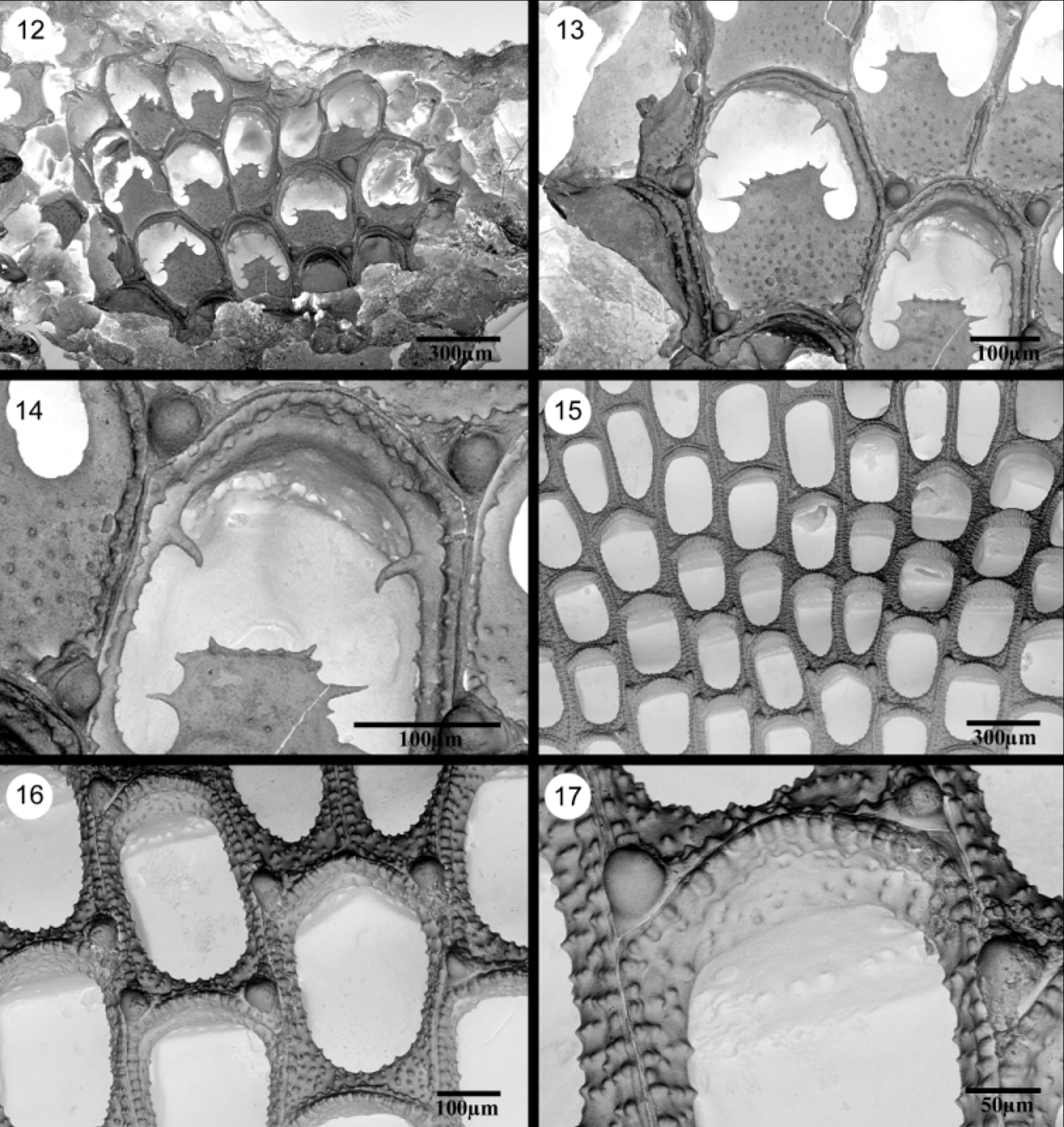
Description. Colony white, encrusting, unilaminar, multiserial. Zooids rectangular to hexagonal, 0.371 – 0.463 mm (0.424 ± 0.027) long and 0.235 – 0.346 mm (0.287 ± 0.027) wide, distal end rounded and proximal margins straight to concave. Lateral walls slightly raised and thin, without uncalcified bands; proximal corners often developed into raised and rounded gymnocystal tubercles with triangular bases. Cryptocyst surrounding almost all opesia length, shorter laterally than proximally; proximal cryptocyst slightly convex and granulose, a proximomedial plate with sharped triangular spines projecting into the membranous part of the frontal surface; two sharp and slightly curved denticles placed laterodistally, projecting obliquely toward to the midline of opesia. Opesia occupying about half of zooid length. Operculum with lightly sclerotized outer rim, 0.080 – 0.093 mm (0.086 ± 0.004) long and 0.099 – 0.117 mm (0.105 ± 0.006) wide. Distal transverse walls with a row of uniporous mural septula near to the basal wall; lateral transverse walls with two pairs of multiporous mural septula. Colonies formed by a twinned ancestrula.
Vieira, Leandro M., Almeida, Ana C. S., Winston, Judith E. (2016): Taxonomy of intertidal cheilostome Bryozoa of Maceió, northeastern Brazil. Part 1: Suborders Inovicellina, Malacostegina and Thalamoporellina. Zootaxa 4097 (1): 59-83, DOI: 10.11646/zootaxa.4097.1.3

Diagnosis. Biflustra with encrusting colonies, unilaminar, multiserial, with cryptocyst surrounding almost entire opesia length, shorter laterally than proximally, with proximo-medial plate with triangular spines projecting into the opesia and two sharp curved denticles placed laterodistally at the cryptocyst. Distal transverse walls with a row of uniporous mural septula; lateral walls with two pairs of multiporous mural septula.
Vieira, Leandro M., Almeida, Ana C. S., Winston, Judith E. (2016): Taxonomy of intertidal cheilostome Bryozoa of Maceió, northeastern Brazil. Part 1: Suborders Inovicellina, Malacostegina and Thalamoporellina. Zootaxa 4097 (1): 59-83, DOI: 10.11646/zootaxa.4097.1.3
Remarks. The type of Biflustra d’Orbigny, 1852, Biflustra ramosa d’Orbigny, 1852 (Grischenko et al. 2002: fig. 2; Tilbrook 2006: pl. 2 A), has erect vincularian colonies and no ancestrula has been described or figured. There are, however, many interpretations for the usage of the genus Biflustra (e. g. Tilbrook 2006; Taylor & Tan 2015), with morphologically related species sometimes being assigned to distinct genera — e. g. Biflustra arborescens (Canu & Bassler, 1928 b) and Acanthodesia irregulata (Liu, 1992) — due to the absence of information on ancestrula type. To avoid the usage of two generic names for morphologically related species, here we disagree with Taylor & Tan (2015) who assigned some species to the genus Acanthodesia Canu & Bassler, 1919 rather than Biflustra d’Orbigny, 1852 based on the presence of a twinned ancestrula and encrusting colonies. We believe that skeletal characters are useful to distinguish some problems in Membraniporidae, but due to the simplicity of external morphology, only a more complete knowledge of ancestrual formation and astogeny and / or results of molecular studies will clarify the use of Acanthodesia and Biflustra. At least two species of Membraniporidae, Biflustra savartii (Audouin, 1826) and Biflustra tenuis (Desor, 1848) have been reported as widespread (e. g. Harmer 1926; Marcus 1937; Osburn 1940; Maturo 1957; Winston 1982; Winston 2005; Winston & Hayward, 2012). Some of these records, however, may also refer to different species, including Biflustra ramosa (d’Orbigny, 1852) (see Tilbrook 2006). The illustrations of Flustra savartii from Egypt (Savigny 1817: pl. 10, figs. 10.1, 10.2), type species of Acanthodesia, do not show the proximomedial denticle in the cryptocyst that is seen in syntype specimens of B. ramosa, type of Biflustra, and Biflustra crenulata (Okada, 1923). SEM images of putative B. savartii from the Northern Bay of Safaga (Ostrovsky et al. 2011, 2016), however, show autozooids without gymnocystal tubercles, and a short proximomedial cryptocystal denticle (present in some zooids). Biflustra marcusi n. sp. is distinguished from B. savartii, B. crenulata and B. ramosa, however, in having encrusting colonies; by the shape and size of the proximomedial denticle of cryptocyst, occupying 40 – 60 % of the opesia width; and by the presence of two distolateral denticles directed medially to the opesia. Marcus (1937) illustrated similar zooids in specimens reported as Acanthodesia tenuis (Marcus 1937: pl. 8, fig. 17 B) — assigned to Biflustra denticulata (Busk, 1856) by Vieira et al. (2008), but identical to B. tenuis (sensu Winston & Hayward 2012, as Membranipora) — and A. savartii (sensu Marcus 1937: pl. 7, figs. 16 A – C). Acanthodesia savartii sensu Marcus (1937) is here reassigned to B. marcusi n. sp. Rounded tubercles at proximal corners of zooids are often present in specimens of B. tenuis from Brazil, while these tubercles are often present in younger colonies of B. marcusi n. sp. from Alagoas. Specimens from Brazil of B. tenuis have cryptocyst with some denticles projecting into the opesia, without a proximomedial plate. In two other species reported from Brazil, B. arborescens and Biflustra paulensis (Marcus, 1937), the proximomedial cryptocystidial plate is absent. Specimens from Gulf of Mexico reported as A. savartii by Osburn (1940) resemble B. marcusi n. sp., being distinguished only by the absence of distolateral denticles directed toward the midline of the opesia; these specimens may be conspecific. Specimens reported as Acanthodesia serrata Hincks, 1882 by Marcus (1937, p. 44, pl. 8, fig. 8) have developed cryptocyst, thus are distinct from Membranipora membranacea form serrata described by Hincks (1882) (= Membranipora villosa Hincks, 1880). Membranipora villosa is attributed to the Membranipora “ membranacea-serrimella-villosa ” morphs, known from NE Pacific (see Dick et al. 2005, p. 3692). Acanthodesia serrata studied by Marcus resembles those specimens figured by Hastings (1930, p. 707, pl. 4, figs. 13 – 15), but its identity remains uncertain. Specimens identified as Conopeum commensale Kirkpatrick & Metzelaar, 1922 by Marcus (1937) have spinules on frontal membrane, and they belong to B. arborescens.
Vieira, Leandro M., Almeida, Ana C. S., Winston, Judith E. (2016): Taxonomy of intertidal cheilostome Bryozoa of Maceió, northeastern Brazil. Part 1: Suborders Inovicellina, Malacostegina and Thalamoporellina. Zootaxa 4097 (1): 59-83, DOI: 10.11646/zootaxa.4097.1.3
Distribution. Biflustra marcusi n. sp. is often found encrusting algae. In Brazil, this species occurs at least from Alagoas to Paraná.
Vieira, Leandro M., Almeida, Ana C. S., Winston, Judith E. (2016): Taxonomy of intertidal cheilostome Bryozoa of Maceió, northeastern Brazil. Part 1: Suborders Inovicellina, Malacostegina and Thalamoporellina. Zootaxa 4097 (1): 59-83, DOI: 10.11646/zootaxa.4097.1.3
Etymology. Named after Ernst Marcus (1893 – 1968), for his contributions to bryozoology.
Vieira, Leandro M., Almeida, Ana C. S., Winston, Judith E. (2016): Taxonomy of intertidal cheilostome Bryozoa of Maceió, northeastern Brazil. Part 1: Suborders Inovicellina, Malacostegina and Thalamoporellina. Zootaxa 4097 (1): 59-83, DOI: 10.11646/zootaxa.4097.1.3
Material examined. Holotype: UFPE 0 91, Pratagy (Sereia), Maceió, Alagoas State, Brazil, 9 º 33 ' 55 " S, 35 º 38 ' 40 " W; intertidal, on algae, Sargassum spp., coll. 0 7 September 2007 by A. G. A. Borba Jr. Paratypes: UFBA 1597, UFPE 0 56, UFPE 0 57, same data as holotype. UFPE 0 59, Riacho Doce, Maceió, Alagoas, Brazil, 9 º 34 ' 42 " S, 35 º 39 ' 19 " W, intertidal, on algae, Sargassum spp., coll. 31 March 2007 by L. M. Vieira; UFBA 1599, Sobral sewer outfall, Maceió, Alagoas, Brazil, 9 º 40 ' 45 " S, 35 º 45 ' 01 " W, intertidal, erect colony on hydroids, coll. 21 October 2009 by L. M. Vieira & M. D. Correia. Additional specimens: UFPE 114, Jatiúca, Maceió, Alagoas, Brazil, 9 º 39 ' 10 " S, 35 º 41 ' 40 " W, intertidal, on algae, Sargassum spp., coll. 0 9 September 2003 by L. M. Vieira.
Vieira, Leandro M., Almeida, Ana C. S., Winston, Judith E. (2016): Taxonomy of intertidal cheilostome Bryozoa of Maceió, northeastern Brazil. Part 1: Suborders Inovicellina, Malacostegina and Thalamoporellina. Zootaxa 4097 (1): 59-83, DOI: 10.11646/zootaxa.4097.1.3

Export occurrence data

Darwin Core Archive (ZIP)

CLASSIFICATION

Taxonomic Classification Tree

MULTIMEDIA

Media Files(1)

FIGURES 12 – 17. Species of Biflustra from Maceió: 12 – 14, Biflustra marcusi n. sp., UFPE 0 91, holotype, Pratagy, Maceió, Alagoas, Brazil; 12, group of zooids; 13, close-up of autozooid with developed cryptocyst; 14, close-up of distal half of autozooid showing the median cryptocystal denticle and the two sharp denticles projecting obliquely to the midline of opesia; 15 – 17, Biflustra sphinx n. sp., UFBA 1599, paratype, Sobral, Maceió, Alagoas, Brazil, erect bilaminar colony; 15, group of autozooids; 16, close-up of autozooids, showing the tuberculate cryptocyst and gymnocystal tubercles; 17, close-up of vertical wall showing the distal multiporous mural septula.

Imageimage/png© Vieira, Leandro M.;Almeida, Ana C. S.;Winston, Judith E.Vieira, Leandro M.;Almeida, Ana C. S.;Winston, Judith E.

IMAGES

Gallery(1)

See Gallery

Occurrences with images

Source Information

Taxonomy of intertidal cheilostome Bryozoa of Maceió, northeastern Brazil. Part 1: Suborders Inovicellina, Malacostegina and Thalamoporellina

checklist

This dataset contains the digitized treatments in Plazi based on the original journal article Vieira, Leandro M., Almeida, Ana C. S., Winston, Judith E. (2016): Taxonomy of intertidal cheilostome Bryozoa of Maceió, northeastern Brazil. Part 1: Suborders Inovicellina, Malacostegina and Thalamoporellina. Zootaxa 4097 (1): 59-83, DOI: 10.11646/zootaxa.4097.1.3

Abstract

Thirteen cheilostome bryozoan species from intertidal habitats of Maceió, Alagoas State, Brazil, are reported here. We describe four new species: Aetea cultrata n. sp., Biflustra marcusi n. sp., Biflustra sphinx n. sp. and Jellyella brasiliensis n. sp. Two other species of Inovicellina, Aetea arcuata Winston & Hayward, 2012, and Aetea curta Jullien, 1888, and four species of Malacostegina, Arbocuspis bellula (Hincks, 1881), Arbocuspis bicornis (Hincks, 1881), Arbocuspis ramosa (Osburn, 1940), and Jellyella tuberculata (Bosc, 1802), are reported on drift algae. Three species of Thalamoporellina are found for the first time in Maceió, Labioporella tuberculata Winston, Vieira & Woollacoot, 2014, Steginoporella magnilabris (Busk, 1854) and Thalamoporella floridana Osburn, 1940.

Key words: Alagoas, Atlantic, Biodiversity, bryozoans, new species

Vieira L M, Almeida A C S, Winston J E, plazi (2016). Taxonomy of intertidal cheilostome Bryozoa of Maceió, northeastern Brazil. Part 1: Suborders Inovicellina, Malacostegina and Thalamoporellina. Plazi.org taxonomic treatments database. Checklist dataset https://doi.org/10.11646/zootaxa.4097.1.3 accessed via GBIF.org on 2026-06-19.

CC0Published 12/31/2016View dataset
GBIF Usage Key
127640097
Dataset Key
4d26544d-be4b-4440-a33e-26dee7d14b5e
Origin
source
Backbone Key
8449724
Taxon ID
08474F3DFFE0FFC0FF63FF5AFE5AFC4B.taxon
Last Crawled
6/11/2026
Last Interpreted
6/11/2026