

Leptodactylodon perreti
Amiet, 1971
GBIF:127667038
ABOUT
Descriptions(1)
Leptodactylodon perreti Amiet, 1971
Three tadpoles of L. perreti were examined and genotyped. All were found on Mount Oku in the Emfveh-mi forest, near Elak. ZMB 79084–86 (Gosner stages 25, 35, 37, respectively; Mount Oku, 6°13’42.4”N, 10°31’17.4”E, 2269 m, 23 August and 2 September 2012). Tadpoles were collected in a stream in montane forest, ca. 300 m from the farm-forest boundary. The description is based on all three tadpoles.
Morphology. Long and slender tadpoles with long, muscular tail; body elliptical in dorsal and narrow elliptical lateral view (see Fig. 3 in Cruz et al. 2013); body length 36.2–39.3% (N= 3) of total length; body width 47.2– 57.9% (N= 3) of body length; body widest at level of spiracle; snout rounded in dorsal view; nostrils oval and situated lateroventrally; nostrils equidistant from eye and snout tip (closer to eye Cruz et al. 2013); eye diameter 11.7–12.4% (N= 3) of body length; inter-orbital distance slightly exceeds inter-nostril distance; tail fins narrow; narrow dorsal fin originates distinctly posterior to tail base (3.1–3.5 mm), running almost parallel to muscular tail axis; ventral fin originates at tail base, only slightly narrower than dorsal fin, runs parallel to tail axis; tail tip roundish to slightly pointed; tail axis broad, continuously converging towards tail tip; body height equal to or slightly less than total tail height; maximum height of tail axis 67.2–70.7% (N= 3) of total tail height; vent tube dextral; lateral sacs present, extending from spiracle to end of body, covering lower two thirds of flanks; short spiracle, sinistral, translucent, opening lateral, not visible in dorsal view, originating slightly anterior (N= 1) or posterior (N= 2) of mid-body; mouth opening frontal; labial tooth row formula 0/0; both jaw sheath completely keratinized, serrated, almost straight and narrow; two small caniniform projections (fangs) towards edges of lower sheath; lower jaw slightly bent; median part of lower jaw with indistinct needle-like cusps (Fig. 11 b; Channing et al. 2012: 8); four distinct serrations abaxial to fangs; broad semicircular posterior lip covered with 21 large papillae (Fig. 11 a; Channing et al. 2012: 30); arrangement of papillae symmetrical to vertical body axis; papillae arranged in two semicircular rows; short, very depressed w-shaped skin fold on lower lip, just posterior to lower jaw sheath; oral disc width 29.8–33.3% (N= 3) of body length; mouth width 22.2–28.6% (N= 2) of oral disc width.
ZMB 79084 (Gosner stage 25) had a total length of 38.3 mm (body length: 10.8 mm; tail length: 27.5 mm). Our most advanced tadpole (ZMB 79086, Gosner stage 37) measured 48.2 mm total length (body length: 12.8 mm; tail length: 35.4 mm). Cruz et al. (2013) report total lengths of 45.1 and 51.6 mm in Gosner stage 25 tadpoles. Metamorphs with completely resorbed tails measure 15.5–17.5 mm SVL (Amiet 1980).
Coloration in preservation. Pale to deep dark brown dorsal parts of body and tail, dense irregular dark mottling; venter slightly lighter; fins with irregular dark mottling, more pronounced in dorsal parts, otherwise translucent cream-white; fins lighter than in other species.
Export occurrence data
Darwin Core Archive (ZIP)
CLASSIFICATION
Taxonomic Classification Tree

MULTIMEDIA
Media Files(2)
FIGURE 3. Adult Leptodactylodon; a: L. bicolor (ZMB 77489); b: L. boulengeri (ZMB 79588); c: L. erythrogaster (voucher not collected); d: L. mertensi (ZMB 77500); e: L. ornatus ornatus (ZMB 78528); f: L. ovatus orientalis (ZMB 78536); g: L. perreti (BMNH 2008.304); h: L. ventrimarmoratus (BMNH 2008.469) (see Appendix 1 for origin of adults used in barcode comparisons).
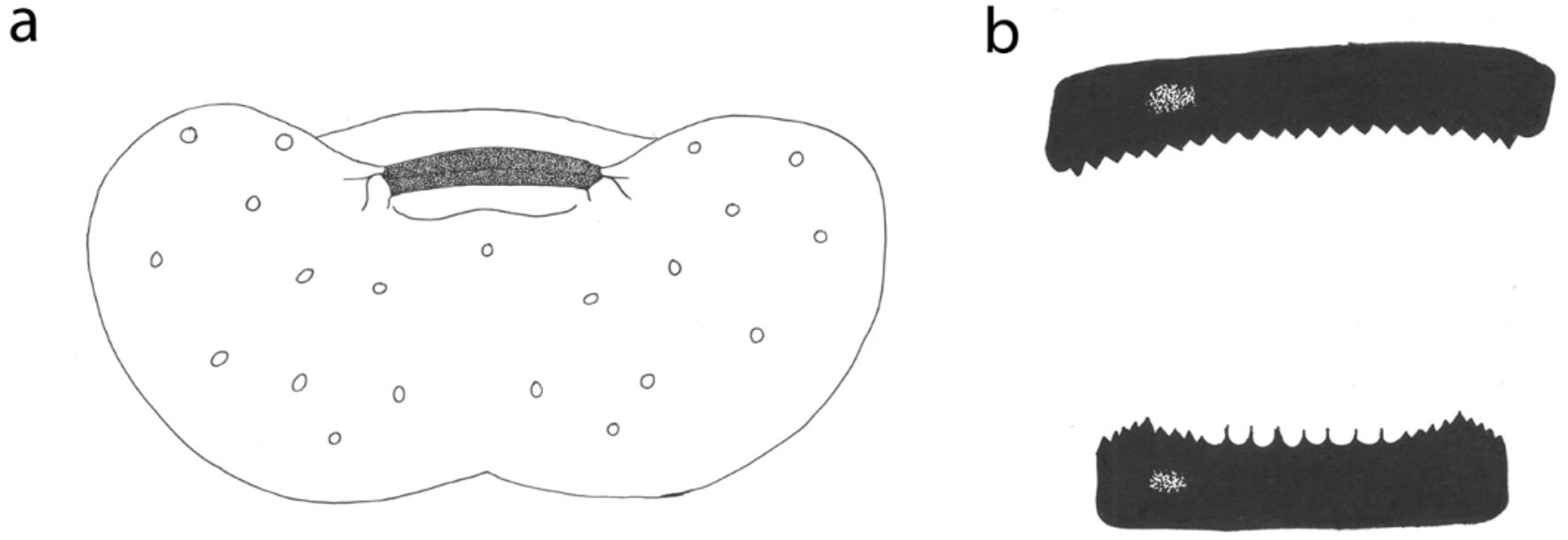
FIGURE 11. Mouthpart (a) and jaw sheaths (b) of Leptodactylodon perreti, lacking caniniform projections.
IMAGES