
Leptodactylodon boulengeri
Nieden, 1910
GBIF:127667044
ABOUT
Descriptions(1)
Leptodactylodon boulengeri Nieden, 1910
We examined sixteen individuals collected near Fotabong and on Mount Manengouba: ZMB 78466 (one tadpole, Gosner stage 25, Manengouba village, 4°58’23.76”N, 9°52’31.8”E, 1290 m, 21 November 2010); ZMB 78469–71 (two tadpoles, Gosner stages 36 & 40, respectively; one tadpole Gosner stage not assessable; five tadpoles, Gosner stage 25; Fotabong, 5°28’36.12”N, 9°55’25.08”E, 1272 m, 3 November 2011); ZMB 78476 (seven tadpoles, Gosner stage 25–37, Fotabong, 5°28’38.88”N 9°55’24.48”E, 1267 m, 2 November 2011). All tadpoles of L. boulengeri were found on soaked sandy soil along small rivers or buried in sandy ground of these rivers in mid altitude (1267–1290 m), the sand being only covered by a very thin film of water.
The description is based on four genotyped tadpoles (ZMB 78466, 78470, 78471, 78476) at Gosner stage 25. Body length/total length ratio, maximum tail length and height; as well as description of tail tip was based on nongenotyped specimens of the same developmental stage.
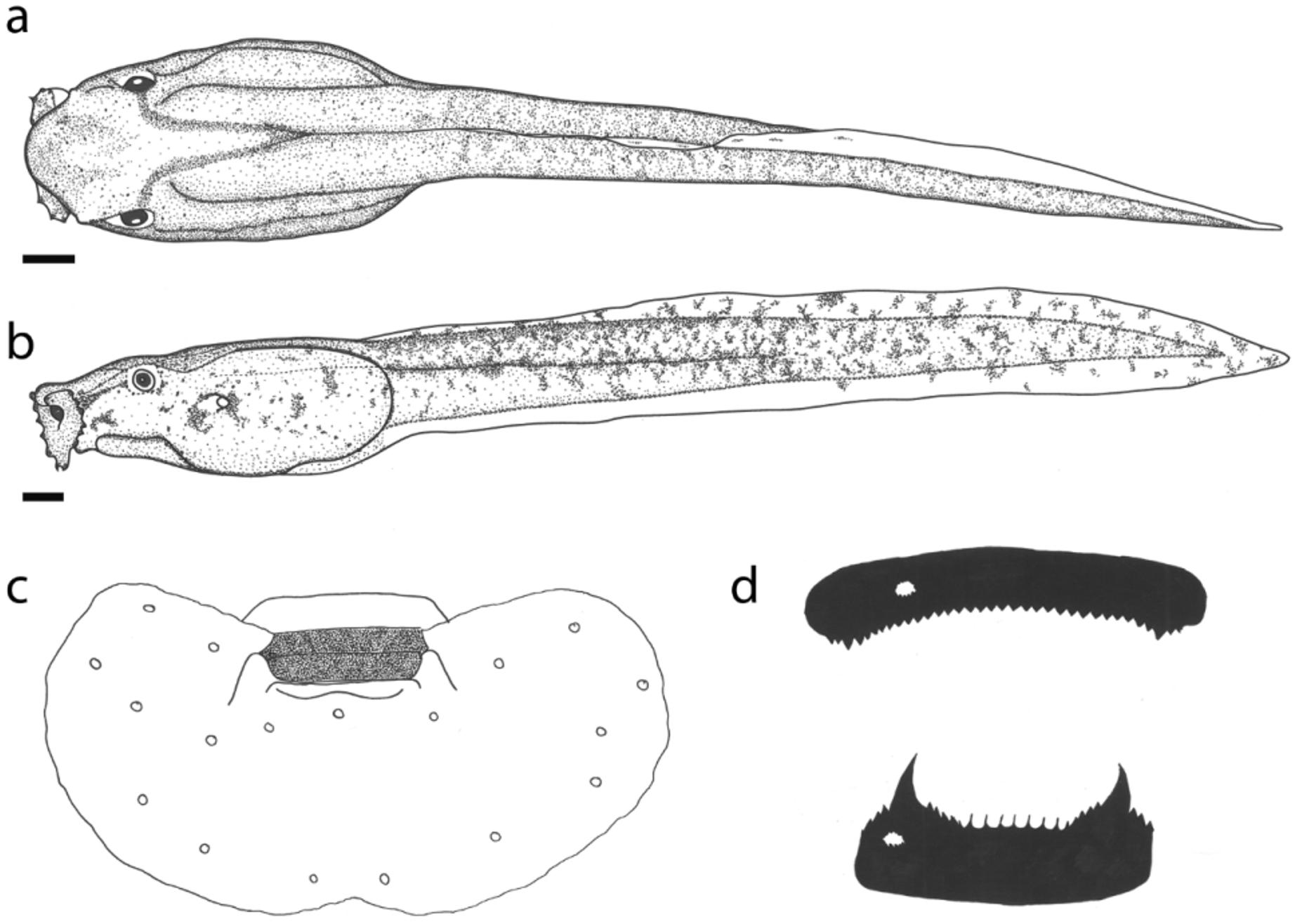
Morphology. Long slender tadpole with narrow and long muscular tail; body elongate, elliptical in dorsal and depressed in lateral view (Fig. 5 a, b); body length 29.9 ± 2.0% (N= 10) of total length; body height 40.6 ± 7.5% (N= 4) of body length; body width 52.2 ± 3.8% (N= 4) of body length; maximum body width on level of spiracle insertion; snout nearly rounded to truncate in dorsal view; nostrils oval, situated laterally; nostrils equidistant from eye and snout tip; eye diameter 8.3 ± 2.7% (N= 4) of body length; inter-orbital distance equals inter-nostril distance (inter-orbital distance of ZMB 78470 slightly exceeds inter-nostril distance); tail fins narrow; dorsal fin originating 0.3–1.0 mm (N= 3) anterior to tail base, narrow, reaching maximum depth after about first quarter, as high or only slightly deeper as ventral fin; ventral fin narrow, originates on level with tail base, almost parallel to tail axis; tail tip pointed; tail axis slender, edges almost parallel towards tail tip; body height 97.4–98.5 (N= 2) of total tail height; maximum height of tail axis 57.7 ± 2.7% (N= 5) of total tail height; vent tube dextral; lateral sacs present, extending from spiracle to end of body, covering lower two thirds of flanks; short sinister spiracle, translucent, opening lateral, not visible in dorsal view, originating at app. mid-body; mouth opening frontal; labial tooth row formula 0/0; both jaw sheaths fully keratinized and of narrow almost rectangular shape; upper jaw distinctly serrated, serrations almost uniform, slightly larger serration towards edges; lower jaw flat U-shaped, distinctly serrated with a lateral pair of caniniform projections (fangs), median part with six to seven needle-like cusps (Fig. 5 d); one distinct serration abaxial to fangs; large semicircular posterior lip covered with 18 papillae; papillae symmetrically arranged along body axis; most papillae arranged in two semicircular rows, one near the lower jaw sheath, the second closer to posterior margin of lower lip (Fig. 5 c); distinct short skin fold on lower lip, just posterior to lower jaw sheath; oral disc width 35.5–48.5% (N= 3) of body length; mouth width 23.1–31.8% (N= 3) of oral disc width.
The largest tadpole at Gosner stage 25 (ZMB 78471) measured 24.4 mm total length (body length: 7.7 mm; tail length: 16.7 mm). The most advanced/developed individual (ZMB 78476, Gosner stage 37) measured 52.1 mm (body length. 14.1 mm; tail length: 38.0 mm). The smallest juveniles reported by Amiet (1980) measured 16–19 mm SVL.
Coloration in preservation. Pale brown; dorsal parts of body and tail with irregular dark speckling; lower part of body and tail paler; anterior part of tail with longitudinal black line (not visible in life); only few dark spots on venter and on the last third of ventral tail fin; dorsal fin with dark spots, fins otherwise translucent cream-white.
Coloration in life (Fig. 6). Pale brown with dark brown speckles, some of them lighter brown; funnel dark, almost black; tail axis with whitish-blue spots; ventral fin with yellow spots; tail tip almost white; venter with light reddish coloration; some individuals with cream-white snout (like some L. bicolor and L. ventrimarmoratus).
Export occurrence data
Darwin Core Archive (ZIP)
CLASSIFICATION
Taxonomic Classification Tree

MULTIMEDIA
Media Files(2)
FIGURE 5. Dorsal (a) and lateral view (b) of Leptodactylodon boulengeri with sketches of the mouthpart in frontal view (c) and jaw sheaths with caniniform projections (d); scale bars: 1 mm.

FIGURE 6. Life coloration of Leptodactylodon tadpoles, from top to bottom: L. cf. polyacanthus punctiventris (ZMB 78551, Fotabong), L. boulengeri (ZMB 78471, Fotabong), L. ventrimarmoratus (ZMB 78554, Mt. Kala); pictures not to scale.
IMAGES